Back to the on-screen lesson ·
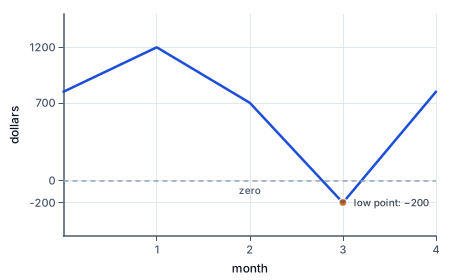
Closing balances month by month, the balance drawn as a line, each receipt and payment in the month it moves, stock paid for ahead of the season, and the cash to arrange before the lowest month.
Paper packet. Every task here also exists on screen, where it is checked automatically; answers written on paper are not assessed by Nydus. When you are back at a device, enter your answers there.
You will roll a four-month cash forecast forward from dated money in and out, draw its closing balances, put invoices, bills and quarterly payments in the months their money moves, and read off how much cash to arrange and by when, including the dip that stock paid for ahead of a season makes.
You built a short cash forecast in the first course, and this course has spent a whole unit on why cash moves on different days from sales and bills. A forecast is where those days are written down in advance, month by month, so that the month the account runs short is seen before it arrives. This lesson builds four-month forecasts with invoices, account suppliers and lumpy payments, and reads them for the one figure that matters: the lowest balance and the month it falls in.
| Term | What it means |
|---|---|
| Cash forecast | Month by month, the money expected in and out, and the balance it leaves. |
| Opening balance | What the account holds at the start of a month. |
| Closing balance | Opening plus in less out; it opens the next month. |
| Low point | The lowest closing balance, and the month it falls in. |
| Lumpy payment | A large payment that leaves in one month: a quarterly lease, a year's insurance, a tax bill. |
| Rolling forecast | A forecast updated every month with what actually happened, and extended a month further. |
Corner Bean opens a four-month forecast with 800 dollars in the account.
$$\text{closing} = \text{opening} + \text{in} - \text{out}$$
Month 1 brings in 9000 and pays out 8600: it closes at 1200. Month 2 opens at 1200, brings in 8200 and pays 8700: 700. Month 3 brings in 7600 and pays 8500: the account closes at −200. Month 4 recovers to 800.
Read the last number and the forecast looks fine: Alexa ends where she began. Read the lowest and it does not: in month 3 the rent, the roaster or the wages cannot all be paid. That is why the figure to take from a forecast is the low point and its month. It says how much help is needed — here 200 dollars — and by when: before month 3, not after it.
A forecast is only as good as the month each figure sits in, which the section below takes line by line.
Another way: steps
Another way: table
Corner Bean's four months, in dollars.
| Month | Opening | In | Out | Closing |
|---|---|---|---|---|
| 1 | 800 | 9000 | 8600 | 1200 |
| 2 | 1200 | 8200 | 8700 | 700 |
| 3 | 700 | 7600 | 8500 | −200 |
| 4 | −200 | 9800 | 8800 | 800 |
Every closing figure becomes the next opening figure.
Start from the bank balance today. Not an estimate: the figure on the statement, less any checks or payments already made that have not yet cleared.
List what will come in, with dates. Card takings by week, invoices by the day each customer will actually pay, any loan or grant by the day it lands.
List what will go out, with dates. Wages and rent on their days, supplier bills on their due dates, loan payments, and every lumpy payment in the month it leaves.
Close each month and carry it forward. Opening plus in less out, and that close becomes the next opening.
Read the low point. The lowest close and its month say how much help to arrange and by when.
Check the forecast by adding up the whole period: the opening balance, plus every month's money in, less every month's money out, must equal the last closing balance. Then check it against last year: a month that looks unusually good or bad should have a reason written beside it.
A forecast goes wrong most often not in its arithmetic but in its calendar. Three rules cover nearly every line:
Card takings reach the account within days, and wages and rent leave on known dates, so those lines are easy. The invoices and the lumps are where a forecast earns its keep.
The sharpest dips come from buying ahead. A Christmas-gift stall that pays its wholesalers in October for stock it will sell in November and December carries the whole cost for weeks before a single gift sells. A forecast shows it plainly: September closes comfortably, October falls far below zero when the stock is paid for, and November and December climb back as the stock sells.
Nothing is wrong with the business: the season will be profitable and the account will end the year higher than it began. But in October the stall cannot pay its pitch fee or its own wages without help, and a bank asked in October for a line of credit it should have been asked for in August may say no.
The forecast turns this from a crisis into a plan. It gives the size of the line of credit (the October low point, turned positive), the month it is needed and the month it will be repaid (when the balance climbs back above zero). It also shows the levers: supplier credit on the Christmas order moves the payment into November, when the stock is already selling; buying in two smaller deliveries spreads it; a deposit taken on pre-ordered hampers brings some December cash into October.
A forecast is written once and wrong within a week: a customer pays late, a bill arrives larger than expected, a busy Saturday brings in more. So it is kept as a rolling forecast. At the end of each month, the month just past is replaced with what actually happened, the months ahead are updated with what is now known, and one more month is added at the end.
Comparing each month's forecast with what happened is how the forecast gets better. A line that is always too high — a customer who always pays two weeks late, takings that never reach the hopeful figure — should be moved in every future month, not only in the one just passed.
A forecast that dips below zero offers a short list of responses, and it arrives early enough to use the cheap ones first.
Move money out later. Ask the supplier whose bill falls in the low month for a few weeks more; pay a lumpy bill in installments; delay a purchase that can wait.
Move money in sooner. Invoice on the day of the job rather than at the month's end; ask for a deposit on large orders; chase the customer who always pays late before the low month, not during it.
Arrange cover. A line of credit or a short loan sized to the low point, with a margin, agreed while the forecast still shows how it will be repaid.
Each response is tried in the forecast before it is tried in the world: move the bill a month, and see what the low point becomes. The forecast then shows not only the problem but which fix removes it, and at what cost. Often the cheapest fix is a single phone call, made a month early, to a supplier or a customer who is happy to help when asked in good time.
A stall selling handmade decorations at a Christmas market does most of its year's trade in November and December. Its owner buys materials in September and October, pays the market's pitch fee of 4,000 dollars in full on 1 November, and sells from mid-November to Christmas Eve.
Her forecast opens September with 3,000. September's materials and her own drawings take 2,500: 500. October's materials and drawings take another 2,500: −2,000. November brings in 6,000 of sales and pays the 4,000 pitch fee and 1,500 of drawings and costs: −1,500. December brings in 14,000 and pays 2,000: 10,500.
The low point is −2,000 at the end of October, and November is still below zero. The business ends the season 7,500 better off than it started, and without help it cannot pay for its materials in October or its pitch in November.
She takes the forecast to her bank in August and asks for a line of credit of 2,500 — the low point with a margin — from October to the end of December. The bank agrees, because the forecast shows how the money will be repaid and when. She also asks the market whether the pitch fee can be paid in two halves, in November and December; it can, and her November close rises to +500. The line of credit is then only needed for October, and she repays it on the second weekend of November.
Businesses under financial pressure, and their lenders, often work with a thirteen-week cash forecast: every receipt and payment for the next quarter, week by week, updated every Monday. Weeks rather than months show the dips a monthly forecast smooths over — the wages on a Thursday, the customer who pays on the Friday after — and it is the same method as this lesson at a finer grain.
All of a month's sales are that month's cash. Only the ones paid for then.
A forecast that ends higher is safe. A bill falls due in the lowest month, not the last one.
Start each month from the first opening balance. Each month opens where the last one closed.
Spread a quarterly bill over three months. It leaves in one month, in full.
Once written, the forecast is settled. It is a plan built on dates that customers and suppliers can move. Roll it forward every month with what actually happened, and the low point will move with it — sometimes earlier.
A dip means the business is failing. Stock bought ahead of a season dips the account in a healthy business; the forecast says by how much and for how long.
Close March: open 900, in 1,800, out 2,400.
$900 + 1800 - 2400 = 300$
Spring spending comes before the first salad sells.
Close April: in 2,600, out 3,300 including the lease.
$300 + 2600 - 3300 = -400$
The quarter's lease leaves in full.
Close May: in 5,200, out 4,600.
$-400 + 5200 - 4600 = 200$
The salad starts selling.
Close June: in 6,100, out 5,000.
$200 + 6100 - 5000 = 1300$
Summer trade.
Read the low point.
$-400 \text{ in April}$
Tomasz needs 400 arranged before April, or the lease cannot be paid.
Close month 1: open 500, in 7,200, out 6,900.
$500 + 7200 - 6900 = 800$
A comfortable start.
Close month 2: in 6,100, out 7,000.
$800 + 6100 - 7000 = -100$
A corporate client paid late.
Close month 3: in 8,300, out 7,100.
$-100 + 8300 - 7100 = 1100$
The late payment arrives.
Close month 4: in 7,900, out 7,900.
$1100 + 0 = 1100$
A flat month.
Check the totals.
$500 + 29500 - 28900 = 1100$
Opening plus all in less all out equals the last close.
Read the low point.
$-100 \text{ in month 2}$
One hundred to arrange before month 2.
Close September: open 2,000, surplus 3,000.
$2000 + 3000 = 5000$
Ordinary trading.
Close October with 10,000 of Christmas stock paid.
$5000 - 10000 = -5000$
The stock leaves in full before any of it sells.
Close November: surplus 6,000.
$-5000 + 6000 = 1000$
The stock starts selling.
Close December: surplus 20,000.
$1000 + 20000 = 21000$
The season's trade.
Read the line of credit needed.
$5000 \text{ in October}$
Arranged in August, repaid in November.
Move half the order to November on supplier credit.
$5000 - 5000 = 0; \quad 0 + 6000 - 5000 = 1000$
October closes at zero, November at 1,000.
Read the new low point.
$0 \text{ in October}$
Supplier credit removes the need for the line of credit.
Close month 1.
$500 + 7200 - 6900 = 800$
Opening plus in, less out.
Close month 2.
$800 + 6100 - 7000 = -100$
Carried forward.
Read the cash to arrange.
Fixit Mobile opens month $1$ with $300$ dollars in the account. Money in: $6800$, $7400$, $6200$ and $7700$ in months $1$ to $4$. Money out: $6500$, $7200$, $7300$ and $7100$. Fill in each month's closing balance in dollars, with a minus sign for a balance below zero.
| Money in | Money out | Closing balance | |
|---|---|---|---|
| Month 1 | 6800 | 6500 | |
| Month 2 | 7400 | 7200 | |
| Month 3 | 6200 | 7300 | |
| Month 4 | 7700 | 7100 |
Complete the worked solution: a shop opens month 1 with $300$ dollars. In month 1 it takes $6100$ and pays $5600$; in month 2 it takes $6100$ and pays $7000$; in month 3 it takes $6800$ and pays $6100$. Find each closing balance and the cash to arrange.
Close month one.
$300 + 6100 - 5600 =$ p
Opening plus in, less out.
Close month two from month one's close.
$(\text{month one}) + 6100 - 7000 =$ q
Each month opens where the last closed.
Close month three.
$(\text{month two}) + 6800 - 6100 =$ r
The balance recovers.
Find the cash to arrange.
$-(\text{lowest closing balance}) =$ n
It brings the low month back to zero.
Say when it must be in place.
$\text{before month two}$
The month the balance goes below zero.
The cash forecast at Corner Bean shows closing balances of $900$, $500$, $-400$ and $-300$ dollars for months $1$ to $4$. When does the owner need extra cash in place by?
Fixit Mobile opens month $1$ with $300$ dollars in the account. Money in: $6800$, $7400$, $6200$ and $7700$ in months $1$ to $4$. Money out: $6500$, $7200$, $7300$ and $7100$. Plot the closing balance at the end of each of the four months, in hundreds of dollars.
Plot your answer on the grid:
Alexa's draft cash forecast for March has these notes beside its figures. Corner Bean's catering clients pay on thirty-day terms, and the lease on the storeroom is paid once a quarter, in April. Mark every note that puts money in the wrong month.
This task has no paper form; do it on a device.
A Christmas-gift market stall opens September with $2500$ dollars. September's trading leaves $2100$ dollars after costs. In October it pays $10000$ for its Christmas stock and trades nothing extra. November's trading leaves $5200$ after costs, and December's $16800$. Fill in the closing balance each month, and the line of credit to arrange.
| Amount | |
|---|---|
| September closing balance, dollars | |
| October | |
| November | |
| December | |
| Line of credit to arrange before October |
A plumber is building a cash forecast for April, May and June. Choose the month each item's money moves in.
| Month the money moves | |
|---|---|
| Paid in cash on completion, 28 April | |
| Job invoiced 20 April, thirty-day terms | |
| Parts bought 10 April, due at the end of the following month | |
| Cash job, 5 May | |
| A $400$-dollar job invoiced 15 April, sixty-day terms | |
| A year's van insurance, paid in one go on 1 June |
Lesson test: one question per skill, one attempt each, no hints. Your answers are checked when you submit.
Fixit Mobile opens month $1$ with $300$ dollars in the account. Money in: $6800$, $7400$, $6200$ and $7700$ in months $1$ to $4$. Money out: $6500$, $7200$, $7300$ and $7100$. How many dollars does the owner need to arrange, before the account runs out, to keep every month's closing balance at zero or above?
Answer:
You can build a cash forecast and read its low point. Tell someone why a forecast that ends where it began can still hide a month the rent cannot be paid. Next: telling what a forecast knows from what it assumes.
16. Your turn: open with 500; in 7200 and 6100; out 6900 and 7000, step 3
$100 \text{ before month 2}$
The low point turned positive.