Back to the on-screen lesson ·
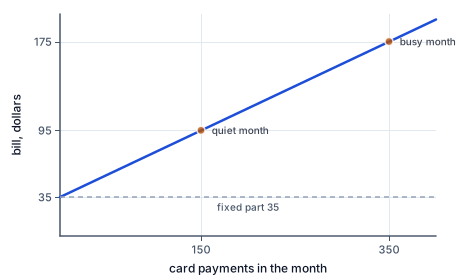
Two months of a bill split into a rate per unit used and a fixed part, drawn as a line and used to predict the bill at a new level of use.
Paper packet. Every task here also exists on screen, where it is checked automatically; answers written on paper are not assessed by Nydus. When you are back at a device, enter your answers there.
You will split a bill with a standing charge into its fixed part and its rate per unit of use from two months' figures, read the two parts as the intercept and slope of a line, write the bill as a rule, and use it to predict a month not yet seen. You will also put each part where it belongs in a contribution and a break-even.
You sort costs into fixed and variable, and you have just seen fixed costs that jump in steps. Some bills do something else again: part of them is fixed and part grows with use, on the same bill. Electricity with a standing charge, a card terminal with a monthly fee and a charge per payment, a van with a lease and fuel. The bill arrives as one total, and the owner has to split it before it can be used to predict a busier or quieter month, or to cost a unit honestly.
| Term | What it means |
|---|---|
| Mixed cost | A bill with a fixed part and a part that grows with use. |
| Fixed part | What the bill would be in a month of no use at all. |
| Rate | The cost of one unit of use: the variable part per unit. |
| High-low method | Splitting a mixed cost using the two months furthest apart in use. |
| Slope | On the bill's line, the rate. |
| Intercept | On the bill's line, the fixed part. |
Corner Bean's electricity has a standing charge and a price per kilowatt-hour. The bill shows the total, not the split — and the split is what an owner needs to know what a busier month will cost.
Take two months with different use. The fixed part is the same in both, so the whole difference between the two bills comes from the difference in use:
$$\text{rate} = \frac{\text{difference in the bills}}{\text{difference in use}}$$
Then take that rate times either month's use off that month's bill, and what is left is the fixed part:
$$\text{bill} = \text{fixed part} + \text{rate} \times \text{use}$$
Drawn, that is a straight line whose slope is the rate and whose intercept is the fixed part — a line that meets the side axis above zero. A purely variable cost would start at zero; a purely fixed one would be flat.
Use the two months furthest apart in use, and check the split on a third month if one is available: a bill that also has a step or a seasonal price will not sit on one line, and the check is how you find out.
Another way: steps
Another way: table
Fixit Mobile's card processing, in dollars.
| Payments | Bill | |
|---|---|---|
| Quiet month | 150 | 95 |
| Busy month | 350 | 175 |
| Difference | 200 | 80 |
Rate 80 ÷ 200 = 0.40 a payment; fixed part 95 − 0.40 × 150 = 35 a month. At 250 payments: 35 + 0.40 × 250 = 135.
Choose the months. Look through the year's bills with their use — kilowatt-hours, payments, kilometers, calls — and pick the lowest and the highest. The further apart they are, the less a small error in either bill throws off the rate.
Take the two differences. Use and bill, high month less low month.
Divide for the rate. The bill difference over the use difference is the cost of one more unit of use.
Find the fixed part. Take the rate times the low month's use off the low month's bill. The high month must give the same figure: its bill less the rate times its use. If it does not, one of the subtractions is wrong.
Write the rule and predict. Bill = fixed part + rate × use.
Check the rule on a third month whose bill is known. If it lands close, the bill really is a straight line and the rule can be trusted. If it misses by a lot, something else is going on — a price change partway through the year, a step in the tariff, a month with an extra charge — and the rule should be built from months on the same side of the change.
The method uses only two months, and it trusts both of them completely. Three things spoil it.
An unusual month at either end. If the highest-use month also had a one-off repair charge on the bill, the rate comes out too high and the fixed part too low. Leave out months with anything unusual on them.
A price change between the two months. If the rate per unit rose in June, a January month and a July month mix two different rates. Use two months under the same prices.
A bill that is not a straight line. Some tariffs charge a lower rate after a certain amount of use, or add a step when use passes a threshold. The third-month check catches these.
Where there are many months of bills, an accountant may fit a line through all of them rather than two, which smooths out the unusual months. For a small business deciding what a busier month will cost, two well-chosen months and a third to check are usually enough.
Once a bill is split, each part goes where it belongs in the rest of the course's arithmetic.
The fixed part joins the fixed costs. It is paid whatever the volume, so it belongs in break-even with the rent and the insurance.
The rate joins the variable cost per unit — if use rises with sales. The card terminal's charge per payment rises with every sale, so it is part of each sale's variable cost and comes off its contribution. The electricity's rate per kilowatt-hour rises with the hours the café is open more than with the coffees it sells, so it may belong with the fixed costs of opening, not with each coffee.
Getting that last judgment right is what makes a contribution per sale honest. The high-low arithmetic gives the two parts; asking what the use actually rises with decides where each part goes.
A new business, or a new supplier, may have only one bill so far. The split can still be found, in one of three ways.
Read the tariff. Most utilities, card providers and phone companies publish the fixed charge and the rate. The agreement signed with them usually states both, and the first bill can be checked against it: the fixed charge plus the rate times the use shown should equal the total.
Take the fixed part from the bill itself. Many bills print the standing charge as its own line. The rest of the bill divided by the use is the rate.
Measure two weeks instead of two months. A meter read at the start and end of a quiet week and a busy week gives two points on the line just as two monthly bills do, as long as the fixed part is counted for a week in both.
Whichever way the split is found, test it as soon as a second full month's bill arrives. The first prediction from a new split is a check on the split as much as it is a forecast of the bill. If the two disagree by more than a few dollars, find out why before relying on either.
A bakery is thinking of adding a night bake for a supermarket order. Its owner needs to know what the extra oven hours will add to the electricity bill, which arrives as one figure each month.
She takes the year's bills and picks the quietest month, 3,200 kWh for 1,040 dollars, and the busiest, 5,600 kWh for 1,640. The differences are 2,400 kWh and 600 dollars, so the rate is 0.25 a kilowatt-hour. The fixed part is 1,040 − 0.25 × 3,200 = 240 a month. She checks it on a middle month, 4,400 kWh billed at 1,340: 240 + 0.25 × 4,400 = 1,340. The bill is a straight line.
The night bake would run the ovens for about 120 hours a month at 15 kWh an hour: 1,800 kWh more. At 0.25, that is 450 dollars a month of electricity. The fixed part does not change, because the bakery already pays the standing charge.
Had she treated the whole bill as variable, using her average month of 4,400 kWh at 1,340 dollars — about 0.30 a kilowatt-hour — she would have priced the extra electricity at 1,800 × 0.30 = 540, ninety dollars a month too high, and might have quoted the supermarket out of an order that was worth taking. The split gave her the true cost of the extra use.
Many utility and phone tariffs publish their two parts — a standing or line charge and a unit rate — and some add bands in which the unit rate changes. Reading the tariff gives the split directly, and comparing it with the high-low split from the business's own bills is a good check that the business is being charged what it agreed to.
Call the whole bill variable. Then the fixed part grows with use in the prediction. From the quiet month above, 95 ÷ 150 × 250 is about 158, not 135 — a busier month predicted too dear, a quieter one too cheap.
Call the whole bill fixed. Then a busier month is predicted at the quiet month's bill, and the rate is forgotten.
Use two months with almost the same use. A small difference divides into a rate that any rounding throws off. Use the months furthest apart.
The fixed part is the smaller bill. It is what the bill would be at no use at all — less than either month's bill.
Every rate belongs in the cost of a sale. Only if the use rises with sales. Electricity that rises with the hours the doors are open belongs with the costs of opening, whatever is sold in those hours.
One month is enough to split a bill. One month gives one point, and a line needs two. Without a second month, read the tariff or the standing charge on the bill, and test the split when the next bill arrives.
Pick two months far apart: 500 km for 310, 1,500 km for 610.
$1500 - 500 = 1000; \quad 610 - 310 = 300$
The two differences.
Divide for the rate.
$300 \div 1000 = 0.30$
Dollars per kilometer: fuel and wear.
Find the fixed part from March.
$310 - 0.30 \times 500 = 160$
Lease and insurance.
Check it on July.
$610 - 0.30 \times 1500 = 160$
The same figure: the split is right.
Predict a 1,200 km month.
$160 + 0.30 \times 1200 = 520$
Fixed part plus rate times use.
Pick the low and high months: 1,500 kWh for 420, 2,100 kWh for 540.
$2100 - 1500 = 600; \quad 540 - 420 = 120$
The two differences.
Divide for the rate.
$120 \div 600 = 0.20$
Dollars per kilowatt-hour.
Find the fixed part.
$420 - 0.20 \times 1500 = 120$
The standing charge for the month.
Write the rule.
$\text{bill} = 120 + 0.20 \times \text{kWh}$
Intercept 120, slope 0.20.
Check it on a third month: 1,800 kWh, billed 480.
$120 + 0.20 \times 1800 = 480$
It lands exactly: the bill is a straight line.
Compare with treating the bill as variable.
$420 \div 1500 \times 1800 = 504$
Twenty-four too high, because the standing charge was scaled up.
Split the bill: 200 payments for 130, 320 for 190.
$(190 - 130) \div (320 - 200) = 60 \div 120 = 0.50$
Fifty cents a payment.
Find the fixed part.
$130 - 0.50 \times 200 = 30$
The terminal's monthly fee.
Put the fixed part with the fixed costs.
$30 \text{ a month}$
Paid whatever the repairs.
Put the rate in each repair's variable cost.
$\text{parts } 28 + 0.50 = 28.50$
Every repair is paid by card.
Find the contribution on a 75-dollar repair.
$75 - 28.50 = 46.50$
The card charge comes off every sale.
Find its effect on 250 repairs a month.
$250 \times 0.50 = 125$
Small on one repair, 125 a month in all.
Predict the bill at 250 payments.
$30 + 0.50 \times 250 = 155$
The fixed part plus the use: both halves accounted for.
Find the rate per cubic meter.
$(400 - 240) \div (90 - 50) = 160 \div 40 = 4$
Difference in bills over difference in use.
Find the fixed part.
$240 - 4 \times 50 = 40$
The low bill less its use at the rate.
Check it on the high month.
At Fixit Mobile, the bill for phone and internet was $60$ dollars in a month with $300$ minutes of calls, and $70$ dollars in a month with $500$. Split it into its two parts and predict the bill for a month with $400$ minutes of calls.
| Figure | |
|---|---|
| Difference in use, minutes of calls | |
| Difference in the bill, dollars | |
| Rate per unit of use, dollars | |
| Fixed part, dollars a month | |
| Predicted bill at $400$ minutes of calls, dollars |
Complete the worked solution: a bill was $438$ dollars in a month with $43$ units of use and $762$ in a month with $97$. Split it and predict a month with $143$ units.
Find the difference in use.
$97 - 43 =$ e
How much more was used in the busier month.
Find the difference in the bills.
$762 - 438 =$ g
The fixed part cancels, so this is all use.
Divide for the rate.
$(\text{bill difference}) \div (\text{use difference}) =$ r
Dollars per unit of use.
Take the low month's use off its bill.
$438 - (\text{rate}) \times 43 =$ k
What is left is the fixed part.
Predict the new month.
$(\text{fixed}) + (\text{rate}) \times 143 =$ p
Fixed part plus rate times use.
Plot the bill for phone and internet at Fixit Mobile against use and it lies on a straight line through two months: $60$ dollars at $300$ minutes of calls and $70$ dollars at $500$. Give the slope and the intercept of that line.
A straight line through two months' bills, rising with use.
Slope, dollars per unit of use:
Intercept, dollars:
Corner Bean paid $210$ dollars for water in a month with $40$ cubic meters, and $300$ in a month with $70$. The bill has a fixed monthly part and a part that grows with use. What should it expect to pay in a month with $55$ cubic meters, in dollars?
Answer:
Seven of Corner Bean's costs. Sort each by how it behaves as the number of drinks sold changes.
| Fixed | Variable | Mixed | |
|---|---|---|---|
| The rent | |||
| Coffee beans | |||
| Electricity: a daily standing charge plus a rate per unit | |||
| Takeout cups | |||
| The card terminal: $30$ dollars a month plus a fee on each payment | |||
| The insurance premium | |||
| The phone: a monthly plan plus calls beyond it |
A salon's card terminal costs a fixed $22$ dollars a month plus a charge on each payment. In March it took $58$ payments and the bill was $85.8$ dollars. What is the charge on each payment, in dollars?
Answer:
A coffee cart hires its generator for a fixed monthly fee plus a charge for each hour it runs. In May it ran $42$ hours and the bill was $350$ dollars; in June it ran $71$ hours and the bill was $495$ dollars. Write the monthly bill in dollars as a rule in $h$, the hours run.
Answer:
Lesson test: one question per skill, one attempt each, no hints. Your answers are checked when you submit.
At Long Row Gardens, the bill for the van was $380$ dollars in a month with $800$ kilometres and $530$ in a month with $1400$. How many dollars a month of it are fixed, paid whatever the use?
Answer:
You can split a mixed bill by the high-low method, check it on a third month and predict from it. Tell someone what goes wrong when the whole bill is treated as variable. Next: the costs that actually differ between two options, and the ones that only look as if they do.
15. Your turn: 50 cubic meters of water cost 240; 90 cost 400, step 3
$400 - 4 \times 90 = 40$
The same fixed part.