Back to the on-screen lesson ·
Supplier bills set out on the days they fall due, a running balance with the receipts in their places, and the first bill the account cannot meet.
Paper packet. Every task here also exists on screen, where it is checked automatically; answers written on paper are not assessed by Nydus. When you are back at a device, enter your answers there.
You will set a business's unpaid bills out on the days they fall due, run the balance through the month with the expected receipts in their places, and find the lowest point and the first bill the account cannot meet — the one to ask the supplier about before its date. You will also measure how long the business takes to pay its suppliers on average.
You have read invoices customers owe as cash not yet received, and aged them to see which are late. A bill the business owes is the same thing from the other side: a cost already incurred, and cash not yet gone. The skills carry straight across — dates, running totals, the difference between a promise and a payment — and this lesson adds one tool, the payment calendar, which puts every bill and every expected receipt on its own day so that the month can be read before it happens.
| Term | What it means |
|---|---|
| Payables | Bills the business has received and not yet paid. |
| Due date | The day a bill must be paid by. |
| Payment calendar | The bills listed by due date, with expected receipts on their days. |
| Running balance | The cash left after each event, in date order. |
| Low point | The smallest balance the month reaches, wherever it falls. |
| Early-payment discount | A reduction a supplier offers for paying before the due date. |
| Average days to pay suppliers | What the business owes suppliers divided by one day's credit purchases. |
When the roaster delivers a month's beans with a bill due in fourteen days, Corner Bean has used the beans and not paid for them. The cost is real now. The cash leaves on day fourteen. In between, the café is trading on the roaster's money — which is useful, and is exactly why the date matters: on day fourteen that money has to be in the account.
One bill is easy. The difficulty is several bills and a receipt, each on its own day, and the order they fall in. So the bills go on a calendar, and the balance is run down it:
$$\text{balance after an event} = \text{balance before} - \text{bill} + \text{receipt}$$
The figure that matters is not where the month ends but its low point, and the bill that matters is the first one that takes the balance below zero. That is the one to talk to the supplier about — before its date. Most suppliers will move a date for a customer who asks early and explains why; very few are pleased to be told on the day.
Another way: steps
Another way: table
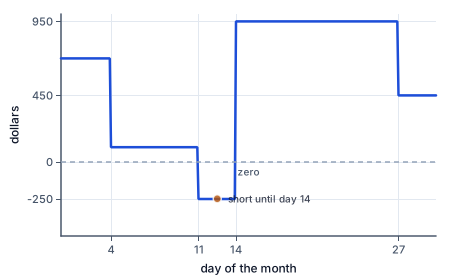
Fixit Mobile's month, opening with 700 dollars.
| Day | Event | Amount | Balance |
|---|---|---|---|
| 4 | Screen supplier | −600 | 100 |
| 11 | Van installment | −350 | −250 |
| 14 | Westgate Clinic pays | +1200 | 950 |
| 27 | Insurance | −500 | 450 |
The month ends at 450 and the insurance is the largest bill after the screens. Neither matters: the van installment on day 11 is the problem, because it falls three days before the clinic pays. Moving that one date by four days fixes the whole month.
Collect every bill. Supplier invoices, rent, wages, loan and lease installments, tax payments, automatic payments. A calendar that leaves out the insurance automatic payment is wrong on the day the insurer takes it.
Put each on its due date. Not the date it arrived and not the date you would like to pay it: the date it must be paid by. For a automatic payment, the day the bank takes it.
Put each receipt on the day it will really arrive. For a customer who always pays a week late, that is a week after the invoice's due date. Optimism here is the commonest reason a calendar fails.
Run the balance. One line per date, the balance after everything on that date. Where a bill and a receipt share a day, put the bill first: it is the safer assumption.
Read the low point and the first failure. The lowest balance says how much help the month needs; the first bill that fails says whom to ask and by when.
Check the calendar by adding every receipt to the opening cash and taking off every bill: the result must equal the final balance. Then check it against last month's bank statement — a regular payment that appears there and not on the calendar has been forgotten.
Supplier credit is one of the few kinds of finance a small business gets for nothing. Paying on the due date, not before, keeps that money in the account for as long as the supplier has agreed to lend it.
Paying early gives the credit back for nothing, unless the supplier offers something for it. An early-payment discount — say 2 percent for paying in ten days instead of thirty — is worth taking only when the business has the cash to spare, and it is worth a surprising amount: 2 percent for twenty days is far more than most savings accounts pay for a year.
Paying late is the opposite mistake. A supplier who is paid late stops offering credit, moves the business to payment on order, or quietly puts it at the back of the line when stock is short. In many places late payment can also carry interest or fees. Asking for more time before the due date protects the relationship; missing it damages it.
Asking for better terms works best after a record of paying on time. A café that has paid its roaster on the fourteenth for a year is in a strong position to ask for thirty days.
Just as customers' invoices can be read as an average number of days, so can the business's own bills. Divide what the business owes its suppliers by what it buys on credit in one day:
$$\text{average days to pay suppliers} = \frac{\text{owed to suppliers}}{\text{credit purchases} \div \text{days}}$$
A figure well below the suppliers' terms means the business is paying early and giving away free credit. A figure well above them means it is paying late, and relying on suppliers' patience. Read beside the average days customers take to pay, it shows how the two ends of the cash cycle compare: a business that pays in twenty days and is paid in fifty is funding thirty days of its customers' purchases out of its own pocket.
A calendar that dips below zero is not a verdict; it is a list of options, and it arrives early enough to use them. In rough order of cost:
Move a date. Ask the supplier whose bill fails first for a week or two, explaining when the receipt that covers it is due. This costs nothing but a phone call and is usually granted to a customer with a good record.
Bring a receipt forward. Ask the customer whose payment would close the gap to pay a few days early, or to pay part now.
Hold back a purchase. Stock that can wait a week, an order that can be split into two deliveries, a piece of equipment that can be bought next month.
Arrange short-term borrowing — a line of credit agreed in advance — for the size of the low point and the days it lasts. Arranged before it is needed it is a routine request; asked for on the day it is an emergency.
The calendar says which of these is needed, how much, and by when. That is the whole reason for building it before the month rather than finding out during it.
A restaurant opened in September and traded well through Christmas. On the first of January it has 6,000 dollars in the bank. Its owner builds a payment calendar for the month, because January is quiet and the December bills are large.
The wine merchant's December invoice of 4,200 is due on the 5th, wages of 5,500 on the 10th, the food suppliers' 3,800 on the 15th, rent of 3,000 on the 20th, and the quarterly sales tax payment of 2,600 on the 31st. Card takings arrive a day after each night's trade, about 900 a day in January for 26 trading days, so roughly 4,500 by the 5th, 9,000 by the 10th and so on.
Run through: 6,000 + 4,500 − 4,200 = 6,300 on the 5th; + 4,500 − 5,500 = 5,300 on the 10th; + 4,500 − 3,800 = 6,000 on the 15th; + 4,500 − 3,000 = 7,500 on the 20th; + 5,400 − 2,600 = 10,300 on the 31st. The month never goes below zero, and its low point is 5,300 on the 10th.
Then she tests it. If January takings are 30 percent lower — 630 a day — the 10th becomes 6,000 + 3,150 − 4,200 + 3,150 − 5,500 = 2,600, and the 15th 2,600 + 3,150 − 3,800 = 1,950. Still above zero, but thin. She asks the wine merchant, whom she has paid on time since opening, to move the invoice to the 25th this once. It agrees, and her low point in the bad case rises to about 5,250. One phone call, made in December, bought her a quiet January.
Large companies often set long payment terms for their suppliers — sixty or ninety days — because every day they hold a supplier's money is a day they do not have to borrow it. For a small supplier, those days are its customers' cash cycle. Several governments now require large companies to publish how quickly they pay, so that a small business can see before signing a contract how long it is likely to wait.
A bill can wait until the end of the year. It waits until its due date, and the calendar is built from those dates.
The month-end balance says whether the month works. It hides the dip in the middle. The lowest point is the figure that matters.
The biggest bill is the problem. The first bill the account cannot meet is the problem, and it may be a small one that falls before a receipt.
Paying early is always good practice. Paying before the due date gives away credit the supplier offered for free, and can create the very dip the calendar was built to avoid.
Receipts arrive on their due dates. They arrive when customers pay, which is often later.
Write the opening cash for April.
$400$
The start of the calendar.
Pay the seed merchant's 250 on day 2.
$400 - 250 = 150$
The first bill in date order.
Pay the polytunnel lease of 600 on day 20.
$150 - 600 = -450$
The first balance below zero.
Add Bramble Café's 900 on day 25.
$-450 + 900 = 450$
The month ends above zero and hides the dip.
Move the lease to day 26 and run it again.
$150 + 900 - 600 = 450; \quad \text{low point } 150$
Asked on day 1, the landlord agrees, and the account never goes below zero.
Write the opening cash.
$700$
The first of the month.
Pay the screen supplier's 600 on day 4.
$700 - 600 = 100$
Still above zero.
Pay the van installment of 350 on day 11.
$100 - 350 = -250$
The first failure.
Add Westgate Clinic's 1,200 on day 14.
$-250 + 1200 = 950$
Three days too late for the van.
Pay the insurance of 500 on day 27.
$950 - 500 = 450$
The month ends comfortably.
Check against the totals.
$700 + 1200 - 600 - 350 - 500 = 450$
Opening plus receipts less bills equals the final balance.
Note the offer: 2 percent off the roaster's 1,500 for paying in 10 days, not 30.
$1500 \times 0.02 = 30$
The saving if Alexa pays early.
Find the days of credit given up.
$30 - 10 = 20$
The roaster's money she would stop holding.
Find the cash she would pay early.
$1500 - 30 = 1470$
Twenty days sooner.
Check the calendar with the early payment on day 10.
$1100 - 1470 = -370$
The account would go below zero before the catering invoice arrives.
Check it with payment on day 30.
$1100 + 900 - 1500 = 500$
Paid on its due date, after Harbor Office pays on day 25, the month works.
Weigh the saving against the risk.
$30 \text{ saved against a } 370 \text{ shortfall}$
A line of credit to cover it could cost more than the discount saves.
Decide on the calendar, not the discount.
$\text{pay on day } 30 \text{ this month}$
Take the discount in a month when the cash is already there.
Pay the first bill.
$500 - 300 = 200$
Day 5 comes first.
Add the receipt on day 9.
$200 + 400 = 600$
Between the bills.
Pay the second bill.
Fixit Mobile starts the month with $600$ dollars. Three bills fall due: the screen supplier, $700$ dollars on day $3$; the van installment, $350$ on day $12$; the insurance, $500$ on day $28$. Delta Couriers' invoice, $1500$ dollars, is expected on day $10$. Fill in the balance after each bill is paid, in dollars, counting the receipt on its day. Write a balance below zero with a minus sign.
| Bill, dollars | Balance after it, dollars | |
|---|---|---|
| After the screen supplier, day $3$ | 700 | |
| After the van installment, day $12$ | 350 | |
| After the insurance, day $28$ | 500 |
Complete the worked solution: a shop opens the month with $600$ dollars. It pays a $200$ dollar bill on day 5, receives $500$ dollars from a customer on day 9, and owes a $1300$ dollar bill on day 12. Run the balance and find the bill to ask about.
Pay the first bill.
$600 - 200 =$ p
Day 5 comes first.
Add the receipt on its day.
$(\text{balance}) + 500 =$ q
Day 9 falls between the two bills.
Pay the second bill.
$(\text{balance}) - 1300 =$ s
Below zero: the money is not there on the day.
Name the first bill the account cannot meet.
$\text{the bill due on day 12}$
It is the first to take the balance below zero.
Say when to ask about it.
$\text{now, before its due date}$
Asked early it is a conversation; asked on the day it is an apology.
Long Row Gardens has $400$ dollars on the first of the month. It owes the seed merchant $250$ dollars on day $2$, the polytunnel lease $600$ on day $20$ and the fuel account $180$ on day $27$, and expects $900$ dollars from Bramble Café's invoice on day $25$. Which supplier should the owner ask, now, for more time?
Long Row Gardens opens the month with $600$ dollars. Four things happen, in this order: the seed merchant is paid $500$ dollars, the fuel account $400$, Bramble Café pays $1000$, and the polytunnel lease of $300$ is paid. Plot the balance after each of the four events, numbering the events $1$ to $4$ along the bottom.
Plot your answer on the grid:
Corner Bean's paperwork on the first of the month. Sort each item by who owes whom.
| Money the café owes | Money owed to the café | Settled: nothing owed either way | |
|---|---|---|---|
| The roaster's bill for $739$ dollars, due on the tenth | |||
| This week's wages, paid on Friday | |||
| The invoice sent to Harbor Office for last week's catering | |||
| The milk delivery, paid in cash when it arrived | |||
| Yesterday's counter takings, in the register |
A florist buys all her flowers on account. Over the last $90$ days her credit purchases came to $6030$ dollars, and today she owes her suppliers $2613$ dollars. On average, how many days does she take to pay them?
Answer:
A bicycle repair shop opens the month with $200$ dollars. The parts wholesaler's bill of $700$ dollars is due on day $6$, a club pays $900$ dollars for a season's servicing on day $15$, and the workshop rent of $400$ is due on day $20$. The wholesaler agrees to move its bill to day $16$. What is the lowest balance the account now reaches during the month, in dollars?
Answer:
Lesson test: one question per skill, one attempt each, no hints. Your answers are checked when you submit.
Corner Bean opens the month with $900$ dollars. It must pay the roaster $650$ dollars on day $5$, the rent $800$ on day $15$ and the milk supplier $300$ on day $25$, and expects $1200$ dollars from the Town Hall canteen's invoice on day $20$. What is the lowest balance the account reaches, in dollars?
Answer:
You can build a payment calendar and read it for its lowest point and the first bill that fails. Tell someone why the month-end balance can look fine while one bill in the middle cannot be paid. Next: stock, and how it turns cash into something that sits on a shelf.
15. Your turn: open with 500; bill of 300 on day 5; receipt of 400 on day 9; bill of 700 on day 12, step 3
$600 - 700 = -100$
The day 12 bill is the one to ask about.