Back to the on-screen lesson ·
How many of a resource a volume needs, what that costs a month, where the current step ends, and whether an order that forces the next step pays for it.
Paper packet. Every task here also exists on screen, where it is checked automatically; answers written on paper are not assessed by Nydus. When you are back at a device, enter your answers there.
You will work out how many of a resource a volume needs and what they cost a month, draw the staircase a step cost makes, find the first volume past the current step, and decide whether an order that forces the next step contributes enough to pay for it.
You sort costs into fixed and variable, and you know that fixed means fixed inside the range the business trades in. This lesson is about the edge of that range: what happens when a resource that was comfortably fixed runs out of room, and the next unit of volume needs a whole new one. You need division and the habit of rounding up; the rest is reading the staircase that results, and deciding what to do when an order would push the business over a step.
| Term | What it means |
|---|---|
| Step cost | A cost that stays level across a range of volume and then jumps by a whole amount. |
| Capacity | How much one unit of a resource — a barista, a bench, a van — can handle. |
| Step | The range of volume one number of that resource covers. |
| Edge | The last volume a step can carry; one more needs the next step. |
| Utilization | The share of a step's capacity actually being used. |
| Room in the step | Capacity already paid for and not yet used. |
Fixit Mobile's technician, at a bench, can handle about 80 repairs a month and costs 2200 dollars a month. At 60 repairs, one technician. At 80, still one. At 81, two — and the monthly cost goes from 2200 to 4400 in a single repair.
That is a step cost. Within a step it behaves exactly like a fixed cost: more volume costs nothing extra. At the edge it behaves like nothing else in the business: one more unit costs a whole new resource.
$$\text{number needed} = \frac{\text{volume}}{\text{what one handles}}, \text{ rounded up}$$
Rounding up is the whole idea. Half a technician is not on offer; the eighty-first repair gets a whole one or it does not get done.
The decision the edge creates. Near the top of a step, an extra order that would otherwise look like pure gain has to pay for the next step before it adds anything. Set what the order contributes a month against what the next step costs a month. And remember the other side: once the step is paid for, the new capacity is mostly empty — room that later orders can use for nothing extra.
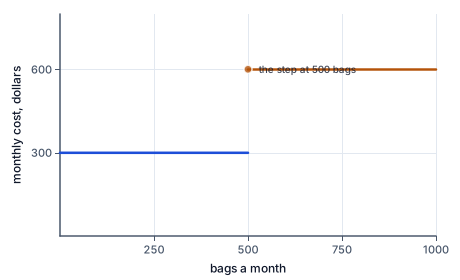
Another way: steps
Another way: table
Long Row Gardens' polytunnels, each growing up to 500 bags of salad a month at 300 dollars a month.
| Bags a month | Tunnels needed | Monthly cost | Cost per bag |
|---|---|---|---|
| 500 | 1 | 300 | 0.60 |
| 750 | 2 | 600 | 0.80 |
| 1000 | 2 | 600 | 0.60 |
The cost per bag jumps when a tunnel is added half-full, and falls again as the tunnel fills.
Find the capacity honestly. What one barista, bench or van can handle in a real month, with breaks, cleaning and the quiet hours in it — not the most it could do on its best day. An optimistic capacity puts the edge further away than it is.
Divide and round up. Volume over capacity; any part becomes a whole.
Cost the step. The number needed times the monthly cost of one.
Find the edge and the room. The number needed times the capacity is the top of the step; that less the volume is the room already paid for.
Weigh any order that crosses the edge. Its monthly contribution against the next step's monthly cost. If it falls short, ask how many more units a month would fill the new step enough to pay: the step's cost over one unit's contribution.
Check the count by multiplying back: the number needed times the capacity must be at least the volume, and one fewer times the capacity must be less than it. If both hold, the rounding is right. Check the decision by asking whether the order is likely to last: a step taken on for a one-month order is still paid for in the months after.
Because a step cost is fixed within the step, what it adds to each unit depends on how full the step is. A polytunnel costing 300 a month adds 0.60 to each bag when it grows 500, and 1.20 when it grows 250.
So the cost per unit is lowest at the top of each step and highest just after a new step is added. A business that has just added a second technician, a second van or a second tunnel will see its cost per unit jump and its margin fall, even though nothing has gone wrong — the new step is simply mostly empty. The figure to watch is utilization: the volume over the capacity paid for. As the new step fills, the cost per unit falls back.
This is also why a quote priced at the full-step cost per unit can win work that fills an empty step profitably, while the same price at the top of a step would force a new one and lose money.
A step is only as large as the smallest unit of the resource the business can buy. Many businesses make their steps smaller, so that crossing an edge costs less.
Part-time staff turn one large step — a full-time barista — into two or three smaller ones. Hiring equipment by the day for a busy week avoids leasing a second machine for a year. Subcontracting the overflow to another business turns a step cost into a variable one: the business pays for each job passed on and nothing when there are none. Overtime stretches the current step a little way past its edge, at a higher cost per hour.
Each has a price: part-time staff may cost more per hour, hire costs more per day than a lease, a subcontractor takes a margin. The arithmetic of this lesson says when that price is worth paying: when the order is too small, or too uncertain, to fill a whole new step.
The staircase is easy to climb and slow to descend. A technician hired for a busy spring cannot be let go the week the work falls away; a van leased for a year is paid for all year; a second polytunnel built in March stands empty in November. Contracts, notice periods and leases mean that a step taken on in response to a rise in volume often stays after the volume has gone.
This is why the decision at the edge should look at how long the extra volume will last, not only at this month's figures. An order that more than pays for the next step for three months, and then ends, may leave the business carrying the step for nine months with nothing to fill it. Set the order's total contribution over its life against the step's cost over the shortest time the business could be committed to it.
It is also why the ways of making steps smaller matter most when volume is uncertain. A business that is not sure a rise will last is usually better off stretching the current step with overtime or hire for a few weeks, and committing to the next step only once the volume has held.
A children's day nursery can take 12 children per room, with the rules where it operates requiring a set number of staff for each room whatever the number of children in it. Each room costs about 6,500 dollars a month to staff and run. The nursery has five rooms and 58 children: 58 ÷ 12 is 4.8, so five rooms, costing 32,500 a month, with room for two more children.
A local employer asks whether the nursery could take eight children of its staff from September, at the usual fee, which contributes about 900 a month per child after food and materials. Eight children take the nursery to 66, past the edge of 60, so a sixth room is needed. The eight contribute 8 × 900 = 7,200 a month, against 6,500 for the room: 700 better off.
That is on the figures alone. The owner looks further. The sixth room would have space for 72 − 66 = 6 more children, each worth 900 a month with no extra room cost, and the waiting list has four families. She also asks the employer for a year's commitment, because a room staffed for eight children who leave in December would cost 6,500 a month with nobody to pay for it.
The employer agrees to a year. With the waiting list, the sixth room's utilization will be 10 of 12 by October, and the nursery's cost per child falls back toward where it was before the step.
An airline adding a route has to add whole aircraft and whole crews, however many passengers turn up. That is a step cost on a very large scale, and it is why airlines price empty seats close to departure so cheaply: once the aircraft is flying, the step is paid for, and any passenger who contributes anything above the extra fuel and meal is better than an empty seat.
Every fixed cost stays fixed at every scale. Only within its step.
Step costs grow in proportion to volume. They grow in whole jumps; between jumps they do not grow at all.
Round to the nearest. A resource that is 1.1 times too small is two resources, not one.
Any order that contributes is worth taking. Not if it forces a step that costs more a month than it contributes.
A rise in cost per unit means something went wrong. Just after a new step, it is the empty part of the step showing.
A step can be dropped as easily as it was added. Leases, contracts and notice periods keep a step in place long after the volume that needed it has gone, so judge an order by how long it will last as well as by what it pays each month while it does.
Divide the volume: 1,900 coffees, 1,000 a barista.
$1900 \div 1000 = 1.9 \to 2$
Round up to whole baristas.
Cost them at 1,700 each.
$2 \times 1700 = 3400$
The step cost at this volume.
Find the edge.
$2 \times 1000 = 2000$
Room for 100 more coffees a month.
Check the office order: 300 coffees at 3 contribution.
$1900 + 300 = 2200 > 2000; \quad 300 \times 3 = 900$
The order crosses the edge and contributes 900.
Set it against the third barista.
$900 - 1700 = -800$
On these figures alone, not worth it — unless more orders will fill the third barista's month.
Note one technician's capacity and cost.
$90 \text{ repairs}, \ 2400 \text{ a month}$
From the shop's own records.
Count technicians at 150 repairs.
$150 \div 90 \approx 1.67 \to 2$
Round up.
Cost the whole units.
$2 \times 2400 = 4800$
The step cost.
Find the edge.
$2 \times 90 = 180$
The 181st repair needs a third technician.
Find the utilization.
$150 \div 180 \approx 0.83$
The step is about five-sixths full.
Find the technician cost per repair.
$4800 \div 150 = 32$
It would fall to about 26.70 at 180 repairs.
Note the current position: 700 bags, tunnels of 400 at 350 a month.
$700 \div 400 = 1.75 \to 2$
Two tunnels, 700 a month.
Find the edge.
$2 \times 400 = 800$
Room for 100 more bags.
Check the hotel's order of 250 bags at 3 contribution.
$700 + 250 = 950 > 800$
It forces a third tunnel.
Find what the order contributes.
$250 \times 3 = 750$
A month's contribution.
Set it against the third tunnel.
$750 - 350 = 400$
The order pays for the step with 400 to spare.
Find the room left after the order.
$3 \times 400 - 950 = 250$
Space for 250 more bags at no extra tunnel cost.
Find the bags that would have paid for the tunnel on their own.
$350 \div 3 \approx 117$
The hotel's 250 comfortably clear it.
Divide and round up.
$700 \div 250 = 2.8 \to 3$
Three are needed.
Cost the whole units.
$3 \times 600 = 1800$
The monthly step cost.
Find the room left.
At Corner Bean, one of a delivery e-bike handles up to $300$ deliveries a month and costs $240$ dollars a month. For each monthly volume, fill in how many are needed and what they cost, in dollars.
| How many needed | Monthly cost, dollars | |
|---|---|---|
| $250$ deliveries a month | ||
| $650$ deliveries a month | ||
| $900$ deliveries a month |
Complete the worked solution: one technician handles up to $79$ repairs a month and costs $1600$ dollars a month. The shop expects $361$ repairs a month. How many technicians does it need, what do they cost, and how much room is left?
Divide the volume by what one handles.
$361 \div 79 = 4 \text{ and a part}$
More than a whole number of technicians' work.
Round up to whole technicians.
$\text{needed} =$ n
The part needs a whole technician.
Cost the whole units.
$(\text{needed}) \times 1600 =$ c
A whole monthly cost for each.
Find what they can handle.
$(\text{needed}) \times 79 =$ p
The top of the current step.
Find the room left in the step.
$(\text{capacity}) - 361 =$ s
Repairs the shop can add for nothing extra in technicians.
Long Row Gardens runs $700$ salad bags a month, and its current a polytunnel capacity tops out at $800$. A customer offers a monthly order for $150$ more salad bags, each contributing $3$ dollars. One more of a polytunnel costs $350$ dollars a month. Is the order worth taking on these figures alone?
Corner Bean's delivery e-bikes each cover up to $200$ deliveries a month and cost $100$ dollars a month each to lease. Plot the monthly cost of the e-bikes needed at $100$, $200$, $300$, $400$, $500$ and $600$ deliveries, with deliveries in hundreds along the bottom.
Plot your answer on the grid:
At Corner Bean, one of a barista handles up to $1200$ coffees a month. The business now runs $2000$ coffees a month with $2$ of them. At what monthly volume, in coffees, does it first need another?
Answer:
A laundry service is full. A second industrial washer would cost $1755$ dollars a month to lease, and each extra load it washes contributes $9$ dollars. How many extra loads a month must the second washer do before it pays for itself?
Answer:
A window-cleaning business runs vans that can each do up to $29$ jobs a week. For what numbers of jobs a week does it need exactly two vans?
This task has no paper form; do it on a device.
Lesson test: one question per skill, one attempt each, no hints. Your answers are checked when you submit.
Corner Bean pays $3600$ dollars a month for a barista capacity at $2000$ coffees a month. One of a barista handles up to $1200$ coffees and costs $1800$ dollars a month. What will the capacity cost a month at $4900$ coffees?
Answer:
You can cost a resource that comes in whole units, find the edge of each step and the units that pay for the next one. Tell someone why an order that adds contribution can still be a bad order near the top of a step. Next: bills with a fixed part and a part that grows with use.
15. Your turn: a resource handles 250 units and costs 600 a month; volume 700, step 3
$3 \times 250 - 700 = 50$
Fifty units before the next step.