Back to the on-screen lesson ·
Contribution a unit and as a share of price, the extra volume a price cut needs and the sales a price rise can lose, and the month's profit as a rule in units sold.
Paper packet. Every task here also exists on screen, where it is checked automatically; answers written on paper are not assessed by Nydus. When you are back at a device, enter your answers there.
You will lay out one unit's price and variable costs, work out its contribution and contribution ratio, find how many extra sales a price cut needs just to keep the month's contribution and how many sales a price rise can lose, and write the month's profit as a rule in the units sold.
You met contribution in the first course as price less variable cost, and the last two lessons showed that a unit's share of overhead is a division rather than a cost it causes. Unit economics keeps only what one more unit really brings in and really costs, and then asks the two pricing questions owners most often get wrong: how many more sales a price cut needs, and how many sales a price rise can afford to lose. The arithmetic is the same for both, and it gives answers that surprise almost everyone the first time.
| Term | What it means |
|---|---|
| Variable costs | The costs one more unit brings with it: materials, a card fee, hourly labor for its minutes. |
| Contribution | Price less the variable costs of one unit. |
| Contribution ratio | Contribution as a percentage of price. |
| Price cut | A lower price, which comes entirely out of contribution. |
| Price rise | A higher price, which adds entirely to contribution. |
| Break-even revenue | The fixed costs divided by the contribution ratio. |
A flat white at Corner Bean sells for 4 dollars. The coffee, milk and cup cost 0.80, the card processor takes 0.10, and the barista's two minutes cost 1.10. Those three come with every cup, so one more flat white adds
$$\text{contribution} = 4 - 0.80 - 0.10 - 1.10 = 2$$
dollars — a contribution ratio of 50 percent. Nothing has been said yet about rent. That is the point: contribution is what a sale adds toward the fixed costs, and a month is profitable only once the contributions of all its sales have covered them.
$$\text{profit} = \text{contribution a unit} \times \text{units} - \text{fixed costs}$$
The price cut trap. Cut the flat white by 50 cents and the price falls by one eighth. The contribution falls from 2 to 1.50, by one quarter, because the whole cut comes out of it and none out of the costs. At 3000 cups a month the café earned 6000 of contribution; at 1.50 a cup it needs 4000 cups to earn the same. A cut of an eighth needs a third more customers just to stand still.
Another way: steps
Another way: table
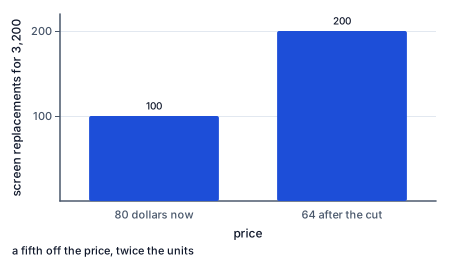
Fixit Mobile's screen replacement, before and after a cut.
| Line | Now | After a 16 dollar cut |
|---|---|---|
| Price | 80 | 64 |
| Parts, fee and labor | 48 | 48 |
| Contribution a unit | 32 | 16 |
| Units for 3200 a month | 100 | 200 |
A fifth off the price halves the contribution and doubles the volume needed.
List the variable costs honestly. Everything that comes with one more unit: materials, packaging, the card fee, the delivery platform's commission, labor paid for the minutes it takes. Leave out anything paid whatever the volume.
Work the contribution and the ratio. Price less variable costs; that over the price, times a hundred.
Work the month. Contribution a unit times the units sold is the pot the fixed costs are paid from.
Test a price change. Change the contribution a unit by the whole of the change, divide the month's contribution by the new figure, and compare with the units sold now.
Check the answer by working the month again at the new price and the new volume: the month's contribution must come out equal to what it was. Then check the judgment: is the extra volume a cut needs, or the loss a rise can stand, a number the business could believe? A cut that needs half as many customers again, in a town where customers are not waiting, is a cut that loses money.
Labor is the line owners argue about. If the barista is paid by the hour and the schedule shrinks when the café is quiet, the minutes a coffee takes are a variable cost. If the same person is on a fixed salary and would be standing there anyway, their time is fixed for this decision, and the contribution of one more coffee is higher. Neither answer is always right; the sheet should say which it assumed.
The same question applies to anything that looks per unit. A delivery platform's commission on each order is variable. A monthly fee to be listed on the platform is not, however it is quoted.
The same arithmetic run the other way is often the more useful. A rise adds its whole amount to each unit's contribution. A salon cut that contributes 20 dollars and rises by 5 now contributes 25, a quarter more. The salon could lose a fifth of its cuts and still earn the same contribution: 400 cuts at 20 is 8,000, and 320 cuts at 25 is 8,000 too.
So a modest rise can survive losing a surprising share of customers, and the fewer customers leave, the better off the business is. For a business whose customers come for quality, convenience or a relationship rather than the lowest price, a rise is often much safer than it feels. The figure to compare against is honest: how many customers would really leave over a price change of this size? Most owners, asked that question with the arithmetic in front of them, find the answer is far fewer than the allowance.
When a business sells many products at many prices, counting units becomes awkward. The contribution ratio turns the same idea into revenue. If every dollar of sales contributes 50 cents on average, then fixed costs of 6,000 a month need 6,000 ÷ 0.50 = 12,000 dollars of sales to break even.
$$\text{break-even revenue} = \frac{\text{fixed costs}}{\text{contribution ratio}}$$
A price cut lowers the ratio and raises the revenue needed; a rise does the opposite. And because the ratio is an average across products, a shift in what customers buy — more of the low-contribution items, fewer of the high ones — moves break-even revenue even when no price has changed. That is the subject of the next lesson.
Many offers do not look like price cuts and are exactly that on the unit's economics. A loyalty card that gives the tenth coffee free cuts the price of every coffee a card-holder buys by a tenth of a coffee's price — 0.40 on a 4-dollar flat white — and every cent of it comes out of the 2 dollars of contribution. A two-for-one offer gives away the second unit's whole price, while its variable costs are still paid. A bundle — a coffee and a pastry for 6 instead of 7 — cuts a dollar off what the two would have contributed together.
None of these is wrong. A loyalty card that keeps a regular coming back twice a week, or a bundle that sells pastries that would otherwise be thrown away, may well pay. But each should be tested the same way as any cut: what does it take off the contribution of the sales it touches, and how many extra sales, or which sales that would otherwise be lost, does it have to bring to pay for that? An offer that mostly goes to customers who would have bought anyway is a price cut with nothing to show for it.
The sale price itself is only half the test. The other half is who takes the offer, and whether they would have paid full price without it.
A dog groomer charges 55 dollars for a full groom. Shampoo, conditioner, blades and towels come to about 4 a dog, the card fee to 1, and she pays her assistant 20 dollars for the hour each groom takes. Each groom contributes 55 − 4 − 1 − 20 = 30, a ratio of about 55 percent. She does 160 grooms a month: 4,800 of contribution against fixed costs of 3,200 for the van, insurance and booking software, leaving 1,600.
A new groomer in town charges 45, and she wonders whether to match it. At 45 each groom would contribute 20. To keep 4,800 she would need 240 grooms a month — half as many again, and more than she and her assistant can fit into their week. Matching the price would lose money even if every customer stayed.
She looks at a rise instead. At 60, each groom contributes 35, and 4,800 needs only about 137 grooms: she could lose 23 a month and be no worse off. She knows her regulars come because their dogs are calm with her, and she guesses she might lose five or six a month to the cheaper groomer. So she raises the price to 60, explains the change to her regulars with a month's notice, and keeps a count. Three months later she is doing 152 grooms a month at 35 each: 5,320 of contribution, 520 more than before.
Retail trade bodies often warn that a business with a low contribution ratio cannot discount its way to growth. A shop whose products contribute 20 percent of their price needs to sell twice as much to make up for a 10 percent discount, because the discount takes half its contribution. The lesson's arithmetic is the reason: every price change lands entirely on contribution.
Contribution is profit. It is profit only after the fixed costs are covered; before that it is paying them.
A 10 percent cut needs 10 percent more sales. It needs far more, because the cut comes out of the contribution, which is smaller than the price.
Only materials are variable. The card fee and hourly labor go up with every sale too.
More customers always mean more profit. Not if each one now contributes less than enough to cover the ones you were already serving.
A price rise must keep every customer. It can lose a share of them and still leave the business better off; the arithmetic says how large a share.
A loyalty card is not a discount. It is a price cut on every sale it touches.
Find a bag's contribution: price 5; seed and bag 1.10, fee 0.10, picking 1.30.
$5 - 1.10 - 0.10 - 1.30 = 2.50$
A contribution ratio of 50 percent.
Find the month's contribution at 1,200 bags.
$1200 \times 2.50 = 3000$
The pot the fixed costs are paid from.
Find the contribution after a cut to 4.50.
$2.50 - 0.50 = 2$
The cut comes out of the 2.50.
Find the bags the cut needs.
$3000 \div 2 = 1500$
To earn the same month.
Compare the extra needed with the extra expected.
$1500 - 1200 = 300 > 200$
He expects 200 more: on contribution alone, the cut does not pay.
Find the contribution now.
$4 - 0.80 - 0.10 - 1.10 = 2$
Fifty percent of the price.
Find the month's contribution at 3,000 cups.
$3000 \times 2 = 6000$
What any price change must keep.
Find the cups a 50-cent cut needs.
$6000 \div 1.50 = 4000$
A thousand more cups a month.
Find the contribution after a 50-cent rise.
$2 + 0.50 = 2.50$
The whole rise adds to contribution.
Find the cups a rise needs to keep 6,000.
$6000 \div 2.50 = 2400$
Six hundred fewer cups still earn the same.
Compare the two.
$\text{cut: } +1000 \text{ cups}; \quad \text{rise: } -600 \text{ allowed}$
The same 50 cents moves the volume needed very differently each way.
Note the month's fixed costs.
$4800$
Rent, van, insurance and Dan's own salary.
Find a screen's contribution ratio: 32 on 80.
$32 \div 80 \times 100 = 40$
Forty cents of every screen dollar.
Find a battery swap's: 20 on 50.
$20 \div 50 \times 100 = 40$
The same ratio.
Find the break-even revenue.
$4800 \div 0.40 = 12000$
Sales needed to cover the fixed costs.
Find the break-even revenue after a screen cut to 64.
$16 \div 64 = 0.25$
The screen ratio falls to 25 percent.
Work out the average ratio if screens are half of sales.
$(0.25 + 0.40) \div 2 = 0.325$
The mix now contributes 32.5 cents a dollar.
Find the new break-even revenue.
$4800 \div 0.325 \approx 14770$
About 2,770 more sales a month just to break even.
Find the contribution now and after the cut.
$50 - 30 = 20; \quad 20 - 10 = 10$
The cut comes out of contribution.
Find the month's contribution now.
$60 \times 20 = 1200$
What the cut must still earn.
Find the units the cut needs.
Fixit Mobile sells a battery swap for $50.00$ dollars. Each one uses $18.00$ of materials, costs $1.00$ in card fees and takes $11.00$ of labor paid by the hour. Complete the sentence in dollars.
The costs one more brings with it add to v dollars, so each one contributes c dollars.
Complete the worked solution: a product sells for $8$ dollars with $5$ of variable cost, and $64$ are sold a month. The owner considers cutting the price by $1$ dollars. How many more must sell just to keep the month's contribution?
Find the contribution a unit now.
$8 - 5 =$ c
Price less variable cost.
Take the cut off it.
$(\text{contribution}) - 1 =$ n
The whole cut comes out of contribution.
Find the month's contribution now.
$(\text{contribution}) \times 64 =$ t
What the cut must still earn.
Divide by the new contribution a unit.
$(\text{month's contribution}) \div (\text{new contribution}) =$ u
The units the cut needs.
Subtract the units sold now.
$(\text{units needed}) - 64 =$ e
The extra sales needed just to stand still.
The unit economics of a screen replacement at Fixit Mobile, which sells $100$ screen replacements a month. Complete the sheet in dollars, with the contribution's share of the price as a percentage.
| Figure | |
|---|---|
| Price | 80 |
| Materials | 30 |
| Card fee | 2 |
| Labor | 16 |
| Contribution a unit | |
| Contribution as a percentage of price | |
| Contribution a month |
Corner Bean sells $3000$ flat whites a month at $4.00$ dollars, each contributing $2.00$. The owner is thinking of cutting the price by $0.50$ dollars. How many more flat whites a month would have to sell just to keep the month's contribution where it is?
Answer:
Corner Bean sells $3000$ flat whites a month at $4.00$ dollars, each contributing $2.00$. The owner expects a price of $3.50$ to bring $600$ more sales a month. On contribution alone, does the cut pay?
A hair salon's cut contributes $6$ dollars after products, card fee and the stylist's hourly pay, and it does $440$ cuts a month. The owner is thinking of raising the price by $4$ dollars. How many cuts a month could the salon lose before the rise stopped paying?
Answer:
After water, soap and fuel, each wash a mobile car wash does contributes $8$ dollars. Its fixed costs are $240$ dollars a week. Plot the week's profit at $0$, $10$, $20$, $30$ and $40$ washes.
Plot your answer on the grid:
Lesson test: one question per skill, one attempt each, no hints. Your answers are checked when you submit.
Long Row Gardens sells a salad bag for $5.00$ dollars; the materials, card fee and labor in each come to $2.50$. Its fixed costs are $1500$ dollars a month. Write the month's profit in dollars as a rule in $n$, the number sold.
Answer:
You can read a unit's economics and test a price cut and a price rise against them. Tell someone why a cut of an eighth in price can need a third more customers. Next: two products competing for the same scarce minutes.
16. Your turn: price 50, variable costs 30, 60 sold, a 10 dollar cut, step 3
$1200 \div 10 = 120$
Sixty more: double the volume.