Back to the on-screen lesson ·
A process delivers only as fast as its slowest step; speeding up any other step adds nothing, and relieving the bottleneck moves the limit to the next-slowest step.
Paper packet. Every task here also exists on screen, where it is checked automatically; answers written on paper are not assessed by Nydus. When you are back at a device, enter your answers there.
You will find the step that limits a process, work out what the whole process delivers in an hour and a day, spot a bottleneck from what happens on the floor, and add people where they actually raise output.
You can work out each step's capacity. A process is those steps in a line, and every unit has to go through all of them. This lesson asks what the line as a whole can deliver.
| Term | What it means |
|---|---|
| Bottleneck | The step with the lowest capacity, which limits the whole process. |
| Throughput | What the process delivers: the bottleneck's capacity. |
| Relieving | Raising the bottleneck's capacity. |
| Next bottleneck | The step that becomes slowest once the first is relieved. |
| Pile-up | Work waiting in front of the bottleneck. |
| Starved step | A step after the bottleneck that waits for work. |
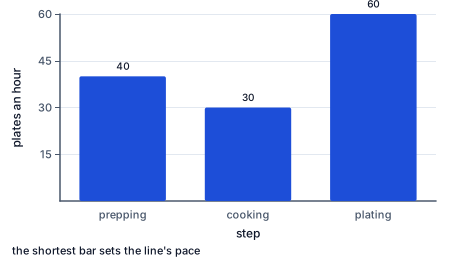
Neighborhood Kitchen's lunch line: prepping can finish 40 plates an hour, cooking 30, plating 60. Every plate needs all three. However fast prepping and plating go, no more than 30 plates an hour come out of the kitchen, because cooking can only finish 30. Cooking is the bottleneck, and 30 is the line's throughput. Over a three-hour lunch, that is 90 plates, not 120 or 180.
$$\text{throughput} = \text{the smallest step capacity}$$
Two consequences follow, and owners resist both. First, speeding up any other step delivers nothing extra: a third person on prepping just builds a pile of prepped plates in front of the cook. Second, relieving the bottleneck moves the limit rather than removing it: a second cook lifts cooking to 60, and the line now delivers 40, held by prepping, the new bottleneck.
Another way: table
Neighborhood Kitchen's line before and after a second cook.
| Step | Before | After a second cook |
|---|---|---|
| Prepping | 40 | 40 |
| Cooking | 30 | 60 |
| Plating | 60 | 60 |
| The line delivers | 30 | 40 |
Another way: steps
The arithmetic finds the bottleneck on paper. On the floor, it shows itself two ways: work piles up in front of it, and it never stops. Maya's studio on a busy Saturday had a shelf of thrown mugs waiting for trimming and a trimmer who did not pause all day, while the glazer had gaps between batches. Trimming was the bottleneck, whoever looked busiest.
Steps after the bottleneck show the opposite sign: they wait for work. A plater standing idle while the cook catches up is not lazy; plating is starved by cooking. Moving the plater to help cook, if they can, is often the fastest improvement of all.
List the steps in order. From the process map: every step each unit must pass.
Work out each capacity. Sixty times the people over the minutes a unit, under today's conditions.
Find the smallest. That step is the bottleneck, and its capacity is the process's throughput.
Scale to the day. Throughput times the productive hours.
Choose the improvement. Only a change to the bottleneck raises throughput: more people there, fewer minutes a unit there, or work moved off it.
Recompute. After the change, work out every capacity again and find the new smallest. That is where the next improvement belongs.
Check on the floor. Watch a busy period. The bottleneck should have work waiting in front of it and should never stop; steps after it should sometimes wait. If the pile-up is somewhere else, the timings are wrong, and the step with the pile-up is the real limit.
Taking the smallest capacity is allowed because each unit must pass every step in turn. A step that can finish 30 an hour releases 30 an hour to the steps after it, whatever they could do, and accepts no more than 30 an hour from the steps before it, whatever they send.
Ignoring improvements elsewhere is allowed because they change a capacity that is not the smallest. The minimum of 40, 30 and 60 is 30; raising the 40 to 50 leaves the minimum at 30.
Recomputing after each change is needed because the minimum can move. Raising the 30 to 60 makes the 40 the new minimum, and the next gain must come from there.
An hour lost at the bottleneck is an hour lost to the whole process. An hour lost anywhere else is usually made up, because those steps have spare capacity. So protect the bottleneck first.
Keep it supplied, so it never waits for work: prepped plates ready before the cook needs them, thrown mugs ready before the trimmer finishes the last. Schedule its breaks so someone covers them. Move any task off it that another step could do: the cook should not also be fetching supplies, answering the phone or wiping counters during the rush. Keep its equipment in good repair, and check its quality before it, so it does not spend minutes on units that will be thrown away.
Adding a person or a machine at the bottleneck works, but it is often not the first or cheapest move. Look first for work the bottleneck does that could be done elsewhere. If the cook also garnishes each plate, moving garnishing to the plater, who has spare capacity, cuts the cook's minutes a plate.
Look next for work done at the bottleneck that does not need doing: complicated dishes that could be simplified, paperwork that could be filled in afterwards. Then look at quality before the bottleneck: every faulty unit the bottleneck processes is time wasted. Only after these should the owner pay for more capacity there.
In many businesses the bottleneck depends on what is being made. On a day of simple sandwiches, the bottleneck may be the register; on a day of hot catering orders, the stove. A repair shop doing mostly tune-ups is limited by mechanics; on a day of wheel builds, by the truing stand.
Work out the bottleneck for the usual mix and for the busiest one. If it moves, plan staffing for each kind of day: an extra person at the register for sandwich rushes, a second cook for catering days. Knowing in advance where the limit will be is what lets the owner put the spare person there before the line forms.
Sometimes the slowest step is not inside the business at all. A cleaning company may finish cleans faster than its single van can move crews between jobs; a bakery may bake faster than its supplier delivers flour. The same rule applies: the slowest link sets the pace, and improving anything else adds nothing.
Include travel, supplier delivery and customer approval in the list of steps when they sit in the line. A repair shop whose mechanics wait two hours for customers to approve estimates has a bottleneck at the phone, and a quicker approval, such as a text with a one-tap reply, may raise its daily output more than another mechanic would.
A bottleneck explains most of the lines a small business sees. Work arrives faster than the slowest step can finish it, so it waits in front of that step: plates on the pass, bikes in the rack, customers at the register. The pile-up is not a sign that everyone is busy; it is a sign that one step is full and the others are feeding it faster than it can cope.
The next lesson looks at those lines directly, and at why they grow suddenly when the bottleneck gets close to full. The link to this lesson is simple: shorten the line by raising the bottleneck's capacity or by evening out the arrivals, not by speeding up the steps that are already waiting for work.
Write the bottleneck on the capacity sheet from the last lesson: which step it is, its capacity, the process throughput it sets, and the next-slowest step and its capacity. Update it after every change. When the owner is asked 'can we take a bigger order?' or 'should we hire?', the sheet answers at once: the extra work will be limited by this step, and an extra person helps only if they work there.
Over time the record shows how the business's limit has moved, from cooking to prepping to the register, and where the next investment will pay most.
A small brewery taproom in Minneapolis had a long line every Friday evening and assumed it needed more bartenders. The owner timed the steps instead. Taking an order and payment took about a minute: with two bartenders on the register side, 120 customers an hour. Pouring took about 90 seconds a drink on a four-tap tower: roughly 160 drinks an hour. Checking ID at the door took about 30 seconds with one person: 120 an hour.
None of those was the limit. Watching the floor showed glasses piling up unwashed and bartenders waiting for clean ones: the single small glass washer ran a 3-minute cycle of 25 glasses, about 500 an hour on paper, but it was only loaded when someone had a free moment, which on a Friday was rarely. In practice, clean glasses arrived at about 90 an hour.
The fix cost almost nothing: one person assigned to glasses from 6 to 9 on Fridays. Clean glasses rose above 150 an hour, the bottleneck moved to the register, and the Friday line shortened by more than half.
Eliyahu Goldratt's theory of constraints, set out in his book The Goal, rests on this lesson's idea: every system has one constraint that limits its output, and improvement means finding it, making the most of it, subordinating everything else to it, raising it, and then finding the next one.
Improve every step a bit. Only the bottleneck's improvement shows up in what the process delivers.
The busiest-looking person is the bottleneck. Look for work piling up and a step that never stops.
Add the capacities to get the total. Units pass through every step; the smallest decides.
Fix the bottleneck and the problem is gone. The limit moves to the next slowest step.
An idle person after the bottleneck is lazy. That step is starved of work.
List the step capacities.
$\text{loading 6; cleaning 2; walk-throughs 4}$
Jobs an hour each.
Find the smallest.
$2$
Cleaning is the bottleneck.
Work out the day's output.
$2 \times 8 = 16$
Cleans in an eight-hour day.
Test a change elsewhere.
$\text{faster loading: still } 2$
Nothing gained.
Choose where to improve.
$\text{cleaning only}$
The only step that adds cleans.
List the step capacities.
$40; \ 30; \ 60$
Prepping, cooking, plating.
Find the bottleneck.
$\text{cooking, at } 30$
The smallest.
Work out a three-hour lunch.
$30 \times 3 = 90$
Plates delivered.
Relieve the bottleneck.
$\text{a second cook: } 60$
Cooking doubled.
Find the new bottleneck.
$\text{prepping, at } 40$
The limit moved.
Work out the new lunch.
$40 \times 3 = 120$
Thirty more plates.
Work out checking in.
$60 \div 5 = 12$
Bikes an hour.
Work out servicing.
$60 \times 2 \div 40 = 3$
Two mechanics.
Work out test ride and handover.
$60 \div 10 = 6$
Bikes an hour.
Find the bottleneck.
$\text{servicing, at } 3$
The smallest.
Work out the day.
$3 \times 8 = 24$
Bikes a day.
Relieve it with a third mechanic.
$60 \times 3 \div 40 = 4.5$
Servicing raised.
Find the new day and the next limit.
$4.5 \times 8 = 36; \text{ then test rides at } 6$
Known in advance.
List the step capacities.
$\text{picking 90; weighing 60; paying 120}$
Customers an hour.
Find the bottleneck.
$\text{weighing, at } 60$
The smallest.
Work out a five-hour morning.
At Maya's Ceramics, mugs go through three steps. throwing can finish $5$ an hour, trimming and handles $10$ an hour, and glazing $15$ an hour. Which step limits how many mugs the whole process delivers?
Complete the worked solution: Neighborhood Kitchen's breakfast line has three steps. Toasting takes $5$ minutes a plate with $4$ people; frying eggs takes $2$ minutes a plate with $1$ cook; plating takes $1$ minute with $1$ person, so $60$ an hour. Breakfast runs $4$ hours. Find the toasting capacity, the frying capacity, and the plates the line delivers in a morning.
Find the toasting capacity.
$\text{sixty} \times (\text{people}) \div \text{five} =$ a
Plates an hour at toasting.
Find the frying capacity.
$\text{sixty} \times \text{one} \div (\text{minutes a plate}) =$ b
Plates an hour at frying, the slowest step.
Find the morning's plates.
$(\text{slowest capacity}) \times (\text{hours}) =$ d
The line delivers its slowest step's pace.
Say where a spare person should go.
$\text{to frying}$
Nowhere else adds a plate.
Notes from a busy Saturday at Maya's studio. Mark every note that shows where the bottleneck is.
This task has no paper form; do it on a device.
At Neighborhood Kitchen, lunch plates go through three steps. prepping can finish $40$ an hour, cooking $30$ an hour, and plating $60$ an hour. How many lunch plates can the whole process deliver in an hour?
Answer:
Neighborhood Kitchen's lunch line: prepping has $2$ people at $3$ minutes a plate ($40$ an hour), cooking has $1$ cook at $2$ minutes a plate ($30$ an hour), plating has $1$ person at $1$ minute ($60$ an hour). The line delivers the smallest. Two spare staff can each join one step. Get the line to $40$ plates an hour with as few moves as possible.
This task has no paper form; do it on a device.
An urgent care clinic in Raleigh has three steps for each patient. Check-in takes $4$ minutes with $1$ clerk. Triage takes $10$ minutes with $2$ nurses. A doctor's visit takes $15$ minutes with $1$ doctors on shift. The clinic is open $9$ hours. How many patients can it see in a day? Fill in each figure on the sheet.
| Amount | |
|---|---|
| Patients an hour the clinic delivers | |
| Patients a day |
A hand car wash can soap $17$ cars an hour, rinse and dry $13$ an hour, and take payment for $60$ an hour. It is open $6$ hours. How many cars can it wash in a day?
Answer:
Lesson test: one question per skill, one attempt each, no hints. Your answers are checked when you submit.
At Bright Home Cleaning, loading the van takes $10$ minutes a unit with $1$ people, cleaning $120$ minutes with $4$, and inspection walk-round $15$ minutes with $1$. The process runs $8$ hours a day. Fill in each step's capacity an hour, and what the whole process delivers in a day.
| Units | |
|---|---|
| loading the van, an hour | |
| cleaning, an hour | |
| inspection walk-round, an hour | |
| Whole process, a day |
You can say which step holds a process back and why improving the others is wasted. Tell someone where the limit goes when the bottleneck is fixed. Next: what a line is, and why it grows.
20. Your turn: Monica's Saturday stall, step 3
$60 \times 5 = 300$
Customers served.