Back to the on-screen lesson ·
Before an operations decision, separate what the records show from what is assumed, name the evidence that could reverse the decision — often the bottleneck — and get it before committing.
Paper packet. Every task here also exists on screen, where it is checked automatically; answers written on paper are not assessed by Nydus. When you are back at a device, enter your answers there.
You will name the evidence that could reverse an operations decision, sort known facts from assumptions, match decisions to the evidence they need, and work out what a piece of equipment really adds to a line with a bottleneck.
This course has given you capacity, bottlenecks, lines, reorder points, holding costs and supplier records. An operations decision is where several of them meet, and where a missing one is most expensive.
| Term | What it means |
|---|---|
| Operations decision | A change to how the work is done or how much of it there is. |
| Known | Counted from the business's own records. |
| Assumption | What the owner believes but has not counted. |
| Missing evidence | The fact that, if it turned out differently, would reverse the decision. |
| Bottleneck | The slowest step, which sets the pace of the whole process. |
| Spare capacity | What the bottleneck could do beyond what it already does. |
Neighborhood Kitchen's owner wants a second oven 'to serve more lunches'. Before spending the money, she writes down what she knows and what she is assuming.
Known (from records): lunches sold each day, the oven's rated output, the hours of the lunch rush.
Assumed: that cooking is what holds lunch back.
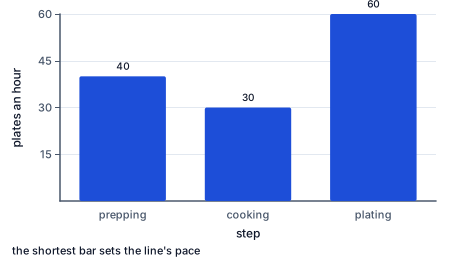
That assumption is the one that could reverse the decision. If cooking is the bottleneck, a second oven lifts the line — but only to the next-slowest step. If prepping or plating is the bottleneck, the oven adds nothing at all. So the missing evidence is the capacity of every step, and she counts it over a week: prep 40, cook 30, plate 60.
Cooking is the bottleneck; a second oven lifts cooking to 60, and the line from 30 to 40 plates an hour — now held by prepping. Ten more plates an hour is the figure to set against the oven's price.
Another way: table
The second-oven decision, laid out.
| Before | After a second oven | |
|---|---|---|
| Prepping | 40 | 40 |
| Cooking | 30 | 60 |
| Plating | 60 | 60 |
| The line delivers | 30 | 40 |
Another way: steps
Each kind of operations decision has its own fact most likely to reverse it. Extra equipment or staff: is it at the bottleneck, and where does the limit go next? A peak-hour hire: are the line's arrivals really above the service rate, and at which step? Buying in bulk: how fast is it used, and how long does it keep? A new contract: can the bottleneck carry the extra volume without breaking promises to existing customers? A new supplier: what does their delivery record say?
Money questions — can the business afford it, and when does it pay back — belong alongside, from the costing course. This lesson finds the operational fact the money question depends on: an oven that adds ten plates an hour pays back very differently from one that adds thirty.
State the decision. One sentence: buy a second oven, or not.
List what is known. Only what the records show: sales, capacities, delivery dates, use per day.
List what is assumed. Everything else the decision rests on, written down plainly.
Find the assumption that could reverse it. Ask of each: if this turned out wrong, would the answer change? Usually one stands out.
Get the evidence. Count it for a week, time it, or calculate it from figures already held. For capacity, find every step's rate and the smallest, before and after the change.
Decide, and write down why. Include the figures, so the decision can be checked later against what happened.
Check the work. Is each 'known' really from a record? Was the line worked out as the smallest step both before and after? Does the written reason name the evidence?
Separating known from assumed is needed because the two feel the same in an owner's head. Writing them in two lists shows which beliefs have never been checked.
Testing only the assumption that could reverse the decision is allowed because most assumptions would not change the answer if they were a little wrong. Testing them all would delay every decision; testing the one that matters is quick.
Using the smallest step capacity is right because a process can deliver no faster than its slowest step. Work piles up in front of the bottleneck and the steps after it wait. Speeding up any other step changes nothing.
Writing down why is needed because the decision will be reviewed. Without the reasons, nobody can tell later whether a good result was luck or a bad one was a wrong assumption.
Relieving a bottleneck never makes capacity unlimited; it moves the limit to the next-slowest step. Doubling the oven at Neighborhood Kitchen does not double lunches: it lifts the line from 30 to 40 plates an hour, because prepping, at 40, becomes the bottleneck. To go further, the kitchen would need faster prepping as well.
So the right question is never 'how much faster is the new oven?' but 'what does the whole line deliver after the change?'. Work out every step's rate, change the one the decision touches, and find the smallest again.
A new contract or a new product adds volume, and the volume goes through the bottleneck. Find the spare capacity there first: what the bottleneck can do less what it already does. If the new volume is larger, the business will break promises to someone, usually its existing customers, unless it adds capacity or takes less volume.
Maya's kiln could fire 400 mugs a month, but her trimming, the real bottleneck, had room for only about 120 more. The kiln's spare capacity was the wrong figure to look at. The question is always the spare capacity at the slowest step, because every extra mug, loaf or plate has to pass through it.
Some assumptions cannot be calculated, only tried. Will Sunday customers come? Will the new supplier deliver on time? A short, cheap trial answers them before the big commitment: open four Sundays and count, or give the new supplier one small order a week for a month. Decide in advance what result would mean yes, so the trial cannot be read to suit a hope. Write that threshold down before the trial starts.
Much missing evidence needs nothing more than a week of counting. To find each step's capacity, time the step at the peak, when work is waiting for it, not in a quiet hour when it sits idle. Count finished items in a measured stretch, such as fifteen minutes, and scale up to an hour. Repeat on several days, because one unusual morning can mislead.
Write the counts on a simple sheet: the step, the day, the time, the count. A sheet like that turns an argument about which step is slow into a reading anyone can check, and it becomes the 'known' list for the next decision too.
Sometimes the evidence reverses the decision entirely: the oven would add nothing, the Sunday trial draws too few customers, the new supplier is late three times in a month. That is a success, not a waste. The business has kept its money and learned something true about its process.
Write that result down as carefully as a yes. A note that says 'second oven: not now, because prepping limits the line at 40' stops the same idea returning next season without anyone checking whether prepping has changed.
A decision with its reasons written down can be reviewed. A month or a quarter later, read the measure the decision was meant to move: plates an hour, loaves a day, on-time deliveries. Did it move as the figures said it would? If it moved less, which assumption was wrong? This is the same habit as the operations review, applied to a bigger change, and over time it makes the owner's estimates better, because each one is checked against what happened.
A taqueria in Austin sold out of breakfast tacos most weekday mornings and planned to buy a second flat-top griddle for about 3,000 dollars. Before ordering, the owner listed what he knew: about 180 tacos sold between 7 and 10 a.m., a line out the door from 7:30 to 8:30, and a griddle that could cook about 120 tacos an hour. He was assuming the griddle was the bottleneck.
He spent one week timing each step at the peak: the griddle cooked 120 an hour, the two people assembling tacos managed about 90, and the register handled 100 orders' worth. The assembly station, not the griddle, set the pace. A second griddle would have added nothing at all.
Instead he moved one prep cook to assembly from 7:30 to 8:30, which lifted assembly to about 130 an hour. Now the griddle, at 120, set the pace, and the morning line delivered 30 more tacos an hour for the cost of one shifted schedule. He wrote the figures into a short decision note and planned to revisit the griddle if mornings kept growing, now that the griddle really was the limit.
Manufacturers across the US use the theory of constraints, which says the same thing as this lesson: find the step that limits output, improve it, and look for where the limit moves next. Its best-known teaching story is a factory that kept buying machines for the wrong step, until someone walked the floor and found where the work piled up. The same walk, with a stopwatch and a sheet of paper, works in a kitchen, a repair shop or a studio, and it costs far less than the equipment it might save the owner from buying.
More equipment means more output. Only at the bottleneck, and only up to the next limit.
What competitors did is evidence. Their bottleneck may be somewhere else entirely.
Decide first and check if it works. The missing fact is cheaper to find before the money is spent.
Every assumption must be tested. Test the one that could reverse the decision.
Doubling a step doubles the output. The limit moves to the next-slowest step.
State the decision.
$\text{buy a second oven, or not}$
One sentence.
Name the assumption.
$\text{cooking holds lunch back}$
Could reverse it.
Count every step.
$40, \ 30, \ 60 \text{ plates an hour}$
Prep, cook, plate.
Find the line after.
$\text{smallest of } 40, 60, 60 = 40$
Prepping, at 40, is now the slowest step, so it sets the pace.
Find the gain.
$40 - 30 = 10 \text{ plates an hour}$
Ten more plates an hour is the figure to set against the price.
State the decision.
$\text{take } 200 \text{ mugs a month, or not}$
A wholesale order.
List the known.
$180 \text{ made now; kiln fires } 400$
From her records.
Name the assumption.
$\text{trimming can keep up}$
The busy-Saturday bottleneck.
Get the evidence.
$\text{a timed week of trimming}$
At the higher volume.
Read the result.
$\text{room for about } 120 \text{ more a month}$
Not 200.
Decide, and write down why.
$\text{accept } 120 \text{ a month}$
The timed week changed the answer, and the note says why.
State the decision.
$\text{take } 110 \text{ loaves a day, or not}$
A wholesale contract.
Find the bottleneck.
$\text{the oven: } 340 \text{ a day}$
From a counted week.
Note what is already sold.
$250 \text{ a day in the shop}$
From the till.
Find the spare capacity.
$340 - 250 = 90$
At the bottleneck.
Find the shortfall.
$110 - 90 = 20 \text{ loaves a day}$
Without a change, shop customers or the contract would go short.
Look at the options.
$\text{an earlier bake, or } 90 \text{ a day}$
Costed alongside.
Decide, and write down why.
$\text{offer } 90 \text{ now; review in a month}$
With the figures.
Name the assumption.
$\text{the van, not cleaners' hours, limits cleans}$
Could reverse it.
Name the evidence.
$\text{each step's capacity}$
Hours against trips.
Say how to get it.
Neighborhood Kitchen's owner wants to buy a second oven for $4576$ dollars to serve more lunches. What should she find out before deciding?
Complete the worked solution: Neighborhood Kitchen's lunch line can prep $33$ plates an hour, cook $27$ an hour with one oven, and plate $64$ an hour. A second oven would double cooking. The lunch rush runs two hours a day, five days a week. Find cooking with two ovens, the extra plates an hour the line delivers, and the extra plates a week.
Find cooking with two ovens.
$\text{two} \times (\text{cooking}) =$ d
Double the oven, double the rate.
Find the extra plates an hour.
$(\text{prepping}) - (\text{cooking}) =$ g
Prepping becomes the slowest step.
Find the extra plates a week.
$(\text{extra an hour}) \times \text{ten} =$ w
Two rush hours, five days.
Say what to weigh it against.
$\text{the oven's price and running cost}$
The money side of the decision.
Northside Repairs is deciding whether to open on Sundays. Mark every statement that is known from the shop's own records.
This task has no paper form; do it on a device.
Match each operations decision to the evidence that could change it.
| The line and service rates at the peak | Daily use against how long the clay keeps | Whether the bottleneck step can carry the extra volume | The new supplier's delivery record | |
|---|---|---|---|---|
| Hire a second barista | ||||
| Buy clay in bulk | ||||
| Take a wholesale contract for 200 mugs a month | ||||
| Change vegetable supplier |
Maya is deciding whether to take a wholesale order. Put her steps in order.
Number the steps in order (write the number in the box):
Neighborhood Kitchen uses $8$ pounds of flour a day. A supplier offers a discount on a bulk order of $160$ pounds. How many days would the bulk order last?
Answer:
A bakery in Portland, Oregon, is offered a wholesale contract for $110$ loaves a day. Its oven, the bottleneck, can bake $305$ loaves a day, and it already sells $245$ a day in the shop. How many loaves a day short would it fall if it took the contract without changing anything?
Answer:
A pizza takeout can prep $38$ pizzas an hour, bake $24$ an hour in its one oven, and box and take payment for $40$ an hour. A second oven would double baking. Complete the sentence.
The second oven would add g pizzas an hour to what the line delivers.
Lesson test: one question per skill, one attempt each, no hints. Your answers are checked when you submit.
Neighborhood Kitchen's lunch line: prepping $41$ plates an hour, cooking $30$ an hour with one oven, plating $52$ an hour. A second oven would double cooking. Fill in cooking's capacity after the change, and what the line delivers before and after.
| Plates an hour | |
|---|---|
| Cooking after the change | |
| The line before | |
| The line after |
You can find the missing fact before spending the money. Tell someone why a second oven might add nothing at all. Next: making a people decision on the evidence.
20. Your turn: Bright Home Cleaning's second van, step 3
$\text{count cleaner hours and van trips for a week}$
Then find the smallest.