Back to the on-screen lesson ·
Training built from standard work runs in four stages — show, supported practice, check against the standard, release with spot checks — and readiness is decided from a run of attempts that meet the standard.
Paper packet. Every task here also exists on screen, where it is checked automatically; answers written on paper are not assessed by Nydus. When you are back at a device, enter your answers there.
You will sequence training in four stages from the standard work, match training activities to their stage, plot a trainee's practice attempts, and decide readiness from the record of checks rather than the calendar.
You have hired someone on evidence that they can do the work. Doing it the business's way, to its standard, still has to be learned, and the standard work you wrote in the first unit is what training is built from.
| Term | What it means |
|---|---|
| Showing | Explaining the standard work and demonstrating it. |
| Supported practice | The trainee does the work, with the trainer correcting. |
| Checking | Comparing the result with the written standard. |
| Release | Working alone, with spot checks that taper off. |
| Readiness | A run of recent attempts that meet the standard. |
| Training record | Date, task, check passed or not, and time taken. |
'Watch me for a day, then have a go' leaves the trainee to guess which of the owner's habits matter and which are just habits. A plan built from the standard work does better, in four stages:
Each stage needs the one before it. A trainee released before the checks pass is not independent; they are unsupervised.
Another way: table
Training a new cleaner, stage by stage.
| Stage | What happens |
|---|---|
| Show | Trainer cleans a kitchen to the standard, explaining |
| Supported practice | Trainee cleans, trainer corrects |
| Check | Result compared with the written standard |
| Release | Trainee alone; one apartment in three spot-checked |
Another way: steps
When is someone ready to work alone? Not after a fixed number of weeks, not when they say they feel confident, and not when the owner is too busy to keep watching. They are ready when a run of recent attempts has met the standard. Keep a simple record: the date, the task, whether the check passed, and how long it took.
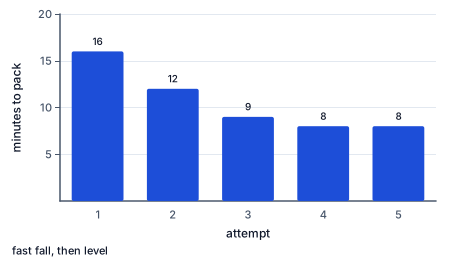
Plotted, the time for each attempt usually falls quickly and then levels off: Maya's new assistant packed an order in 16 minutes, then 12, then 9, then 8, then 8. Once the line is level and every attempt meets the standard, more supervised practice adds little, and the spot checks can begin.
Pick one task. Train one piece of standard work at a time, starting with what the role needs most.
Show it. The trainer does the task at normal pace, then slowly, naming each step and why it is done that way. The trainee has the written standard in hand.
Practice with support. The trainee does it; the trainer watches and corrects at once, before a wrong habit sets.
Check. Each result is compared with the standard and recorded: pass or not, time, and what was missed.
Release. When a run of checks passes, such as the last five or ten, the trainee works alone.
Spot-check and taper. One job in three, then one in five, then occasionally, as long as checks keep passing.
Check the training itself. If many trainees fail the same step, the showing or the standard work is unclear at that step; fix it there. If one trainee's pass rate stalls, look at what they were shown before looking at the trainee.
Showing before practice is needed because the trainee cannot practice a standard they have not seen. A demonstration with reasons makes the standard concrete.
Correcting during practice is allowed, and better than correcting later, because a habit repeated a few times is hard to change. Ten seconds of correction on the first attempt saves an hour of unlearning.
Deciding readiness from a run of checks is allowed because a single good attempt can be luck. Five or ten in a row at the standard show the trainee can do it reliably, which is what working alone requires.
Tapering spot checks is allowed because the risk falls as the record grows. Stopping them overnight throws away the evidence that the standard is still being met.
New staff are often shown everything in the first week and expected to remember it all. Most of it is forgotten. Train one task to release before starting the next, beginning with the one the role needs most and the one least likely to cause harm if a little slow.
For Maya's studio assistant that order is packing, then trimming, then the kiln-loading checklist. Each is shown, practiced, checked and released before the next begins. The first weeks look slow, but by the end of the month the assistant can do three tasks to the standard, rather than half-doing six.
The best trainer is someone who does the task to the standard and can explain why each step is done that way. That is not always the owner. A senior cleaner who has passed every inspection for a year may train better than an owner who has not cleaned for months.
Give the trainer time for it. Training squeezed into the gaps of a busy shift becomes 'watch me' again. Block the hours, as the coffee shop example shows, and count them as part of the cost of hiring.
Training time is working time. Under the federal Fair Labor Standards Act, time an employee spends in training required by the employer is generally paid working time, and the trainer's time is paid too. Budget for both.
Some tasks need safety training by law: handling cleaning chemicals, using certain equipment, food safety. The Occupational Safety and Health Administration sets federal requirements, and states and counties add rules such as food handler cards. Check what applies to each task in the business's state and county, and train those first, before speed or anything else.
A hire with experience still needs training, but a different kind. They know how to clean, cook or fix bikes; they do not yet know this business's standard. Skip the parts of showing they clearly do not need, but keep the checks. An experienced mechanic may service a brake well and still set the cable tension differently from the shop's written setting.
Start with a few checked attempts. Where the work already meets the standard, release quickly. Where it differs, show the shop's way and the reason for it, and ask whether their way might be better; sometimes it is, and the standard work should change. Experienced hires are often the best source of improvements, as long as the improvement is tested and written down rather than quietly substituted.
Sometimes a trainee's checks keep failing after reasonable practice. Look at the training first: was the step shown, with the reason? Is the standard written clearly, with a picture where that helps? Was there enough supported practice before checks began? Most stalls are fixed here.
If the training was sound and the checks still fail, have an honest, private conversation using the training record: which step, how often, what has been tried. The next lesson covers how to give that kind of feedback so it helps rather than hurts. Occasionally the role is simply not a fit, and the record makes that conversation fair, because it rests on evidence both people can see.
The training record is short: one line per checked attempt, with the date, the task, pass or not, the time and what was missed. Kept for every trainee, it shows three things. It shows when each person is ready, from evidence. It shows which steps trainees most often miss, which points to weak spots in the standard work or the showing. And it is a record that safety training was given, which some rules require.
Keep it with the role's standard work, so the next trainer can see how long the last trainee took and where they struggled.
A pool cleaning company in Phoenix used to send new technicians out with an experienced one for a week, then give them their own route. Within a month, about one pool in six on a new technician's route had a water-chemistry complaint, and two customers had pool equipment damaged by wrongly mixed chemicals.
The owner rebuilt the training from the company's written standard for a service visit. Safety came first: chemical handling was shown, practiced and checked before anything else, as federal safety rules require. Then each part of a visit was shown and practiced: testing the water, balancing it, cleaning the filter. Every practice visit was checked by re-testing the water an hour later.
New technicians are now released route by route, once ten checked visits in a row meet the standard, and their first month's visits are spot-checked one in four. Water-chemistry complaints from new technicians fell to about one pool in forty, and the training, though longer on paper, cost less than the complaints and equipment repairs it replaced.
The Job Instruction method, developed in the United States during World War II to train factory workers quickly, used the same four steps: prepare the worker, present the operation, try out performance, and follow up. It is still taught to supervisors today, because the stages work for almost any hands-on task.
Watching is training. Watching without practice and checks teaches habits, not the standard.
Readiness is a date. It is a run of attempts that meet the standard.
Confidence means readiness. Confident trainees can still miss the standard.
Once released, no more checks. Spot checks taper; they do not stop overnight.
Teach everything in the first week. Train one task to release at a time.
Show the task.
$\text{zero the scale; read the price per pound}$
With the reason for each.
Practice with support.
$\text{helper weighs, Monica watches}$
Corrected at once.
Check against the standard.
$\text{Monica re-weighs a sample of bags}$
Each recorded.
Decide the trainee's readiness.
$\text{a morning's sample all match}$
A run at the standard.
Release with spot checks.
$\text{one bag in ten re-weighed}$
Tapering.
Show the task.
$\text{pack an order to the standard, explaining}$
Standard in hand.
Time the first attempt.
$16 \text{ minutes}$
With corrections.
Time the next attempts.
$12; \ 9; \ 8; \ 8$
Falling, then level.
Check each against the standard.
$\text{last three all pass}$
Recorded.
Release the trainee.
$\text{packing alone}$
On the record.
Spot-check the work.
$\text{one order in five}$
Then fewer.
Show the task.
$\text{Dev services a brake, explaining}$
The standard work is the plan.
Practice with support.
$\text{trainee services, Dev corrects}$
Before habits set.
Check the first ten.
$6 \div 10 \times 100 = 60$
Percent at the standard.
Check the next twenty.
$18 \div 20 \times 100 = 90$
Rising.
Look at what was missed.
$\text{cable tension, every time}$
Shown again, with the torque setting.
Release the trainee.
$\text{brakes alone}$
At 90 percent over a run of twenty.
Spot-check the work.
$\text{one bike in five re-tested}$
Tapering as checks pass.
Show the task.
$\text{plate to the standard, explaining each step}$
With the photo by the pass.
Choose the check.
$\text{each plate against the photo and the scale}$
Recorded.
Decide the trainee's readiness.
Bright Home Cleaning is training a new cleaner in the move-out clean. Put the training stages in order.
Number the steps in order (write the number in the box):
Complete the worked solution: Bright Home Cleaning's trainee passed the move-out check on $4$ of their first $10$ checked cleans and on $18$ of the next $20$. Find the pass rate for each stretch and how many percentage points it rose.
Find the first pass rate.
$(\text{passes}) \div (\text{cleans}) \times \text{a hundred} =$ p
The first ten cleans.
Find the second pass rate.
$(\text{passes}) \div (\text{cleans}) \times \text{a hundred} =$ q
The next twenty.
Find the rise.
$(\text{second rate}) - (\text{first rate}) =$ d
Percentage points.
Say what decides release.
$\text{a run of checks at the standard}$
The record, not the calendar.
Neighborhood Kitchen's new assistant has been plating lunches for $2$ weeks. What should decide whether they are ready to plate alone at the lunch peak?
Dev is training a new mechanic in brake servicing. Match each activity to its stage.
| Showing | Supported practice | Checking | Independent work with spot checks | |
|---|---|---|---|---|
| Dev services a brake, explaining each step | ||||
| The trainee services a brake with Dev watching and correcting | ||||
| Dev tests the finished brake against the shop standard | ||||
| The trainee works alone; Dev re-tests one bike in five |
Maya's new assistant timed four practice attempts at packing an order to the standard: $14$, $12$, $10$ and $8$ minutes. Plot the minutes for each attempt.
Plot your answer on the grid:
Bright Home Cleaning's newly released cleaner will do $52$ cleans this month. The trainer will spot-check one clean in $4$. How many spot checks is that this month?
Answer:
A coffee shop in Raleigh trains each new barista with $9$ hours of one-on-one sessions: showing, supported practice and checks on the espresso standard. The trainer is paid $23$ dollars an hour and the trainee $17$ dollars an hour, and both are paid for the training time. What does the training cost in pay, in dollars?
Answer:
A barber's training plan for a new barber. Mark every line that gives the trainee something specific to learn from.
This task has no paper form; do it on a device.
Lesson test: one question per skill, one attempt each, no hints. Your answers are checked when you submit.
Northside Repairs' trainee met the brake standard in $9$ of their first $10$ checked services, and in $18$ of the next $20$. Complete the sentence.
In the first ten services x percent met the standard; in the next twenty, y percent.
You can plan training that ends with someone doing the work to the standard on their own. Tell someone why 'watch me and have a go' is not a plan. Next: feedback that helps someone improve.
20. Your turn: Neighborhood Kitchen's plating, step 3
$\text{last 10 plates at standard, at peak pace}$
A run, not a date.