Back to the on-screen lesson ·
An operations review reads one process measure against its target, finds the process cause of a gap, agrees one testable change with an owner and a date, and reads the same measure again to see whether it worked.
Paper packet. Every task here also exists on screen, where it is checked automatically; answers written on paper are not assessed by Nydus. When you are back at a device, enter your answers there.
You will order a review from measure to target to cause to one testable change, compute the gap to a target, tell a testable change from an exhortation, and read a measure before and after a change.
Every unit of this course produced a measure: failure rates, capacity, line length, shrinkage, on-time deliveries, accountability figures. This lesson turns them into a habit — a short, regular review that improves the process one change at a time.
| Term | What it means |
|---|---|
| Operations review | A short, regular meeting that reads process measures and acts on one. |
| Target | The level the business has decided a measure should reach. |
| Gap | The target less the measure, in the measure's own units. |
| Process cause | The step in the process that produces the gap. |
| Testable change | One specific action, with an owner and a date, that should move the measure. |
| Percentage point | The unit for the difference between two percentages. |
Neighborhood Kitchen's Monday review takes twenty minutes and follows the same five steps every week:
The discipline is in the word one. Change ten things at once and, if the measure improves, nobody knows which change did it; if it worsens, nobody knows which to undo. 'Everyone be more careful' and 'improve quality' are not changes at all — they have no owner, no action and nothing to check.
Another way: table
A review note that can be tested.
| Part | Neighborhood Kitchen, this Monday |
|---|---|
| Measure | 85% of orders on time |
| Target | 90% |
| Process cause | Bridge deliveries late |
| Change | Bridge deliveries scheduled first |
| Owner and date | The driver, from Tuesday |
| Check | On-time rate at next Monday's review |
Another way: steps
Measures that nobody reads change nothing. A review held at the same time every week or two, short enough that it never gets skipped, turns the measures into decisions. Twenty minutes is usually enough for one or two measures in a small business. The regularity matters more than the length: a change agreed on Monday is only tested if there is a next Monday where someone reads the measure again.
Pick the measures that matter most this season, not all of them. A café in December might watch only on-time catering and waste; a bike shop in April might watch only bikes ready on the promised day.
Read the measure. Count it the same way it was counted last time: the same period, the same definition of 'on time' or 'unbroken'.
Compare with the target. Subtract: target less measure gives the gap in the measure's own units. Between two percentages, the gap is in percentage points: 90 percent less 85 percent is 5 points.
Find the process cause. Look in the log for what the misses share: a route, a shift, a product, a step. Ask 'what in the process' before 'who'.
Agree one testable change. A specific action, an owner and a date, aimed at that cause.
Read the same measure again. At the next review, and for a few after.
Check the work. Is the measure counted the same way both times? Does the change answer the cause the log showed? Could someone reading the note next week tell whether the change was made and whether it worked?
Comparing with a target is needed because a measure alone says nothing: 85 percent is good for one business and poor for another. The target, set in advance, says which.
Looking for a process cause is allowed, and usually right, because most misses repeat for a reason in the process: the same route, the same step, the same time of day. Blaming a person fixes nothing if the route is the cause.
Making only one change is needed because the measure can show only one thing at a time. If two changes are made together and the measure moves, there is no way to tell which change moved it.
Reading the same measure the same way is needed because a change of definition can look like an improvement. If 'on time' becomes 'within half an hour', the rate rises with no change in the process.
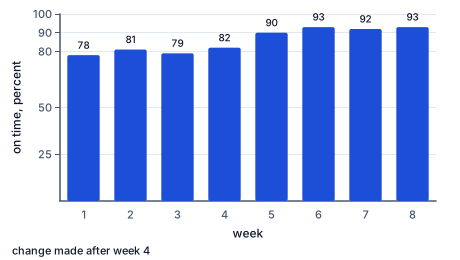
A change is only an improvement if the measure moves. Read the same measure, counted the same way, before and after: Neighborhood Kitchen's on-time rate averaged 80 percent over the four weeks before the bridge change and 92 percent over the four weeks after — a rise of 12 percentage points. Plotted week by week, every bar after the change stands above every bar before.
Be honest about short records: two good weeks might be luck, and a change that seems to work should be watched for a few more reviews before it goes into the standard work for good. If the measure does not move, the change did not fix the cause — go back to the process cause, not to a bigger version of the same change.
When a rate moves from 80 percent to 92 percent, it rose by 12 percentage points. It is tempting to say it rose by 12 percent, but that is a different number: 12 is 15 percent of 80. Reviews that mix the two overstate or understate their own progress. Use points for the difference between two rates, and keep 'percent' for the rates themselves. Write the unit beside every number in the review note, so a later reader cannot confuse the two.
Write each review as a short note: the measure, the target, the cause, the change, the owner, the date, and the result at the next review. Keep the notes together. Over months they become the history of how the business learned to run better, and they show a new team member why each step in the standard work is there.
The notes also stop the same idea being tried twice. A change that did not move the measure last spring is written down, with the reason it failed.
A target should be set before the review, written down, and kept steady long enough for changes to be judged against it. A good target comes from what customers need and what the process can reach with effort: a catering client who needs food by 12:30 makes 90 percent by 12:15 a fair aim. A target of 100 percent sounds admirable but usually tells the team that every miss is a failure, so misses get hidden instead of logged. A target the business already beats every week tells it nothing.
Change a target only at a review, for a stated reason, and note the change, so later readers do not mistake a new target for a better process.
Invite the people who run the process: the driver for deliveries, the assistant for packing, the mechanic for repairs. They know what the log does not say, and a change they helped choose is a change they will make. Keep the group small and the time fixed. The owner's job in the room is to keep it to one measure, one cause and one change, and to make sure every change leaves with a name and a date beside it.
Sometimes a change makes the measure worse. That is still useful: the review has learned that the cause was somewhere else, or that the change had a side effect. Undo the change, note the result, and go back to the log. Because only one thing was changed, undoing it is simple, and the business is back where it started with one more fact about its process. Write that fact in the review note too, so nobody tries the same change again next year without first reading why it failed the first time.
An independent pharmacy in Phoenix fills about 600 prescriptions a week and promises them ready within 30 minutes for walk-in customers. The owner holds a fifteen-minute huddle every Tuesday morning before opening. One spring, the share of walk-in prescriptions ready within 30 minutes had slipped to 82 percent against a target of 95, a gap of 13 points.
The team did not try to fix everything. They looked at the log of late fills and found that most of them arrived between 4 and 6 p.m., when one technician was also answering the phone. The change agreed was specific: from the next Monday, calls between 4 and 6 went to the front-counter clerk, and the technician only filled prescriptions. The owner was the pharmacist in charge; the check was the same 30-minute measure at the next four huddles.
Over those four weeks the measure averaged 94 percent, a rise of 12 points, and every week was above the weeks before the change. The team kept watching for another month before writing the phone rule into the store's standard work, and the review note explained why it was there.
Quality improvement methods used in US hospitals and factories, such as the plan-do-study-act cycle, rest on the same rule as this lesson: make one small change, measure it the same way, and decide what to keep before making the next.
A review is a chance to discuss everything. One measure, one cause, one change.
'Try harder' is an action. It has no owner, no change and no check.
Change several things to speed it up. Then nobody knows what worked.
If the measure improved, the change worked. Read it for a few more weeks before being sure.
A rise from 80 to 92 percent is a 12 percent rise. It is a 12-point rise.
Read the measure.
$84 \text{ percent unbroken, last two weeks}$
Counted as before.
Compare with the target.
$96 - 84 = 12 \text{ points}$
The gap.
Find the process cause.
$\text{the log: cups packed on their sides}$
From a record.
Agree one change.
$\text{cups upright; the assistant; from Monday}$
Owner and date.
Read the measure again.
$97 \text{ percent two weeks later}$
Above target; keep watching.
Read the measure.
$34 \div 40 \times 100 = 85 \text{ percent}$
Orders by 12:15.
Compare with the target.
$90 - 85 = 5 \text{ points}$
The gap.
Find the process cause.
$\text{late ones all cross the bridge}$
What the misses share.
Agree one change.
$\text{bridge deliveries first; the driver}$
From Tuesday.
Read the measure over four weeks.
$\text{average } 92 \text{ percent, up from } 80$
The same way each week.
Find the rise.
$92 - 80 = 12 \text{ points}$
A sustained rise, so the change goes into the standard work.
Read the measure.
$\text{bikes ready on the day: } 78 \text{ percent}$
Last week.
Compare with the target.
$90 - 78 = 12 \text{ points}$
The gap.
Find the process cause.
$\text{late ones waited for parts}$
From the job cards.
Agree one change.
$\text{check parts at drop-off; Dev; Monday}$
Promise a day only with parts in.
Read the measure again.
$88 \text{ percent next week}$
Closer.
Find the new gap.
$90 - 88 = 2 \text{ points}$
Still short.
Keep watching before changing more.
$\text{read it at the next two reviews}$
One change at a time, so the next reading shows what this one did.
Read the measure against the target.
$4 \text{ empty crates last Saturday; target none}$
The gap is four.
Find the process cause.
$\text{restocking only when Monica notices}$
She was serving.
Write one testable change.
Neighborhood Kitchen holds a twenty-minute operations review on Monday. Put the agenda in order.
Number the steps in order (write the number in the box):
Complete the worked solution: last week Neighborhood Kitchen delivered $16$ of its $20$ catering orders on time, against a target of $90$ percent. Find the on-time rate, the gap to the target in percentage points, and how many more orders needed to be on time to meet it.
Find the on-time rate.
$(\text{on time}) \div \text{twenty} \times \text{a hundred} =$ p
The measure, in percent.
Find the gap to the target.
$\text{ninety} - (\text{rate}) =$ g
Percentage points short.
Find the orders short.
$\text{eighteen} - (\text{on time}) =$ n
Nine in ten of twenty is eighteen.
Say what the review does next.
$\text{find the process cause in the log}$
Then one change.
Maya's measure of café orders arriving unbroken fell to $85$ percent against a target of $98$. The packing log shows breakages happen when cups are packed on their sides. What should the review agree?
Actions noted at Bright Home Cleaning's review. Mark every action that could be tested at the next review.
This task has no paper form; do it on a device.
Northside Repairs' target is $90$ percent of bikes ready on the promised day. Over three weeks the measure was $85$, $83$ and $92$ percent. Fill in the gap to the target each week, in percentage points.
| Gap to target, points | |
|---|---|
| Week 1 | |
| Week 2 | |
| Week 3 |
Last week Maya shipped $60$ orders and $52$ of them arrived unbroken. Her target is $90$ percent unbroken. How many more orders needed to arrive unbroken to meet the target? Fill in each figure on the sheet.
| Amount | |
|---|---|
| Unbroken orders the target needs | |
| Orders short of the target |
An auto repair shop in Denver tracks comebacks: cars returned for the same fault. In the month before it added a road test to every brake job, $22$ of its $200$ jobs came back; in the month after, $12$ of $200$ came back. By how many percentage points did the comeback rate fall?
Answer:
A bakery's measure of loaves sold out by closing — its aim is to waste less — was $80$ and $70$ percent in the two weeks before it baked a smaller second batch, and $90$ and $100$ percent in the two weeks after. Plot the four weeks.
Plot your answer on the grid:
Lesson test: one question per skill, one attempt each, no hints. Your answers are checked when you submit.
Neighborhood Kitchen's on-time delivery rate averaged $82$ percent over the four weeks before it scheduled bridge deliveries first, and $95$ percent over the four weeks after. Complete the sentence.
On-time delivery rose by d percentage points after the change.
You can run a review that improves a process one tested change at a time. Tell someone why changing ten things at once teaches nothing. Next: a review of how the people side is working.
20. Your turn: Monica's empty crates, step 3
$\text{the helper checks crates hourly; next Saturday}$
Count empty crates at the next review.