Back to the on-screen lesson ·
The reorder point is daily use times the supplier's lead time plus a safety stock; order when stock falls to it, long before the shelf looks empty.
Paper packet. Every task here also exists on screen, where it is checked automatically; answers written on paper are not assessed by Nydus. When you are back at a device, enter your answers there.
You will compute a reorder point from daily use, lead time and safety stock, write it as a rule, follow the stock level falling through an order cycle, and explain what goes wrong when ordering waits for an empty shelf.
You can plan capacity for the people and machines. Stock needs planning too: the rice, the clay, the inner tubes. This unit is about having enough of it, without having too much.
| Term | What it means |
|---|---|
| Lead time | The days between placing an order and the stock arriving. |
| Daily use | How much is used or sold on an ordinary day. |
| Safety stock | A buffer kept for a slow delivery or a busy week. |
| Reorder point | The stock level at which an order must be placed. |
| Order size | How much is ordered each time. |
| Order cycle | The days one order lasts, from delivery to the next delivery. |
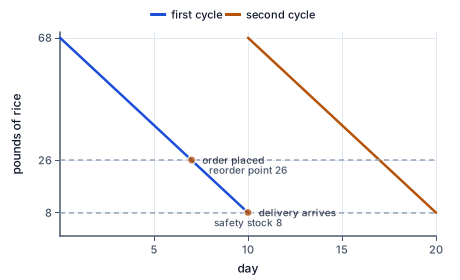
Neighborhood Kitchen uses about 6 pounds of rice a day, and the supplier delivers 3 days after an order. If the owner orders when the rice runs out, the kitchen has no rice for three days. If she orders when there are exactly 18 pounds left, three days' use, the delivery arrives as the last scoop is used. And because some weeks are busier and some deliveries are late, she keeps 8 pounds extra as safety stock.
$$\text{reorder point} = \text{daily use} \times \text{lead time} + \text{safety stock}$$
For the rice: 6 × 3 + 8 = 26 pounds. When the rice bin falls to 26, the order goes in. On an ordinary week, the delivery arrives with 8 pounds still in the bin; on a bad week, the 8 carry the kitchen through.
The reorder point is not 'when it looks low'. At 26 pounds the bin looks comfortably full, which is exactly why ordering by feel keeps failing.
Another way: table
Reorder points in three businesses.
| Item | Daily use | Lead time | Safety stock | Reorder at |
|---|---|---|---|---|
| Rice (pounds) | 6 | 3 days | 8 | 26 |
| Inner tubes | 4 | 7 days | 10 | 38 |
| Clay (pounds) | 15 | 4 days | 25 | 85 |
Another way: steps
Draw the stock level day by day and the pattern is a saw-tooth. It falls by the daily use each day. At the reorder point an order is placed; the level keeps falling through the lead time; the delivery arrives and the level jumps up by the order size; and the fall begins again. An order of 60 pounds of rice lasts 60 ÷ 6 = 10 days, so the kitchen orders roughly every ten days.
Find the daily use. From the records: sales, recipes, job sheets. Use an ordinary day, and note the busiest.
Find the lead time. From order to stock on the shelf, in the days the business is using it. A supplier who delivers in two business days, ordered on Friday, arrives Tuesday: four days of use for a kitchen open on weekends.
Size the safety stock. Ask how late the supplier has been, and how much busier than usual a week has been. Enough to cover that, and no more.
Work out the point. Daily use times lead time, plus safety stock.
Post it. A label on the shelf or bin: 'Order at 26'.
Check it over a few cycles. When each delivery arrives, note what is left. On ordinary weeks it should be close to the safety stock. If it is much more every time, the point is too high; if the shelf ever empties, it is too low or the safety stock too thin.
Multiplying daily use by the lead time is allowed because use continues while the order travels. Every day of the lead time takes another day's use off the shelf, so the stock must cover all of them.
Adding the safety stock is allowed, and needed, because neither figure is certain. A delivery a day late, or a day twice as busy as usual, uses up the buffer instead of emptying the shelf.
Counting lead time in days of use, not calendar days, is needed because only the days the business uses the stock matter. A shop closed on Sundays does not use stock on Sunday, so a delivery that spans Sunday needs one day less cover.
Safety stock is insurance, and like any insurance it has a cost: money sitting on the shelf, which the next lesson prices. Size it from evidence, not worry. Look at the last few months of deliveries: how many days late was the worst? Look at daily use: how much higher than usual was the busiest day?
If the supplier has been up to two days late, safety stock of two days' use covers it. If a busy week uses half again as much, add half the lead-time use. Combine the two only if both can happen at once, which for a seasonal business they often can. A supplier who is never late and steady demand need very little.
A small business might stock dozens of items. Not all deserve the same care. Work out reorder points first for the items that would stop the business if they ran out, such as rice for a lunch kitchen, clay for a potter or inner tubes for a bike shop, and for the items that tie up the most money.
For small, cheap items, such as paper bags or cleaning cloths, a simple two-bin method works: keep two bins, use from the first, and order when it is empty, using the second bin while the order arrives. Size the second bin to the lead-time use plus a little; it is the reorder point made physical.
A reorder point only works if someone acts when stock reaches it. Make it the job of whoever takes the stock: the cook who scoops the rice, the mechanic who takes the last tubes above the line. A label on the shelf, a line on the bin or a card in the second bin tells them when.
Make the action simple: a note on the order sheet, a text to the owner, a standing order with the supplier that the person triggers. Check the order sheet weekly so nothing is missed. The reorder point is the decision, made once with care; the daily job is noticing the line.
A reorder point is only as good as the daily use behind it. A new menu item that uses more rice, a busy season for bike repairs or a quiet month for cleaning all change it. Recompute the point whenever use changes by more than a little, and before predictable peaks, from the peak calendar of the last lesson.
The same goes for lead time. A supplier who moves from three-day to five-day delivery has raised every reorder point that depends on them, even though nothing in the business changed. Ask suppliers to tell you when their lead times change, and check deliveries against what was promised.
For stock that spoils, such as produce, dairy or flowers, the reorder point has a partner: a limit on how much to hold. Monica cannot keep a week of berries in case of a busy Saturday; they will be soft by Wednesday. Here the safety stock must be small, the orders small and frequent, and the lead time short, which is why produce suppliers deliver daily or every other day.
Work out the reorder point the same way, but check it against shelf life. If an order cannot be used up before it spoils, the order is too big or the delivery too infrequent. The next lessons, on holding cost and shrinkage, put a price on stock that sits too long or is thrown away.
Put the reorder points for the important items on one sheet: item, daily use, lead time, safety stock, reorder point, usual order size, supplier, and the date the figures were last checked. It fits on a page and answers most stock questions at once.
Review it monthly. Compare each item's daily use with the last month's actual use, and each supplier's lead time with the last few deliveries. Change any figure that has drifted, and the reorder point with it. Over a season, the sheet also shows which items run out and which pile up, which is where the next two lessons begin.
A taco shop in Austin ran out of corn tortillas about twice a month, usually on a Friday, and had to send someone to a grocery store at retail prices. The owner ordered when the walk-in shelf 'looked low', which in practice meant when there were two or three packs left.
From the order book she found the shop used about 14 packs a day, more on Fridays and Saturdays, and the tortilla supplier delivered two days after an order, never on Sundays. Orders placed on Friday therefore arrived on Tuesday, four days of use later. The worst week had used 20 packs a day.
She set the reorder point at 14 × 4 + 24 = 80 packs, with the safety stock sized to cover a busy weekend, and marked a line on the shelf at that level. The cooks text the owner when the stock crosses the line. In the next three months the shop did not run out once, and the emergency grocery runs, which had cost about 150 dollars a month in higher prices and staff time, stopped.
Point-of-sale and inventory systems used by small retailers can track stock as it sells and alert the owner, or place an order automatically, when an item reaches its reorder point. The software does the counting; the owner still has to set the point, using the same three figures as this lesson.
Order when it runs out. The business keeps using stock through the lead time.
Order when it looks low. At the reorder point the shelf often looks comfortably full.
Safety stock is wasted money. It is insurance against a late delivery or a busy week, sized to the real risk.
Set it once and forget it. It changes with daily use and lead time.
Count lead time in calendar days. Count the days the stock is being used.
Find the daily use.
$12 \text{ cloths a day}$
From the laundry log.
Find the lead time.
$5 \text{ days}$
From the supplier's record.
Find the lead-time use.
$12 \times 5 = 60$
Cloths used while the order travels.
Add the safety stock.
$60 + 20 = 80$
The reorder point.
Post it on the shelf.
$\text{order at 80}$
Where cloths are taken.
Find the daily use.
$4 \text{ tubes a day}$
From repair tickets.
Find the lead time.
$7 \text{ days}$
From order to shelf.
Size the safety stock.
$10$
The supplier was a week late last spring.
Work out the reorder point.
$4 \times 7 + 10 = 38$
Lead-time use plus the buffer.
Work out how long an order lasts.
$80 \div 4 = 20$
Days.
Post the label.
$\text{order at 38}$
On the tube shelf.
Find the daily use.
$6 \text{ pounds a day}$
From recipes and sales.
Find the lead time in days of use.
$3 \text{ days}$
Open every day.
Find the lead-time use.
$6 \times 3 = 18$
Pounds.
Size the safety stock.
$8$
About a busy day and a third.
Work out the reorder point.
$18 + 8 = 26$
Pounds.
Work out the cycle.
$60 \div 6 = 10$
Days an order lasts.
Check it on delivery.
$\text{about 8 pounds left}$
The point is right.
Find the lead-time use: 50 bags a day, 6-day lead time.
$50 \times 6 = 300$
Bags used while the order travels.
Add a safety stock of 100.
$300 + 100 = 400$
The reorder point.
Work out how long an order of 1,000 lasts.
Maya orders clay when she opens the last bag. Her supplier takes $5$ days to deliver. What goes wrong?
Complete the worked solution: Maya uses about $11$ pounds of clay a day. Her supplier delivers $3$ days after an order, and she keeps $30$ pounds as safety stock. Find the clay used during the lead time, the reorder point, and how much clay would be left if a delivery came one day late.
Find the use during the lead time.
$(\text{daily use}) \times (\text{lead time}) =$ u
Clay used while the order travels.
Find the reorder point.
$(\text{lead-time use}) + (\text{safety stock}) =$ r
Order when the stock falls to this.
Find what is left if the delivery is a day late.
$(\text{safety stock}) - (\text{daily use}) =$ x
The safety stock covers the extra day.
Say where to put the figure.
$\text{on the clay shelf: order at this level}$
Where the person taking clay sees it.
Neighborhood Kitchen uses about $6$ pounds of rice a day. The supplier delivers $3$ days after an order, and the owner keeps $8$ pounds as a safety stock for a bad week. At what stock level, in pounds, should the owner reorder?
| Amount | |
|---|---|
| Use during the lead time | |
| Reorder point |
An item is used at $d$ units a day, the supplier takes $L$ days to deliver, and the safety stock is $b$ units. Write the reorder point $r$.
Answer:
Neighborhood Kitchen has $36$ pounds of rice on Monday morning and uses $6$ pounds a day. Plot the stock at the end of days $1$, $2$ and $3$.
Plot your answer on the grid:
A coffee shop in Chicago goes through about $77$ gallons of milk a week, open every day. The dairy delivers $3$ days after an order, and the owner keeps $13$ gallons as safety stock. At how many gallons should the shop reorder? Fill in each figure on the sheet.
| Amount | |
|---|---|
| Daily use | |
| Use during the lead time | |
| Reorder point |
A florist is working out when to reorder roses. Mark every note that gives a figure the reorder point needs.
This task has no paper form; do it on a device.
Lesson test: one question per skill, one attempt each, no hints. Your answers are checked when you submit.
Northside Repairs uses about $4$ tubes of inner tubes a day. The supplier delivers $7$ days after an order, and the owner keeps $10$ tubes as a safety stock for a bad week. Each order is $80$ tubes. Fill in the reorder point and how many days one order lasts.
| Value | |
|---|---|
| Reorder point | |
| Days one order lasts |
You can say exactly when to order so the shelf never runs empty. Tell someone why the reorder point usually looks like plenty. Next: what it costs to keep stock on the shelf.
20. Your turn: Monica's paper bags, step 3
$1000 \div 50 = 20$
Days.