Back to the on-screen lesson ·
Accountability matches each role outcome to a measure both people can see, a target and a fixed review rhythm, and reads the measure as a trend rather than a verdict on one day.
Paper packet. Every task here also exists on screen, where it is checked automatically; answers written on paper are not assessed by Nydus. When you are back at a device, enter your answers there.
You will match role outcomes to measures the person in the role can see, choose a measure of the outcome rather than effort, plot a measure over weeks and read its trend, and set up a review that runs without supervision.
A role has outcomes and a measure; feedback is specific and timely. Accountability puts the two together into a routine that runs whether or not the owner is watching.
| Term | What it means |
|---|---|
| Accountability | Answering for a role's outcomes, and seeing how it is going. |
| Measure | A figure matched to an outcome, visible to the person in the role. |
| Target | The level of the measure that counts as doing well. |
| Review rhythm | A fixed, short time to look at the measure together. |
| Trend | The measure over several periods. |
| Gaming | Producing the number without the outcome, when a measure is feared. |
Most small businesses run accountability by noticing: the owner sees a messy plate or a late bike, and says something. It is tiring for the owner, arbitrary for the team, and depends on what the owner happened to see.
A system does it instead. Match each outcome of the role to a measure the person can see for themselves: for Bright Home Cleaning's team leader, whose outcome is 'every move-out clean passes first time', the measure is the monthly first-time pass rate. Set a target: 95 percent. Fix a rhythm: fifteen minutes every Monday.
In the review, the person in the role brings the measure, not the owner. They compare it with the target. If it slipped, they agree one action, and note when they will look again. Nobody has to supervise, because the measure tells both of them what the owner used to find out by watching.
Another way: table
Accountability for three roles.
| Role outcome | Measure | Target | Review |
|---|---|---|---|
| Move-outs pass first time | First-time pass rate | 95% | Mondays |
| Bikes ready as promised | Share ready on the day | 90% | Fridays |
| Orders arrive unbroken | Share confirmed unbroken | 98% | Every two weeks |
Another way: steps
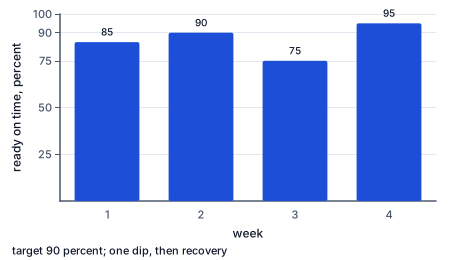
A measure recorded week after week shows a trend, and trends are what accountability should respond to. Northside Repairs' second mechanic had bikes ready on time 85, 90, 75 and 95 percent of the time over four weeks.
Week three stands out, and it is worth one question (was it the parts delay that week?) but not a verdict. A mechanic judged on week three alone learns to fear the measure, and a feared measure gets gamed.
Start from the role. Each outcome in the written role needs a measure.
Choose the measure. A figure that shows the outcome, that the person can record or see, and that is counted the same way every period. One or two per role.
Set a target. From the recent record and what customers need: a target far above anything achieved recently is a source of frustration, not accountability.
Fix the rhythm. A short, regular time: ten or fifteen minutes, weekly or every two weeks.
Run the review. The person brings the measure; both compare it with the target; if it slipped, they agree one action; they note the next review.
Read the trend. Respond to a pattern over several periods, and ask a question about any single low one.
Check the system. Could the person in the role tell, without asking, how they are doing? Has the measure stayed tied to the outcome, or has it drifted? If the measure improves but customers are no happier, it is measuring the wrong thing.
Matching measures to outcomes is needed because people learn to produce whatever is measured. Measure hours, and hours rise; measure the pass rate, and the pass rate rises, which is what the business wanted.
Letting the person bring the measure is allowed, and better, because it puts the information where the work is done. The person sees their own results first and often fixes a problem before the review.
Reading trends rather than single periods is allowed because one period includes chance: a parts delay, a sick day, an unusual job. A trend over several periods mostly shows the work itself.
Agreeing one action at a time is needed because several changes at once make it impossible to see which one worked.
Some measures reward the wrong thing. Plates per hour, without a quality check, rewards rushing. Complaints received rewards discouraging complaints. Calls answered rewards short calls that fix nothing. Each one can rise while the real outcome falls.
Test each measure with one question: if this number went up and nothing else changed, would the customer be better off? Plates checked to the standard passes; plates per hour alone does not. Where one measure can be gamed, pair it with a second that pulls the other way, such as speed with the share of plates sent back.
A target should be set from the record, not from a hope. If the pass rate has been 88 to 92 percent for six months, a target of 95 is a stretch worth working toward; a target of 100 is a promise nobody can keep, and it turns every review into a failure.
Agree the target with the person in the role, and say what support comes with it: a revised checklist, a better tool, more time for the hardest jobs. Review the target itself every few months. A target met easily for a season can rise; one missed for reasons outside the person's control should change or come with help.
When the measure slips for several periods, look at the process and the support first, as the root-cause lesson taught. Did the jobs change? Did a supplier slow down? Is the standard work still right? Most slips have a cause outside the person's effort.
If the cause is in how the person works, use the feedback method: the observed action, its effect, the next practice, and a check back. Keep a short record of what was agreed. The next lessons cover what a role costs, and the reviews and decisions that follow when a role, or a person in it, is not working.
The review only works if it happens, and it only keeps happening if it is short. Ten or fifteen minutes, at the same time each week or fortnight, with the measure on one page, is enough. Longer meetings drift into general talk; irregular ones get skipped when the business is busy, which is exactly when they matter.
Follow the same order every time: the measure, the comparison with the target, one action if needed, and the next date. Write the action and the date on the same page as the measure, so the next review starts by checking whether the action was taken. Over a few months, that page becomes the role's history: what slipped, what was tried, what worked.
Accountability is not only about slips. When the measure is on target, or rising, say so specifically, as in the feedback lesson: 'the pass rate has been at 96 percent or above for six weeks; the new oven step is working.' People who only hear about their measure when it falls learn to dread the review; people who hear about it when it rises learn that the measure is how their good work gets seen.
Some businesses tie a small reward to a sustained good trend, such as a bonus for a quarter at target. If so, tie it to the trend, not a single week, and to a measure that cannot be gamed, for the reasons given above about measures that backfire.
The same system works for the owner's own role. An owner whose outcomes are 'cash covers the next two months' and 'every customer complaint answered the same day' can track both, set targets and review them weekly, perhaps with a partner, an adviser or simply a calendar reminder.
An owner who holds their own measures in view shows the team that accountability is how the business works, not something done to them. It also gives the owner the evidence for the reviews and decisions in the rest of this course.
A small moving company in Columbus, Ohio, ran three crews and judged its crew leaders mostly by complaints reaching the owner. Leaders never knew how they were doing until something went wrong, and the owner spent much of each Monday arguing about which crew was at fault for what.
The owner set one measure per crew, tied to the outcome customers cared about: the share of moves finished within the quoted hours with no damage claim. Each crew leader recorded it from the job sheets, with a target of 90 percent, and brought it to a ten-minute review every Monday.
In the first month the three crews came in at 92, 85 and 78 percent. The lowest crew's leader pointed out that their jobs were mostly third-floor apartments without elevators, which the quotes had not allowed for. The fix was in the quoting, not the crew. Within a quarter all three crews were above 88 percent, damage claims had fallen by about a third, and the Monday arguments had become ten-minute reviews.
Larger organizations call these measures key performance indicators and review them on a dashboard. The useful core is the same at any size: a few measures tied to outcomes, visible to the people doing the work, with targets and a regular time to look at them together.
Accountability means blame when things go wrong. It means a measure both can see, and a routine for looking at it.
Measure effort. Hours and busyness are not outcomes.
One bad week shows who is failing. Read the trend.
The owner should hold the numbers. The person in the role brings them.
A higher target is always better. Set it from the record, with support.
Take the outcome.
$\text{the stall never runs out of a best seller}$
From the role.
Choose the measure.
$\text{times a crate was found empty}$
The helper can count it.
Set the target.
$\text{no empty crates}$
From recent Saturdays.
Fix the rhythm.
$\text{five minutes after packing up}$
Every Saturday.
Run the first review.
$\text{2 empty crates; agree a mid-morning check}$
One action.
Take the outcome.
$\text{bikes ready on the promised day}$
From the role.
Choose the measure.
$\text{share ready on the day}$
From the job tags.
Set the target.
$90 \text{ percent}$
From the last quarter.
Record four weeks.
$85; \ 90; \ 75; \ 95$
The mechanic keeps the figures.
Find the four-week rate.
$(85 + 90 + 75 + 95) \div 4 = 86.25$
Equal weeks, so the average.
Ask about the dip.
$\text{week 3: parts delay}$
A process cause, not a verdict.
Take the outcome.
$\text{catering delivered by 12:15}$
From the role.
Choose the measure.
$\text{share delivered on time}$
From the delivery log.
Set the target and rhythm.
$90 \text{ percent; Mondays}$
Ten minutes.
Read week one.
$36 \div 40 \times 100 = 90$
On target.
Read week two.
$31 \div 40 \times 100 = 77.5$
Below.
Ask about the slip.
$\text{bridge works that week}$
The driver brings the reason.
Agree one action.
$\text{bridge deliveries leave first}$
A process change.
Choose the measure.
$\text{share of orders confirmed unbroken}$
Tied to the outcome.
Set the target.
$98 \text{ percent}$
From the last two months.
Fix the rhythm.
Match each role outcome at the five businesses to the measure that shows it.
| First-time inspection pass rate each month | Share of bikes ready when promised | Plates checked at the pass that meet the standard | Number of times a crate was found empty | |
|---|---|---|---|---|
| Every move-out clean passes first time | ||||
| Bikes ready on the promised day | ||||
| Lunch plated to the standard at pace | ||||
| The stall never runs out of a best seller |
Complete the worked solution: Northside Repairs' second mechanic handled $25$ bikes a week for four weeks, and had $20$, $22$, $21$ and $20$ of them ready on the promised day. Find the on-time rate for the first week, for the second week, and for the four weeks together.
Find the first week's rate.
$(\text{on time}) \div \text{twenty-five} \times \text{a hundred} =$ p
On time over bikes.
Find the second week's rate.
$(\text{on time}) \div \text{twenty-five} \times \text{a hundred} =$ q
The same measure.
Find the four-week rate.
$(\text{all on time}) \div \text{a hundred} \times \text{a hundred} =$ t
The trend, not one week.
Say which figure to respond to.
$\text{the four-week rate}$
One week is a question, not a verdict.
Maya's assistant is accountable for 'café orders packed so nothing arrives broken'. Which measure fits?
Bright Home Cleaning's team leader and owner meet for fifteen minutes every Monday. Put the review in order.
Number the steps in order (write the number in the box):
Northside Repairs' second mechanic has bikes ready on the promised day $85$, $90$, $75$ and $95$ percent of the time in four weeks. Plot the measure for each week.
Plot your answer on the grid:
Bright Home Cleaning's team leader has a target of a $95$ percent first-time pass rate. This month $42$ of $50$ move-out cleans passed first time. By how many percentage points is the month below the target? Fill in each figure on the sheet.
| Amount | |
|---|---|
| The month's rate, percent | |
| Points below the target |
A heating and cooling company in Denver holds each technician accountable for the share of service calls fixed on the first visit, with a target of $85$ percent. Last month one technician fixed $102$ of $120$ calls on the first visit. What was the technician's first-time fix rate, as a percentage?
Answer:
A bakery sets up accountability for its morning baker. Mark every part of the arrangement that lets it run without the owner supervising.
This task has no paper form; do it on a device.
Lesson test: one question per skill, one attempt each, no hints. Your answers are checked when you submit.
Neighborhood Kitchen's driver is accountable for 'catering orders delivered by 12:15'. This week $31$ of $40$ orders arrived on time. Complete the sentence.
This week p percent of catering orders were delivered by 12:15.
You can set accountability that does not depend on the owner watching. Tell someone why the person in the role should bring the numbers. Next: what a paid hour really costs.
20. Your turn: Maya's assistant, step 3
$\text{every other Friday}$
The assistant brings the figure.