Back to the on-screen lesson ·
A market position names the customers, the job and the one basis the business wins on; a map of competitors on what those customers value shows the crowded corners and the open space, which is scored and sized before it is taken.
Paper packet. Every task here also exists on screen, where it is checked automatically; answers written on paper are not assessed by Nydus. When you are back at a device, enter your answers there.
You will plot competitors on two things customers value, find an open space the business can deliver, score candidate positions with weights, size the open space from stated assumptions, and write a position that also says what the business will not do.
Four courses have taught you to cost, price, sell, deliver and employ. This course asks the questions above all of that: where should the business compete, how should it grow, and what could stop it? It starts with where, and it uses the arithmetic you already have — shares of a market, weighted totals, contribution a week — to keep the answer honest.
| Term | What it means |
|---|---|
| Market position | Where the business chooses to compete: which customers, which job, and the basis on which it wins. |
| Basis | What the business wins on: price, speed, convenience, quality or a specialty. |
| Position map | Competitors plotted on two things the chosen customers care about. |
| Open space | A combination customers value that no competitor offers. |
| Weighted score | Each candidate's scores multiplied by how much each thing matters, then added. |
Ask a new owner what their position is and the answer is often 'good quality at a fair price', which is what everyone says. A position is a choice, and it has three parts: the customers it is for, the job it does for them, and the one basis it wins on.
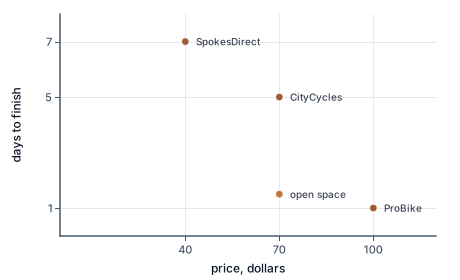
To find one, map the competition on two things the chosen customers care about. For commuters with a broken bike, those are price and speed. Dev's three local competitors: CityCycles at 70 dollars and 5 days, SpokesDirect at 40 dollars and 7 days, ProBike at 100 dollars and next day. Plotted, the map has two crowded corners — cheap and slow, dear and fast — and one open space: a mid-priced service ready in a day or two.
An open space is only worth taking if the customers value it and the business can deliver it. Dev's commuters said they would pay about 70 dollars to have their bike back for Monday, and his Thursday-to-Friday promise is one he can keep. That is his position: for commuters, your bike back for Monday, at a mid-range price.
Another way: table
Northside Repairs' map, in figures.
| Repairer | Price | Days | Where it sits |
|---|---|---|---|
| SpokesDirect | 40 | 7 | cheap, slow |
| CityCycles | 70 | 5 | mid, slow |
| ProBike | 100 | 1 | dear, fast |
| Open space | about 70 | 1–2 | mid, fast |
Another way: steps
Start with customers, not the product. Name a group narrow enough to find and ask: commuters within two kilometers, cafés opening this year, tenants leaving a rented apartment. Then name the job they need done in their own words.
Choose the map's two axes from what they say. Ask a handful of them what made them choose the last business they used. The two answers that come up most become the axes. A map on axes the owner cares about, and customers do not, finds open spaces nobody wants.
Plot the competitors from evidence. Prices from their price lists, speed from asking or trying, not from memory.
Score and size the candidates. An open space still has to be one the business can deliver and one big enough to be worth it — the two tests the next sections work through.
Check the result by writing the position in one sentence and reading it to a customer from the group. If they recognize themselves and the job, and can say which competitor they would leave for it, the position is real. If they shrug, it is a slogan.
When a map shows more than one open space, a weighted score makes the comparison explicit. Choose three or four criteria — how much customers value it, whether the business can deliver it, how crowded the corner is — and give each a weight for how much it matters. Score each candidate out of five on each, multiply by the weight and add.
Neighborhood Kitchen weights customer value 3, ability to deliver 2 and crowding 1. Office lunches score 5, 4 and 3: 15 + 8 + 3 = 26. Evening family meals score 4, 2 and 2: 12 + 4 + 2 = 18. The lunches lead by 8.
The totals are only as good as the scores and weights behind them, so test the lead: change the weights to equal, or drop one score by a point, and see whether the order holds. A lead that survives is a decision; one that flips is a sign the owner needs more evidence, not more arithmetic.
An open space can be open because nobody wants it. Before committing, work down from everyone nearby to the customers the position could win, each step a share of the one before:
$$\text{customers} = \text{people nearby} \times \text{share with the need} \times \text{share who would choose you}$$
Dev counts about 3000 commuters within two kilometers. If 10 percent need a service in a month and 20 percent of those would choose a next-day service, that is 3000 × 0.1 × 0.2 = 60 customers a month, and at 70 dollars about 4200 of revenue. Each share is an assumption, written down so that it can be tested: counting bikes at the station, asking twenty commuters, running the service for a month.
The result is set against the costs of delivering the position. If the open space cannot carry the business's fixed costs even on generous shares, it is too small, however empty it looks.
A small business cannot outspend a chain on advertising or undercut a supermarket on price, but it can know a narrow group of customers better than anyone. A narrow position turns that into an advantage: the owner hears the same request often enough to get very good at it, word of mouth travels inside the group, and the few competitors who serve it are easy to watch.
Narrow does not mean small for ever. Dev's commuters are a few hundred customers a month, enough to fill his bench; once the bench is full, the next customers can come from a second narrow group — cargo-bike parents, say — rather than from trying to serve everyone. Many businesses that look broad today began as one narrow position done well, and added a second only when the first was full.
The risk of a narrow position is that the group shrinks or moves: an office block closes, a cycle lane is dug up for a year. That is a reason to watch the group, and to know which second group would be next, not a reason to serve everyone from the start.
An open space that proves profitable will not stay open. If CityCycles starts offering next-day service at 70 dollars, Dev's position loses its emptiness, though not necessarily its customers. The next lesson asks what, if anything, stops a competitor copying a position; the answer is what decides whether the space was worth taking. A position built on something hard to copy — a skill, a relationship, a location — lasts; one built only on being first lasts until the second arrives.
The test of a real position is that it tells the owner what to say no to. Neighborhood Kitchen's position — hot shared lunches delivered to office teams of up to twenty, by 12:15 — rules out weddings, evening events and tray-bakes for school fairs, however tempting each request is. Without those refusals, the kitchen drifts back toward 'something for everyone', and competes on nothing in particular against businesses that have chosen.
Two positions are traps. 'The cheapest' works only for a business whose costs are genuinely lowest — a later lesson tests that. 'The best' is not a basis at all, because every competitor claims it. And a position copied from a successful competitor puts the business in the one corner that is already full. Positions change as markets change; revisit the map each year, from fresh evidence rather than memory.
A dog groomer opening in a market town found five competitors within ten kilometers. She asked thirty dog owners at the park what made them choose their groomer, and two answers dominated: price, and how long the dog was away. She mapped the five: three salons charged 45 to 55 dollars and kept the dog most of the day; one mobile van charged 80 and took an hour at the owner's door; a budget salon charged 35 and kept dogs all day.
The open space was a mid-priced groom with the dog back within two hours. She scored it against a mobile van of her own, weighting what owners valued 3, what she could deliver 2 and crowding 1: the two-hour salon scored 3 × 4 + 2 × 5 + 4 = 26, the van 3 × 5 + 2 × 2 + 2 = 21, because a van cost far more than she had.
She sized it before signing a lease. About 6,000 dogs were registered in the area; she assumed a quarter were groomed professionally each month and that she could win one in fifteen of those: 6,000 × 0.25 ÷ 15 = 100 grooms a month at 55 dollars, 5,500 of revenue against about 3,200 of fixed costs. She wrote the position — 'a full groom with your dog home in two hours, booked to the minute' — and turned down requests for all-day day-care, which would have put her back in the crowded corner.
Many small businesses never write their position down, and drift as each new request pulls them a little further from it. Writing it as customers, job, basis and refusals gives every later decision in this course — pricing, growth, what to standardize — something to be tested against.
Our position is quality at a fair price. Everyone says it; it chooses nothing.
Serve everyone, so no sale is lost. A position without refusals competes on nothing.
Copy the most successful competitor. Their corner is the most crowded.
Any open space is an opportunity. Only if customers value it, the business can deliver it, and it is big enough.
A weighted score decides. It organizes evidence; the weights and scores still have to come from customers.
Name the customers and the job.
$\text{new cafés; tableware that survives the dishwasher}$
In the customers' own words.
Choose the axes from what cafés said.
$\text{looks distinctive; survives commercial washing}$
The two reasons they gave.
Place the competitors.
$\text{factory white: durable, plain; other potters: distinctive, fragile}$
Two crowded corners.
Name the open space.
$\text{distinctive and durable}$
Nobody offers both.
Write the position and its refusal.
$\text{café tableware tested to survive; no gift-shop pieces}$
A statement that also says what she will not do.
Plot SpokesDirect and CityCycles.
$(40, 7), \ (70, 5)$
Price and days.
Plot ProBike's point.
$(100, 1)$
Fast and dear.
Name the open space.
$\text{about } 70, \text{ one or two days}$
Nobody is there.
Find the commuters needing a service a month.
$3000 \times 0.1 = 300$
A share of everyone nearby.
Find those who would choose the position.
$300 \times 0.2 = 60$
A share of those.
Find the revenue a month.
$60 \times 70 = 4200$
On those assumptions, to test.
Set the weights from what customers said.
$\text{value } 3, \text{ delivery } 2, \text{ crowding } 1$
Value matters most.
Score office lunches.
$3 \times 5 + 2 \times 4 + 3 = 26$
Valued, deliverable, fairly open.
Score evening family meals.
$3 \times 4 + 2 \times 2 + 2 = 18$
Valued, but the kitchen closes at four.
Score weekend catering.
$3 \times 3 + 2 \times 3 + 1 = 16$
A crowded corner.
Find the leader's margin.
$26 - 18 = 8$
Office lunches lead.
Test with equal weights.
$5 + 4 + 3 = 12 \text{ against } 4 + 2 + 2 = 8$
The lead holds.
Write the position.
$\text{hot team lunches, delivered by 12:15; no evenings}$
With its refusal.
Name what the customers value.
$\text{speed of shopping and price}$
Shoppers who want the week's vegetables fast.
Place the competitors.
$\text{supermarkets cheap but slow; organic stall dear}$
The two corners.
Name the open space.
Three bike repairers near Northside Repairs charge, for a standard service: CityCycles $68$ dollars and $7$ days, SpokesDirect $43$ dollars and $7$ days, and ProBike $105$ dollars and $2$ days. Plot each repairer: price along the bottom, days up the side.
Plot your answer on the grid:
Complete the worked solution: Dev scores two positions out of five on what commuters told him matters, with price weighted $4$ and speed weighted $2$. The next-day mid-price service scores $3$ on price and $2$ on speed; a budget three-day service scores $1$ and $1$. Compare them.
Weight and add the next-day service's scores.
$4 \times 3 + 2 \times 2 =$ x
Each score counts as much as customers say it matters.
Weight and add the budget service's scores.
$4 \times 1 + 2 \times 1 =$ y
The same weights for both.
Take the second total from the first.
$(\text{first}) - (\text{second}) =$ z
The next-day service's lead.
Check the weights came from customers.
$\text{what commuters said matters}$
A score is only as good as its weights.
Test the lead against a change of weights.
$\text{does it survive equal weights?}$
A lead that flips easily is not a decision yet.
On the map, the cheap repairers take five to eight days and ProBike charges about $94$ dollars for next-day service. Northside Repairs' commuters need their bikes back by Monday and have told Dev they would pay about $70$ dollars. Which position fits the open space?
Match each of the five businesses' positions to the basis it wins on.
| Price | Speed | Convenience | Quality | A specialty | |
|---|---|---|---|---|---|
| The lowest price on seasonal produce in the market | |||||
| Your bike back for Monday | |||||
| A hot team lunch delivered to your meeting | |||||
| Handmade tableware that survives a café dishwasher | |||||
| Move-out cleans to inspection standard |
Neighborhood Kitchen scores three possible positions out of five on customer value (weight 3), whether it can deliver (weight 2) and how uncrowded the corner is (weight 1). Office lunches delivered: $1$, $1$, $2$. Evening family meals: $3$, $2$, $3$. Weekend catering: $1$, $4$, $5$. Fill in each weighted total and the office lunches' lead over the evening meals.
| Amount | |
|---|---|
| Office lunches, weighted total | |
| Evening family meals, weighted total | |
| Weekend catering, weighted total | |
| Office lunches' lead over evening meals |
About $5000$ commuters ride to work within two kilometers of Northside Repairs. Dev reckons $6$ percent of them need a service in any month, and that $21$ percent of those would choose a next-day service at $70$ dollars. On those assumptions, how much revenue a month could the position bring, in dollars?
Answer:
A small bakery weighs the position 'sourdough baked on site each morning for commuters'. About $300$ people walk past between seven and nine, and the owner assumes $10$ percent of them would buy a loaf, which earns $4$ dollars of contribution. It opens six mornings a week. Fill in what the position could bring, on those assumptions.
| Amount | |
|---|---|
| Buyers a morning | |
| Buyers a week | |
| Contribution a week, dollars | |
| Contribution over four weeks, dollars |
Lesson test: one question per skill, one attempt each, no hints. Your answers are checked when you submit.
Monica weighs the position 'a ready-packed weekly vegetable bag at a fair price' for shoppers in a hurry. About $2200$ shoppers pass her stall on a market day, and she assumes $5$ percent of them would take a bag, each earning $3$ dollars of contribution. How much contribution would the bags bring on one market day, in dollars?
Answer:
You can choose where to compete, size it, and say what that rules out. Tell someone why 'quality at a fair price' is not a position. Next: testing whether an advantage is real.
17. Your turn: Monica's stall, step 3
$\text{a ready-packed weekly bag at a fair price}$
Nobody offers it at the market.