Back to the on-screen lesson ·
A single decision's break-even is its extra fixed cost over the contribution each extra unit brings; set it beside the extra volume honestly expected and the capacity added, and read the gain and the cushion together.
Paper packet. Every task here also exists on screen, where it is checked automatically; answers written on paper are not assessed by Nydus. When you are back at a device, enter your answers there.
You will find the extra units a decision needs a month to break even, compare them with the volume honestly expected and the capacity the decision adds, work the gain and the cushion, and write the rule.
A business breaks even when its contribution covers its fixed costs. A single decision can be tested the same way: what it adds to fixed costs, against what each extra unit it brings contributes. You have also learned to ask where a volume assumption comes from, and to test it against a low case.
| Term | What it means |
|---|---|
| Decision break-even | The extra units a month a decision needs to cover the fixed cost it adds. |
| Extra fixed cost | What the decision adds to the month's costs whether or not sales come: a lease, a rent, a wage. |
| Contribution a unit | Price less the variable cost of the extra unit the decision brings. |
| Cushion | Expected extra units less the units needed: how far the expectation can fall short. |
| Capacity added | The most extra units the decision could possibly deliver. |
Neighborhood Kitchen is thinking of leasing a coffee machine for 300 dollars a month. Each coffee sold contributes 1.50 after beans, milk and cup. How many coffees must it sell a month for the machine to pay for itself?
$$\text{extra units to break even} = \frac{\text{extra fixed cost}}{\text{contribution a unit}} = \frac{300}{1.50} = 200 \text{ coffees}$$
That is the decision's own break-even. It says nothing yet about whether 200 coffees will sell. The owner's honest expectation, from the lunch crowd and a week of asking customers, is 260. At 260 the machine earns 260 × 1.50 − 300 = 90 dollars a month, and the cushion is 260 − 200 = 60 coffees: the expectation can be 23 percent too hopeful before the machine loses money.
The test works for any decision with a monthly cost: a second van, a rented kiln, a Wednesday booth, a mobile repair van. Each has its own break-even volume, to be set beside the volume the owner can defend with evidence.
Another way: table
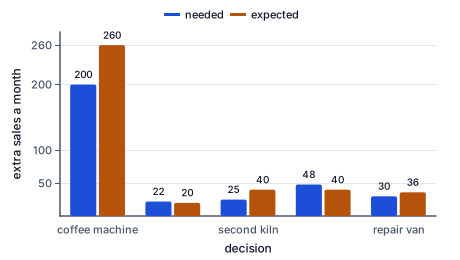
Five decisions, tested.
| Decision | Extra cost | Contribution | Needed | Expected |
|---|---|---|---|---|
| Coffee machine | 300 | 1.50 | 200 | 260 |
| Second van | 880 | 40 | 22 | 20 |
| Second kiln | 450 | 18 | 25 | 40 |
| Wednesday booth | 240 | 5 | 48 | 40 |
| Repair van | 750 | 25 | 30 | 36 |
Another way: steps
Count every extra fixed cost. A second van is not only its lease: it is insurance, parking, a phone for the crew, and perhaps a supervisor's extra hours. Leaving any out lowers the break-even falsely.
Work the contribution of the extra unit, not the average one. The cleans a second van brings may be farther away and use more fuel; the coffees a machine sells may be cheaper than the average drink. Use the figures for the extra work.
Divide, then compare. The break-even is the extra cost over the extra contribution. Set it beside the expected extra volume, capped at the capacity the decision adds.
Read the gain and the cushion together. The gain is what the decision adds a month; the cushion is how much the expectation can be wrong.
Check the arithmetic by working the gain at the break-even volume: it must be zero. Check the judgment by asking where the expected volume came from. An expectation built from a count, a trial or existing demand turned away can be defended; one that is simply the number that makes the decision work cannot.
The break-even is arithmetic; the expected volume is judgment, and the judgment is where decisions go wrong. Owners who want to make a decision tend to expect exactly enough volume to justify it. The defense is to write the expectation down with its source before working the break-even, and to look at the cushion rather than only the gain.
A cushion of 60 coffees on an expectation of 260 means the expectation can be about a quarter too high before the machine loses money. A cushion of 4 cleans on an expectation of 40 means almost any shortfall turns the decision into a loss. The two decisions may show similar gains on paper and carry very different risks.
A decision that adds capacity can only bring as many extra units as that capacity allows. A nail station with one technician can do perhaps 60 manicures a month, however many customers ask; a second kiln can fire so many mugs a week. If the owner expects more than the capacity, the expectation must be capped, and the gain worked at the capped figure. Sometimes this turns a decision around: a second van that would need 30 extra cleans to break even, adding a crew that can do only 25, cannot pay whatever the demand.
Of Bright Home Cleaning's five decisions, the second van needs 22 extra cleans and the owner expects 20; Monica's Wednesday booth needs 48 baskets and she expects 40. On these figures both lose money. That is not the end of either idea. The owner can lower the extra cost (a van shared with another business, a cheaper booth), raise the contribution (a higher price for the new service area, a better-selling basket) or wait until the expected volume rises. Each changes one side of the division, and the test can be run again in a minute.
A 'not yet' decided this way is far cheaper than a 'yes' that fails. A van leased for a year on hope costs twelve months of its break-even shortfall before it can be handed back.
Some decisions carry a one-off cost as well as a monthly one: fitting out the new booth, a deposit on the lease, training. The monthly break-even ignores these, so work them separately: divide the one-off cost by the month's gain to find how many months the decision takes to repay it. A decision that gains 90 a month and cost 600 to start needs about seven months to be ahead, which matters if the lease runs for only six.
Some decisions add cost in steps rather than all at once. A second van may need a second driver only when bookings pass a certain level; a kiln rental may come with a minimum number of firings. Decisions like these have more than one break-even. Below the first step the decision needs so many units; once the second cost is added, it needs more. Working each step separately shows where the decision is fragile: a van that covers its lease at 22 cleans but needs 40 to cover a driver as well is a decision worth taking only if demand is expected well beyond 40, or if the driver can be added gradually.
Other decisions change the contribution a unit as well as the fixed cost. A delivery service costs a monthly fee and also adds a per-delivery cost for packaging and fuel, so each delivered lunch contributes less than a lunch served at the counter. The break-even must use the delivered lunch's contribution, not the counter's. Using the wrong contribution is one of the commonest mistakes in decision break-evens, and it always makes the decision look better than it is.
A useful habit is to write each decision on a single card: the extra fixed cost with its parts, the contribution of the extra unit with its source, the break-even, the expected volume with its source, the capacity, the gain and the cushion. The card can be read in a minute by a partner, a lender or the owner a year later, and it records the assumptions that will need checking once the decision is running. After three months, the actual extra volume can be written on the same card beside the expected one.
That comparison is where decision-making improves. An owner who finds that their expected volumes have run about 20 percent high on the last three decisions can take 20 percent off the next expectation before working the break-even. Over a few years, the cards become the business's own record of how good its judgment is, and which kinds of decision it tends to be too hopeful about.
A small brewery with a taproom open Thursday to Saturday was asked by regulars to open on Sundays. Opening would cost about 1,300 dollars a month: two bartenders for four Sundays, extra cleaning, and the utilities for another day. Each pint sold contributed about 5 dollars after the beer's cost and card fees.
The break-even was 1,300 ÷ 5 = 260 pints a month, 65 a Sunday. The owners asked how many customers would really come, and ran four trial Sundays with a single bartender to keep the cost down. The trial Sundays sold 48, 61, 55 and 70 pints — an average of 58.5, about 234 a month at full staffing, against a break-even of 260. On those figures Sunday lost about 130 dollars a month.
They changed one side of the division instead of giving up: Sundays became a single-bartender afternoon with food trucks, which cut the extra cost to 750 and the break-even to 150 pints. At the trial's 234 pints the gain was about 420 a month and the cushion 84 pints. They opened Sundays on that model and, six months later, with Sunday sales steady at about 280 pints, added the second bartender back.
In larger businesses the same question is asked of every proposal: what extra volume does it need to pay for itself, and how sure are we of getting it? The arithmetic is the same division, and the argument is always about the expected volume.
A decision pays if the business is profitable. Each decision must cover its own extra cost.
Only the lease counts. Every cost the decision adds belongs in the extra fixed cost.
Expect whatever makes it work. The expected volume needs its own evidence.
More capacity means more sales. Only up to the demand, and only up to the capacity itself.
A small gain is a safe gain. Read the cushion; a thin one is fragile.
The break-even says whether to decide. It says what volume the decision needs; whether that volume will come is a separate judgment, made from evidence.
Read the extra fixed cost.
$300 \text{ a month}$
The lease.
Work the contribution a coffee.
$1.50$
After beans, milk and cup.
Find the coffees needed.
$300 \div 1.50 = 200$
The decision's break-even.
Find the gain at the expected 260.
$260 \times 1.50 - 300 = 90$
A month.
Find the cushion.
$260 - 200 = 60$
About a quarter of the expectation.
Add the van's costs.
$700 + 120 + 60 = 880$
Lease, insurance and parking.
Read the contribution a clean.
$40$
Price less the extra crew's wages and supplies.
Find the cleans needed.
$880 \div 40 = 22$
The break-even.
Read the expected cleans.
$20$
From move-outs turned away last quarter.
Find the gain.
$20 \times 40 - 880 = -80$
A small loss.
Decide what to do next.
$\text{not yet: share a van two days a week}$
Lower the extra cost and test again.
Read the extra fixed cost.
$450 \text{ a month}$
Rent of a second kiln.
Read the contribution a mug.
$18$
Price less clay, glaze and firing.
Find the mugs needed.
$450 \div 18 = 25$
The break-even.
Read the expected mugs.
$40$
From café orders on the waiting list.
Cap it by her throwing time.
$\min(40, 35) = 35$
She can throw only 35 more a month.
Find the gain at the capped volume.
$35 \times 18 - 450 = 180$
A month.
Find the cushion.
$35 - 25 = 10$
Enough, but thinner than the list suggested.
Find the repairs needed.
$750 \div 25 = 30$
Extra fixed cost over contribution.
Find the gain at the expected 36.
$36 \times 25 - 750 = 150$
A month.
Find the cushion.
Neighborhood Kitchen is considering leasing a coffee machine. It would add $300$ dollars a month of fixed cost, and each extra coffees it brings would contribute $1.5$ dollars. How many extra coffees a month must it bring to break even on the decision?
Answer:
Complete the worked solution: Bright Home Cleaning could lease a second van for $800$ dollars a month plus $200$ of insurance. Each extra clean it allows contributes $50$ dollars, and the owner expects $16$ extra cleans a month. Test the decision.
Add the lease and the insurance.
$800 + 200 =$ k
The decision's extra fixed cost.
Divide by the contribution a clean.
$(\text{extra cost}) \div 50 =$ x
Extra cleans to break even.
Take the needed from the expected.
$16 - (\text{needed}) =$ c
The cushion; below zero, a shortfall.
Work the month's gain.
$16 \times 50 - (\text{extra cost}) =$ n
What the van adds, on these figures.
Check the capacity it adds.
$\text{can the second crew do } 16 \text{ more?}$
Expected cleans beyond capacity are not real.
Neighborhood Kitchen is considering leasing a coffee machine. It would add $300$ dollars a month of fixed cost, and each extra coffees it brings would contribute $1.5$ dollars. The owner honestly expects $260$ extra coffees a month. Fill in the extra units needed to break even and the month's gain, in dollars, at the expected volume.
| Extra units to break even | Gain a month, dollars | |
|---|---|---|
| The decision |
Northside Repairs is considering running a mobile repair van. It would add $750$ dollars a month of fixed cost, and each extra repairs it brings would contribute $25$ dollars. It needs $30$ extra repairs a month to break even, and the owner expects $36$. Is the decision worth making on these figures?
A bakery could open on Sundays. It would add $120$ dollars a month of fixed cost, and each extra loaf sold on Sundays contributes $3$ dollars. Mark the extra loaves a month it needs to break even.
0 |——————————| 100
Mark the position with a cross, then write the value:
A hairdresser could add a second chair, costing $K$ dollars a month, and each extra haircut it allows contributes $u$ dollars. Write the extra haircuts a month, $x$, that the chair needs to break even.
Answer:
A hair salon could add a nail station for $900$ dollars a month in rent share, equipment lease and supplies stock. Each manicure contributes $25$ dollars. The owner expects $30$ manicures a month, and one technician could do at most $65$. Fill in the test.
| Amount | |
|---|---|
| Manicures needed to break even | |
| Manicures the station can really do | |
| Gain a month, dollars | |
| Cushion, manicures |
Lesson test: one question per skill, one attempt each, no hints. Your answers are checked when you submit.
Monica's Market Stall is considering taking a second pitch on Wednesdays. It would add $240$ dollars a month of fixed cost, and each extra baskets it brings would contribute $5$ dollars. The owner expects $40$ extra baskets a month. Complete the sentence.
The decision needs x extra units a month to break even, and at the expected volume it gains n dollars a month.
You can test any decision with a monthly cost on its own terms. Tell someone why a profitable business can still make a decision that loses money. Next: opportunity cost, the value of what the choice gives up.
17. Your turn: Northside Repairs' mobile van, step 3
$36 - 30 = 6$
A sixth of the expectation.