Back to the on-screen lesson ·
A risk map estimates each risk's likelihood and impact; expected cost, likelihood times impact, ranks them; each risk gets a response — avoid, reduce, transfer or accept — and a reduction is worth up to the expected cost it removes.
Paper packet. Every task here also exists on screen, where it is checked automatically; answers written on paper are not assessed by Nydus. When you are back at a device, enter your answers there.
You will compute and rank risks' expected costs, work out what a reduction is worth, plot a risk map, fill in a food truck's risk sheet, and find what servicing saves.
Growth decisions weigh what could go right. Resilience weighs what could go wrong. A small business usually has no spare cash to absorb a shock, so thinking about risks before they happen matters more, not less. The arithmetic is familiar: a chance, a cost, and a comparison between options.
| Term | What it means |
|---|---|
| Risk | Something that might happen and would cost the business. |
| Likelihood | The chance a risk happens in a year, such as 3 in 10. |
| Impact | What the risk would cost if it happened. |
| Expected cost | Likelihood times impact: an average for comparing risks. |
| Risk map | A chart placing each risk by its likelihood along one axis and its impact up the other. |
| Four responses | Avoid the risk, reduce it, transfer it to someone else, or accept it knowingly. |
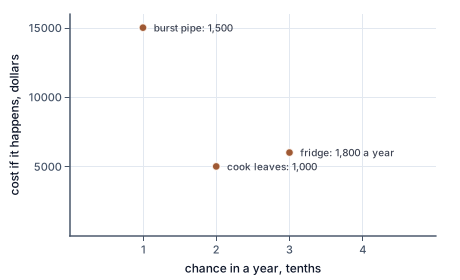
Neighborhood Kitchen maps three risks for the year:
$$\text{expected cost} = \text{likelihood} \times \text{impact}$$
The fridge, not the dramatic pipe, tops the list: it is fairly likely and costly. The expected cost is not a prediction — the fridge either fails or does not — but it puts different kinds of risk on one scale.
Rare but very costly risks need a second look: a 1-in-10 chance of losing 15,000 could close a kitchen that has only 5,000 in the bank, whatever its expected cost.
Another way: table
Neighborhood Kitchen's risk map.
| Risk | Chance | Cost | Expected |
|---|---|---|---|
| Fridge fails | 3 in 10 | 6,000 | 1,800 |
| Burst pipe | 1 in 10 | 15,000 | 1,500 |
| Cook leaves | 2 in 10 | 5,000 | 1,000 |
Another way: steps
List the risks. Walk through the business and ask what could stop it trading, or cost it heavily: equipment, people, premises, suppliers, customers, money, data, the law. A list of eight to twelve is usually enough for a small business.
Estimate the chance. Use the business's own history first — how often has the fridge failed in the last five years? — then suppliers, similar businesses and common sense. Write it as a chance in a year, such as 3 in 10. Precision is not the point; a sensible estimate is.
Estimate the cost. Count the direct cost and the trade lost while the business recovers: spoiled stock, repairs, days closed, customers who go elsewhere.
Multiply and rank. The expected cost ranks the list.
Check each figure by sense. The expected cost can never be larger than the cost itself, and a risk with a chance of 1 in 10 has an expected cost of a tenth of its impact.
Every risk on the map gets a response:
Avoiding a risk usually means giving up whatever the activity earned, so it suits risks where the activity earns little and the risk is large. Accepting suits risks that are small and cheap to recover from, provided the business keeps a cash cushion to absorb them.
Reducing a risk is worth paying for up to the expected cost it removes. If servicing halves the fridge's chance of failing, from 3 in 10 to 1.5 in 10, it removes 0.15 × 6,000 = 900 dollars of expected cost a year. Servicing that costs less than 900 pays on average; servicing that costs more does not, on the arithmetic alone.
Some reductions cut the cost rather than the chance. A temperature alarm does not stop the fridge failing, but it means the failure is caught in an hour instead of overnight, and far less food is lost. The same calculation applies: the expected cost before, less the expected cost after, is what the reduction is worth.
Expected cost treats a 1-in-100 chance of losing 30,000 the same as a certain loss of 300. For a business with 5,000 in the bank, those are not the same at all: the first could end it. So any risk whose impact alone is larger than the business could survive gets a response even if its expected cost is small. Usually that response is to transfer it, through insurance, because an insurer can carry a rare large loss across many businesses in a way one small business cannot.
Chances and costs here are the owner's estimates, and should be revisited each year and after anything changes: a new site, a new product, new equipment, a near miss.
The hardest part of a risk map is the list itself, because the risks an owner has never experienced are the ones least likely to occur to them. A few prompts help. Walk through a normal week and ask, at each step, what would stop it: the van that does not start, the supplier who does not deliver, the card reader that goes down on a Saturday, the key person who calls in sick. Then walk through the premises: water, fire, power, break-ins, the landlord selling the building. Then the money: a large customer who pays late or not at all, a rise in rent or interest, a tax bill larger than expected.
Some risks come from outside the business altogether. A road closed for months of construction in front of a shop, a new rival opening across the street, a change in the law on what can be sold or how, a spell of extreme weather. These are harder to put a chance on, but they belong on the list, because a business that has thought about them in advance responds faster when they come.
People are often the largest risk in a small business and the least often listed. A business that depends on one person who knows how everything works — often the owner — is exposed to that person's illness, injury or departure. Writing down how the key tasks are done, and training a second person on each, reduces that risk more cheaply than almost anything else on the map.
Ask staff, too. The cook knows which piece of equipment has been making a strange noise; the driver knows which route floods. A risk map made by the owner alone misses what only the people doing the work can see.
The risk map is usually drawn as a chart: chance along the bottom, cost up the side, each risk a point. The chart shows at a glance what a table of expected costs hides.
Risks in the top right are likely and costly; they come first, and usually call for a reduction. Risks in the bottom left are unlikely and cheap; they are usually accepted. Risks in the bottom right happen often but cost little each time, such as a broken glass or a late delivery; they are best reduced with a simple routine, because their small costs add up over a year. Risks in the top left are rare but costly, such as a fire or a flood; they are usually transferred through insurance, because a reduction rarely makes them small enough to carry.
Plotting the map again after the responses are in place shows whether each response moved its risk where it was meant to: down, left, or off the business's books altogether.
A small craft brewery in Colorado sat down with its accountant to map its risks for the first time. The owners listed ten and put a chance and a cost on each. Three stood out.
A glycol chiller failure, which would warm the fermenting tanks and spoil the batches in them, had failed twice in six years: about a 3 in 10 chance a year, costing about 12,000 dollars in lost beer. Expected cost: 3,600. A contaminated batch, about 2 in 10, cost about 4,000: expected 800. A fire in the taproom, perhaps 1 in 100, would cost 250,000: expected 2,500, but large enough to close the business.
The owners responded to each. A service contract and a remote alarm on the chiller, costing 1,400 a year, cut its chance to about 1 in 10 and caught failures before whole batches spoiled; the expected cost fell by well over the 1,400 it cost. Contamination was reduced with a written cleaning standard. The fire risk was transferred through property and business-interruption insurance, because no reduction could make it small enough to carry alone. Four smaller risks were accepted, with a cash cushion of 5,000 set aside to absorb them.
Larger companies keep the same map as a risk register, reviewed by their boards each quarter, with an owner named for each risk. The arithmetic is the same; what changes is the number of risks and the formality of the review.
The most dramatic risk is the biggest. Rank by likelihood times impact.
Expected cost is what will happen. It is an average for comparing risks.
Every risk must be removed. Some are best accepted knowingly.
Rare risks can be ignored. A rare risk big enough to close the business needs a plan.
Any reduction is worth buying. Only up to the expected cost it removes.
A risk map is made once. Review it every year, and after anything changes: a new site, a new product, new equipment, a new key employee, or a near miss that shows a risk was more likely than it looked. A near miss is the cheapest lesson a business ever gets, because it shows the risk without charging its full cost.
Work the kiln element's expected cost.
$0.4 \times 800 = 320$
Four in 10, costing 800.
Work the fire's expected cost.
$0.01 \times 30000 = 300$
One in 100, costing 30,000.
Compare the two.
$320 \approx 300$
Similar expected costs.
Respond to the element.
$\text{keep a spare element: reduce}$
A cheap, fast fix.
Respond to the fire.
$\text{insure it: transfer}$
It alone could close the studio.
Work the fridge.
$0.3 \times 6000 = 1800$
Fairly likely and costly.
Work the burst pipe.
$0.1 \times 15000 = 1500$
Rare, very costly.
Work the cook leaving.
$0.2 \times 5000 = 1000$
Lost trade and hiring.
Rank the three.
$1800 > 1500 > 1000$
The fridge first.
Price the servicing.
$1800 - 0.15 \times 6000 = 900$
Worth paying up to 900 a year.
Flag the pipe.
$15000 > 5000 \text{ in the bank}$
Insure it, whatever its rank.
Work the battery-fire risk.
$0.05 \times 40000 = 2000$
Rare, large.
Compare with what battery work earns.
$1500 < 2000$
It earns less than it risks.
Respond to the battery work.
$\text{stop it: avoid}$
Refer customers elsewhere.
Work the theft risk.
$0.2 \times 5000 = 1000$
Bikes left overnight.
Price a second lock and alarm.
$1000 - 0.05 \times 5000 = 750$
Worth up to 750 a year: reduce.
Insure the stock.
$\text{a premium of } 400$
Transfer what is left.
Accept the coffee machine.
$0.5 \times 150 = 75$
Small; replace it when it breaks.
Work the weather risk.
$0.5 \times 600 = 300$
A lost week, half the years.
Price a covered pitch.
$300 - 0.1 \times 600 = 240$
Worth up to 240 a year.
Choose the response.
Neighborhood Kitchen maps three risks for the coming year. The walk-in fridge failing: a $3$ in 10 chance, costing $6000$ dollars in spoiled food and lost trade. The head cook leaving without notice: a $2$ in 10 chance, costing $18000$. A burst pipe closing the kitchen: a $1$ in 10 chance, costing $6000$. What is the fridge failure's expected cost for the year, in dollars?
Answer:
Complete the worked solution: Bright Home Cleaning's van has a $6$ in 10 chance of a serious breakdown this year, costing $12000$ dollars in repairs and canceled cleans. A service plan costing $350$ dollars a year would cut the chance to $2$ in 10. Find what the plan is worth a year, on average.
Multiply today's chance by the cost.
$6 \div 10 \times 12000 =$ e
Expected cost now.
Multiply the reduced chance by the cost.
$2 \div 10 \times 12000 =$ f
Expected cost with the plan.
Subtract the second from the first.
$(\text{now}) - (\text{with the plan}) =$ g
What the plan removes.
Subtract the plan's cost.
$(\text{removed}) - 350 =$ n
What it is worth, on average.
Read the sign.
$\text{positive, so the plan pays}$
Before counting the peace of mind.
Neighborhood Kitchen maps three risks for the coming year. The walk-in fridge failing: a $5$ in 10 chance, costing $6000$ dollars in spoiled food and lost trade. The head cook leaving without notice: a $7$ in 10 chance, costing $17000$. A burst pipe closing the kitchen: a $1$ in 10 chance, costing $16000$. Fill in each risk's expected cost for the year, in dollars.
| Expected cost, dollars | |
|---|---|
| Fridge fails | |
| Head cook leaves | |
| Burst pipe |
Neighborhood Kitchen maps three risks for the coming year. The walk-in fridge failing: a $6$ in 10 chance, costing $16000$ dollars in spoiled food and lost trade. The head cook leaving without notice: a $5$ in 10 chance, costing $18000$. A burst pipe closing the kitchen: a $2$ in 10 chance, costing $19000$. The expected costs are $9600$, $9000$ and $3800$ dollars. Which risk should the owner deal with first?
A food truck's owner lists three risks. Engine breakdown: $8$ in 10 chance a year, costing $8$ hundred dollars. Losing its best pitch: $1$ in 10, costing $12$ hundred. A food-safety fine: $5$ in 10, costing $2$ hundred. Plot each risk on a map of chance against cost.
Plot your answer on the grid:
A food truck in Seattle puts two risks on its map. An engine breakdown: $6$ in 10 chance this year, costing $3000$ dollars in repairs and lost days. A health-code fine and closure: $5$ in 10, costing $6000$. A service plan would cut the engine's chance to 1 in 10. Fill in the working sheet.
| Amount | |
|---|---|
| Engine, expected cost | |
| Fine, expected cost | |
| Total expected cost | |
| Most the service plan is worth |
Lesson test: one question per skill, one attempt each, no hints. Your answers are checked when you submit.
Bright Home Cleaning's van has a $2$ in 10 chance of a serious breakdown this year, which would cost $8000$ dollars in repairs and canceled cleans. Regular servicing would halve the chance. Complete the sentence.
The breakdown's expected cost is e dollars a year, and servicing would save s dollars a year on average.
You can put very different risks on one scale and decide what to do about each. Tell someone why the most dramatic risk is not always the biggest. Next: reading insurance limits.
17. Your turn: Monica's stall, step 3
$\text{a covered pitch costing } 150$
Reduce, because it pays.