Back to the on-screen lesson ·
A growth step spends cash before it earns: its low point is the up-front cost plus the running costs before it earns, less any deposit, and the months to earn it back are the low point over the monthly recovery; fund the low point before starting.
Paper packet. Every task here also exists on screen, where it is checked automatically; answers written on paper are not assessed by Nydus. When you are back at a device, enter your answers there.
You will find a growth step's cash at its low point, the months it takes to earn that back, what a deposit or late payment does to the dip, whether the business can fund it, and plot the dip month by month.
A growth step can clear its break-even and still be dangerous, because profit and cash arrive at different times. The money course followed that gap month by month; this lesson applies it to the growth steps the last two lessons chose.
| Term | What it means |
|---|---|
| Cash dip | The fall in the bank balance while a growth step costs money and does not yet earn. |
| Low point | The deepest the dip goes: the cash the step needs before it starts. |
| Monthly recovery | The contribution a step earns each month, less its running cost. |
| Months to earn it back | The low point divided by the monthly recovery. |
| Deposit | Money a customer pays up front, which makes the dip shallower. |
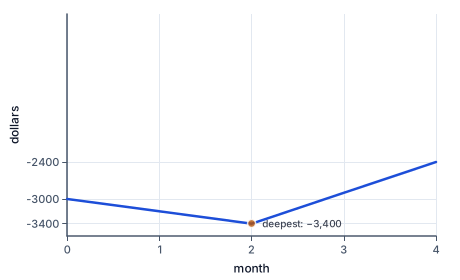
Neighborhood Kitchen is planning a catering van. It costs 3,000 dollars up front and 200 a month to run. For the first two months, while the catering round builds, it brings in nothing extra; after that, 700 a month of contribution.
The cash dip: 3,000 on day one, then 200 in each of the first two months, with nothing coming in. The low point is
$$3000 + 2 \times 200 = 3400 \text{ dollars}$$
the cash the kitchen must have before it buys the van. From month three the van recovers 700 − 200 = 500 a month, so it takes 3,400 ÷ 500 = 6.8 months of earning to get back to where the kitchen started: nearly nine months in all, counting the two that earned nothing.
A profitable step the business cannot fund to its low point is not safe to start. It will be abandoned, or rescued with expensive borrowing, before it pays.
Another way: table
The catering van's cash, month by month.
| Month | Cash in | Cash out | Running total |
|---|---|---|---|
| 0 | 0 | 3,000 | −3,000 |
| 1 | 0 | 200 | −3,200 |
| 2 | 0 | 200 | −3,400 |
| 3 | 700 | 200 | −2,900 |
| 4 | 700 | 200 | −2,400 |
Another way: steps
Write every cash movement on its date. The equipment on the day it is bought; wages from the first week; customers' payments on the day they will actually arrive, which for business customers may be thirty or sixty days after the work.
Find the low point. The running total is lowest just before the step's money starts arriving: the up-front cost plus every month's running cost until then, less any deposit.
Find the recovery. Each earning month adds the contribution less the running cost; divide the low point by that for the months to earn it back.
Compare with the cash available. The cash the business can set aside without breaking its buffer must be at least the low point.
Check by running the table month by month: the running total must reach the low point in the last unearning month and climb from there by the monthly recovery each month. If the table and the formula disagree, a month's cost or a payment date has been misplaced.
The dip gets smaller in three ways, and each has its own cost. Money in sooner: a deposit on a contract, payment on completion instead of sixty days later, a discount for paying early. Money out later: leasing equipment instead of buying it, supplier credit, hiring the new staff member a month after the contract starts rather than a month before. A smaller first step: one extra market day before two, a second-hand van before a new one.
Each is worth pricing. A 20 percent deposit on a 4,000 contract takes 800 off the low point and costs nothing but the asking. A lease that spreads a 3,000 van over three years takes most of the up-front cost out of the dip, in exchange for paying more in total, as the money course showed.
The most dangerous growth is profitable work from customers who pay late. An office-cleaning contract that pays sixty days after each month's work means two full months of wages paid before the first invoice arrives; if the contract grows, the dip grows with it, because each new month's wages go out before the previous month's invoice comes in. Businesses that win large, slow-paying customers are the ones that most often run out of cash while their order books look healthy.
The defense is to price the terms: a sixty-day contract needs its first two months' costs in cash, and the owner should know that figure before signing, and ask for shorter terms or a deposit if it is more than the business can carry.
If the cash on hand does not cover the low point, the step is not necessarily wrong; it needs funding arranged in advance. A line of credit sized to the low point, an equipment loan, a customer deposit, or the owner's own money put in: each can carry the dip. What must not happen is starting the step on the hope that the cash will stretch, and finding in month two that it does not.
Lenders are far more willing to fund a dip that has been calculated in advance, with its low point and recovery written down, than one that arrives as an emergency.
The cash for the low point must come from money the business can spare, not from the buffer it keeps against ordinary bad months. A step that needs 3,400 funded from a 4,000 balance, when the owner's rule is never to go below 1,500, needs 900 more from somewhere. Spending the buffer on growth leaves the business exposed to a slow month at exactly the moment it is most stretched.
A growth step's cash plan is most useful when it sits inside the business's whole cash forecast, not beside it. The step's dip does not happen in an otherwise empty account; it happens in months that also carry rent, wages, the sales tax return and perhaps a quiet season. A catering van whose low point is 3,400 may be easy to fund in March and impossible in August, when the kitchen's own trade is at its lowest and the quarterly tax payment falls due.
So the plan is laid month by month onto the existing forecast: the step's costs and payments added to each month's figures, and the new lowest balance read off. That new low point, not the step's own, is the figure to compare with the buffer. Sometimes the answer is simply to start the step two months later, when the business's own trade carries it.
Plans also slip. The months before a step earns are the ones owners most often underestimate: the catering round builds more slowly than hoped, the gift shops take longer to reorder, the new mechanic takes a month to reach full speed. Working the dip with one more unearning month than expected is a simple test of resilience. If the business can carry the dip with that extra month, the plan is robust; if one late month would break the buffer, the plan needs more funding or a smaller start before it begins.
Finally, the monthly recovery can disappoint. A step that recovers 500 a month in the plan may recover 350 in practice, stretching the months to earn back the low point by nearly half. None of this makes growth a bad idea. It makes the cash plan a working document, checked each month against what actually happened, with the funding kept in place until the running total has climbed back above zero.
A catering business won a contract to supply lunches to a regional hospital: about 9,000 dollars of sales a month at a healthy margin. The hospital paid on sixty-day terms. The caterer hired two extra cooks at about 5,500 a month and bought a second van for 14,000, and within ten weeks could not make payroll.
The arithmetic had been there all along. Van plus two months of the extra cooks and food before the first payment came to 14,000 + 2 × (5,500 + 2,700), about 30,400 — and the business had 12,000 in the bank. The contract was profitable, at about 800 of monthly recovery once payments flowed, but the owners had budgeted for its profit, not its cash.
Their bank agreed an emergency loan at a high rate, and the hospital, asked, agreed to pay on thirty days in future. When a second hospital offered a similar contract a year later, the owners worked the dip first — about 24,000 with a leased van and thirty-day terms — arranged a line of credit for it in advance, and asked for a 15 percent deposit, which the hospital paid. That contract never touched their buffer.
Surveys of small businesses that fail often find that many were profitable on paper when they closed. The common cause is growth funded from too little cash: more work taken on, more wages and materials paid out, and the customers' money still weeks away.
A profitable step pays for itself. Only after the dip, which must be funded first.
The purchase price is the cash needed. Add the running costs before the step earns.
Growth fixes a cash shortage. Growth usually deepens it first.
A big contract is always good news. Not if it pays late and the dip cannot be carried.
The buffer can fund the dip. The buffer is for bad months, not for growth.
If the step pays in the end, the cash will take care of itself. A step that pays over a year can still empty the account in its third month. The low point, not the final total, decides whether the business can take the step.
Funding can be found when the account runs low. Lenders are slowest to help a business that is already short. Arrange the line of credit or the owner's savings before the step begins, sized to the low point plus the buffer.
The plan will run to schedule. Work the dip with one more month before the step earns than expected, and with a lower monthly recovery. If the business survives both, the plan is robust.
Read the up-front cost.
$800$
Stall and scales.
Add the unearning month's running cost.
$1 \times 400 = 400$
Fees and a helper.
Find the low point.
$800 + 400 = 1200$
The cash to have before starting.
Find the monthly recovery.
$600 - 400 = 200$
Once it earns.
Find the months to earn it back.
$1200 \div 200 = 6$
Seven months in all, counting the first.
Read the up-front cost.
$1200$
Equipment for the offices.
Add the unpaid month's wages.
$1 \times 1500 = 1500$
Before the first payment.
Find the low point.
$1200 + 1500 = 2700$
Cash needed.
Find the monthly recovery.
$2100 - 1500 = 600$
Once payments flow.
Find the months to earn it back.
$2700 \div 600 = 4.5$
After it starts paying.
Ask for a deposit of 900.
$2700 - 900 = 1800$
A shallower dip.
Read the up-front cost.
$2500$
Molds, samples and a trade fair.
Add three unearning months.
$3 \times 300 = 900$
Gift shops order slowly at first.
Find the low point.
$2500 + 900 = 3400$
Cash needed.
Find the monthly recovery.
$1100 - 300 = 800$
Once orders arrive.
Find the months to earn it back.
$3400 \div 800 = 4.25$
After the first orders.
Compare with her spare cash.
$2800 \text{ above her buffer}$
600 short.
Arrange the gap in advance.
$\text{a 600 deposit from the first gift-shop order}$
The dip is funded before she starts.
Find the low point.
$500 + 2 \times 2000 = 4500$
Tools up front and two months' wages.
Find the monthly recovery.
$2500 - 2000 = 500$
Once the extra repairs flow.
Find the months to earn it back.
Maya's Ceramics is planning a wholesale range for gift shops. It costs $2500$ dollars up front and $300$ dollars a month to run. For the first $3$ month(s) it brings in nothing extra; after that it brings in $1100$ dollars a month of contribution. How much cash does the step need at its low point?
Answer:
Complete the worked solution: a caterer takes a corporate contract that needs $2700$ dollars of equipment up front and $300$ a month of extra staff. The client pays nothing for the first $1$ month(s), but agrees to a deposit of $600$ at the start. After that the contract brings $700$ a month of contribution. Plan its cash.
Add the up-front cost and the unpaid months' running costs.
$2700 + 1 \times 300 =$ a
The dip before the deposit.
Take off the deposit.
$(\text{dip}) - 600 =$ b
The low point with the deposit.
Take the running cost from the monthly contribution.
$700 - 300 =$ c
What each earning month recovers.
Divide the low point by the monthly recovery.
$(\text{low point}) \div (\text{recovery}) =$ t
Months to earn it back.
Check the cash on hand covers the low point.
$\text{cash set aside} \ge \text{low point}$
Otherwise arrange funding before starting.
Northside Repairs is planning a second mechanic. It costs $500$ dollars up front and $2000$ dollars a month to run. For the first $2$ month(s) it brings in nothing extra; after that it brings in $2500$ dollars a month of contribution. At its low point it has used $4500$ dollars. Once it starts earning, how many months does it take to earn that back?
Answer:
Monica's Market Stall is planning a second market pitch. It costs $800$ dollars up front and $400$ dollars a month to run. For the first $1$ month(s) it brings in nothing extra; after that it brings in $600$ dollars a month of contribution. The owner can set aside $1100$ dollars of cash for it. Can the business fund the step to its low point?
A bakery buys a second oven for $8$ hundred dollars. Running it costs $1$ hundred dollars a month; for two months it brings in nothing extra, then $4$ hundred a month. Plot the running total of cash, in hundreds of dollars, at the end of months $0$ to $4$.
Plot your answer on the grid:
Neighborhood Kitchen is planning a catering van. It costs $3000$ dollars up front and $200$ dollars a month to run. For the first $2$ month(s) it brings in nothing extra; after that it brings in $700$ dollars a month of contribution. Fill in its cash plan.
| Cash at the low point, dollars | Recovered a month, dollars | Months to earn it back | |
|---|---|---|---|
| The growth step |
A landscaper takes a city contract. Each month's work costs her $3900$ dollars in crew wages and fuel, paid that month, and the city pays each month's invoice of $5400$ two months later. Fill in the running cash total at the end of each of the first three months, in dollars, and what a $20$ percent advance on the first invoice would do to the low point.
| Amount | |
|---|---|
| End of month one | |
| End of month two | |
| End of month three | |
| Low point with the advance |
Lesson test: one question per skill, one attempt each, no hints. Your answers are checked when you submit.
Bright Home Cleaning is planning an office-cleaning contract paid sixty days in arrears. It costs $1200$ dollars up front and $1500$ dollars a month to run. For the first $1$ month(s) it brings in nothing extra; after that it brings in $2100$ dollars a month of contribution. Counting from the day it starts, how many months until the business is back where it started in cash?
Answer:
You can say how much cash a growth step needs before it pays, and for how long. Tell someone why a profitable contract can empty the bank. Next: equipment, people or price as ways to grow.
17. Your turn: Northside Repairs' second mechanic, step 3
$4500 \div 500 = 9$
Eleven months in all.