Back to the on-screen lesson ·
Which way the energy went, why the sign is written from the reaction's side, and what an energy profile holds.
Paper packet. Every task here also exists on screen, where it is checked automatically; answers written on paper are not assessed by Nydus. When you are back at a device, enter your answers there.
By the end of this lesson you will be able to say whether a change is exothermic or endothermic from any one of four things — the sign of its enthalpy change, what a thermometer does, which side holds more energy, or the words used to describe it — and to get the other three from it. You will also be able to read an energy profile: the activation energy from the reactants to the top of the hump, the enthalpy change from the reactants across to the products, and what a catalyst changes and what it leaves alone.
You can balance an equation and read its coefficients as a ratio of amounts. Every reaction you have balanced so far has been treated as though the only thing that mattered was what went in and what came out. Something else always happens as well: energy moves. This lesson is about which way it moved and how the movement is written down.
| Term | What it means |
|---|---|
| System | The reaction itself: the atoms that are rearranging. |
| Surroundings | Everything else: the rest of the mixture, the beaker, the bench, the air. |
| Exothermic | Giving energy out from the system to the surroundings. |
| Endothermic | Taking energy in from the surroundings into the system. |
| Enthalpy change | $\Delta H$: how much the system's energy changed, in kilojoules. |
| Activation energy | The energy colliding molecules need before they can react at all. |
Here is the sentence the whole unit rests on.
$$\Delta H = \text{energy of the products} - \text{energy of the reactants}$$
It is written from the system's point of view. If the products hold less than the reactants did, the system has lost energy, the subtraction comes out negative, and the energy that left has gone into the surroundings — so the beaker gets warmer.
That is four statements and they all agree:
Endothermic is the same four sentences with every word reversed: energy in, products hold more, $\Delta H$ positive, surroundings get colder.
The reason this catches people out is that the last of the four is the one you can feel and the first three are the ones you write down, and they appear to contradict each other. They do not. A beaker that gets hot is a beaker that has received energy, and it received it from the reaction, which therefore has less.
Nothing here is created or destroyed. An exothermic reaction does not make energy; it moves energy out of chemical bonds and into the motion of everything nearby. That is why conservation is the reason the temperature changes rather than a reason it should not.
Another way: picture
Think of the reaction as a bank account and the surroundings as your wallet. $\Delta H$ is the change in the account. Taking money out of the account is a negative change to the account and a fuller wallet. Nobody is confused about the signs when it is money; the only difficulty in chemistry is remembering whose balance is being reported.
Another way: steps
To decide the sign of any change:
Fix the point of view. Before anything, say out loud: the number describes the reaction, not the beaker.
Find one fact. You will be given one of four things — a sign, a temperature change, which side holds more energy, or a word. Start from whichever you have.
Read off the other three. Negative sign, surroundings warmer, products lower, exothermic — all four together. Positive, colder, higher, endothermic — all four together.
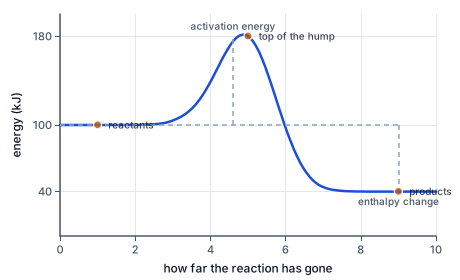
For a profile, read three heights: reactants, top of the hump, products. Activation energy is hump minus reactants. Enthalpy change is products minus reactants. The reverse barrier is hump minus products.
For an amount, scale: $\Delta H$ per mole times moles, keeping the sign.
Check the work. Do your four statements agree with each other? If you wrote exothermic and positive together, one is wrong. On a profile, is the activation energy positive? It always is — every reaction has a barrier. And does the reverse barrier equal the forward barrier minus the enthalpy change? It must, because both are measured to the same hump.
Writing $\Delta H$ from the system's side is a convention, and like driving on the right it only works if everyone follows it. Chemistry chose the system because the system is what an equation describes.
Reading all four facts from any one is allowed because energy is conserved. Whatever the system loses, the surroundings gain, so the system's sign fixes the surroundings' temperature change and the relative heights of the two levels.
Subtracting heights on a profile is allowed because each feature is a difference between two energies. Activation energy is a climb; enthalpy change is a step from one end to the other; neither depends on the absolute height of the drawing, only on the gaps.
Scaling $\Delta H$ by moles is allowed because the energy released is proportional to how much reacts. Twice as much methane burned releases twice the energy, with the same sign.
Treating a catalyst as moving only the hump is allowed because the two ends are properties of the substances, which the catalyst does not change.
An energy profile is a drawing of one reaction with energy up the page and progress across it. It has exactly three features worth reading.
The left-hand level is the energy of the reactants. The right-hand level is the energy of the products. The hump between them is the barrier that has to be climbed before any reacting can happen.
From those three heights come two different quantities:
| Quantity | Measured from | Measured to | What it tells you |
|---|---|---|---|
| Activation energy | the reactants | the top of the hump | how hard the reaction is to start |
| Enthalpy change | the reactants | the products | how much energy it gives out or takes in |
They are independent, and that independence is the interesting part. Gasoline and air sitting together in a fuel tank are an extremely exothermic mixture with a very tall hump, so nothing happens; a spark supplies the climb for a few molecules, those release enough energy to push the next ones over, and the whole mixture goes at once.
The reverse reaction is read off the same picture. It starts at the products and climbs to the same hump, so its activation energy is the height of the hump above the right-hand level, and its enthalpy change is the same number with the opposite sign.
The chart draws the methane profile worked below: reactants at 100 kJ, a hump at about 180 and products at 40. The activation energy is the climb of 80 kJ and the enthalpy change is the drop of 60.
A catalyst gives the reaction a different route with a lower hump. More of the colliding molecules have enough energy to get over a lower hump, so the reaction gets to where it was going in less time.
What a catalyst never does is move either end of the profile. The reactants are the reactants and the products are the products; their energies are properties of those substances and have nothing to do with the road taken between them. So $\Delta H$ is untouched.
This is worth saying plainly because the opposite claim sounds plausible and is not. A catalyst that increased the energy given out would be producing energy from nothing, and the reason to disbelieve it is conservation rather than chemistry.
One consequence that matters industrially: a catalyst lowers the hump in both directions by the same amount, so it makes the reverse reaction faster too. It changes when a reaction arrives, never where it arrives.
Every high school athletic trainer's bag holds instant cold packs, and each one is an endothermic reaction on demand. Inside the outer bag is solid ammonium nitrate and a separate pouch of water. Squeeze the pack, the water pouch bursts, and the ammonium nitrate dissolves.
Dissolving ammonium nitrate has $\Delta H = +26$ kJ per mole: the system takes energy in. It can only get that energy from its surroundings — the water it is dissolving in, the plastic, and the sprained ankle it is held against. A typical pack holds about 80 g of ammonium nitrate, which is $80 \div 80 = 1$ mol, so it absorbs about 26 kJ. That is enough to drop the water inside from room temperature to near freezing within a minute or two.
The instant hot pack on the same shelf runs the opposite chemistry. Many use calcium chloride dissolving, with $\Delta H$ about $-80$ kJ per mole, so the system gives energy out and the pack warms. The words on the two packages — instant cold and instant hot — describe the surroundings, the thing you feel. The signs a chemist writes describe the reaction. Both are correct, and the trainer reaching for the right pack is relying, without thinking about it, on the sign convention this lesson teaches.
A match head is a strongly exothermic mixture that sits safely in its box because its activation energy is high. Striking supplies the climb through friction, and the heat released by the first molecules to react carries the rest over the hump.
Reading the sign off the thermometer. The sign of an enthalpy change is written from the reaction's point of view and not from the thermometer's. An exothermic reaction gives energy out, so the reaction loses it and the number is negative — while the beaker it happens in gets warmer. The two statements agree; they are about different things.
Taking the hump for the enthalpy change. The activation energy is the height of the barrier and the enthalpy change is the difference between the two ends. A reaction can have a tall barrier and a tiny enthalpy change, or a small barrier and an enormous one.
Thinking an exothermic reaction makes energy. It moves energy that was already there, out of the chemical bonds of the reactants and into everything nearby. Nothing is created.
Thinking a catalyst changes how much energy comes out. It changes the route, not the destination. Both ends of the profile stay exactly where they were.
Expecting endothermic reactions to be rare or strange. Dissolving ammonium nitrate, decomposing limestone and photosynthesis are all endothermic, and the last of those is the reaction most of the life on this planet depends on.
Feel the hand warmer.
$\text{the pouch gets hot}$
Start with what you can feel.
Locate where energy arrived.
$\text{the surroundings: pouch and hand}$
So it left the system.
Write the sign.
$\text{crystallizing: } \Delta H < 0$
Exothermic.
Feel the cold pack.
$\text{ammonium nitrate dissolves; pack goes cold}$
The same reasoning reversed.
Write its sign.
$\Delta H = +26 \text{ kJ/mol}$
The surroundings are the ones paying.
Read the three heights.
$100, \ 180, \ 40 \text{ kJ}$
Reactants, hump, products.
Find the activation energy.
$180 - 100 = 80 \text{ kJ}$
Reactants up to the hump.
Find the enthalpy change.
$40 - 100 = -60 \text{ kJ}$
The sign falls out of the subtraction.
Name the kind of change.
$\text{negative: exothermic}$
What a gas stove is for.
Find the reverse barrier.
$180 - 40 = 140 \text{ kJ}$
From the products up.
Check the relationship.
$140 = 80 - (-60)$
Reverse barrier is forward minus the enthalpy change.
Read the uncatalyzed heights.
$50, \ 170, \ 20 \text{ kJ}$
Reactants, hump, products.
Find the old barrier.
$170 - 50 = 120 \text{ kJ}$
Without the catalyst.
Lower the hump.
$170 - 45 = 125 \text{ kJ}$
The catalyst's whole effect.
Find the new barrier.
$125 - 50 = 75 \text{ kJ}$
A lower hill.
Find the enthalpy change.
$20 - 50 = -30 \text{ kJ}$
With or without the catalyst.
Find the new reverse barrier.
$125 - 20 = 105 \text{ kJ}$
Lowered by the same 45 kJ.
State what changed.
$\text{speed, not energy released}$
Both ends stayed put.
Find the activation energy.
$200 - 60 = 140 \text{ kJ}$
From the reactants up to the top.
Find the enthalpy change.
$150 - 60 = +90 \text{ kJ}$
Products minus reactants.
Name the kind of change.
For ethanol burning in a spirit burner the enthalpy change is $-1367$ kJ. A thermometer is left in the mixture. What does it do?
Complete the worked solution: an energy profile has its reactants at sixty kilojoules, the top of its hump at two hundred, and its products at one hundred fifty. Find the activation energy, the enthalpy change, and the activation energy of the reverse reaction.
Find the activation energy.
$\text{two hundred} - \text{sixty} =$ a
Reactants up to the hump.
Find the enthalpy change.
$\text{one hundred fifty} - \text{sixty} =$ h
Positive, so endothermic.
Find the reverse barrier.
$\text{two hundred} - \text{one hundred fifty} =$ r
Same hump, other starting level.
Each of these six statements describes a change. Put each one under exothermic or endothermic.
| exothermic | endothermic | |
|---|---|---|
| The beaker gets warmer while the reaction runs | ||
| The products hold more energy than the reactants did | ||
| The enthalpy change is written with a minus sign | ||
| A lime kiln has to be heated the whole time or it stops | ||
| A hand warmer warms a pocket for an hour | ||
| Energy is taken in from the surroundings |
An energy profile is drawn for a reaction. The reactants sit at $79$ kJ, the top of the hump is at $183$ kJ, and the products sit at $134$ kJ. Give the activation energy, the enthalpy change, and the activation energy of the reverse reaction.
An energy profile: reactants on the left, one hump, products on the right.
Activation energy, in kJ:
Enthalpy change, in kJ:
Activation energy of the reverse, in kJ:
A natural gas furnace in a Chicago house burns methane: $\mathrm{CH_4 + 2O_2 \rightarrow CO_2 + 2H_2O}$, with $\Delta H = -890$ kJ per mole of methane. In one hour it burns $6$ mol. What is the enthalpy change of that hour's burning, in kJ?
The answer: a kJ.
A plant chemist is deciding whether a new catalyst is worth its price. Without it the reactants sit at $54$ kJ, the hump is at $135$ kJ and the products at $15$ kJ. The catalyst lowers the top of the hump by $22$ kJ and changes nothing else. Give the activation energy without the catalyst, the activation energy with it, and the enthalpy change of the catalyzed reaction.
Two profiles on one pair of axes: the same two ends, one hump lower than the other.
Activation energy without the catalyst, in kJ:
Activation energy with the catalyst, in kJ:
Enthalpy change with the catalyst, in kJ:
Lesson test: one question per skill, one attempt each, no hints. Your answers are checked when you submit.
Three changes, with the enthalpy change of each one already filled in. For every row, say whether it is exothermic or endothermic, what a thermometer left in the mixture does, and whether the products hold more or less energy than the reactants.
| enthalpy change, in kJ | exothermic or endothermic? | does a thermometer in it rise or fall? | do the products hold more or less energy? | |
|---|---|---|---|---|
| calcium chloride dissolving in water | -82 | |||
| limestone decomposing in a lime kiln | 178 | |||
| ethanol burning in a spirit burner | -1367 |
You can tell an exothermic change from an endothermic one and give the sign that goes with it, and you can read an activation energy and an enthalpy change off a profile. Say out loud what a thermometer does when a reaction has an enthalpy change of minus eighty kilojoules, and why the minus sign and the rising thermometer are not a contradiction. Next: turning a measured temperature rise into a number of kilojoules per mole.
15. Your turn: a profile has reactants at $60$ kJ, a hump at $200$ kJ and products at $150$ kJ. Give the activation energy, the enthalpy change, and say which kind of change it is., step 3
$\text{positive: endothermic}$
The surroundings would get colder.