Back to the on-screen lesson ·
The time in which half of a sample decays — a constant of the nuclide that nothing outside the nucleus can change — and the arithmetic of halving that follows from it.
Paper packet. Every task here also exists on screen, where it is checked automatically; answers written on paper are not assessed by Nydus. When you are back at a device, enter your answers there.
By the end of this lesson you will be able to work out how much of a sample is left after a given time, as a mass, a fraction and a percentage, and to go the other way — finding a half-life from two weighings and the time between them. You will also be able to say why the size of the sample never enters the calculation, and why nothing a chemist does to a sample changes its half-life.
You can predict which way an unstable nucleus is out of balance and write the equation for the decay that fixes it. What neither of those said is when. This lesson answers that, and the answer has a shape you have not met anywhere else in chemistry: a rate that nothing outside the nucleus can change.
| Term | What it means |
|---|---|
| Half-life | The time in which half of any sample of a nuclide decays. |
| Activity | How many nuclei decay per second; it halves over each half-life too. |
| Tracer | A small amount of a radioactive nuclide placed on purpose to be followed. |
| Share left | The fraction of the original still undecayed. |
| Elapsed time | How long the sample has been left. |
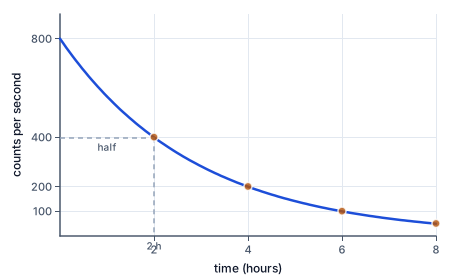
A detector beside a radioactive sample counts its decays each second.
| Time (hours) | Counts per second |
|---|---|
| 0 | 800 |
| 1 | 566 |
| 2 | 400 |
| 3 | 283 |
| 4 | 200 |
| 6 | 100 |
| 8 | 50 |
Find the shape before it is named. How long does the count take to fall from 800 to 400? From 400 to 200? From 200 to 100? Compare the three answers.
If the sample lost a fixed number of decays per second each hour, the drops would be equal. They are not — the first hour costs 234 counts and the seventh costs 25 — and yet the three intervals you measured are identical.
Now the strange part. The time to fall from 800 to 400 is measured again under four conditions.
| What was different | Time to halve |
|---|---|
| nothing | 2 hours |
| ten times as much | 2 hours |
| heated to 300 °C | 2 hours |
| dissolved as a different compound | 2 hours |
Everything a chemist reaches for to change a rate changes nothing here. What does that say about where the decay happens?
Take any sample of a radioactive nuclide. After a certain time, half of it will have decayed. Take the half that is left and wait the same time again: half of that will have decayed. And again, and again.
That time is the half-life, and three things about it are worth stating separately because each one surprises somebody.
It does not depend on how much you started with. A microgram and a kilogram of the same nuclide both halve in the same time. This is not true of anything else that empties — a big bathtub takes longer to drain than a small one — and it is true here because every nucleus decays independently, with a fixed chance per second, and a fixed chance per nucleus makes a fixed share per second.
Nothing you can do to the sample changes it. Not heating it, not cooling it, not compressing it, not dissolving it, not burning it into a different compound. Chemistry moves electrons, and the energies involved are millions of times too small to reach the nucleus. A catalyst speeds a reaction up; nothing whatever speeds up a decay.
It never reaches zero. Halving something always leaves something. In practice a sample is called gone after about ten half-lives, when a thousandth of it is left, but the arithmetic itself never arrives at nothing.
So the calculation is always the same two questions: how many half-lives have passed? and what is a half that many times over?
Another way: picture
Picture a very large crowd of people, each of whom tosses a coin once a minute and leaves if it comes up heads. After the first minute about half have gone. After the second, about half of those who stayed. Nobody is keeping count of the crowd and nobody decides when to leave; each person's coin is their own. That is why the share is fixed and the number is not, and why shouting at the crowd changes nothing.
Another way: steps
To do any half-life calculation:
Find the number of half-lives. From a time: elapsed time divided by the half-life. From two masses: halve the first repeatedly, counting, until you reach the second.
For the share left, multiply one half by itself that many times: $\tfrac{1}{2}$, $\tfrac{1}{4}$, $\tfrac{1}{8}$, $\tfrac{1}{16}$. As a percentage: 50, 25, 12.5, 6.25.
For the mass or activity left, multiply the starting amount by the share.
For the time taken, multiply the half-life by the number of half-lives.
For the half-life itself, divide the elapsed time by the number of half-lives.
Check the work. Is the amount left smaller than the amount at the start? It must be. Did the units match — the half-life and the elapsed time in the same unit before dividing? A half-life in hours and a time in days give nonsense until one is converted. And does each successive drop get smaller? If your table loses the same mass every row, you subtracted instead of halving.
Counting half-lives is allowed because the half-life is constant: the first halving and the tenth take the same time, so a total time is simply that many half-lives laid end to end.
Multiplying halves together is allowed because each half-life acts on whatever is left at its start. Half of a half is a quarter, half of that an eighth.
Ignoring the sample's size is allowed because each nucleus decays on its own, with a fixed chance per second. Double the sample and you double the decays per second, so the share lost per second stays the same.
Ignoring temperature, pressure and chemistry is allowed because none of them reaches the nucleus. The energies of chemical change are about a million times too small.
Dividing time by the number of halvings to find a half-life is the same relationship run backwards: total time equals half-life times count, so half-life equals total time over count.
A sample starting at 160 g:
| Half-lives passed | Share left | Mass left | Mass lost in that step |
|---|---|---|---|
| 0 | 1 | 160 g | — |
| 1 | 1/2 | 80 g | 80 g |
| 2 | 1/4 | 40 g | 40 g |
| 3 | 1/8 | 20 g | 20 g |
| 4 | 1/16 | 10 g | 10 g |
| 5 | 1/32 | 5 g | 5 g |
The last column is the one to look at. Each step loses half as much as the step before, which is what the same share each time means in grams. A learner who subtracts a fixed 80 g per half-life has the first row right and runs out of sample by the third, which is the error this table exists to prevent.
The shares as percentages turn up constantly and are worth knowing: 50, 25, 12.5, 6.25, 3.125.
That is the investigation's counter, drawn: every two hours the count halves, from 800 to 400 to 200 to 100, so each step down is half the size of the one before.
Half-life is not a nuisance to be worked around; it is the property something is chosen for.
A tracer put into a person wants a short half-life — hours, not years — so that it is gone soon after the picture has been taken. Technetium-99m has a half-life of 6 hours and is the most used nuclide in any hospital largely for that reason. Fluorine-18, at 110 minutes, is so short that it is made in a machine an hour's drive away and delivered against the clock, and carbon-11, at 20 minutes, has to be made in the building where it is used.
A source inside a sealed instrument wants a long one, so that it does not need replacing. The americium-241 in a smoke detector has a half-life of about 430 years, which is why the detector still works in twenty.
Waste is where the two pull against each other, and it is the whole of the argument about storing it. Cesium-137 and strontium-90 have half-lives of about 30 years, so they are intensely active and gone from the reckoning within a few centuries. Plutonium-239 has a half-life of about 24 000 years and technetium-99 about 211 000, so they are far less active per gram and have to be kept away from people for longer than any institution has ever lasted. Both facts follow from the same arithmetic, and neither is a reason to ignore the other.
None of those long half-lives is graded anywhere in this course: the school's unit registry has no year in it, so every half-life in an item is in seconds, minutes, hours or days.
Tens of thousands of nuclear medicine scans are done in the United States every day, and most use technetium-99m. A patient having a bone scan is injected with a small dose bound to a compound that collects where bone is growing or repairing — around a fracture, an infection or a tumor. A gamma camera then photographs where the technetium has gathered.
The half-life is the reason this nuclide is used. At 6 hours, it is long enough for the compound to travel to the bones and for the scan to be done a few hours after the injection, and short enough that the activity is mostly gone by the next day. After 24 hours, four half-lives have passed, so only $\tfrac{1}{16}$ of the original activity remains — about 6 percent — and the body excretes much of the rest besides.
The same half-life creates a supply problem. Technetium-99m cannot be stockpiled: a week's supply would be almost entirely gone before it was used. Hospitals instead receive generators holding molybdenum-99, which has a half-life of 66 hours and decays into technetium-99m. A technician draws off fresh technetium each morning, a process called milking the cow. When the few reactors that make molybdenum-99 shut down for repairs, American hospitals have had to postpone scans within days — a shortage that follows directly from the arithmetic of halving.
Carbon-14's half-life is about 5,730 years. A wooden tool with a quarter of the carbon-14 of living wood has been through two half-lives, so it is about 11,500 years old — the kind of age archaeologists have measured for early sites in the Americas.
The same mass is subtracted each half-life. A 160 g sample loses 80 g in the first half-life, so the next one takes it to nothing? No: the next one takes it to 40 g. The share is constant, not the amount, and that is the difference between halving and subtracting.
The sample is expected to run out. Two half-lives leave a quarter, ten leave about a thousandth, a hundred leave a number too small to write comfortably — and none of them leave nothing. "How long until it is completely gone" has no answer; "how long until it is below the level anyone cares about" does, and it is the question actually asked.
Something is thought to speed it up. This is the one worth arguing with, because everything else in chemistry can be pushed. Heating a sample makes its atoms move faster and does not touch its nuclei. There is no catalyst for radioactive decay, there is no way of making waste safe faster by chemistry, and that single fact is why the disposal problem is a problem at all.
Units are compared without converting. Six hours is longer than fifty-six seconds, and the number 56 is larger than the number 6. Put everything into one unit before ranking anything.
Half-life is confused with lifetime. A nuclide with a half-life of 8 days has not all gone in 16 days; a quarter of it is still there. And an individual nucleus has no schedule at all — it may decay in the next second or in a thousand years, and the half-life is a statement about a crowd of them rather than about any one.
Count the half-lives.
$24 \div 8 = 3$
Always turn the time into half-lives first.
Find the share left.
$\tfrac{1}{2} \times \tfrac{1}{2} \times \tfrac{1}{2} = \tfrac{1}{8}$
A half per half-life.
Read the starting mass.
$64 \text{ g}$
Any size would do.
Find the mass left.
$64 \div 8 = 8 \text{ g}$
The share of the start.
Account for the rest.
$56 \text{ g is now xenon-131}$
What decayed became the daughter.
Read the two masses.
$80 \text{ g} \to 5 \text{ g in } 24 \text{ h}$
The measurement.
Halve and count.
$80 \to 40 \to 20 \to 10 \to 5$
Counting is safer than a formula.
Count the halvings.
$4$
Four arrows.
Divide the time.
$24 \div 4 = 6 \text{ h}$
One half-life.
Check by multiplying.
$4 \times 6 = 24$
Back to the elapsed time.
Identify the nuclide.
$\text{technetium-99m}$
The hospital tracer.
Read the data.
$\text{fluorine-18}: 110 \text{ min}; \ 5.5 \text{ h later}$
Two different units.
Convert to one unit.
$5.5 \times 60 = 330 \text{ min}$
Minutes for both.
Count the half-lives.
$330 \div 110 = 3$
Time over half-life.
Find the share left.
$\tfrac{1}{8} = 12.5\%$
Three halvings.
Apply it to a dose.
$400 \div 8 = 50 \text{ units}$
From 400 units of activity.
Show the unconverted error.
$5.5 \div 110 = 0.05$
A meaningless count of half-lives.
Draw the lesson.
$\text{convert before dividing}$
Same unit on top and bottom.
Count the half-lives.
$220 \div 110 = 2$
Turn the time into half-lives first.
Find the share left.
$\tfrac{1}{4} = 25\%$
Two halvings.
Find the mass left.
Four nuclides, four half-lives, four different units. Put them in order, shortest half-life first.
Number the steps in order (write the number in the box):
Complete the worked solution: iodine-131 has a half-life of eight days. A sample of sixty-four grams is left for twenty-four days. Find the number of half-lives, the share left as a decimal, and the grams left.
Count the half-lives.
$\text{twenty-four} \div \text{eight} =$ h
Always turn time into half-lives first.
Find the share left.
$\text{one half, multiplied together that many times} =$ s
A half per half-life.
Find the mass left.
$\text{sixty-four} \times (\text{share}) =$ m
The rest is now stable xenon.
carbon-11 has a half-life of $20$ minutes. A sample of it is in a scanner fed by the cyclotron in the next building, and someone wants to know how long it takes for $4$ half-lives to pass. Answer in minutes.
Answer: unit: d / h / s / min
A sample of bismuth-212 is left for $244$ minutes, and its half-life is $61$ minutes. What percentage of the original amount is still there?
Answer: %
A hospital in Ohio injects a patient with technetium-99m for a bone scan, half-life $6$ hours. The dose starts at $240$ units of activity. How much activity is left in the patient's body $24$ hours later, ignoring what the body excretes?
The answer: a.
A technician working in a scanner's supply, which is made near by because it will not keep weighs out $96$ g of fluorine-18, leaves it, and finds $24$ g of it left $220$ minutes later. Nobody has told them the half-life. Work it out, in minutes.
Answer: unit: d / h / s / min
Lesson test: one question per skill, one attempt each, no hints. Your answers are checked when you submit.
A sealed sample holds $192$ g of barium-137m, whose half-life is $153$ seconds. The elapsed times are filled in for you. Work out how much is left at each one.
| time elapsed, in seconds | mass of barium-137m left, in g | |
|---|---|---|
| at the start | 0 | 192 |
| after one half-life | 153 | |
| after two half-lives | 306 | |
| after three half-lives | 459 | |
| after four half-lives | 612 |
You can turn a time into a number of half-lives and halve a sample that many times, and you can recover a half-life from two masses and an elapsed time. Say out loud why a 160 gram sample does not run out after two half-lives, when it lost 80 grams in the first one. Next: where the energy of a nuclear change comes from, and what ionizing radiation does when it reaches something living.
16. Your turn: 96 g of fluorine-18, half-life 110 minutes. How much is left after 220 minutes, and what share is that?, step 3
$96 \div 4 = 24 \text{ g}$
A quarter of the start.