Back to the on-screen lesson ·
Why some nuclei last forever and others do not, and how the two numbers in a nuclear symbol predict which decay a nucleus will undergo.
Paper packet. Every task here also exists on screen, where it is checked automatically; answers written on paper are not assessed by Nydus. When you are back at a device, enter your answers there.
By the end of this lesson you will be able to read the mass number and the atomic number off a nuclear symbol and turn them into a count of protons, neutrons and electrons. You will be able to say why a heavy nucleus needs more neutrons than protons to hold together, why no nucleus above atomic number 82 is stable at all, and — given those two numbers — predict whether a nuclide will shed an alpha particle, turn a neutron into a proton, or simply lose energy as a gamma ray.
You know that an atom is a nucleus of protons and neutrons with electrons around it, that the number of protons is what makes it the element it is, and that isotopes of one element differ in their neutrons alone. You also know what a relative atomic mass is and why chlorine's is not a whole number. This lesson asks a question none of that answered: why are some of those isotopes there forever and others are not?
| Term | What it means |
|---|---|
| Nuclide | One particular nucleus: an element with a stated number of neutrons. |
| Mass number | Protons plus neutrons; the top number of the symbol. |
| Atomic number | Protons alone; the bottom number of the symbol. |
| Unstable | Able to change on its own; also called radioactive. |
| Decay | The change an unstable nucleus undergoes. |
| Daughter | The nucleus a decay leaves behind. |
A nucleus is a crowd of protons and neutrons pressed together. Two things are going on in it at once, and they pull in opposite directions.
So a small nucleus is easy to hold together: everything is somebody's neighbor. A large one is not, because the repulsion adds up across the whole thing while the attraction does not.
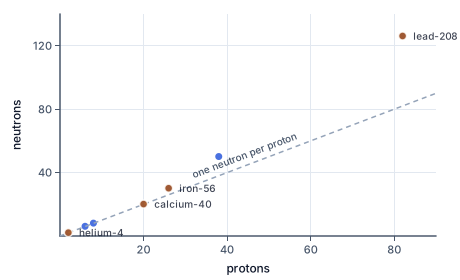
Neutrons are the fix. A neutron attracts its neighbors and repels nothing, so adding neutrons buys a nucleus room. That is why the stable nuclides drift away from one-neutron-per-proton as they get heavier: helium-4 and carbon-12 and oxygen-16 have exactly as many neutrons as protons, iron-56 has four spare, and lead-208 has forty-four.
And it is why the drift runs out. Past atomic number $82$ — past lead — no arrangement of neutrons is enough, and every nuclide decays.
That gives the whole rule, in two lines:
A third mode does not fix a balance at all. A nucleus left holding surplus energy after one of the other two sheds it as a gamma ray: no particles leave, so neither number changes.
Another way: picture
Picture the protons as magnets that push each other apart no matter how far apart they are, and the neutrons as sticky padding that holds whatever it is touching. A small pile needs no padding. A big pile needs a great deal, packed between the magnets. Past a certain size no amount of padding helps, because the pushing reaches all the way across the pile and the stickiness only reaches next door.
Another way: steps
To predict what an unstable nuclide does:
Read the symbol. The top number is the mass number, $A$; the bottom is the atomic number, $Z$. If only a name like carbon-14 is given, the number after the dash is $A$ and the periodic table gives $Z$.
Count the particles. Protons $= Z$. Neutrons $= A - Z$. Electrons in the neutral atom $= Z$.
Ask the heavy question. Is $Z$ above 82? Then the nucleus is too heavy: alpha decay, $A$ down by 4 and $Z$ down by 2.
Ask the neutron question. If not, compare the neutrons with the stable isotope of the same element. More neutrons: beta-minus decay, $A$ unchanged and $Z$ up by 1.
Name the daughter. Look up the element with the new $Z$; that is what the nucleus has become.
Check the work. Neutrons should never come out negative or larger than the mass number. For an alpha decay, the daughter's $A$ and $Z$ plus the alpha's 4 and 2 must give back the parent's. For a beta decay, $A$ must be unchanged. And the daughter of a beta decay should be one place to the right in the periodic table; of an alpha decay, two places to the left.
Reading protons from the atomic number is allowed because that is what the atomic number is defined to count, and it is what makes the element the element.
Subtracting to get neutrons is allowed because the mass number counts every particle in the nucleus, and protons and neutrons are the only two kinds.
Predicting alpha decay above 82 is allowed because measurement has found no stable nuclide there, and the reason is the competition between long-range repulsion and short-range attraction described above.
Predicting beta-minus for a neutron-rich nucleus is allowed because turning a neutron into a proton moves the nucleus toward the stable ratio without changing its size.
Trusting the numbers over the setting is allowed because chemical energies are about a million times too small to reach into a nucleus. Where a nuclide is found, and what compound it is part of, cannot change what its nucleus does.
Every nuclide in this column is stable. Watch what the last column does.
| Nuclide | Protons | Neutrons | Neutrons beyond one per proton |
|---|---|---|---|
| helium-4 | 2 | 2 | 0 |
| carbon-12 | 6 | 6 | 0 |
| oxygen-16 | 8 | 8 | 0 |
| calcium-40 | 20 | 20 | 0 |
| iron-56 | 26 | 30 | 4 |
| strontium-88 | 38 | 50 | 12 |
| lead-208 | 82 | 126 | 44 |
Calcium-40 is the heaviest stable nuclide that still manages one neutron per proton; after it the surplus never comes back to zero, and by lead it is forty-four.
Lead-208 is the heaviest stable nucleus there is. The element after it, bismuth, was counted as stable for a century before anyone measured its half-life; it does decay, and it takes about a billion times the age of the universe to get round to it. Past that the decays are quick enough to notice, and every element beyond bismuth in the periodic table is on this page rather than that one.
Plotted, the same table is a band that starts on the line of one neutron per proton and bends further and further above it as the nuclei get heavier.
The second lesson of this course argued that a chemical equation has to balance because atoms are rearranged and never created. A nuclear change breaks that rule flatly: an atom of uranium becomes an atom of thorium, and the uranium atom is gone.
What has happened is not that conservation stopped applying. It is that the quantity being conserved has changed. In a chemical equation it is the number of atoms of each element. In a nuclear one it is the mass number and the atomic number, and those two are conserved exactly as strictly as atoms ever were.
That is the next lesson, and the reason to say it here is that it explains why the decay modes take the form they do. An alpha particle is $\mathrm{^{4}_{2}He}$ and takes exactly 4 and 2 away with it. A beta-minus particle is $\mathrm{^{0}_{-1}e}$ and takes 0 and $-1$ away, which is the same as leaving the mass number alone and putting the atomic number up by one. The numbers on the emitted particle are not decoration; they are the accounting.
The EPA estimates that radon causes about 21,000 lung cancer deaths in the United States each year, more than any cause but smoking, and the reason starts with this lesson's rule. Uranium-238 is spread through ordinary rock and soil. Its atomic number, 92, is above 82, so it decays — and its daughters decay in turn, a chain of fourteen steps that ends at stable lead-206.
One link in that chain is radium-226, atomic number 88, which sheds an alpha particle to become radon-222: mass number down by four, atomic number down by two, to 86. Every other member of the chain is a solid that stays in the rock. Radon is a noble gas. It seeps up through cracks in a foundation and collects in basements, where people breathe it.
Radon-222 is itself above 82, so it decays by alpha emission too, to polonium-218, which is a solid that lodges in the lungs and keeps decaying there. The alpha particles do the damage at close range. That is why a radon test kit, sold in hardware stores and required in many states when a house is sold, measures the gas in picocuries per liter, and why the EPA recommends fixing a home above 4. A typical fix is a fan that draws air from beneath the floor slab and vents it above the roof — a plumbing solution to a nuclear problem, entirely predicted by two numbers on a symbol.
An ionization smoke detector holds a tiny amount of americium-241, atomic number 95. Above 82, so it emits alpha particles, which ionize the air in a small chamber. Smoke disrupts the current those ions carry, and the alarm sounds.
Treating the mass number as a mass. A mass number counts particles in a nucleus and is always a whole number; a relative atomic mass is an average over the isotopes an element actually comes as, and almost never is. Chlorine has no atom of mass 35.5 in it. It has atoms of 35 and atoms of 37, in a fixed proportion, and 35.5 is what that mixture weighs on average.
Radioactivity is treated as a property of the element. It is a property of the nuclide. Carbon is not radioactive; carbon-14 is, and carbon-12 sitting beside it in the same lump of charcoal is not and never will be. Potassium in a banana is mostly potassium-39, which is stable, with a small and fixed share of potassium-40, which is not.
Something outside the nucleus is thought to change the rate. Nothing does. Heating a sample, freezing it, squeezing it, dissolving it, burning it into a different compound — none of it touches the nucleus, because the energies involved in chemistry are millions of times too small to reach in there. This is the single most useful fact in the unit and the next lesson but one leans on it entirely.
A nucleus is expected to reach stability in one step. Uranium-238 does not become lead in one decay; it takes fourteen of them, and every nuclide along the way is unstable too. A decay makes a nucleus less unbalanced, not balanced.
Beta-minus is read as the atomic number falling. The electron carries a charge of $-1$ away, which leaves the nucleus one charge more positive. The atomic number rises.
Read the symbol.
$\mathrm{^{226}_{88}Ra}: A = 226, \ Z = 88$
Top is mass number, bottom atomic number.
Ask the heavy question.
$88 > 82$
Too heavy to be stable at all.
Choose the mode.
$\text{alpha decay}$
The only way to get smaller.
Change both numbers.
$A: 226 - 4 = 222; \ Z: 88 - 2 = 86$
Four particles, two protons.
Name the daughter.
$Z = 86: \text{radon}$
A different element.
Read the symbol.
$\mathrm{^{14}_{6}C}: A = 14, \ Z = 6$
A light nucleus.
Ask the heavy question.
$6 < 82$
Not too heavy.
Count the neutrons.
$14 - 6 = 8$
Mass number minus atomic number.
Compare the stable isotope.
$\text{carbon-12 has } 6$
Two neutrons too many.
Choose the mode.
$\text{beta-minus: } A = 14, \ Z = 7$
A neutron becomes a proton.
Name the daughter.
$Z = 7: \text{nitrogen}$
The total particle count never moved.
Read the symbol.
$\mathrm{^{238}_{92}U}$
The start of a long chain.
Ask the heavy question.
$92 > 82: \text{alpha}$
Too heavy.
Find the first daughter.
$\mathrm{^{234}_{90}Th}$
Four and two off.
Count thorium's neutrons.
$234 - 90 = 144$
Still heavy, and now neutron-rich.
Choose the second mode.
$\text{beta-minus}$
Alpha decay left too many neutrons.
Find the second daughter.
$\mathrm{^{234}_{91}Pa}$
Same mass number, one more proton.
Read the lesson.
$\text{fourteen steps to lead-206}$
Each decay is less unbalanced, not balanced.
Ask the heavy question.
$38 < 82$
Always rule the heavy case out first.
Compare the neutrons.
$90 - 38 = 52 \text{ against } 88 - 38 = 50$
Two more than the stable isotope.
Name the decay.
A sample of polonium-210 is sitting in a sealed container, and over the next few hours some of its nuclei will decay. Before working out what they turn into, match each of the three decay modes to what it does to the two numbers.
| the mass number falls by four and the atomic number by two | the mass number does not change and the atomic number rises by one | neither number changes; only energy leaves the nucleus | the mass number does not change and the atomic number falls by one | |
|---|---|---|---|---|
| alpha decay | ||||
| beta-minus decay | ||||
| gamma emission |
Complete the worked solution: uranium-238 has mass number two hundred thirty-eight and atomic number ninety-two. Its atomic number is above eighty-two, so it sheds an alpha particle. Find its neutrons, then the mass number and atomic number of what is left.
Count the neutrons.
$\text{two thirty-eight} - \text{ninety-two} =$ n
Mass number minus atomic number.
Lower the mass number.
$\text{two thirty-eight} - \text{four} =$ a
The alpha particle takes four.
Lower the atomic number.
$\text{ninety-two} - \text{two} =$ z
It takes two protons: thorium.
polonium-210, written $\mathrm{^{210}_{84}Po}$, has $84$ protons and $126$ neutrons. What happens to it?
Here are two isotopes of cobalt: $\mathrm{^{59}_{27}Co}$, which is stable, and $\mathrm{^{60}_{27}Co}$, which is not. They are the same element, so something other than the proton count has to be the difference. Fill the table in and find it.
| protons | neutrons | neutrons beyond one per proton | |
|---|---|---|---|
| $\mathrm{^{59}_{27}Co}$ | |||
| $\mathrm{^{60}_{27}Co}$ |
cobalt-60, $\mathrm{^{60}_{27}Co}$, is found in the machines that sterilize medical supplies. What is the atomic number of the nucleus it decays into?
The answer: a.
carbon-14 turns up in a piece of charcoal an archaeologist is dating. Its mass number is $14$ and its atomic number is $6$, and it carries more neutrons than the stable isotope of the same element does. What does a nucleus of it do?
Lesson test: one question per skill, one attempt each, no hints. Your answers are checked when you submit.
A symbol such as $\mathrm{^{90}_{38}Sr}$ carries two numbers: the mass number on top and the atomic number underneath. Take strontium-90 apart into the particles it is made of, and work out how many more neutrons than protons it carries.
| protons | neutrons | electrons in the neutral atom | neutrons beyond one per proton | |
|---|---|---|---|---|
| $\mathrm{^{90}_{38}Sr}$ |
You can take a nuclear symbol apart into protons and neutrons, and you can predict a decay mode from the two numbers rather than from having met the isotope before. Say out loud why carbon-14 decays and carbon-12 does not, when the two sit side by side in the same piece of charcoal. Next: writing the change down as an equation, where two counts are conserved instead of one.
15. Your turn: strontium-90, $\mathrm{^{90}_{38}Sr}$. The stable isotope of strontium is strontium-88. What does strontium-90 do?, step 3
$\text{beta-minus: } \mathrm{^{90}_{39}Y}$
Yttrium, with the same mass number.