Back to the on-screen lesson ·
Pressure, volume and absolute temperature for a fixed amount of gas, and the three named laws as three special cases of one equation.
Paper packet. Every task here also exists on screen, where it is checked automatically; answers written on paper are not assessed by Nydus. When you are back at a device, enter your answers there.
By the end of this lesson you will be able to work out any one of the pressure, volume or absolute temperature of a fixed amount of gas from the other five numbers of a two-state problem, by writing $p_1V_1/T_1 = p_2V_2/T_2$, crossing off the quantity that was held still and solving what is left. You will be able to say why every temperature in that calculation has to be in kelvin, and to check an answer's direction against what the physical change ought to do.
You can rearrange a simple equation to make any letter its subject, and you know that a mole is a count of particles. This lesson adds nothing about reactions at all. It is about one relationship between four quantities, and what happens to a gas when you change one of them and hold the others still.
| Term | What it means |
|---|---|
| Pressure | The force a gas exerts on each unit of area, here in kilopascals (kPa). |
| Volume | The space the gas occupies, in liters. |
| Absolute temperature | Temperature measured from the coldest possible, in kelvin (K). |
| Room conditions | About 293 K and 100 kPa, an ordinary lab bench. |
| Kilopascal | A thousand pascals; sea-level air is about 100 kPa. |
A fixed amount of gas has three measurable things about it: a pressure $p$, a volume $V$ and an absolute temperature $T$. They are not independent. For a fixed amount of gas,
$$\frac{pV}{T} \ \text{is the same number, whatever you do to it.}$$
Measure the gas once and work that number out; measure it again after any change, and you get the same number. So for two states of the same gas,
$$\frac{p_1V_1}{T_1} = \frac{p_2V_2}{T_2}.$$
That is the whole of this lesson. The three named laws are what is left when one of the three quantities does not change and cancels from both sides:
Three names, three special cases, one equation. If you remember the equation you never have to remember which name goes with which situation — you ask which quantity was held still, cross it off both sides, and what remains is the law you needed.
Another way: picture
Think of the molecules as a swarm of tiny balls bouncing off the walls, and pressure as how hard and how often they hit. Halve the volume and each ball has half as far to travel between hits, so it hits twice as often: twice the pressure. Double the absolute temperature and each ball moves faster, so it hits harder and more often: twice the pressure again, or twice the volume if the container can give way. Every one of the three laws is that same swarm seen from a different side.
Another way: steps
To work out any missing one of the six numbers:
List both states. Write $p_1$, $V_1$, $T_1$ and $p_2$, $V_2$, $T_2$, marking the unknown. Every temperature in kelvin, every pressure in kPa, every volume in liters.
Find what was held still. Read the situation: a sealed rigid can holds volume still; a balloon or a piston at the air's pressure holds pressure still; a slow change in a water bath holds temperature still.
Cross it off both sides of $p_1V_1/T_1 = p_2V_2/T_2$. If nothing was held still, keep all six.
Solve for the unknown by moving one factor at a time.
Check the work. The direction check is the one that catches almost every slip. Pressure and volume move opposite ways; temperature moves the same way as each of them. If a gas was squeezed and your pressure fell, or warmed and your volume shrank, a fraction is upside down. And check the size: a modest change in conditions — tens of kelvin, a doubling of pressure — gives a modest change in the answer, not a factor of a hundred.
Using one relationship for all cases is allowed because the three laws are measured facts about the same thing, and combining them gives $pV/T$ constant for a fixed amount of gas. Any special case follows by holding one quantity still.
Crossing off the held quantity is allowed because it appears identically on both sides; dividing both sides by the same nonzero number keeps the equation true.
Using kelvin is required because the relationship is a proportion. Doubling a kelvin temperature really does double the molecules' average energy of motion; doubling a Celsius temperature means nothing physical at all.
Ignoring which gas it is is allowed at ordinary conditions because the molecules are far apart and rarely interact, so the walls feel only how many hit and how fast — not what they are.
The direction check works because each law has a physical reason behind it, not just an algebraic one: fewer, slower or more spread-out molecules hit the walls less.
This is the one place in the unit where using the obvious number gives a badly wrong answer rather than a slightly wrong one.
Take a gas at $0$ °C and warm it to $10$ °C at constant pressure. If the Celsius numbers went into $V_1/T_1 = V_2/T_2$ we would be dividing by zero at one end and claiming the volume had grown by an infinite factor. Warm it from $10$ °C to $20$ °C instead and the same arithmetic claims the volume doubled. Both are nonsense, and they are nonsense for the same reason: the relationship is a proportion, and a proportion needs a scale whose zero is a real zero. Fahrenheit, used on every American weather report, fails for the same reason.
The kelvin scale has one. Its zero is the temperature at which the molecules have no energy of motion left to give up, and a gas extrapolated down to it would occupy no volume at all. A kelvin is the same size as a degree Celsius, so converting is an addition and never a multiplication:
$$T \text{ in K} = \theta \text{ in } {}^{\circ}\mathrm{C} + 273.$$
Room temperature, $20$ °C, is $293$ K. Ice melts at $273$ K. Water boils at $373$ K. Redo the first example properly: $273$ K to $283$ K is a rise of about four percent, and the volume grows by about four percent, which is what actually happens.
There is a second reason this course writes every temperature in kelvin and never converts one with the grader. The school's unit registry holds a conversion factor for every unit it knows, and a temperature is the one quantity whose conversion is an offset rather than a factor. So a temperature difference is a unit here and a temperature is not, and the safe thing — the thing this unit does — is to state every temperature in kelvin from the start.
Written out side by side, so that the family resemblance is visible rather than asserted:
| Held still | What cancels | What is left | What it says |
|---|---|---|---|
| temperature | $T$ | $p_1V_1 = p_2V_2$ | squeeze it and the pressure rises |
| pressure | $p$ | $V_1/T_1 = V_2/T_2$ | warm it and it expands |
| volume | $V$ | $p_1/T_1 = p_2/T_2$ | warm a sealed rigid can and the pressure rises |
| amount | — | $pV/T$ constant | the general case, all three free to change |
Two things are worth reading off it. First, pressure and volume move in opposite directions and everything else moves the same way: that one sentence gets the direction right every time, and the direction is what a wrong answer usually gets wrong.
Second, the amount of gas is held still in all four rows. Every one of these relationships is about a fixed quantity of gas in a sealed container. Let some out and none of them holds, which is the next lesson's subject: an amount of gas, and how a volume tells you what it is.
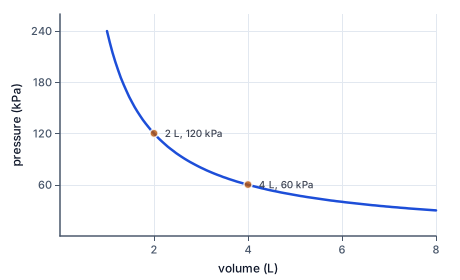
The chart is the first row of that table drawn out: one fixed amount of gas at one temperature, pressure against volume. Halve the volume from 4 L to 2 L and the pressure doubles from 60 to 120 kPa, and the curve never reaches either axis, because pressure times volume stays at 240.
Every new car sold in the United States since 2008 must have a tire-pressure monitoring system, a rule Congress passed after a series of rollover crashes linked to underinflated tires. Drivers in the northern states learn its habits quickly: the warning light comes on during the first cold snap of the year, even when nothing is leaking.
The gas law explains it. A tire is close to rigid, so its volume barely changes and the pressure is proportional to the absolute temperature. Fill a tire to 240 kPa absolute in a 300 K garage — about 80 °F — and leave it outside overnight in Minneapolis at 250 K, about −10 °F. The new pressure is $240 \times 250 \div 300 = 200$ kPa, a drop of a sixth.
A gauge at the gas station reads pressure above the outside air, about 100 kPa, so the drop on the gauge looks even bigger: from 140 kPa to 100 kPa, or roughly from 20 to 15 pounds per square inch. That is enough to trip the warning light. The fix is to add air when the tires are cold, which is why tire placards always specify the pressure "cold." Check them after an hour of highway driving and they read high, by the same proportion running the other way.
Aerosol cans carry the warning "do not store above 120 °F" because the gas inside is sealed at fixed volume. Heat a can from 293 K to 340 K and its pressure rises by about 16 percent, which is why a can left in a hot car is a real hazard.
Temperatures in degrees Celsius or Fahrenheit. The commonest and the worst. The relationship is a proportion, so the scale has to start at a true zero. Convert to kelvin before anything else happens, every time.
The proportion the wrong way up. Pressure and volume move in opposite directions; temperature moves the same way as both of them. If the gas was squeezed and your pressure came out lower, the fraction is inverted.
Forgetting that the amount is fixed. These relationships describe a sealed sample. A tire that has a slow leak is losing gas, and none of this applies to it.
Thinking a different gas behaves differently. Not here. Nothing in $pV/T$ names the substance, and hydrogen and chlorine follow it equally well at ordinary conditions, even though one molecule is thirty-five times heavier than the other. Where that stops being true is the last lesson of this unit.
Mixing pressure units. A tire gauge reads pounds per square inch above the outside air. Use absolute pressures in one unit throughout, or the proportion compares numbers on different scales.
Read the two states.
$200 \text{ kPa}, 6 \text{ L} \to 100 \text{ kPa}, ?$
About 33 feet down, then the surface.
Name what is held still.
$\text{temperature: } p_1V_1 = p_2V_2$
Before anything else.
Work out the product.
$200 \times 6 = 1200$
The number that does not change.
Divide by the new pressure.
$1200 \div 100 = 12 \text{ L}$
The bubble doubles.
Check the direction.
$\text{less pressure, more volume}$
Why divers never hold their breath while surfacing.
Read the two states.
$200 \text{ kPa at } 280 \text{ K} \to ? \text{ at } 315 \text{ K}$
An hour of driving warms it.
Name what is held still.
$\text{volume: } p_1/T_1 = p_2/T_2$
A tire is nearly rigid.
Work out the constant.
$200 \div 280 = 5/7$
Kept as a fraction, unrounded.
Multiply by the new temperature.
$5/7 \times 315 = 225 \text{ kPa}$
Pressure per kelvin times kelvin.
Check the direction.
$\text{warmer, higher pressure}$
When the volume cannot give.
Read what it means.
$\text{a rise of one eighth}$
Why tire pressures are specified cold.
Read the two states.
$100 \text{ kPa}, 10 \text{ L}, 300 \text{ K} \to 250 \text{ kPa}, ?, 450 \text{ K}$
A gas compressed and heated.
Name what is held still.
$\text{nothing: keep all six}$
The general case.
Write the relationship.
$V_2 = p_1V_1T_2 / (p_2T_1)$
Rearranged for the unknown.
Substitute the numbers.
$100 \times 10 \times 450 \div (250 \times 300)$
All in kPa, liters and kelvin.
Work out the top.
$450{,}000$
Numerator first.
Divide by the bottom.
$450{,}000 \div 75{,}000 = 6 \text{ L}$
The new volume.
Check both effects.
$\times 0.4 \text{ for pressure}, \times 1.5 \text{ for heat}$
Ten times 0.6 is six.
Name what is held still.
$\text{pressure: } V_1/T_1 = V_2/T_2$
Say what is held still first.
Scale by the temperatures.
$4 \times 270 \div 300$
New over old.
Work out the volume.
Consider a weather balloon climbing into thinner air. The gas starts at a pressure of $100$ kPa in a volume of $20$ L, and ends up in a volume of $80$ L with the temperature unchanged throughout. What is its pressure at the end, in kPa?
Answer: unit: Pa / atm / hPa / kPa
Complete the worked solution: about thirty-three feet down, a diver's bubble holds six liters at two hundred kilopascals and two hundred eighty kelvin. It rises to the surface, at one hundred kilopascals, where the water is two hundred ninety-four kelvin. Find the constant pressure times volume, the volume at the surface if the temperature had not changed, and the volume after the warming.
Work out the product.
$\text{two hundred} \times \text{six} =$ c
Pressure times volume, at first.
Divide by the new pressure.
$(\text{product}) \div \text{one hundred} =$ v
Less pressure, more volume.
Scale for the warming.
$(\text{that volume}) \times \text{two ninety-four} \div \text{two eighty} =$ w
Warmer gas, a little larger.
A fixed amount of gas — a car tire warmed by an hour on the highway — is measured twice. Before, its pressure is $p$, its volume $v$ and its temperature $t$; after, the same three are $q$, $w$ and $u$. The one relationship that holds for both measurements is $\dfrac{pv}{t} = \dfrac{qw}{u}$. Make $w$ the subject: write an expression for the second volume in terms of $p$, $v$, $t$, $q$ and $u$.
Answer:
Consider the air in a parked car's cabin warming in the sun. The gas occupies $3$ L at $290$ K, and its temperature then becomes $348$ K with the pressure unchanged. What volume does it occupy now? Answer in liters.
Answer: unit: L / cL / m3 / mL
A car's tires are filled to $240$ kPa in a heated garage in Minneapolis at $300$ K. Overnight the car sits outside and the tires cool to $280$ K. Treating each tire as rigid, what is the pressure in the morning, in kPa?
The answer: a kPa.
A safety engineer is writing the rating plate for a sealed vessel. The engineer knows the pressure $p$, volume $v$ and temperature $t$ at which a fixed amount of gas was sealed in, and the pressure $q$ and volume $w$ the vessel would reach in a fire. The plate needs the temperature $u$ at which that happens. From $\dfrac{pv}{t} = \dfrac{qw}{u}$, write an expression for $u$ in terms of $p$, $v$, $t$, $q$ and $w$.
Answer:
Lesson test: one question per skill, one attempt each, no hints. Your answers are checked when you submit.
Three samples of gas, each measured twice at an unchanged temperature. The first three numbers of every row are given. Work out the volume each one ends up in.
| pressure at the start, in kPa | volume at the start, in L | pressure at the end, in kPa | volume at the end, in L | |
|---|---|---|---|---|
| a bicycle pump with its outlet blocked and the handle pushed half-way in | 100 | 0.6 | 200 | |
| a gas syringe pushed in against a stopper | 100 | 0.1 | 250 | |
| a bubble of air rising from a diver toward the surface | 300 | 8 | 100 |
You can take a gas measured under one set of conditions and say what it does under another. Say what happens to the pressure in a sealed rigid can when it is warmed, and why the temperature in that calculation must be in kelvin. Next: how a volume of gas becomes an amount in moles, so that a balanced equation can use it.
15. Your turn: a balloon holds $4$ L of air at $300$ K. It is taken outside, where the temperature is $270$ K, and the pressure is the same indoors and out. What volume does it have now?, step 3
$3.6 \text{ L}$
Colder gas, smaller balloon.