Back to the on-screen lesson ·
Regions of electrons repel, so they spread out — and what is left over decides the shape and the bond angle.
Paper packet. Every task here also exists on screen, where it is checked automatically; answers written on paper are not assessed by Nydus. When you are back at a device, enter your answers there.
By the end of this lesson you will be able to count the regions of electrons round a central atom — bonds of any order as one region each, lone pairs as one region each — and use that count to give the shape of a small molecule and its bond angle, reducing the angle for each lone pair. You will also be able to say why a molecule built entirely of polar bonds can have no overall dipole, which is the fact the next unit rests on.
You can build the structure of a small molecule: which atom is in the middle, which atoms are joined to it, how many shared pairs each bond holds, and how many lone pairs are left over. What you cannot yet say is where any of it is. A structure drawn on paper is flat and a molecule is not, and this lesson is the step from one to the other.
| Term | What it means |
|---|---|
| Region of electrons | One bond, of any order, or one lone pair round the central atom. |
| Electron-pair repulsion | The regions push each other as far apart as they can. |
| Bond angle | The angle between two bonds meeting at the central atom. |
| Polar bond | A bond whose shared pair sits nearer one atom. |
| Overall dipole | A positive end and a negative end across the whole molecule. |
Electrons repel electrons. Round a central atom there are several places where electrons sit, and each of them pushes the others away, so they end up as far apart as the geometry allows. That is the entire model.
The counting rule is the part people get wrong, so it is worth stating flatly: a bond is one region whatever its order. A double bond holds two shared pairs and still counts as one region, because both pairs lie between the same two atoms and point the same way. A lone pair is one region too.
Count the regions and the arrangement follows:
| Regions | Arrangement | Angle |
|---|---|---|
| 2 | a straight line | $180^\circ$ |
| 3 | a flat triangle | $120^\circ$ |
| 4 | a tetrahedron | $109.5^\circ$ |
Then two corrections turn an arrangement of regions into a shape.
The shape is named for the atoms, not the regions. Ammonia has four regions arranged as a tetrahedron, but one corner holds a lone pair, and you cannot see a lone pair. What you see is nitrogen with three hydrogens below it: a pyramid. Water has four regions and two lone pairs, so what you see is bent.
A lone pair pushes harder. A bonding pair is held between two nuclei and is stretched thin between them; a lone pair is held by one nucleus and bulges out. So it takes up more angular room and squeezes the bonds together — about two and a half degrees per lone pair, which turns $109.5^\circ$ into $107^\circ$ for ammonia and $104.5^\circ$ for water.
Another way: picture
Tie four balloons together at their necks and let go. They do not need to be told anything: they arrange themselves so that no two are squashed against each other, and the knot ends up at the center of a tetrahedron. Now swap one balloon for a bigger one and the other three are pushed a little closer together. The bigger balloon is the lone pair.
Another way: steps
To get the shape of a molecule:
Build the structure. Find the central atom, its bonds and its lone pairs, as in the last lesson.
Count the bonding regions. One for each atom joined to the central atom, however many pairs the bond holds.
Count the lone pairs. Each is one region.
Add them for the arrangement. Two regions make a line, three a flat triangle, four a tetrahedron.
Name the shape from the atoms. With no lone pairs the shape is the arrangement; with lone pairs, look only at where the atoms are.
Correct the angle. About two and a half degrees off for each lone pair.
Check the work. Did the central atom's electrons balance — shared pairs plus twice the lone pairs equal its outer-shell count? Is the angle in the right band: near 180 for two regions, 120 for three, 109.5 or a little less for four? And did you count a double bond once rather than twice? A carbon dioxide molecule that comes out bent has had its double bonds counted as four regions.
Counting a multiple bond as one region is allowed because its pairs all lie in the space between the same two atoms. They cannot point in different directions, so for the purpose of pushing other regions away they act as one.
Arranging the regions as far apart as possible is allowed because like charges repel, and the arrangement with the largest angles between regions has the least repulsion and the lowest energy. Two points on a sphere are furthest apart opposite each other; three, at the corners of a flat triangle; four, at the corners of a tetrahedron.
Naming the shape from the atoms alone is allowed because shape is what experiments measure, and experiments locate atoms. A lone pair has no nucleus to detect, though its effect on where the atoms sit is plain.
Reducing the angle for lone pairs is allowed because a lone pair, held by one nucleus, sits closer to it and spreads wider than a bonding pair stretched between two. The measured angles — 107 degrees for ammonia, 104.5 for water — confirm it.
| Regions | Bonds | Lone pairs | Shape | Angle | Example |
|---|---|---|---|---|---|
| 2 | 2 | 0 | linear | $180^\circ$ | $\mathrm{CO_2}$ |
| 3 | 3 | 0 | trigonal planar | $120^\circ$ | $\mathrm{BF_3}$ |
| 4 | 4 | 0 | tetrahedral | $109.5^\circ$ | $\mathrm{CH_4}$ |
| 4 | 3 | 1 | trigonal pyramidal | $107^\circ$ | $\mathrm{NH_3}$ |
| 4 | 2 | 2 | bent | $104.5^\circ$ | $\mathrm{H_2O}$ |
Read the last three rows downwards. The arrangement of regions is the same tetrahedron every time; all that changes is how many corners of it hold an atom you can see. Four corners is a tetrahedron, three is a pyramid, two is a bend — one model, three names.
Two entries are worth a second look. $\mathrm{CO_2}$ has four shared pairs round the carbon and only two regions, because they are packed into two double bonds. And the ammonium ion $\mathrm{NH_4^+}$ is tetrahedral at $109.5^\circ$ rather than pyramidal at $107^\circ$: ammonia's lone pair has become a fourth bond, so there is no lone pair left to squeeze anything.
A bond between two different atoms is usually polar: one of them pulls the shared pair harder, so that end of the bond is slightly negative and the other slightly positive. That is a property of the bond.
Whether the molecule has a positive end and a negative end is a different question, and it is a question about shape. Each polar bond pulls in a direction; the molecule has an overall dipole only if those pulls fail to cancel.
This is the fact the next unit is built on, and it is the reason shape is taught before intermolecular forces rather than after. A learner who explains boiling points by bond polarity alone will get carbon dioxide badly wrong.
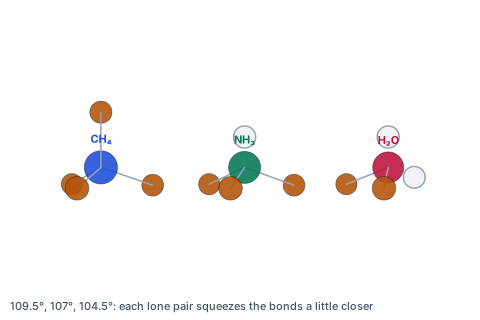
Methane, ammonia and water each have four regions of electrons round the central atom, so all three start from the same tetrahedron. In $\mathrm{CH_4}$ all four regions are bonds and the shape is the tetrahedron itself, $109.5^\circ$. In $\mathrm{NH_3}$ one region is a lone pair, drawn as a faint lobe; the three bonds make a trigonal pyramid, squeezed to $107^\circ$. In $\mathrm{H_2O}$ two regions are lone pairs and the two bonds make a bent shape at $104.5^\circ$. Turn each molecule: the regions always point to a tetrahedron's corners, but the atoms alone make the shape.
A microwave oven in an American kitchen heats food by acting on molecules with a positive end and a negative end, and the shape of the water molecule is what gives it one. Water is bent at 104.5 degrees, so its two polar O–H bonds do not cancel: the oxygen side is negative and the hydrogen side positive.
The oven's microwaves are an electric field reversing about 2.45 billion times a second. Each reversal tugs every water molecule round to line its dipole up with the field, and the molecules jostle their neighbors as they turn. That jostling is heat, and it is why a cup of water warms in a minute.
A glass or ceramic plate has no small, freely turning polar molecules, so it barely warms on its own; it gets hot mostly from the food sitting on it. Carbon dioxide, for all its polar bonds, would not heat either, because its linear shape cancels them. If water were linear — which is what you would predict if you forgot its two lone pairs — it would have no dipole, and the microwave in every American kitchen would not work at all.
Natural gas is mostly methane, a tetrahedral molecule with no dipole and no smell. Utilities add a tiny amount of a sulfur compound with a strongly polar, bent shape that the nose detects at parts per billion, so a leak can be noticed.
A double bond is counted as two regions. It is one. Both pairs lie between the same two atoms and point the same way, so they push as a single region. Carbon dioxide has four shared pairs round the carbon and is linear, which would make no sense if each pair were its own region.
Lone pairs are counted for the arrangement and then also named in the shape. Water is not described as tetrahedral. Four regions arrange themselves tetrahedrally; the shape names where the atoms are, and only two of the four corners hold one.
Lone pairs are left out altogether. Then water comes out with two regions and is predicted to be linear at $180^\circ$, which is the single most consequential wrong answer in this part of chemistry. A linear water molecule would have no dipole, would not dissolve salt, and would boil far below room temperature.
Polar bonds are taken to mean a polar molecule. They do not. Carbon dioxide is built of two very polar bonds and has no dipole, because the shape points them at each other.
The angle is explained by the size of the atoms. It is not. Methane and silane are both $109.5^\circ$, and silicon is a much bigger atom than carbon. What sets the angle is how many regions there are and how hard each of them pushes.
Find the central atom.
$\text{oxygen}$
It is bonded to both hydrogens.
Count the bonding regions.
$2$
One for each hydrogen.
Count the lone pairs.
$2$
Oxygen keeps four of its six electrons.
Add for the arrangement.
$2 + 2 = 4: \text{tetrahedron}$
The total sets the arrangement.
Name the shape and correct the angle.
$\text{bent}; \ 109.5 - 2 \times 2.5 = 104.5^\circ$
Two corners hold atoms; two lone pairs squeeze.
Find the central atom.
$\text{carbon}$
Joined to each oxygen by a double bond.
Check carbon's own electrons.
$4 \text{ shared pairs}, 0 \text{ lone pairs}$
All four of its electrons are in bonds.
Count the regions.
$2$
A double bond is one region.
Read the arrangement.
$\text{linear}, 180^\circ$
Two regions point opposite ways.
Check the bond polarity.
$\text{each C=O bond is polar}$
Oxygen pulls the shared pairs harder.
Decide the overall dipole.
$\text{none: the two pulls cancel}$
The shape, not the bonds, decides it.
Count ammonia's bonding regions.
$3$
Three hydrogens.
Count its lone pairs.
$1$
Nitrogen keeps two of its five electrons.
Add for the arrangement.
$3 + 1 = 4: \text{tetrahedron}$
Four regions.
Name the shape and angle.
$\text{trigonal pyramidal}, 107^\circ$
One corner holds the lone pair.
Add a hydrogen ion.
$\mathrm{NH_3} + \mathrm{H^+} \to \mathrm{NH_4^+}$
The lone pair becomes a fourth bond.
Count the ion's regions.
$4 \text{ bonds}, 0 \text{ lone pairs}$
No lone pair is left.
Name the ion's shape.
$\text{tetrahedral}, 109.5^\circ$
Nothing squeezes the bonds now.
Count the regions.
$3 + 1 = 4$
Bonds plus lone pairs gives the arrangement.
Name the shape from the atoms.
Correct the angle.
Match each molecule or ion to the shape its electron regions force it into.
| tetrahedral | trigonal pyramidal | linear | bent | |
|---|---|---|---|---|
| the ammonium ion, $\mathrm{NH_4^+}$ | ||||
| ammonia, $\mathrm{NH_3}$ | ||||
| carbon dioxide, $\mathrm{CO_2}$ | ||||
| water, $\mathrm{H_2O}$ |
Complete the worked solution: a central atom has $3$ bonds and $1$ lone pair(s). Find the number of regions, the angle that many regions would give if all were bonds, and the bond angle once the lone pairs squeeze it.
Count the regions.
$(\text{bonds}) + (\text{lone pairs}) =$ r
Each bond and each lone pair is one region.
Read the arrangement's angle.
$\text{tetrahedron} =$ t
Four regions point to a tetrahedron's corners.
Squeeze it for the lone pairs.
$(\text{that angle}) - \text{two and a half} \times (\text{lone pairs}) =$ a
A lone pair pushes harder than a bond.
Methane and ammonia both have four regions of electrons round the central atom. Methane's bond angle is $109.5^\circ$ and ammonia's is $107^\circ$. Why is ammonia's the smaller?
What is the bond angle in the oxonium ion, $\mathrm{H_3O^+}$? Answer in degrees.
Answer: degrees
ammonia, $\mathrm{NH_3}$, is the product of a Kansas fertilizer plant. Its central atom has $3$ bonds and $1$ lone pair(s). What is its bond angle, in degrees?
The answer: a degrees.
A paint workshop keeps four substances on a shelf and wants them sorted by whether the molecule has a positive end and a negative end, because that is what decides which of them will mix with water. Every bond in all four is polar. Sort them by whether those bond dipoles cancel out.
| the bond dipoles point opposite ways and cancel, so the molecule has no overall dipole | the bond dipoles do not cancel, so the molecule has a positive end and a negative end | |
|---|---|---|
| carbon dioxide, $\mathrm{CO_2}$, which is linear | ||
| water, $\mathrm{H_2O}$, which is bent | ||
| tetrachloromethane, $\mathrm{CCl_4}$, which is tetrahedral | ||
| ammonia, $\mathrm{NH_3}$, which is trigonal pyramidal |
Lesson test: one question per skill, one attempt each, no hints. Your answers are checked when you submit.
Take methane, $\mathrm{CH_4}$, apart: how many bonding regions there are round the central atom, how many lone pairs, how many regions altogether, and what bond angle that gives. Give the angle in degrees.
| value | |
|---|---|
| bonding regions round the central atom | |
| lone pairs on the central atom | |
| regions of electrons altogether | |
| bond angle, in degrees |
You can turn a structure into a shape and an angle. Say out loud why water is bent and carbon dioxide is straight when both have two atoms joined to a central one, and why carbon dioxide has no positive end even though both its bonds are strongly polar. Next: those dipoles, and the forces between whole molecules that they produce.
16. Your turn: the shape and bond angle of the oxonium ion, one oxygen bonded to three hydrogens with one lone pair left, step 2
$\text{trigonal pyramidal}$
Three corners hold hydrogens.
16. Your turn: the shape and bond angle of the oxonium ion, one oxygen bonded to three hydrogens with one lone pair left, step 3
$109.5 - 2.5 = 107^\circ$
One lone pair squeezes the bonds.