Back to the on-screen lesson ·
Measuring a concentration by reacting it away: moles from the buret, moles through the equation, and the concentration that comes back out.
Paper packet. Every task here also exists on screen, where it is checked automatically; answers written on paper are not assessed by Nydus. When you are back at a device, enter your answers there.
By the end of this lesson you will be able to work out an unknown concentration from a titer, a known concentration and a balanced equation, and to run the same chain backwards to predict the titer a titration should need. You will be able to balance a neutralization yourself and take the mole ratio off the front of it, to say why that ratio has to be written down even when it turns out to be one to one, and to read off a supplied curve the point at which the two solutions have exactly reacted.
You can get an amount in moles from a concentration and a volume, take an amount through a balanced equation's mole ratio, and turn an amount and a volume back into a concentration. This lesson puts those three together in one chain and gives them a piece of apparatus to live in. There is no new relationship in it at all.
| Term | What it means |
|---|---|
| Buret | A long graduated tube with a stopcock that delivers a measured volume drop by drop. |
| Titer | The volume the buret delivered: the final reading minus the first. |
| End point | Where the reaction is judged complete, by an indicator or a meter. |
| Concordant | Two titers close enough to be averaged. |
| Standard solution | The solution of known concentration, in the buret or the flask. |
Every titration calculation is the same three steps in the same order.
$$\text{volume} \times \text{concentration} \;\longrightarrow\; \text{moles} \;\xrightarrow{\;\text{equation}\;}\; \text{moles} \;\longrightarrow\; \frac{\text{moles}}{\text{volume}}$$
Run it in the other direction and the same three links predict the titer from two known concentrations, which is what you do before a titration rather than after.
The whole of the difficulty is step 2, and the whole of the danger is that step 2 is invisible when the ratio is one to one. Write the balanced equation down first, every time, even when you are sure.
Another way: picture
Think of the buret as a way of counting molecules by pouring. You cannot weigh the substance in the flask — it is dissolved, and most of what is in there is water — but you can keep adding something you can count until it has exactly used up whatever was there. The volume you had to add is the count, once the equation has told you the exchange rate.
Another way: steps
A worked chain: $20.0$ mL of $0.100$ mol/L sulfuric acid neutralizes $25.0$ mL of sodium hydroxide solution.
Assume one to one and you get $0.0800$ mol/L, which is exactly half and looks perfectly reasonable.
Write the balanced equation. Before any arithmetic, so the ratio is on the page.
Pick the known solution. The one whose concentration and volume you both have — usually the buret's.
Into moles. Concentration times volume in liters.
Through the equation. Multiply by the coefficient of the substance you want over the coefficient of the one you have.
Out of moles. Divide by the other solution's volume in liters for its concentration — or, if you are predicting a titer, divide by its concentration for the volume.
Check the work. A titration result should make sense against what you expected: a sodium hydroxide solution labeled roughly 0.1 mol/L that comes out at 0.0005 mol/L has lost a factor of a thousand somewhere. Check the ratio by asking which reagent needs more: if one mole of acid takes two of base, the base's moles must be the larger. And check the volumes are paired correctly — the buret's volume with the buret's concentration, the flask's with the flask's.
Multiplying concentration by volume is allowed because concentration is moles per liter, so liters times it is moles.
Using the equation's ratio is allowed because at the end point the two reagents have reacted in exactly the proportion the balanced equation states — that is what the end point means. Neither is left over, so their amounts stand in the coefficient ratio.
Dividing moles by the flask's volume is allowed because all the moles that reacted were in that flask, dissolved in that volume.
Running the chain backwards is allowed because each step is reversible: a product of two numbers can be divided by either to recover the other.
Averaging only concordant titers is allowed because their agreement shows they measure the same thing within the buret's precision. A titer far from the others has a mistake in it, and averaging a mistake in does not cancel it out; it spreads it into the answer.
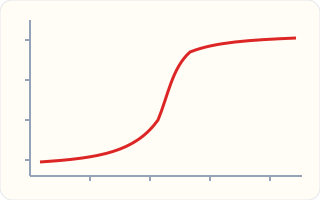
An indicator tells you the reaction is complete by changing color. A meter tells you the same thing by recording a reading after every addition, and the record is a curve.
The shape is the same in every case worth doing. It is nearly flat at first, because the contents of the flask are in large excess and a milliliter from the buret changes them hardly at all. Then it turns up sharply: the excess has nearly run out, so each further addition matters more. Then it climbs almost vertically through a short stretch, where a single drop changes the reading by more than the previous twenty milliliters did. Then it bends over and flattens again, because now what is coming out of the buret is in excess and further additions are just more of it.
The volume the calculation needs is the one under the middle of that steep climb. That is where the two have exactly reacted: the last of what was in the flask has gone and none of what is being added is yet in excess.
And the steepness is the point. If the curve rose gently all the way across, the volume could only be pinned down to within several milliliters and the concentration would be worth little. The steep stretch is what makes a titration an accurate measurement rather than an estimate.
The two curves in this lesson differ in how far that steep stretch runs. Why it is longer in one than the other is a question about the acid, and it is a Chemistry 2 question; here both curves are data to be read, and the part to look at is the same part on each.
A single titration result is not reported. The procedure is: one rough run to find roughly where the end point is, then repeated careful runs, and the careful ones are averaged — but only the ones that agree.
The reasons are all about error. The first run overshoots, because you do not yet know where to slow down. A buret is read to the bottom of the curved surface of the liquid, at eye level, and reading it from above or below gives a volume that is wrong by a consistent amount rather than a random one. The last drop may hang on the tip. A flask rinsed with water rather than with the solution it is about to hold dilutes its contents and changes the answer.
Each of those is a mistake that moves the result in a knowable direction, which is a more useful thing to know about an error than that it is large. Rinsing the buret with water rather than with the acid dilutes the acid, so more of it is needed, so the titer is too high, so the calculated concentration of the flask comes out too high as well.
This course teaches the procedure and does not observe anyone carrying it out. What it can assess is the arithmetic and the reasoning about which way a named mistake moves the answer, and that is what it asks.
Federal standards set by the Food and Drug Administration expect table vinegar to contain at least 4 grams of acetic acid per 100 milliliters, and state and company labs check it by titration. The method is exactly this lesson's chain.
An analyst pipets 10.0 mL of vinegar into a flask, adds a few drops of phenolphthalein indicator, and runs in sodium hydroxide at 0.500 mol/L from a buret until a faint pink color just stays. Suppose the buret reads 16.6 mL. Moles of sodium hydroxide: $0.500 \times 0.0166 = 0.00830$ mol. The equation $\mathrm{CH_3COOH + NaOH \rightarrow CH_3COONa + H_2O}$ is one to one, so the flask held 0.00830 mol of acetic acid. Divided by 0.0100 L, that is 0.830 mol/L.
To compare with the label, convert to grams: acetic acid's molar mass is 60 g/mol, so 0.830 mol/L is about 49.8 g/L, or 4.98 g per 100 mL — just under 5%, typical of a store brand. A result of 3% would mean the product was watered down and mislabeled.
The lab repeats the run until two titers agree within about 0.1 mL, because a single reading cannot be trusted. Rinsing the buret with water instead of with the base would dilute it, raise the titer, and make the vinegar look stronger than it is — a mistake that would pass a bad batch.
Agricultural extension labs at land-grant universities titrate soil extracts to measure acidity, and the result tells a farmer how many tons of lime per acre the field needs. The chain is the same: buret volume to moles, ratio, then a per-acre scale-up.
The mole ratio left out. The single largest source of wrong titration answers, and it is undetectable in the working: a calculation that assumes one to one for sulfuric acid and sodium hydroxide is out by exactly a factor of two and looks entirely reasonable. Write the balanced equation before you start.
The ratio applied upside down. One mole of sulfuric acid needs two of the base, so going from acid to base you multiply by two and going from base to acid you divide. Say the sentence out loud before you press a key.
Milliliters used as liters. A buret and a volumetric flask are both marked in milliliters, and every step of the chain wants liters. An answer out by a thousand comes from here and from nowhere else.
The two volumes confused. The buret's volume goes with the buret's concentration, and the flask's volume goes with the flask's. Mixing them gives a number with no meaning.
The rough titer averaged in. The first run is deliberately an overshoot. It is used to find the end point and then discarded.
Write the balanced equation.
$\mathrm{HCl + NaOH \rightarrow NaCl + H_2O}$
One to one, written down anyway.
Read the buret.
$24.0 \text{ mL at } 0.500 \text{ mol/L}$
The known solution.
Find the acid's moles.
$0.500 \times 0.0240 = 0.0120 \text{ mol}$
Liters before multiplying.
Apply the mole ratio.
$0.0120 \text{ mol of NaOH}$
One to one.
Divide by the flask volume.
$0.0120 \div 0.0250 = 0.480 \text{ mol/L}$
Twenty-five milliliters in liters.
Write the balanced equation.
$\mathrm{2HCl + Na_2CO_3 \rightarrow 2NaCl + H_2O + CO_2}$
Two of acid to one of carbonate.
Read the buret.
$30.0 \text{ mL at } 0.200 \text{ mol/L}$
Hydrochloric acid.
Find the acid's moles.
$0.200 \times 0.0300 = 0.00600 \text{ mol}$
Identical first step.
Apply the mole ratio.
$0.00600 \div 2 = 0.00300 \text{ mol}$
Want carbonate over have acid.
Divide by the flask volume.
$0.00300 \div 0.0250 = 0.120 \text{ mol/L}$
The carbonate's strength.
Compare the skipped ratio.
$\text{one to one gives } 0.240$
Twice the right answer, with no visible error.
Write the balanced equation.
$\mathrm{H_2SO_4 + 2NaOH \rightarrow Na_2SO_4 + 2H_2O}$
One acid to two base.
Read the flask.
$25.0 \text{ mL of NaOH at about } 0.10 \text{ mol/L}$
Its expected strength.
Find the base's moles.
$0.10 \times 0.0250 = 0.0025 \text{ mol}$
Concentration times liters.
Apply the mole ratio.
$0.0025 \div 2 = 0.00125 \text{ mol of acid}$
Want acid over have base.
Read the acid's strength.
$0.050 \text{ mol/L}$
In the buret.
Divide for the volume.
$0.00125 \div 0.050 = 0.025 \text{ L}$
Moles over concentration.
Convert to milliliters.
$25 \text{ mL}$
A sensible buret reading.
Find the acid's moles.
$0.200 \times 0.0150 = 0.00300 \text{ mol}$
Volume into liters before multiplying.
Apply the mole ratio.
Divide by the flask volume.
A titration was followed with a meter, which took a reading after every addition from the buret. The curve shows those readings: the reading runs up the left-hand axis and the volume added from the buret runs along the bottom. Mark the part of the curve that shows where one more drop changes the reading by the most.
This task has no paper form; do it on a device.
Complete the worked solution: twenty milliliters of sulfuric acid at one tenth of a mole per liter neutralizes twenty-five milliliters of sodium hydroxide solution. One mole of the acid takes two of the base. Find the acid's moles, the base's moles, and the base's concentration.
Find the acid's moles.
$\text{one tenth} \times \text{twenty thousandths of a liter} =$ a
Milliliters to liters first.
Apply the mole ratio.
$(\text{acid moles}) \times \text{two} =$ b
Two of base for each acid.
Divide by the flask volume.
$(\text{base moles}) \div \text{twenty-five thousandths} =$ c
Moles over liters.
A buret delivers $15$ mL of sulfuric acid, $\mathrm{H_2SO_4}$, at $0.2$ mol/L to react exactly with $25$ mL of potassium hydroxide solution, $\mathrm{KOH}$, whose concentration is not known. The balanced equation is $\mathrm{H_2SO_4 + 2KOH \rightarrow K_2SO_4 + 2H_2O}$. What is the concentration of the potassium hydroxide solution, in mol/L?
Answer: mol/L
Nobody has balanced this one for you. sulfuric acid neutralizes potassium hydroxide to give potassium sulfate and water. Balance the equation — and notice, when you have, that the ratio every calculation in this lesson needs is sitting in front of the first two formulas.
This task has no paper form; do it on a device.
Federal rules say table vinegar must be at least 4% acetic acid. A food-testing lab titrates $10.0$ mL of a store brand with sodium hydroxide at $0.500$ mol/L, and needs $15$ mL. The reaction is one to one. What is the acetic acid's concentration in mol/L?
The answer: a mol/L.
A water-treatment plant titrates a sample from every incoming tank, and an operator wants to know before starting roughly what the buret should read — a reading nothing like the prediction means something is wrong with the tank. Today's sample is $25$ mL of sodium hydroxide solution, $\mathrm{NaOH}$, expected to be at $0.08$ mol/L, to be titrated against sulfuric acid, $\mathrm{H_2SO_4}$, at $0.05$ mol/L. The equation is $\mathrm{H_2SO_4 + 2NaOH \rightarrow Na_2SO_4 + 2H_2O}$. What volume of the acid should be needed? Answer in milliliters.
Answer: unit: L / cL / m3 / mL
Lesson test: one question per skill, one attempt each, no hints. Your answers are checked when you submit.
A titration of potassium hydroxide solution, $\mathrm{KOH}$, against sulfuric acid, $\mathrm{H_2SO_4}$, at $0.1$ mol/L needed $25$ mL of the acid for $20$ mL of the base. The equation is $\mathrm{H_2SO_4 + 2KOH \rightarrow K_2SO_4 + 2H_2O}$. Fill in the three steps of the calculation. The first row is done for you.
| value | |
|---|---|
| volume of acid delivered, in L | 0.025 |
| amount of acid delivered, in mol | |
| amount of potassium hydroxide in the flask, in mol | |
| concentration of the potassium hydroxide solution, in mol/L |
You can turn a buret reading into a concentration, and a pair of concentrations into the buret reading to expect. Say out loud why a titration of sulfuric acid against sodium hydroxide that assumes a one-to-one ratio is out by a factor of two, and why the volume worth reading is the one under the steepest part of the curve.
15. Your turn: $15.0$ mL of sulfuric acid at $0.200$ mol/L reacted exactly with $25.0$ mL of potassium hydroxide solution. The equation is $\mathrm{H_2SO_4 + 2KOH \rightarrow K_2SO_4 + 2H_2O}$. What is the concentration of the base?, step 2
$0.00300 \times 2 = 0.00600 \text{ mol}$
One acid takes two base.
15. Your turn: $15.0$ mL of sulfuric acid at $0.200$ mol/L reacted exactly with $25.0$ mL of potassium hydroxide solution. The equation is $\mathrm{H_2SO_4 + 2KOH \rightarrow K_2SO_4 + 2H_2O}$. What is the concentration of the base?, step 3
$0.00600 \div 0.0250 = 0.240 \text{ mol/L}$
Moles over liters.