Back to the on-screen lesson ·
The flowchart from a molecule's shape to its point group, the meaning of the letters and subscripts, and the order of a group read from its label.
Paper packet. Every task here also exists on screen, where it is checked automatically; answers written on paper are not assessed by Nydus. When you are back at a device, enter your answers there.
By the end of this lesson you will be able to assign a molecule to its point group with the flowchart and read the order of the group from its label.
Lesson 20 named the five kinds of symmetry element, identity, proper axes, mirror planes, the centre of inversion and improper axes, and counted the operations they generate. You can find the principal axis of a molecule, tell a horizontal plane from a vertical one, and add up the order of a group. This lesson puts a name to the whole set, by asking a few questions in the right order.
| Term | What it means |
|---|---|
| Point group | The complete set of a molecule's symmetry operations, named by a short label such as $C_{2v}$. |
| $C_n$ group | A group built on an $n$-fold principal axis with no perpendicular twofold axes. |
| $D_n$ group | A group with $n$ twofold axes perpendicular to an $n$-fold principal axis; D stands for dihedral. |
| Subscript $h$ | The group contains a horizontal mirror plane, perpendicular to the principal axis. |
| Subscript $v$ | The group contains vertical mirror planes, containing the principal axis, but no horizontal one. |
| Subscript $d$ | The vertical planes run between the perpendicular twofold axes, bisecting the angles between them. |
| Cubic group | One of the groups of the regular solids, $T_d$ for the tetrahedron and $O_h$ for the octahedron, with several principal axes. |
| Flowchart | The fixed order of questions that leads from a molecule's shape to its point group. |
There are infinitely many molecules but only a few dozen point groups in ordinary chemistry, and each has a label that summarizes its symmetry. The label is found by asking questions in a fixed order; skipping or reordering them is the usual way to get it wrong.
1. Is the molecule linear? A linear molecule with a centre of inversion, like carbon dioxide, is $D_{\infty h}$; one without, like hydrogen chloride, is $C_{\infty v}$. 2. Is it one of the regular solids? A regular tetrahedron, like methane, is $T_d$; a regular octahedron, like sulfur hexafluoride, is $O_h$. These cubic groups have several principal axes at once. 3. Does it have a rotation axis at all? If not, it is $C_s$ if it has a mirror plane, $C_i$ if it has only a centre of inversion, and $C_1$ if it has nothing but the identity. 4. Find the principal axis, $C_n$. Then ask: are there $n$ twofold axes perpendicular to it? - If yes, it is a $D$ group. A horizontal plane makes it $D_{nh}$; otherwise $n$ planes between the twofold axes make it $D_{nd}$; with neither, it is $D_n$. - If no, it is a $C$ group. A horizontal plane makes it $C_{nh}$; $n$ vertical planes make it $C_{nv}$; with neither, it is $C_n$.
The label then carries the order of the group in its pattern. $C_n$ has $n$ operations; $C_{nv}$, $C_{nh}$ and $D_n$ have $2n$; $D_{nh}$ and $D_{nd}$ have $4n$. Water, $C_{2v}$, has $2 \times 2 = 4$; boron trifluoride, $D_{3h}$, has $4 \times 3 = 12$, as lesson 20 counted the long way. The cubic groups are fixed: $T_d$ has 24 and $O_h$ has 48.
The most common error is to stop too early. Boron trifluoride has a $C_3$ axis and three vertical planes, just as ammonia does, and a learner who stops there calls it $C_{3v}$. The next question, about perpendicular twofold axes, finds three of them lying along the bonds, and the one after finds a horizontal plane, the plane of the molecule. The group is $D_{3h}$, twice as large.
Another way: picture
Think of the flowchart as sorting a molecule through a series of gates. The first gates pull out the special shapes: lines, the regular solids, the molecules with no axis. Everything else arrives at a gate that asks about the principal axis and its perpendicular partners, which sends it left to the $C$ groups or right to the $D$ groups, and a last gate reads the mirror planes to choose the subscript.
Another way: steps
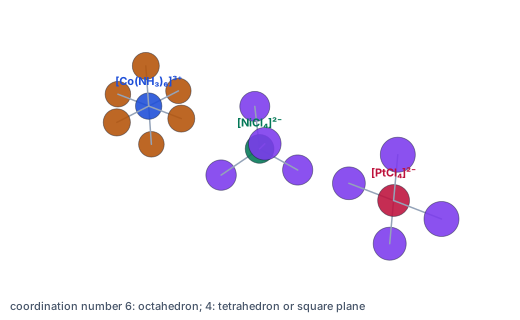
Coordination complexes cover most of the groups in the flowchart, and recognizing a few by sight saves time. A regular octahedral complex such as $\mathrm{[Co(NH_3)_6]^{3+}}$, treating each ammonia as a point, is $O_h$. Replace one ligand and the symmetry drops to $C_{4v}$: the principal axis runs through the odd ligand, and four vertical planes remain. Replace two, and the trans isomer is $D_{4h}$ while the cis isomer is only $C_{2v}$, which is the symmetry reason the two behave differently in the spectra of lesson 14.
A square-planar complex such as $\mathrm{[PtCl_4]^{2-}}$ is $D_{4h}$, and a tetrahedral one such as $\mathrm{[NiCl_4]^{2-}}$ is $T_d$. The tris-chelate complexes of lesson 9, such as $\mathrm{[Co(en)_3]^{3+}}$, are $D_3$: a threefold axis, three perpendicular twofold axes between the rings, and no mirror plane at all, which is exactly why they are chiral. The next lesson turns that observation into a rule.
Treating each ligand as a single point is a deliberate simplification. The hydrogens of an ammonia ligand, or the carbon chain of an ethylenediamine, lower the true symmetry of the whole complex, often all the way to a small group. For questions about the metal and the atoms bonded to it, such as the splitting of the d orbitals or the metal-ligand stretching bands, the simplified group is the one chemists use, because the outer atoms barely affect those properties.
Most molecules in biology and many in organic chemistry sit at the bottom of the flowchart. A molecule with four different groups on one carbon, such as bromochlorofluoromethane, has no symmetry at all besides the identity: it is $C_1$, with a group of order one. A molecule whose only symmetry is a single plane, such as hypochlorous acid, $\mathrm{HOCl}$, a bent molecule lying in its own plane, is $C_s$. One whose only symmetry is a centre of inversion is $C_i$.
These groups are small, but they matter. A $C_1$ molecule is always chiral and may be polar in any direction; a $C_s$ molecule is never chiral, because a mirror plane is enough to superimpose it on its reflection. Hydrogen peroxide, $\mathrm{H_2O_2}$, twisted like a partly opened book, keeps only a $C_2$ axis through the middle of the O-O bond, and so it is $C_2$: chiral in principle, though its two mirror forms turn into each other far too fast to separate.
Once a molecule is known to be in a $D$ group, the last question is where its mirror planes lie. If there is a horizontal plane, the group is $D_{nh}$, and its vertical planes then contain the perpendicular twofold axes. If there is no horizontal plane but there are vertical planes lying between the twofold axes, the group is $D_{nd}$, the $d$ standing for dihedral, bisecting.
Ethane shows the difference. In its eclipsed form, the hydrogens on the two carbons line up, and a horizontal plane halfway along the C-C bond reflects one end onto the other: $D_{3h}$. Turn one end by $60^\circ$ to the staggered form, the one ethane actually prefers, and that horizontal plane is lost, but three planes between the twofold axes remain and a centre of inversion appears: $D_{3d}$. The two conformations have the same order, twelve, but different operations, and different vibrational spectra.
Three checks catch most slips. First, count the operations the label predicts and compare with what you can find: $D_{3h}$ promises twelve, and if you can only find six, either the label is wrong or you have missed the perpendicular axes and the horizontal plane.
Second, the subscript must agree with the planes. A label with $h$ needs a plane at right angles to the principal axis; for a flat molecule whose principal axis stands perpendicular to it, that plane is the molecule's own plane. A $v$ label needs exactly $n$ vertical planes, no more. Third, a $D$ label needs exactly $n$ twofold axes perpendicular to the principal axis. A square-planar molecule with a $C_4$ axis must have four of them; if you have found only two, look along the diagonals, between the ligands.
When a molecule is distorted even slightly, its group drops to a smaller one. That is not an error in the flowchart but a real change in the molecule, and it is what the Jahn-Teller effect of lesson 14 does to a copper(II) octahedron, turning $O_h$ into $D_{4h}$ by stretching two opposite bonds.
When chemists in the 1970s set out to understand how chlorofluorocarbons reach the stratosphere and break down there, they relied on the infrared and ultraviolet spectra of the molecules involved, and every assignment of those spectra began with a point group. Dichlorodifluoromethane, $\mathrm{CCl_2F_2}$, is $C_{2v}$; trichlorofluoromethane, $\mathrm{CCl_3F}$, is $C_{3v}$. The point group fixes how many bands each molecule shows and which of them absorb, so the molecules can be identified and measured in air samples from a distance.
Satellite and ground-based instruments still track these compounds and their replacements in the atmosphere by their infrared bands. The analysis that turns a spectrum into a concentration starts where this lesson ends: with the point group of the molecule being looked for.
Chemists designing catalysts that make one mirror-image form of a drug rather than the other often build their ligands with $C_2$ symmetry. A ligand with a twofold axis but no mirror plane makes the metal's surroundings chiral while keeping the number of different ways a reactant can approach small, which makes the catalyst more selective.
William Knowles and Ryoji Noyori shared the 2001 Nobel Prize in Chemistry for catalysts of this kind, and Noyori's BINAP ligand, which has $C_2$ symmetry, is used to manufacture drugs and flavorings in one mirror-image form. The design principle is stated in point-group terms: keep the rotation axis, remove every mirror plane and improper axis.
The flowchart only works if every question is asked in order. Finding a $C_3$ axis and three vertical planes, a learner may write $C_{3v}$ at once, but boron trifluoride has those and more: three perpendicular twofold axes and a horizontal plane, which make it $D_{3h}$. The perpendicular axes are asked about before the planes precisely because they change the letter, not just the subscript.
The other common slip is calling the plane of a flat molecule vertical. A plane is horizontal or vertical relative to the principal axis, not to the page. For a flat molecule whose principal axis sticks straight out of it, the molecular plane is $\sigma_h$.
Rule out the special groups.
$\text{bent, three atoms}$
Not linear and not a regular solid.
Find the principal axis.
$C_2$
Bisecting the H-O-H angle.
Look for perpendicular twofold axes.
$\text{none}$
So it is a $C$ group.
Look for mirror planes.
$\text{no } \sigma_h, \ 2\sigma_v$
Two planes contain the axis.
Name the group and its order.
$C_{2v}, \quad h = 2 \times 2 = 4$
Matching lesson 20's count.
Rule out the special groups.
$\text{flat triangle}$
Not linear, not cubic.
Find the principal axis.
$C_3$
Perpendicular to the plane, through the boron.
Look for perpendicular twofold axes.
$3C_2$
One along each B-F bond: a $D$ group.
Look for a horizontal plane.
$\sigma_h$
The plane of the molecule, perpendicular to the $C_3$ axis.
Name the group.
$D_{3h}$
Not $C_{3v}$, which stopping early would give.
Count its operations.
$h = 4 \times 3 = 12$
The $D_{nh}$ pattern.
Picture the shape of $\mathrm{H_2C{=}C{=}CH_2}$.
$\text{two } \mathrm{CH_2} \text{ ends at right angles}$
The end groups are twisted by $90^\circ$ to each other.
Find the principal axis.
$C_2 \text{ along the C=C=C line}$
Half a turn swaps each end's hydrogens.
Look for perpendicular twofold axes.
$2C_2$
Through the middle carbon, between the planes of the two ends: a $D$ group.
Look for a horizontal plane.
$\text{none}$
It would have to swap the ends without twisting them.
Look for planes between the twofold axes.
$2\sigma_d$
Each contains one $\mathrm{CH_2}$ end.
Name the group and its order.
$D_{2d}, \quad h = 4 \times 2 = 8$
The $D_{nd}$ pattern.
Find the principal axis and perpendicular axes.
$C_3, \ \text{no perpendicular } C_2$
So it is a $C$ group.
Look at the mirror planes.
$\text{no } \sigma_h, \ 3\sigma_v$
Vertical planes only.
Name the group and count.
Match each molecule to its point group.
| $C_s$ | $C_{3v}$ | $D_{3h}$ | $T_d$ | |
|---|---|---|---|---|
| $\mathrm{HOCl}$ | ||||
| $\mathrm{CHCl_3}$ | ||||
| $\mathrm{BF_3}$ | ||||
| $\mathrm{CH_4}$ |
Complete the worked solution: $\mathrm{XeF_4}$ belongs to $D_{4h}$. Read off its principal axis, its perpendicular twofold axes and the order of its group.
Read the order of the principal axis from the label.
$\text{principal axis order} =$ n
The subscript number.
Count the twofold axes at right angles to it.
$\text{perpendicular twofold axes} =$ d
A dihedral group has one for each step of the principal axis.
Use the pattern of the label for the order.
$\text{operations} =$ h
Twice or four times the principal order, depending on the planes.
What is the point group of $\mathrm{NH_3}$?
The point groups of $\mathrm{NH_3}$ and $\mathrm{BF_3}$ are $C_{3v}$ and $D_{3h}$. For each, in that order, fill in the order of the principal axis, the number of twofold axes perpendicular to it, and the order of the group.
| principal axis order | perpendicular C2 axes | order of the group | |
|---|---|---|---|
| the first molecule | |||
| the second molecule |
$\mathrm{C_2H_4}$ belongs to $D_{2h}$. How many mirror planes does it have?
Answer: mirror planes
$\mathrm{C_2H_4}$ has a $C_{2}$ principal axis, $2$ twofold axes perpendicular to it and $3$ mirror planes, $1$ of them horizontal. Walk the flowchart to its point group and give the order of the group.
Answer: operations in the point group
A spectroscopy lab must look up the right character table before it can predict the infrared bands of three samples, $\mathrm{PCl_5}$ ($D_{3h}$), $\mathrm{SF_4}$ ($C_{2v}$) and $\mathrm{CHCl_3}$ ($C_{3v}$). For each, in that order, fill in the order of the principal axis and the order of the group, the two numbers that pick out the table.
| principal axis order | order of the group | |
|---|---|---|
| the first sample | ||
| the second sample | ||
| the third sample |
Lesson test: one question per skill, one attempt each, no hints. Your answers are checked when you submit.
The point groups of $\mathrm{XeF_4}$ and $\mathrm{H_2C=C=CH_2}$ are $D_{4h}$ and $D_{2d}$. For each, in that order, fill in the order of the principal axis, the number of twofold axes perpendicular to it, and the order of the group.
| principal axis order | perpendicular C2 axes | order of the group | |
|---|---|---|---|
| the first molecule | |||
| the second molecule |
You can assign point groups. Explain why boron trifluoride is $D_{3h}$ and not $C_{3v}$, although it has a threefold axis and three vertical planes.
15. Your turn: what is the point group of ammonia, and its order?, step 3
$C_{3v}, \quad h = 2 \times 3 = 6$
As lesson 20 found.