Back to the on-screen lesson ·
Titrating metal ions with EDTA: the conditional formation constant at a chosen pH, the lowest pH for a sharp end point, the free metal at the equivalence point, indicators, masking and water hardness.
Paper packet. Every task here also exists on screen, where it is checked automatically; answers written on paper are not assessed by Nydus. When you are back at a device, enter your answers there.
By the end of this lesson you will be able to find the conditional formation constant at a given pH, decide whether and at what pH a metal can be titrated with EDTA, and find the hardness of a water sample.
From general chemistry you know how an acid-base titration works: a measured volume of titrant reacts with the sample in a known ratio, and an indicator marks the end point. From lessons 16 and 17 you know formation constants and why EDTA, with six donor atoms, binds metals so strongly. From acid-base chemistry you know that a weak acid is deprotonated only above its $\mathrm{p}K_a$. This lesson combines all three.
| Term | What it means |
|---|---|
| Complexometric titration | A titration in which the titrant forms a complex with the metal being measured. |
| EDTA | Ethylenediaminetetraacetic acid, $\mathrm{H_4Y}$, a hexadentate ligand that binds almost every metal ion one to one. |
| $\alpha_{\mathrm{Y^{4-}}}$ | The fraction of the free EDTA present as the fully deprotonated anion $\mathrm{Y^{4-}}$ at a given pH. |
| Conditional formation constant, $K'$ | The effective formation constant at a fixed pH: $K' = \alpha_{\mathrm{Y^{4-}}} K_f$. |
| pM | The negative logarithm of the free metal ion concentration, as pH is for hydrogen ion. |
| Metal ion indicator | A dye that changes color when EDTA takes the metal away from it. |
| Water hardness | The calcium and magnesium in water, reported as mg/L of calcium carbonate. |
EDTA wraps a metal ion with two nitrogen and four oxygen donors, and it does so one to one, whatever the metal's charge. So a titration with EDTA counts metal ions directly: at the equivalence point, moles of EDTA added equal moles of metal in the sample.
EDTA is also a weak acid, $\mathrm{H_4Y}$, and only its fully deprotonated form, $\mathrm{Y^{4-}}$, binds metals well. Its last proton has $\mathrm{p}K_a = 10.37$, so below pH 10 most of it still carries protons. The fraction present as $\mathrm{Y^{4-}}$ is $\alpha_{\mathrm{Y^{4-}}}$: about $0.30$ at pH 10, $0.041$ at pH 9 and $0.0042$ at pH 8. At a fixed pH, the metal effectively reacts with all the free EDTA, with a conditional formation constant
$$K' = \alpha_{\mathrm{Y^{4-}}} K_f, \qquad \log K' = \log K_f + \log\alpha_{\mathrm{Y^{4-}}}.$$
Calcium has $\log K_f = 10.7$. At pH 10, $\log K' = 10.7 - 0.52 = 10.18$; at pH 7, only $10.7 - 3.43 = 7.27$. A working rule is that a titration gives a sharp end point when $\log K' \ge 8$, so calcium must be titrated in basic solution, and each metal has a lowest pH at which it can be titrated.
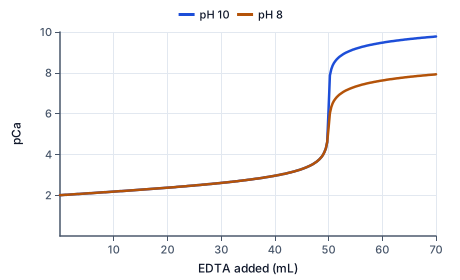
The chart shows why. As EDTA is added, pCa rises slowly while calcium is used up, then jumps at the equivalence point. The size of the jump is set by $K'$: at pH 10 it is large and the end point is easy to see; at pH 8 it is small. At the equivalence point itself, the little free metal comes from the complex falling apart, $[\mathrm{M}] = [\mathrm{EDTA}']$, so
$$\mathrm{pM} = \tfrac{1}{2}(\log K' + \mathrm{p}C),$$
where $C$ is the concentration of the complex. For calcium at pH 10 diluted to $0.00500$ M, $\mathrm{pCa} = \frac{1}{2}(10.18 + 2.30) = 6.24$, the middle of the jump.
Another way: picture
Think of the EDTA as a crowd of hands, most of them still holding on to protons and so not free to grab a metal ion. Raise the pH and more hands let go of their protons and become free to grab. The formation constant says how tightly a free hand grips; $\alpha$ says how many hands are free; the conditional constant multiplies the two.
Another way: steps
The end point is marked by a metal ion indicator, a dye that binds the metal and changes color when it lets go. Eriochrome Black T, used for water hardness, is wine red when bound to magnesium and blue when free at pH 10. At the start of the titration a little of the metal is held by the indicator, and the solution is red. EDTA binds the free metal first; at the equivalence point it finally takes the metal from the indicator, and the solution turns blue.
For that to work, the indicator must bind the metal less strongly than EDTA does, or it would never give it up, but strongly enough to hold on until the very end. Calcium binds Eriochrome Black T too weakly for a sharp change, so analysts add a little of the magnesium-EDTA complex to the sample. Calcium, binding EDTA more strongly, frees the magnesium, which colors the indicator and is titrated along with the calcium without changing the result.
The pH is the analyst's main control. Too low, and $\log K'$ falls below $8$. Too high, and many metals precipitate as hydroxides before EDTA can reach them, which is why titrations of copper, nickel or zinc use an ammonia buffer: the ammonia holds the metal in solution as an ammine, as lesson 16 described, until EDTA takes it.
The pH can also pick out one metal from a mixture. Iron(III), with $\log K_f = 25.1$, can be titrated at pH 2, where calcium and magnesium, with their far smaller constants, are not touched. For metals with similar constants, analysts mask the one they do not want with a ligand that binds it more strongly than EDTA can: cyanide ties up zinc, copper and nickel, leaving magnesium and calcium to be titrated alone.
Some metals cannot be titrated directly. Aluminum(III) and chromium(III) react with EDTA so slowly at room temperature that the end point would drift for minutes after each addition, and some metals have no indicator that changes sharply for them. For these, analysts use a back titration. They add a measured excess of EDTA, give it time to react completely, often by boiling, and then titrate the EDTA left over with a standard solution of magnesium or zinc. The metal of interest used up the difference between the EDTA added and the EDTA left.
A displacement titration works the other way round. A metal with a larger formation constant, such as mercury(II), is added to a solution of the magnesium-EDTA complex; it takes the EDTA and frees an equal amount of magnesium, which is then titrated with EDTA in the usual way. Both methods rest on the one-to-one ratio and on comparing formation constants, the same reasoning used throughout this unit.
Three checks catch most slips. First, the sign of $\log\alpha$: it is always negative or zero, so $\log K'$ is always smaller than $\log K_f$. An answer with the conditional constant larger than the tabulated one has added $\alpha$ the wrong way.
Second, the stoichiometry: EDTA reacts one to one with every metal ion, whether its charge is $2+$ or $3+$, so millimoles of EDTA equal millimoles of metal, never twice or half. Third, the units of hardness: millimoles per liter times $100.09$ gives milligrams per liter, and ordinary waters fall between about $10$ and $500$ mg/L as calcium carbonate. An answer of $0.4$ or $40{,}000$ has slipped a factor of a thousand in the volumes.
A final check comes from the chart: pM at the equivalence point must lie between the pM just before the jump and the pM well after it. And the lowest pH for a titration must fall as the formation constant rises: a metal that binds EDTA more strongly can be titrated in more acidic solution, never less.
Every U.S. water utility publishes a yearly water quality report, and most include hardness. Hard water, rich in calcium and magnesium picked up from limestone and dolomite, is harmless to drink but leaves scale in pipes, kettles and water heaters and keeps soap from lathering. The U.S. Geological Survey classes water as soft up to $60$ mg/L as calcium carbonate, moderately hard to $120$, hard to $180$ and very hard above that.
The standard method for measuring it is this lesson's titration: a buffered sample, a few drops of Eriochrome Black T or its cousin calmagite, and EDTA from a burette until the red turns blue. It needs no instrument, costs little, and takes a few minutes, which is why it appears in the standard methods that utility labs follow. The same titration run at pH 12, where magnesium precipitates as its hydroxide, measures calcium alone, so the two results together give both metals.
When a blood sample is drawn for a complete blood count, it goes into a tube with a lavender or purple stopper. The tube contains a small amount of dried potassium EDTA. Clotting depends on calcium ions, which several of the clotting factors need in order to work. EDTA chelates the calcium as soon as the blood enters the tube, and the sample stays liquid, so that the cells can be counted and examined hours later.
The same chemistry explains why a lavender-top tube cannot be used to measure the patient's blood calcium: the EDTA has bound it. Laboratories therefore draw the tubes in a set order, so that no EDTA is carried over into a tube meant for a calcium test, a precaution that exists because of a formation constant.
A formation constant from a table describes EDTA as $\mathrm{Y^{4-}}$, but in a buffer at pH 7 almost none of it is in that form. Using $\log K_f$ directly predicts that calcium titrates sharply at any pH; the conditional constant shows it needs pH 8 or above, and the titration curve at pH 8 is already poor. Always add $\log\alpha$ for the pH you will use before judging a titration.
A second error is to think EDTA's ratio to the metal depends on the metal's charge, as it would in a precipitation. EDTA forms one-to-one complexes with $\mathrm{Ca^{2+}}$, $\mathrm{Fe^{3+}}$ and $\mathrm{Th^{4+}}$ alike, which is exactly what makes it so convenient.
Look up the constants.
$\log K_f(\mathrm{CaY^{2-}}) = 10.7$
From the EDTA table.
Add $\log\alpha$ at pH 10.
$\log K' = 10.7 + (-0.52) = 10.18$
About a third of the EDTA is $\mathrm{Y^{4-}}$.
Apply the working rule at pH 10.
$10.18 \ge 8$
A sharp end point.
Add $\log\alpha$ at pH 7.
$\log K' = 10.7 + (-3.43) = 7.27$
Only four EDTA molecules in ten thousand are $\mathrm{Y^{4-}}$.
Apply the working rule at pH 7.
$7.27 < 8$
Too weak: titrate calcium in a pH 10 buffer.
Find the concentration at equivalence.
$\dfrac{50.00 \times 0.01000}{100.00} = 0.00500\ \text{M}$
Fifty milliliters of calcium diluted by fifty of EDTA.
Take its negative logarithm.
$\mathrm{p}C = -\log 0.00500 = 2.30$
For the formula.
Take the conditional constant at pH 10.
$\log K' = 10.18$
From the first example.
Apply the equivalence-point formula.
$\mathrm{pCa} = \tfrac{1}{2}(10.18 + 2.30)$
Half the sum of the two logarithms.
Evaluate the free calcium.
$\mathrm{pCa} = 6.24$
Free calcium near $6 \times 10^{-7}$ M.
Compare with the curve.
$\text{the middle of the jump at } 50\ \text{mL}$
Exactly where the chart's pH 10 curve rises most steeply.
Record the titration.
$50.00\ \text{mL sample}, \ 13.26\ \text{mL of } 0.01000\ \text{M EDTA}$
At pH 10 with Eriochrome Black T.
Find the millimoles of EDTA.
$0.01000 \times 13.26 = 0.1326\ \text{mmol}$
Molarity times milliliters.
Equate them to the metal.
$n(\mathrm{Ca} + \mathrm{Mg}) = 0.1326\ \text{mmol}$
One to one.
Find the concentration.
$0.1326 \div 0.05000 = 2.652\ \text{mmol/L}$
Per liter of sample.
Express it as calcium carbonate.
$2.652 \times 100.09 \approx 265.4\ \text{mg/L}$
The unit utilities report.
Classify the water.
$265.4 > 180: \text{very hard}$
Hard enough to leave scale in kettles and water heaters.
Find the conditional constant.
$\log K' = 8.8 + (-0.52) = 8.28$
Formation constant plus $\log\alpha$.
Apply the working rule.
$8.28 \ge 8$
Just enough.
State the conclusion.
Match each pH to $\log\alpha_{\mathrm{Y^{4-}}}$, the log of the fraction of free EDTA present as $\mathrm{Y^{4-}}$.
| $-4.74$ | $-1.39$ | $-0.52$ | $-0.09$ | |
|---|---|---|---|---|
| pH $6$ | ||||
| pH $9$ | ||||
| pH $10$ | ||||
| pH $11$ |
Complete the worked solution: $\mathrm{Fe^{3+}}$ ($\log K_f = 25.1$) is titrated with EDTA at pH $11$ ($\log\alpha = -0.09$), its complex $0.01$ M at the equivalence point.
Add the log of the fraction to the formation constant.
$\log K' =$ k
Only the fully deprotonated share of the EDTA binds.
Halve the conditional constant plus the negative log of the concentration.
$\mathrm{pM} =$ p
The free metal at equivalence comes from a square root.
Find the margin over the working rule.
$\log K' - \text{the rule} =$ m
Positive means a sharp end point.
The EDTA complex of $\mathrm{Mn^{2+}}$ has $\log K_f = 13.9$. A sharp titration needs $\log K' \ge 8$. What is the lowest whole-number pH at which it can be titrated? At pH $6$, $\log\alpha = -4.74$; at pH $5$, $\log\alpha = -6.53$.
At pH $9$, $\log\alpha_{\mathrm{Y^{4-}}} = -1.39$. For $\mathrm{Ni^{2+}}$ ($\log K_f = 18.4$) and $\mathrm{Pb^{2+}}$ ($\log K_f = 18.0$), each titrated so that its complex is $0.01$ M at the equivalence point, fill in $\log K'$ and pM at the equivalence point, in that order.
| log K′ | pM at equivalence | |
|---|---|---|
| the first metal | ||
| the second metal |
A $50.00$ mL water sample from a well in limestone country needs $21.84$ mL of $0.01000$ M EDTA to reach the end point at pH 10. What is its hardness in mg/L as calcium carbonate?
Answer: mg/L as CaCO₃
A solution of $\mathrm{Hg^{2+}}$ is titrated with EDTA at pH $9$, where $\log\alpha_{\mathrm{Y^{4-}}} = -1.39$. The metal's EDTA complex has $\log K_f = 21.5$, and at the equivalence point its concentration is $10^{-2}$ M. What is pM, the negative log of the free metal concentration, at the equivalence point?
Answer: pM at the equivalence point
A water utility's lab titrates samples with $0.01000$ M EDTA at pH 10 to report hardness to customers. From a well in limestone country, $50.00$ mL needs $21.84$ mL; from a city tap, $50.00$ mL needs $13.26$ mL; from a mountain spring, $50.00$ mL needs $3.58$ mL. For each, in that order, fill in the calcium plus magnesium in mmol/L and the hardness in mg/L as calcium carbonate.
| Ca + Mg (mmol/L) | hardness (mg/L CaCO₃) | |
|---|---|---|
| the first sample | ||
| the second sample | ||
| the third sample |
Lesson test: one question per skill, one attempt each, no hints. Your answers are checked when you submit.
At pH $11$, $\log\alpha_{\mathrm{Y^{4-}}} = -0.09$. For $\mathrm{Cu^{2+}}$ ($\log K_f = 18.8$) and $\mathrm{Ni^{2+}}$ ($\log K_f = 18.4$), each titrated so that its complex is $0.01$ M at the equivalence point, fill in $\log K'$ and pM at the equivalence point, in that order.
| log K′ | pM at equivalence | |
|---|---|---|
| the first metal | ||
| the second metal |
You can plan an EDTA titration. Explain why calcium is titrated in a pH 10 buffer rather than at pH 7, and how a titration volume becomes a hardness in mg/L.
15. Your turn: magnesium has $\log K_f = 8.8$. Can it be titrated sharply at pH 10, where $\log\alpha = -0.52$?, step 3
$\text{yes, at pH 10 but not at pH 9}$
At pH 9, $8.8 - 1.39 = 7.41$ falls short.