Back to the on-screen lesson ·
Stepwise and overall formation constants in logarithmic form, the species that dominates at a given ligand concentration, and the free metal ion left in excess ligand.
Paper packet. Every task here also exists on screen, where it is checked automatically; answers written on paper are not assessed by Nydus. When you are back at a device, enter your answers there.
By the end of this lesson you will be able to combine stepwise formation constants, decide which complex dominates at a given ligand concentration, and find the free metal ion left in a solution.
From general chemistry you can write an equilibrium constant and use logarithms: the log of a product is the sum of the logs, and the log of a power is a multiple. From lessons 3 and 4 you know that a complex ion forms when ligands bind a metal ion. In water, the metal is first surrounded by water molecules, so every complex that forms does so by replacing water. This lesson measures how far that replacement goes.
| Term | What it means |
|---|---|
| Stepwise formation constant, $K_n$ | The equilibrium constant for adding the $n$th ligand: $K_n = [\mathrm{ML}_n]/([\mathrm{ML}_{n-1}][\mathrm{L}])$. |
| Overall formation constant, $\beta_n$ | The constant for forming $\mathrm{ML}_n$ from the free metal in one go: $\beta_n = K_1 K_2 \cdots K_n$. |
| Speciation | How a metal is shared among its free ion and its complexes at given conditions. |
| Dominant species | The form that holds more of the metal than any other. |
| Free metal ion | The metal still surrounded only by water, not by the added ligand. |
| Logarithmic form | Writing each constant as $\log K$, so that products of constants become sums. |
When ammonia is added to a solution of copper(II), the ammonia molecules replace water one at a time. Each step is an equilibrium with its own stepwise formation constant:
$$\mathrm{Cu^{2+}} + \mathrm{NH_3} \rightleftharpoons \mathrm{[Cu(NH_3)]^{2+}}, \quad K_1 = \frac{[\mathrm{CuL}]}{[\mathrm{Cu}][\mathrm{L}]},$$
and so on up to $\mathrm{[Cu(NH_3)_4]^{2+}}$ and $K_4$. (Water molecules are left out, as a solvent always is.) Multiplying the steps gives the overall formation constant for making $\mathrm{ML}_n$ directly from the free ion:
$$\beta_n = K_1 K_2 \cdots K_n = \frac{[\mathrm{ML}_n]}{[\mathrm{M}][\mathrm{L}]^n}.$$
These constants are huge and span many powers of ten, so chemists quote their logarithms. Then the products become sums: $\log\beta_n = \log K_1 + \dots + \log K_n$. For copper and ammonia, Jannik Bjerrum measured $\log K_1$ to $\log K_4$ as $4.31$, $3.67$, $3.04$ and $2.30$, so $\log\beta_4 = 13.32$: the tetraammine is $10^{13}$ times favored over the free ion at 1 M ammonia.
Which species is present depends on the free ligand concentration. Taking logs of one step,
$$\log\frac{[\mathrm{ML}_n]}{[\mathrm{ML}_{n-1}]} = \log K_n + \log[\mathrm{L}].$$
When this is positive, $\mathrm{ML}_n$ outweighs $\mathrm{ML}_{n-1}$. So each species takes over as $\log[\mathrm{L}]$ rises past $-\log K_n$.
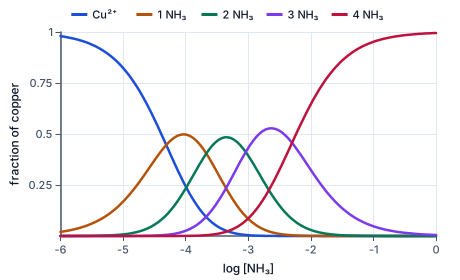
The chart shows the result for copper. Below $\log[\mathrm{NH_3}] = -4.31$ the free ion dominates; then each ammine takes over in turn, and above $-2.30$ the tetraammine does. Because the stepwise constants are close together, the regions overlap: at most concentrations two or three species are present at once.
When the ligand is in large excess, nearly all the metal is in the top complex, and the overall constant gives the tiny concentration of free metal left:
$$\log[\mathrm{M}] = \log C_{\mathrm{M}} - \log\beta_n - n\log[\mathrm{L}].$$
Another way: picture
Think of a metal ion as a seat with four places, each held by a water molecule, and ammonia as a crowd that would rather sit there. When there are few ammonia molecules about, most places stay with water. As the crowd grows, places change hands one at a time, and at any moment some ions have one ammonia, some two, some three. Only when the crowd is large do nearly all ions end up with four.
Another way: steps
For almost every metal and ligand, $K_1 > K_2 > K_3 > \dots$. Three effects add up. The first is statistical: when the first ammonia arrives, there are six water molecules it could replace and only one ammonia that could leave again; by the last step there is one water to replace and five ammonias that could leave. The odds for each new ligand get steadily worse, even if every bond is the same strength. The second is charge: with an anionic ligand such as chloride, each one added makes the complex less positive and less attractive to the next. The third is crowding: large ligands get in each other's way as they accumulate.
A break in the pattern is a sign that something about the complex has changed. For silver(I) and ammonia, $K_2$ is larger than $K_1$, because the ion changes from a water-surrounded ion to a linear two-coordinate complex when the second ammonia arrives. For copper(II), $K_5$ is tiny: the fifth and sixth positions are stretched out by the Jahn-Teller distortion, so ammonia hardly binds there at all.
A formation constant cannot be read off a label; someone has to measure how much of each species is present at equilibrium. Jannik Bjerrum's method for the metal ammines, worked out in Copenhagen around 1940, used the fact that ammonia is a base. He added ammonia to a solution of the metal salt with a large excess of ammonium nitrate and measured the pH. Ammonia bound to the metal no longer affects the pH, so the pH told him how much ammonia was still free. From the free ammonia and the total ammonia added he found the average number of ammonias on each metal ion, and from how that average climbed as more ammonia was added he worked out every stepwise constant in turn.
The same idea runs through the modern methods. An ion-selective electrode, like a pH electrode but sensitive to one metal ion, measures the free metal directly. A spectrophotometer follows the color, since each complex absorbs at its own wavelength, as lesson 14 showed. Computer programs then fit all the constants at once to measurements taken over a range of concentrations.
Because the constants depend on temperature and on the other ions present, a reliable table always states both. Bjerrum worked in a concentrated salt solution so that the other ions stayed the same throughout his measurements, and critical compilations such as Martell and Smith's list each value with its conditions.
Every calculation in this lesson is simplest in logarithms, and it is worth seeing why the numbers stay manageable that way. A formation constant of $10^{13.32}$ is $2.1 \times 10^{13}$, and a free ion concentration of $10^{-15.3}$ M is a few parts in a million billion; multiplying numbers like that by hand invites slips. In logs, $\beta_4$ is just $13.32$, the free ion is just $-15.3$, and the calculation is addition and subtraction.
Two habits keep the signs right. Write every concentration as a power of ten and take its log before starting: 0.01 M is $\log = -2$, and 5 M is $\log = 0.7$. And bracket negative logs when substituting, $\log C - \log\beta - 4 \times (-1)$, so the double negative is not lost.
Three checks catch most slips. First, the overall constants must grow: $\log\beta_1 < \log\beta_2 < \dots$ as long as every $\log K$ is positive, and $\log\beta_n$ must be larger than any single $\log K$ in it.
Second, the dominant species must move up the series as the ligand concentration rises. If an answer says that more ammonia favors a complex with fewer ammonias, a sign has been reversed.
Third, a free metal concentration in excess ligand must be far smaller than the total metal: $\log[\mathrm{M}]$ well below $\log C_{\mathrm{M}}$. An answer with more free metal than total metal has subtracted $n\log[L]$ the wrong way. And the approximation behind it holds only when the top complex really does dominate, which the ratio test confirms: $\log K_n + \log[L]$ should be positive for the last step.
Finally, compare with the chart or with a quick sketch of one. Each species should dominate over a band of $\log[L]$ that starts near $-\log K_n$ and ends near $-\log K_{n+1}$, and the bands should follow each other in order across the axis. If your answer places a species outside its band, recheck which constant you used for which step, because swapping $K_n$ and $\beta_n$ is the commonest cause.
Most of the world's gold is extracted by cyanide leaching. Crushed ore is mixed with a dilute solution of sodium cyanide, and air is blown through it. Gold, which dissolves in almost nothing, dissolves as the dicyanidoaurate ion, $\mathrm{[Au(CN)_2]^-}$, whose formation constant, $\log\beta_2 = 38.3$, is one of the largest known.
That constant is the whole reason the process works. Oxygen alone cannot oxidize gold, because the free $\mathrm{Au^+}$ ion is so unstable. But cyanide holds the gold so tightly that the free ion concentration stays near $10^{-37}$ M, and removing it from the equation that fast pulls the oxidation forward. The same constant is why cyanide leaching needs careful management: the solutions are highly toxic, and U.S. mines operate under state permits that require lined ponds and cyanide destruction before any water is released.
A black-and-white film or print is developed by turning the light-struck silver bromide into metallic silver. The unexposed silver bromide is still there, and still sensitive to light, so it must be removed, or fixed. Silver bromide is almost insoluble in water, with a solubility product near $10^{-12}$.
The fixing bath contains sodium thiosulfate, which binds silver as $\mathrm{[Ag(S_2O_3)_2]^{3-}}$ with $\log\beta_2 = 13.46$. By holding the free silver ion far below the level the solubility product allows, it pulls silver bromide into solution until none is left in the film. Photographers call thiosulfate hypo, from its old name, hyposulfite, and used fixing baths are still collected so the silver in them can be recovered.
It is tempting to picture adding ligand as flipping a switch: first every metal ion is free, then every one is the final complex. The stepwise constants say otherwise. Because they differ by only a few powers of ten, the intermediate complexes each hold a large share of the metal over a range of concentrations, and at a typical concentration two or three species are present together.
A related error is to use $\beta_n$ where $K_n$ belongs. The overall constant compares $\mathrm{ML}_n$ with the free ion; the stepwise constant compares it with $\mathrm{ML}_{n-1}$. The question of which species dominates needs the stepwise constants, one comparison at a time.
Write the first overall constant.
$\log\beta_1 = \log K_1 = 4.31$
One step.
Add the second step.
$\log\beta_2 = 4.31 + 3.67 = 7.98$
$\beta_2 = K_1 K_2$.
Add the third step.
$\log\beta_3 = 7.98 + 3.04 = 11.02$
The running sum.
Add the fourth step.
$\log\beta_4 = 11.02 + 2.30 = 13.32$
The tetraammine.
Turn it back into a number.
$\beta_4 = 10^{13.32} \approx 2.1 \times 10^{13}$
The value quoted in general chemistry tables.
Test the first step.
$4.31 + (-3.0) = 1.31 > 0$
The monoammine outweighs the free ion.
Test the second step.
$3.67 + (-3.0) = 0.67 > 0$
The diammine outweighs the monoammine.
Test the third step.
$3.04 + (-3.0) = 0.04 > 0$
Only just: triammine and diammine are nearly equal.
Test the fourth step.
$2.30 + (-3.0) = -0.70 < 0$
The tetraammine is only a fifth as abundant as the triammine.
Name the dominant species.
$\mathrm{[Cu(NH_3)_3]^{2+}}$
The last step that is still positive.
Check against the chart.
$\text{triammine and diammine close at } -3.0$
Two species share most of the copper, as the curves show.
Write the known values as logarithms.
$\log C_{\mathrm{Cu}} = -2, \quad \log[\mathrm{NH_3}] = 0$
0.010 M copper in 1.0 M ammonia.
Confirm the tetraammine dominates.
$\log K_4 + \log[\mathrm{L}] = 2.30 > 0$
The last step is strongly positive.
Write the free-metal equation.
$\log[\mathrm{Cu}] = \log C - \log\beta_4 - 4\log[\mathrm{L}]$
From $\beta_4 = [\mathrm{CuL_4}]/([\mathrm{Cu}][\mathrm{L}]^4)$.
Substitute the logarithms.
$\log[\mathrm{Cu}] = -2 - 13.32 - 4 \times 0$
At 1 M the ligand term vanishes.
Evaluate the free copper.
$\log[\mathrm{Cu}] = -15.32$
About $5 \times 10^{-16}$ M of free copper ion.
Say what it means.
$\text{one copper in } 10^{13} \text{ is free}$
Far too little to precipitate copper hydroxide, which is why the deep blue solution stays clear.
Add the first two steps.
$2.65 + 2.10 = 4.75$
$\log\beta_2$.
Add the third step.
$4.75 + 1.44 = 6.19$
$\log\beta_3$.
Add the fourth step.
For the $\mathrm{Ni^{2+}}$-ammonia system, the stepwise constants are $\log K_1 = 2.80$, $\log K_2 = 2.24$, $\log K_3 = 1.73$ and $\log K_4 = 1.19$. Match each overall constant to its logarithm.
| $2.80$ | $5.04$ | $6.77$ | $7.96$ | |
|---|---|---|---|---|
| $\log\beta_1$ | ||||
| $\log\beta_2$ | ||||
| $\log\beta_3$ | ||||
| $\log\beta_4$ |
Complete the worked solution: the overall constants of the $\mathrm{Cd^{2+}}$-ammonia system, whose stepwise constants are $\log K_1 = 2.65$, $\log K_2 = 2.10$, $\log K_3 = 1.44$ and $\log K_4 = 0.93$.
Add the first two steps.
$\log\beta_2 =$ b
The first two stepwise logarithms together.
Add the third step.
$\log\beta_3 =$ c
The previous total and the third stepwise logarithm.
Add the fourth step.
$\log\beta_4 =$ e
The previous total and the fourth stepwise logarithm.
For the $\mathrm{Cd^{2+}}$-ammonia system, $\log K_{1} = 2.65$ and $\log K_{2} = 2.10$. Which species dominates when $\log[\mathrm{NH_3}] = -2.375$?
For the $\mathrm{Cu^{2+}}$-ammonia system, $\log K_1 = 4.31$, $\log K_2 = 3.67$ and $\log K_3 = 3.04$, and the free ammonia is at $\log[\mathrm{NH_3}] = -3$. For $n = 1$, $2$ and $3$, fill in $\log\beta_n$ and $\log([\mathrm{ML}_n]/[\mathrm{ML}_{n-1}])$.
| log βn | log of the ratio | |
|---|---|---|
| n = 1 | ||
| n = 2 | ||
| n = 3 |
For $\mathrm{Cd^{2+}}$ with ammonia, $\log K_1 = 2.65$, $\log K_2 = 2.10$, $\log K_3 = 1.44$ and $\log K_4 = 0.93$. What is $\log\beta_4$?
Answer: as log β₄
A solution holds copper(II) at a total concentration of $10^{-2}$ M in ammonia whose free concentration is $10^{-1}$ M, so that nearly all the copper is $\mathrm{[Cu(NH_3)_4]^{2+}}$, with $\log\beta_4 = 13.32$. What is $\log[\mathrm{Cu^{2+}}]$, the log of the free copper ion concentration?
Answer: as the log of the free Cu²⁺ concentration
A process engineer compares how much free metal ion survives in three solutions. In gold leaching with cyanide, $\mathrm{Au^+}$ with $\mathrm{CN^-}$: $\log\beta_{2} = 38.3$, $\log C_M = -4$, $\log[L] = -2.5$. In a photographic fixing bath, $\mathrm{Ag^+}$ with $\mathrm{S_2O_3^{2-}}$: $\log\beta_{2} = 13.46$, $\log C_M = -2$, $\log[L] = -0.5$. In Tollens' reagent, $\mathrm{Ag^+}$ with $\mathrm{NH_3}$: $\log\beta_{2} = 7.23$, $\log C_M = -1$, $\log[L] = 0$. For each, in that order, fill in $n\log[L]$ and $\log[M]$ for the free metal ion.
| n log[L] | log[M] | |
|---|---|---|
| the first solution | ||
| the second solution | ||
| the third solution |
Lesson test: one question per skill, one attempt each, no hints. Your answers are checked when you submit.
For the $\mathrm{Cu^{2+}}$-ammonia system, $\log K_1 = 4.31$, $\log K_2 = 3.67$ and $\log K_3 = 3.04$, and the free ammonia is at $\log[\mathrm{NH_3}] = -2$. For $n = 1$, $2$ and $3$, fill in $\log\beta_n$ and $\log([\mathrm{ML}_n]/[\mathrm{ML}_{n-1}])$.
| log βn | log of the ratio | |
|---|---|---|
| n = 1 | ||
| n = 2 | ||
| n = 3 |
You can use formation constants. Explain why copper(II) in 1 M ammonia is almost all $\mathrm{[Cu(NH_3)_4]^{2+}}$, while at $10^{-3}$ M ammonia several ammines share it.
15. Your turn: for cadmium and ammonia, $\log K_1$ to $\log K_4$ are $2.65$, $2.10$, $1.44$ and $0.93$. What is $\log\beta_4$?, step 3
$6.19 + 0.93 = 7.12$
$\log\beta_4$, much smaller than copper's $13.32$.