Back to the on-screen lesson ·
cis and trans, fac and mer: counting the geometric isomers of square-planar and octahedral complexes by the angles between identical ligands.
Paper packet. Every task here also exists on screen, where it is checked automatically; answers written on paper are not assessed by Nydus. When you are back at a device, enter your answers there.
By the end of this lesson you will be able to name cis, trans, fac and mer isomers, count the geometric isomers of a complex from its type and shape, and count the ligand pairs at $90°$ and $180°$ in each isomer.
From lesson 6 you can assign a complex's shape and count its ligand pairs at $90°$ and $180°$: twelve and three in an octahedron, four and two in a square plane. From organic chemistry you know cis and trans isomers of alkenes, where two groups sit on the same or opposite sides of a double bond that cannot rotate. Complexes show the same idea, held in place not by a double bond but by the metal's fixed geometry.
| Term | What it means |
|---|---|
| Geometric isomers | Isomers with the same bonds and different arrangements of ligands round the metal. |
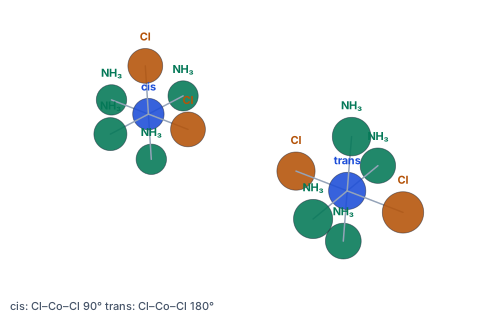
| cis | Two identical ligands at $90°$, next to each other. |
| trans | Two identical ligands at $180°$, opposite each other. |
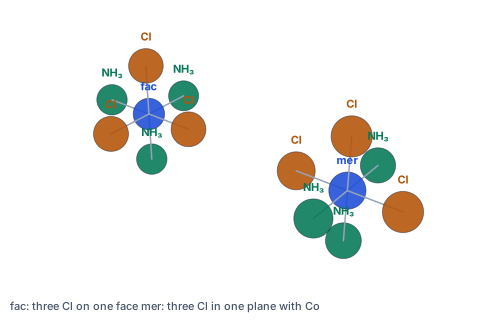
| fac | Facial: three identical ligands on one triangular face of an octahedron, all at $90°$. |
| mer | Meridional: three identical ligands in one plane with the metal, two of them at $180°$. |
| Minority ligand | The ligand of which there are fewer, whose placement decides the isomers. |
| Equivalent positions | Positions that a rotation of the whole complex carries onto each other; every position of a regular octahedron or square is equivalent. |
In a square-planar or octahedral complex, two identical ligands can sit at $90°$ to each other or at $180°$, and no rotation of the whole complex changes one into the other. The two are geometric isomers: the same bonds, a different shape. In $\mathrm{[Pt(NH_3)_2Cl_2]}$ the two chlorides can be neighbors, cis, or opposite, trans. The cis compound is the cancer drug cisplatin; the trans compound, transplatin, has no useful anticancer activity.
The key to counting isomers is that every position is equivalent. In a regular octahedron any corner can be turned into any other, so it does not matter where the first minority ligand goes; what matters is where the others go relative to it. That is why $\mathrm{[Co(NH_3)_5Cl]^{2+}}$ has only one isomer, however you place the chloride, and why $\mathrm{[Co(NH_3)_4Cl_2]^+}$ has two: the second chloride is either at $90°$ from the first or at $180°$.
Turn the figure and try to make the cis isomer on the left look like the trans isomer on the right. You cannot: the two chlorides on the left always make a right angle at the cobalt, and those on the right always lie on one straight line through it.
With three identical ligands on an octahedron there are again two isomers. They can all sit on one triangular face, every pair at $90°$: the fac isomer. Or two can sit opposite each other with the third between them, all three in one plane with the metal like a meridian on a globe: the mer isomer, with two pairs at $90°$ and one at $180°$.
Geometric isomers need right angles. In a tetrahedron every pair of positions is at $109.5°$, so a tetrahedral $\mathrm{[MA_2B_2]}$ has only one arrangement: $\mathrm{[Zn(NH_3)_2Cl_2]}$ has no cis or trans form. The existence of two isomers of $\mathrm{[Pt(NH_3)_2Cl_2]}$ was one of Werner's proofs that platinum(II) complexes are square planar, not tetrahedral.
Another way: picture
Put the metal at the center of a die. Its six faces are the six positions. Two identical ligands on faces that share an edge, like the 1 and the 2, are cis; on opposite faces, like the 1 and the 6, trans. Roll the die however you like: faces that shared an edge still do, and opposite faces stay opposite.
Another way: steps
| Type | Shape | Geometric isomers | What distinguishes them |
|---|---|---|---|
| $\mathrm{MA_5B}$ | octahedral | $1$ | — |
| $\mathrm{MA_4B_2}$ | octahedral | $2$ | B–M–B at $90°$ (cis) or $180°$ (trans) |
| $\mathrm{MA_3B_3}$ | octahedral | $2$ | fac or mer |
| $\mathrm{MA_2B_2C_2}$ | octahedral | $5$ | which of the three pairs are trans |
| $\mathrm{MA_3B}$ | square planar | $1$ | — |
| $\mathrm{MA_2B_2}$ | square planar | $2$ | cis or trans |
| $\mathrm{MA_2BC}$ | square planar | $2$ | B and C cis or trans |
| $\mathrm{MA_2B_2}$ | tetrahedral | $1$ | — |
The $\mathrm{MA_2B_2C_2}$ count is worth checking once. Each of the three kinds of ligand has a pair, and each pair is either trans or cis. All three pairs trans is one isomer. Exactly one pair trans, with the other two cis, gives three isomers, one for each choice of which pair is trans. All three pairs cis gives one more. Two pairs trans forces the third trans too, so it adds nothing. That is $1 + 3 + 1 = 5$, and the all-cis isomer turns out to be chiral, which is the next lesson's subject.
An isomer is fixed by the angles between its identical ligands, and those angles can be counted. Two ligands make one pair: at $90°$ in cis, $180°$ in trans. Three ligands make three pairs:
These counts are what an experiment can see. The number of distinct ligand environments shows up in NMR and infrared spectra: a fac-$\mathrm{MA_3B_3}$ complex has all three B ligands equivalent, while a mer one has two of one kind and one of another, and the spectra show exactly that difference.
Geometric isomers are different compounds with different properties. A trans complex with two identical ligands opposite each other often has no dipole moment, because the two bond dipoles cancel, while the cis isomer does; that makes cisplatin more soluble in water than transplatin. Their colors can differ too: trans-$\mathrm{[Co(en)_2Cl_2]Cl}$ is green and the cis salt violet, because the arrangement of ligands changes how the d orbitals split.
For drugs the geometry decides the target. Cisplatin binds DNA by losing its two chlorides and bonding to two neighboring guanine bases on the same strand. Those two sites are about $90°$ apart at the platinum, which only the cis isomer offers; transplatin's two sites are on opposite sides and cannot reach adjacent bases in the same way.
The fastest check is to count how the repeated ligands sit relative to each other. In an octahedral $\mathrm{MA_4B_2}$ complex the two B ligands are either at $90^\circ$, cis, or at $180^\circ$, trans, and there is no third choice; in $\mathrm{MA_3B_3}$ the three B ligands either share a face, fac, or run round a meridian, mer. Any arrangement you draw must turn into one of these by rotation.
A tetrahedral complex has no geometric isomers at all, because every position is next to every other, so a count above one for a tetrahedron is always wrong. Polarity gives a last check: a trans isomer with identical pairs opposite each other has no dipole moment, while its cis partner does.
In 1965 Barnett Rosenberg was studying how an electric field affects growing bacteria when he noticed that E. coli between platinum electrodes stopped dividing and grew into long filaments. The cause was not the field but a trace of cis-$\mathrm{[Pt(NH_3)_2Cl_2]}$ formed from the electrodes and the ammonium chloride in the medium. Tested against tumors, it worked; the trans isomer, with the same formula, did not.
Cisplatin was approved in 1978, and it turned testicular cancer from a disease that killed most patients whose cancer had spread into one cured in about $90\%$ of cases. Its action depends on the $90°$ angle between its two chlorides: once they are replaced by water inside the cell, the platinum bonds to two neighboring guanine bases on one DNA strand, kinking the helix by about $35°$ so that the cellcannot copy it. Transplatin's leaving groups are $180°$ apart and cannot make that adjacent cross-link, which is why the geometric isomer is the whole difference between a drug and an inactive compound.
Werner's rivals held that cobalt complexes were chains of ammonia molecules, not a metal surrounded by six ligands. Werner's theory made a prediction theirs could not: an octahedral $\mathrm{MA_4B_2}$ complex must exist as exactly two isomers, and a trigonal-prismatic or hexagonal one would give three. For $\mathrm{[Co(NH_3)_4Cl_2]^+}$, a green praseo salt was long known, and in 1907 Werner finally isolated its violet violeo isomer: two, as the octahedron requires, and no third was ever found.
The same counting settles modern structures. When a chemist makes an $\mathrm{MA_3B_3}$ complex and the NMR spectrum shows two different environments for the B ligands in a $2:1$ ratio, the complex is mer; one environment means fac. The pairs at $90°$ and $180°$ that this lesson counts are what the spectrometer sees.
An octahedron has six positions, so it is tempting to say that $\mathrm{[Co(NH_3)_5Cl]^{2+}}$ has six isomers, one for each place the chloride could go. But the six positions are equivalent: turn the complex and a chloride "on top" is a chloride "in front". Isomers are arrangements that no rotation can make the same, and with one chloride there is only one.
The same slip overcounts larger cases: placing two chlorides in any of $\tfrac{1}{2} \times 6 \times 5 = 15$ pairs of positions describes only two compounds, because the twelve right-angle pairs are all equivalent and so are the three straight ones. The test is always the angle between identical ligands, never the label of a position. And a tetrahedral complex gets none at all, since every pair of its positions makes the same angle.
Name the type of $\mathrm{[Co(NH_3)_4Cl_2]^+}$.
$\mathrm{MA_4B_2}, \ \text{octahedral}$
Four ammines and two chlorides on cobalt(III).
Place the first chloride.
$\text{anywhere}$
All six positions are equivalent.
Place the second chloride relative to it.
$\text{at } 90° \text{ (cis) or } 180° \text{ (trans)}$
Those are the only angles in an octahedron.
Check that the four right-angle positions are all equivalent.
$4 \text{ positions at } 90° \to 1 \text{ isomer}$
A turn about the first chloride's axis carries each onto the others.
Count the isomers.
$1 + 1 = 2$
One cis and one trans.
Name the type of $\mathrm{[Co(NH_3)_3Cl_3]}$.
$\mathrm{MA_3B_3}$
Three of each ligand.
Count the chloride pairs.
$\tfrac{1}{2} \times 3 \times 2 = 3$
Three chlorides make three pairs.
Put all three on one face.
$\text{fac: } 3 \text{ at } 90°, \ 0 \text{ at } 180°$
Every pair on a face is at a right angle.
Put two opposite and one between.
$\text{mer: } 2 \text{ at } 90°, \ 1 \text{ at } 180°$
The opposite pair is the ends of the meridian.
Check there is no third arrangement.
$\text{three chlorides must include a } 180° \text{ pair or not}$
No 180° pair means fac; one 180° pair means mer; two would need four chlorides.
Count the isomers.
$2$
fac and mer.
Name the type.
$\mathrm{MA_2B_2C_2}$
Three kinds of ligand, two of each.
Describe each isomer by its trans pairs.
$\text{each pair of like ligands is cis or trans}$
Three pairs, each with two options.
Count all pairs trans.
$1$
Ammines, waters and chlorides each opposite their partner.
Count exactly one pair trans.
$3$
Choose which of the three pairs is trans; the other two are cis.
Count no pair trans.
$1$
All three pairs cis.
Rule out exactly two trans.
$\text{two trans pairs force the third trans}$
Four positions on two axes leave the last two on the third axis, opposite each other.
Add them up.
$1 + 3 + 1 = 5$
Five geometric isomers.
Place the first chloride.
$\text{any corner}$
All four corners of the square are equivalent.
Place the second.
$90° \text{ (cis) or } 180° \text{ (trans)}$
A neighbor or the opposite corner.
Count the isomers.
Match each description of identical ligands to its label.
| cis | trans | fac | mer | |
|---|---|---|---|---|
| two B ligands at $90°$ | ||||
| two B ligands at $180°$ | ||||
| three B ligands on one face | ||||
| three B ligands in a plane with the metal |
Complete the worked solution: in mer-$\mathrm{[Co(NH_3)_3Cl_3]}$, how are the three $\mathrm{Cl}$ ligands paired?
Count the pairs among three ligands.
$\text{pairs among three ligands} =$ n
Each ligand pairs with the other two; halve for double counting.
Count the pairs across the metal.
$\text{pairs at } 180° =$ s
fac has none; mer has one, the two ends of the meridian.
Take them away for the right angles.
$\text{pairs at } 90° = (\text{pairs}) - (\text{pairs at } 180°) =$ r
Every other pair is at $90°$.
How many geometric isomers does the square planar complex $\mathrm{[Pt(NH_3)_3Cl]^{+}}$ have?
Fill in the coordination number and the number of geometric isomers for the octahedral complex $\mathrm{[Co(NH_3)_5Cl]^{2+}}$, the square planar complex $\mathrm{[Pt(NH_3)_2Cl_2]}$ and the octahedral complex $\mathrm{[Co(NH_3)_3Cl_3]}$, in that order.
| coordination number | geometric isomers | |
|---|---|---|
| the first complex | ||
| the second complex | ||
| the third complex |
In trans-$\mathrm{[Co(NH_3)_4Cl_2]^{+}}$, how many pairs of $\mathrm{Cl}$ ligands are at $90°$ to each other?
Answer: pairs at 90 degrees
How many geometric isomers does the octahedral complex $\mathrm{[Co(NH_3)_2(H_2O)_2Cl_2]^{+}}$, of type $\mathrm{MA_2B_2C_2}$, have?
Answer: geometric isomers
Isomers of this kind differ in color and in biological activity: cisplatin is a cancer drug and transplatin is not; the green and violet salts of $\mathrm{[Co(en)_2Cl_2]^+}$ are trans and cis. For cis-$\mathrm{[Co(NH_3)_4Cl_2]^{+}}$, fac-$\mathrm{[Co(NH_3)_3Cl_3]}$ and trans-$\mathrm{[Pt(NH_3)_2Cl_2]}$, in that order, fill in the pairs of the named ligands at $90°$ and at $180°$.
| pairs at 90° | pairs at 180° | |
|---|---|---|
| the first isomer | ||
| the second isomer | ||
| the third isomer |
Lesson test: one question per skill, one attempt each, no hints. Your answers are checked when you submit.
Fill in the coordination number and the number of geometric isomers for the tetrahedral complex $\mathrm{[Zn(NH_3)_2Cl_2]}$, the square planar complex $\mathrm{[Pt(NH_3)_2Cl_2]}$ and the octahedral complex $\mathrm{[Co(NH_3)_3Cl_3]}$, in that order.
| coordination number | geometric isomers | |
|---|---|---|
| the first complex | ||
| the second complex | ||
| the third complex |
You can count geometric isomers. Explain why $\mathrm{[Pt(NH_3)_2Cl_2]}$ has two isomers while tetrahedral $\mathrm{[Zn(NH_3)_2Cl_2]}$ has only one.
15. Your turn: how many geometric isomers does square-planar $\mathrm{[Pt(NH_3)_2Cl_2]}$ have?, step 3
$2$
Cisplatin and transplatin.