Back to the on-screen lesson ·
Pearson's hard and soft acids and bases, classifying metal ions and ligands, reading a class from halide formation constants, and predicting which ligand holds a metal in a mixture.
Paper packet. Every task here also exists on screen, where it is checked automatically; answers written on paper are not assessed by Nydus. When you are back at a device, enter your answers there.
By the end of this lesson you will be able to classify metal ions and ligands as hard or soft, read the class from formation constants, and predict which ligand holds a metal in a mixture.
From general chemistry you know Lewis acids and bases: an acid accepts an electron pair and a base donates one, so every metal ion in a complex is a Lewis acid and every ligand a Lewis base. From lessons 16 and 17 you can compare complexes by their formation constants and turn a difference of $\log K$ into an energy. This lesson explains why a given metal prefers some ligands to others.
| Term | What it means |
|---|---|
| Hard acid | A small metal ion of high charge whose electrons are held tightly, such as $\mathrm{Al^{3+}}$ or $\mathrm{Fe^{3+}}$. |
| Soft acid | A large metal ion of low charge, easily polarized, such as $\mathrm{Ag^+}$ or $\mathrm{Hg^{2+}}$. |
| Hard base | A ligand with a small, electronegative donor atom, such as fluoride, water or hydroxide. |
| Soft base | A ligand with a large, polarizable donor atom, such as iodide, a thiolate or a phosphine. |
| Borderline | Between hard and soft, like most first-row $2+$ ions and bromide. |
| Polarizability | How easily an ion's electron cloud is distorted by a nearby charge. |
| HSAB principle | Hard acids bind hard bases best, and soft acids bind soft bases best. |
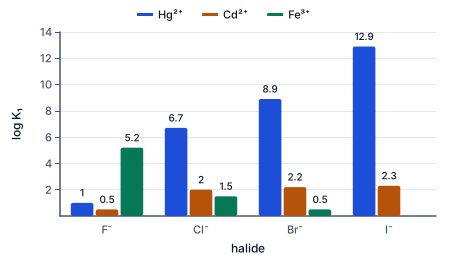
In the 1950s Sten Ahrland, Joseph Chatt and Nigel Davies noticed that metal ions fall into two groups by how they bind the halides. Most metal ions, like iron(III), bind fluoride best and iodide worst. A few, like mercury(II), do the opposite. In 1963 Ralph Pearson gave the two groups the names that stuck: hard and soft.
The chart shows the split. For mercury(II), $\log K_1$ climbs from $1.0$ with fluoride to $12.9$ with iodide; for iron(III) it falls from $5.2$ with fluoride to $0.5$ with bromide. The sign of $\log K_1(\mathrm{X}) - \log K_1(\mathrm{F})$ is a quick test of class: positive for a soft acid, negative for a hard one.
What makes an ion hard or soft is how tightly it holds its electrons.
Bases sort the same way. Hard bases have small, electronegative donor atoms, fluorine and oxygen above all: fluoride, water, hydroxide, carbonate, phosphate, and nitrogen in ammonia. Soft bases have large, polarizable donors: iodide, sulfide and thiolates, phosphines, cyanide and carbon monoxide.
Pearson's principle is short: hard acids prefer hard bases, and soft acids prefer soft bases. A hard-hard pair is held mostly by the attraction of charges, strongest when both are small and highly charged. A soft-soft pair is held mostly by covalent sharing, strongest when both electron clouds are large and easily distorted toward each other.
To predict which ligand wins in a mixture, compare their constants and their amounts. For the exchange $\mathrm{MF} + \mathrm{X} \rightleftharpoons \mathrm{MX} + \mathrm{F}$,
$$\log\frac{[\mathrm{MX}]}{[\mathrm{MF}]} = \log K_1(\mathrm{X}) - \log K_1(\mathrm{F}) + \log[\mathrm{X}] - \log[\mathrm{F}].$$
Another way: picture
Picture a hard acid as a small, tight ball of positive charge and a hard base as a small, tight ball of negative charge: they snap together like magnets. Picture a soft acid and a soft base as two large, squashy balls: they do not attract strongly from a distance, but when they touch they spread into each other and stick. A magnet does not stick to a squashy ball, and a squashy ball does not grip a small hard one.
Another way: steps
The principle can predict the direction of a reaction with no numbers at all. Mix solid lithium iodide with cesium fluoride and warm them: the products are lithium fluoride and cesium iodide,
$$\mathrm{LiI} + \mathrm{CsF} \rightarrow \mathrm{LiF} + \mathrm{CsI}.$$
Lithium is the smallest, hardest alkali metal ion and fluoride the hardest halide, so they pair; the large cesium ion, the softest of the alkali metals, is left with the large iodide. Both starting salts are hard-soft mismatches, and both products are matches. The same reasoning explains why silver fluoride dissolves in water while silver iodide does not: soft silver holds soft iodide in a tight, largely covalent lattice, but holds fluoride so weakly that water pulls the ions apart.
Chemists who need to pull one metal out of a mixture use the principle every day. To remove mercury, cadmium or lead from industrial wastewater, treatment plants add sulfide or pass the water through resins lined with thiol groups. The soft metals are caught by the soft sulfur, while the hard calcium and magnesium that make up most of the dissolved metal pass through untouched, so the resin is not used up on harmless ions.
The reverse choice works for hard metals. Iron(III) and aluminum(III) are gathered by ligands rich in oxygen donors, such as the hydroxamate groups of the siderophores met in lesson 17. The uranyl ion, $\mathrm{UO_2^{2+}}$, a hard acid, is picked out of seawater in research on uranium recovery by fibers carrying amidoxime groups, whose oxygen and nitrogen donors suit it far better than they suit the soft metals present.
Catalyst makers meet the principle as a hazard. Platinum and palladium, soft metals, are the active parts of automobile catalytic converters and many industrial catalysts. Soft sulfur and lead compounds bind to their surfaces and block them, which is why leaded gasoline had to be phased out before catalytic converters could be fitted, and why the sulfur content of fuel is limited by regulation.
Hard and soft is a matter of degree, not two sealed boxes. Chloride and bromide, and the first-row $2+$ ions, sit in between, and for them other effects often matter more than softness. The principle also says nothing about strength: hydroxide is a hard base and very strong, so even some soft acids bind it; cyanide is soft but binds hard iron(III) strongly as well, through its charge and its $\pi$ bonding.
The oxidation state changes the class too. Copper(I), large and with a full d shell, is soft; copper(II), smaller and more highly charged, is borderline. And the same donor atom can be hard or soft depending on what it is bonded to. So the principle is a guide for comparing similar cases, best used, as in this lesson, alongside the formation constants that measure what it predicts.
Three checks catch most slips. First, the signs: in $\log K_1(\mathrm{X}) - \log K_1(\mathrm{F})$ the fluoride value is always subtracted, so a soft acid gives a positive difference and a hard acid a negative one. An answer that calls mercury(II) hard has subtracted the wrong way.
Second, the concentrations in a mixture: a metal's preference for a ligand can be outweighed by how little of that ligand is present. Each power of ten in concentration counts exactly as much as a power of ten in the constant, so never judge a mixture from the constants alone.
Third, the chemistry: an answer that has a hard ion such as aluminum or calcium preferring iodide or sulfur, or a soft one such as silver or mercury preferring fluoride or oxygen, is almost certainly wrong, whatever the arithmetic says. When a borderline ion is involved, expect small differences of a power of ten or two rather than the dozen that separate mercury's halides, and let the measured constants, not the label, decide. A borderline ion can lean either way depending on the other ligands already bound to it, so its class is best read from data for the very complex in question.
Mercury, cadmium and lead are toxic in tiny amounts, and hard-soft reasoning explains much of why. The body's proteins are full of donor atoms, hard oxygen in carboxylate groups and soft sulfur in the thiol groups of cysteine. Soft heavy-metal ions seek out the sulfur. Binding at a cysteine can change the shape of an enzyme or block its active site, and many essential enzymes rely on exactly those thiol groups.
The antidotes follow the same principle. Dimercaprol, developed in Britain during the Second World War against arsenic-based chemical weapons and still called BAL, for British Anti-Lewisite, has two thiol groups that grip soft metals more tightly than the proteins do. Its safer successors, succimer and unithiol, also bind through sulfur, and they are used today against lead, mercury and arsenic poisoning.
The geochemist Victor Goldschmidt sorted the elements by where they end up in the Earth. Lithophile elements, lovers of rock, such as aluminum, magnesium, calcium and titanium, occur as oxides, silicates and carbonates. Chalcophile elements, lovers of copper ore, such as copper, zinc, lead, silver, cadmium and mercury, occur as sulfides. His categories match Pearson's almost exactly: hard acids with hard oxygen, soft acids with soft sulfur.
The pattern shapes mining. Copper, lead and zinc are dug from sulfide ore bodies, such as the porphyry copper deposits of Arizona and Utah and the lead-zinc deposits of the Missouri Lead Belt, and roasted to drive off the sulfur. Aluminum comes from bauxite, an oxide, and cannot be won by roasting at all; it needs the electrolysis of the Hall-Héroult process.
It is natural to think that a small, highly charged ligand must bind any metal ion best, since it offers the strongest attraction. That is true only for hard acids. Mercury(II) binds iodide about $10^{12}$ times more strongly than fluoride, and silver binds neutral phosphines better than negative oxygen donors, because for soft acids the bond is mostly covalent sharing, which large, polarizable ligands do best.
A second error is to treat hard and soft as the same as strong and weak. A hard base can be weak, like water, or strong, like hydroxide; a soft acid can bind a strong hard base when nothing better is present. The principle compares preferences, not absolute strengths.
Take the mercury(II) constants.
$\log K_1: \mathrm{F} \ 1.0, \ \mathrm{Cl} \ 6.7, \ \mathrm{Br} \ 8.9$
First formation constants with each halide.
Subtract fluoride from the others.
$6.7 - 1.0 = 5.7, \quad 8.9 - 1.0 = 7.9$
Both strongly positive.
Take the iron(III) constants.
$\log K_1: \mathrm{F} \ 5.2, \ \mathrm{Cl} \ 1.5, \ \mathrm{Br} \ 0.5$
The opposite trend.
Subtract fluoride from the others.
$1.5 - 5.2 = -3.7, \quad 0.5 - 5.2 = -4.7$
Both negative.
Classify the two ions.
$\mathrm{Hg^{2+}}: \text{soft}; \quad \mathrm{Fe^{3+}}: \text{hard}$
Large and low-charged against small and highly charged.
Write the exchange.
$\mathrm{HgF^+} + \mathrm{Cl^-} \rightleftharpoons \mathrm{HgCl^+} + \mathrm{F^-}$
Chloride replaces fluoride.
Find its constant.
$\log K_{\text{ex}} = 6.7 - 1.0 = 5.7$
Mercury's preference for chloride.
Turn it into an energy.
$-5.71 \times 5.7 \approx -32.5\ \text{kJ/mol}$
Strongly favorable.
Take a solution with far more fluoride.
$\log[\mathrm{Cl^-}] = -4, \quad \log[\mathrm{F^-}] = -1$
A thousand times more fluoride than chloride.
Find the ratio of the complexes.
$5.7 + (-4) - (-1) = 2.7$
$\log([\mathrm{HgCl}]/[\mathrm{HgF}])$.
Read the result.
$10^{2.7} \approx 500$
Even outnumbered a thousand to one, chloride holds mercury five hundred times more often.
Classify the lead(II) ion.
$\mathrm{Pb^{2+}}: \text{borderline to soft}$
A large, heavy ion of moderate charge.
Classify the aluminum(III) ion.
$\mathrm{Al^{3+}}: \text{hard}$
Small and triply charged.
Classify the two anions of the crust.
$\mathrm{O^{2-}}: \text{hard}, \quad \mathrm{S^{2-}}: \text{soft}$
Oxygen is small and electronegative; sulfur is large and polarizable.
Pair them by the principle.
$\mathrm{Al}\text{-}\mathrm{O}, \quad \mathrm{Pb}\text{-}\mathrm{S}$
Like with like.
Name the ores.
$\text{bauxite, } \mathrm{AlO(OH)}; \quad \text{galena, } \mathrm{PbS}$
Exactly what miners find.
Extend it to other metals.
$\text{Zn, Cu, Hg, Ag: sulfides; Mg, Ca, Ti: oxides}$
Sphalerite, chalcopyrite and cinnabar against dolomite, limestone and rutile.
Subtract the fluoride constant.
$2.2 - 0.5 = 1.7$
Bromide less fluoride.
Read the sign.
$1.7 > 0$
It prefers the heavier halide.
Classify the ion.
Match each metal ion to its class as a Lewis acid.
| hard acid | borderline acid | soft acid | |
|---|---|---|---|
| $\mathrm{Ti^{4+}}$ | |||
| $\mathrm{Zn^{2+}}$ | |||
| $\mathrm{Pt^{2+}}$ |
Complete the worked solution: $\log K_1$ for $\mathrm{Hg^{2+}}$ is $1.0$ with fluoride, $6.7$ with chloride and $8.9$ with bromide. Find the two differences from fluoride and the chloride preference as an energy.
Subtract the fluoride constant from the chloride constant.
$\text{chloride less fluoride} =$ p
Positive if the metal prefers chloride.
Subtract the fluoride constant from the bromide constant.
$\text{bromide less fluoride} =$ q
A soft acid's preference grows down the group of halides.
Turn the chloride difference into an energy.
$\Delta G^\circ \approx$ e $\text{kJ/mol}$
Minus five point seven one kJ/mol for each power of ten.
Which of these ligands would you expect $\mathrm{Cd^{2+}}$ to bind more strongly?
For $\mathrm{Hg^{2+}}$, $\log K_1$ is $1.0$ with fluoride, $6.7$ with chloride and $8.9$ with bromide. For $\mathrm{Fe^{3+}}$ it is $5.2$, $1.5$ and $0.5$. For each metal, in that order, fill in $\log K_1(\mathrm{Cl}) - \log K_1(\mathrm{F})$ and $\log K_1(\mathrm{Br}) - \log K_1(\mathrm{F})$.
| chloride less fluoride | bromide less fluoride | |
|---|---|---|
| the first metal | ||
| the second metal |
For $\mathrm{Cd^{2+}}$, $\log K_1 = 0.5$ with fluoride and $2.2$ with $\mathrm{Br^-}$. What is the free energy, in kJ/mol, of exchanging fluoride on the metal for $\mathrm{Br^-}$?
Answer: kJ/mol for the exchange
For $\mathrm{Cd^{2+}}$, $\log K_1 = 0.5$ with fluoride and $2.0$ with $\mathrm{Cl^-}$. In a solution with $\log[\mathrm{Cl^-}] = -1$ and $\log[\mathrm{F^-}] = -2$, what is $\log([\mathrm{MX}]/[\mathrm{MF}])$, the log of the ratio of the two complexes?
Answer: as log([MX]/[MF])
An ocean chemist asks which halide holds a trace metal in seawater, where $\log[\mathrm{F^-}] = -4.2$. Compare each metal's complex with a heavier halide against its fluoride complex. For $\mathrm{Hg^{2+}}$ with $\mathrm{Br^-}$ ($\log K_1$ $8.9$ against $1.0$ for fluoride, $\log[\mathrm{Br^-}] = -3.08$), $\mathrm{Cd^{2+}}$ with $\mathrm{Br^-}$ ($2.2$ against $0.5$, $-3.08$) and $\mathrm{Fe^{3+}}$ with $\mathrm{Br^-}$ ($0.5$ against $5.2$, $-3.08$), in that order, fill in the difference in $\log K_1$ and $\log([\mathrm{MX}]/[\mathrm{MF}])$.
| difference in log K₁ | log([MX]/[MF]) | |
|---|---|---|
| the first pair | ||
| the second pair | ||
| the third pair |
Lesson test: one question per skill, one attempt each, no hints. Your answers are checked when you submit.
For $\mathrm{Hg^{2+}}$, $\log K_1$ is $1.0$ with fluoride, $6.7$ with chloride and $8.9$ with bromide. For $\mathrm{Cd^{2+}}$ it is $0.5$, $2.0$ and $2.2$. For each metal, in that order, fill in $\log K_1(\mathrm{Cl}) - \log K_1(\mathrm{F})$ and $\log K_1(\mathrm{Br}) - \log K_1(\mathrm{F})$.
| chloride less fluoride | bromide less fluoride | |
|---|---|---|
| the first metal | ||
| the second metal |
You can use the hard-soft principle. Explain why mercury(II) binds iodide more strongly than fluoride while iron(III) does the opposite.
15. Your turn: for cadmium(II), $\log K_1$ is $0.5$ with fluoride and $2.2$ with bromide. Is cadmium(II) a hard or a soft acid?, step 3
$\mathrm{Cd^{2+}}: \text{soft}$
Though much less strongly soft than mercury(II), its neighbor in group 12.