Back to the on-screen lesson ·
Pairing energy against the octahedral splitting, the spectrochemical series, and the spin state, unpaired electrons and low-spin advantage of $d^4$ to $d^7$ complexes.
Paper packet. Every task here also exists on screen, where it is checked automatically; answers written on paper are not assessed by Nydus. When you are back at a device, enter your answers there.
By the end of this lesson you will be able to decide whether an octahedral complex is high spin or low spin, count its unpaired electrons, and find the energy advantage of one state over the other.
Lesson 10 split the d orbitals of an octahedral complex into three $t_{2g}$ orbitals at $-0.4\,\Delta_o$ and two $e_g$ orbitals at $+0.6\,\Delta_o$, and filled them high spin, one electron per orbital before any pairing. You can weigh any filling as a crystal field stabilization energy. This lesson asks what happens when the splitting is large enough that electrons would rather pair than climb.
| Term | What it means |
|---|---|
| Pairing energy, $P$ | The energy it costs to put a second electron into an orbital that already holds one, mostly from their repulsion. |
| High spin | The filling that keeps as many electrons unpaired as possible, used when $\Delta_o < P$. |
| Low spin | The filling that fills $t_{2g}$ completely before $e_g$, used when $\Delta_o > P$. |
| Weak-field ligand | A ligand that causes a small splitting, such as a halide or water. |
| Strong-field ligand | A ligand that causes a large splitting, such as cyanide or carbon monoxide. |
| Spectrochemical series | The ligands ranked by the size of the splitting they cause, the same for almost every metal. |
| Paramagnetic | Having unpaired electrons, and so drawn into a magnetic field. |
| Diamagnetic | Having every electron paired, and so weakly pushed out of a magnetic field. |
A $d^3$ ion has no decision to make: its three electrons go one to each $t_{2g}$ orbital. The fourth electron has two choices. It can go up into $e_g$, costing $\Delta_o$ in orbital energy, or it can pair with an electron already in $t_{2g}$, costing the pairing energy $P$, the extra repulsion of two electrons sharing one orbital. It takes whichever costs less.
The same choice appears at $d^5$, $d^6$ and $d^7$. Below $d^4$ and above $d^7$ there is only one filling: $d^8$, $d^9$ and $d^{10}$ must use $e_g$ whatever the field, because $t_{2g}$ holds only six.
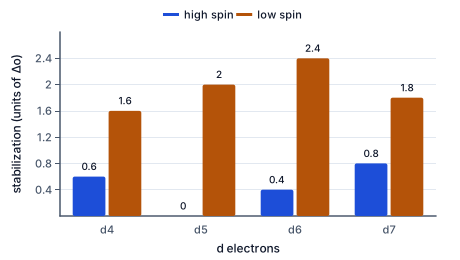
The chart compares the crystal field stabilization of the two fillings before pairing is counted. Low spin always gains more, because it keeps electrons out of the raised $e_g$ set. But count the pairs. At $d^6$, high spin $t_{2g}^4 e_g^2$ has one pair and low spin $t_{2g}^6$ has three: two extra pairs, and a gain of $2.4 - 0.4 = 2.0\,\Delta_o$. Every $d$ count gives the same pattern: the low-spin filling gains exactly one $\Delta_o$ for each extra pair it makes. Moving one electron from $e_g$ to $t_{2g}$ gains $0.6 + 0.4 = 1.0\,\Delta_o$ and creates one pair. So the energy advantage of low spin is
$$n(\Delta_o - P),$$
where $n$ is the number of extra pairs, one at $d^4$ and $d^7$ and two at $d^5$ and $d^6$. Its sign is the sign of $\Delta_o - P$, which is why the whole decision comes down to comparing two numbers.
What makes $\Delta_o$ large? Above all the ligand. The spectrochemical series, found by comparing the spectra of complexes of the same metal, ranks ligands by the splitting they cause:
$$\mathrm{I^- < Br^- < Cl^- < F^- < OH^- < H_2O < NH_3 < en < NO_2^- < CN^- < CO}.$$
Ligands at the left are weak-field and give high-spin complexes of first-row metals; those at the right are strong-field and usually give low-spin ones.
Another way: picture
Think of a building with a ground floor of three rooms and an upper floor of two, where climbing the stairs costs $\Delta_o$ and sharing a room costs $P$. Guests arrive one by one, and each takes the cheapest place. When the stairs are short, a weak field, the fourth guest goes upstairs rather than share. When the stairs are long, a strong field, the fourth guest shares a room downstairs, and so do the next two.
Another way: steps
A simple point-charge picture predicts that charged ligands should split the d orbitals more than neutral ones, yet water beats hydroxide and neutral carbon monoxide beats every anion. The order makes sense only when the ligands' own orbitals are counted.
Every ligand donates a lone pair along the metal-ligand axis, which raises $e_g$. Ligands with extra filled p orbitals, the halides and hydroxide, also donate sideways into $t_{2g}$, pushing it up too and so narrowing the gap: they are $\pi$ donors and sit at the weak end. Ammonia and ethylenediamine have no spare lone pairs and only donate along the axis. Cyanide and carbon monoxide have empty $\pi^$ orbitals that accept electron density from $t_{2g}$, pulling it down* and widening the gap: they are $\pi$ acceptors and sit at the strong end. That is why the series is a property of the ligands and holds, with small exceptions, for every metal.
For a given ligand, two features of the metal ion raise $\Delta_o$. A higher oxidation state draws the ligands closer and splits the orbitals more: $\mathrm{[Co(H_2O)_6]^{3+}}$ has about twice the splitting of $\mathrm{[Co(H_2O)_6]^{2+}}$. And moving down a group increases the splitting by roughly half from the first row to the second, and further again to the third, because the larger 4d and 5d orbitals reach out to the ligands. The pairing energy falls at the same time, since electrons in larger orbitals repel each other less.
The result is a rule worth remembering: complexes of the second- and third-row metals, such as ruthenium, rhodium, palladium, osmium, iridium and platinum, are almost always low spin, whatever the ligand. The high-spin/low-spin question is really a question about the first row, where $\Delta_o$ and $P$ are close enough for the ligand to tip the balance.
The two states can be told apart without any spectroscopy, because unpaired electrons make a substance magnetic. A sample of a high-spin iron(II) salt is pulled into the field of a strong magnet; a sample of potassium hexacyanidoferrate(II), low-spin $d^6$ with every electron paired, is not. Lesson 13 turns the size of that pull into a count of unpaired electrons. Colors and bond lengths change too: a low-spin ion has no electrons in the $e_g$ orbitals that point at the ligands, so its metal-ligand bonds are shorter, by about two tenths of an angstrom for iron(II).
Four checks catch most slips. First, only $d^4$ to $d^7$ have two states; if your answer gives a $d^3$ or $d^8$ octahedral ion two different fillings, one is wrong. Second, the electrons must add up to the $d$ count in either filling, and low spin never puts an electron in $e_g$ until $t_{2g}$ holds six. Third, low spin always has fewer unpaired electrons than high spin at the same $d$ count: two against four at $d^4$, one against five at $d^5$, none against four at $d^6$, one against three at $d^7$. Fourth, the advantage $n(\Delta_o - P)$ is a multiple of $\Delta_o - P$ by one or two only, so an answer three times the difference has miscounted the pairs.
A last check is common sense about the ligand. A first-row complex of fluoride, chloride or water that comes out low spin, or one of cyanide that comes out high spin, deserves a second look at the numbers, because those ligands sit at the two ends of the series.
The iron in each heme group of hemoglobin is iron(II), $d^6$, held by four nitrogen atoms of a porphyrin ring and a fifth from a histidine of the protein. Without oxygen, the splitting is smaller than the pairing energy and the iron is high spin, with four unpaired electrons, two of them in the $e_g$ orbitals that point at the ring's nitrogens. Those electrons make the ion too large to fit in the hole of the ring, and it sits just out of the plane.
When an oxygen molecule binds as the sixth ligand, the field grows, $\Delta_o$ passes $P$, and the iron becomes low spin with its six electrons paired in $t_{2g}$. With $e_g$ empty, the ion shrinks and slips into the plane of the ring, pulling the histidine and the protein chain with it. That small movement is passed from one subunit of the protein to the next and makes the other hemes take up oxygen more readily, the cooperative binding that lets blood load oxygen in the lungs and release it in the tissues. The change of spin can be measured directly: Linus Pauling and Charles Coryell showed in 1936 that deoxygenated hemoglobin is paramagnetic and oxygenated hemoglobin is not.
Some iron(II) complexes have $\Delta_o$ so close to $P$ that a modest change of temperature tips them from one spin state to the other. These spin-crossover compounds change color, magnetism and size together when they switch. A family of iron(II) triazole polymers turns from purple, low spin, to white, high spin, a little above room temperature, and back again on cooling at a lower temperature. That lag gives them a memory: between the two temperatures, the state depends on history.
Chemists have proposed such materials for thermal sensors, displays and data storage, and the design rule is the comparison this lesson teaches. A candidate whose low-spin advantage $n(\Delta_o - P)$ is thousands of wavenumbers from zero will never switch; one within a few hundred may. Choosing ligands near the middle of the spectrochemical series, nitrogen donors such as triazoles and pyridines, is how the splitting is tuned to the pairing energy.
The chart invites a wrong conclusion: low spin always has the taller bar, so low spin must always win. The bars leave out the pairing energy. Each extra pair that low spin makes costs $P$, and the bar gains exactly $\Delta_o$ for each pair, so low spin wins only when $\Delta_o$ is larger than $P$. For water and the halides with first-row metals it usually is not, which is why most aqua ions are high spin.
A second confusion is between field strength and bond strength. A strong-field ligand is one that causes a large splitting, not necessarily one that binds tightly: fluoride binds many metal ions very strongly and is still a weak-field ligand.
Find the $d$ count of $\mathrm{[Fe(H_2O)_6]^{2+}}$.
$8 - 2 = 6$
Iron is in group $8$ and has lost two electrons.
Compare the splitting with the pairing energy.
$\Delta_o = 10{,}400 < P = 17{,}600\ \text{cm}^{-1}$
Water is a weak-field ligand.
Choose the spin state and fill the orbitals.
$\text{high spin: } t_{2g}^{4}\,e_g^{2}$
Climbing to $e_g$ is cheaper than pairing.
Count the unpaired electrons.
$3 - 1 + 2 = 4$
Three $t_{2g}$ orbitals with one of them paired, and two single $e_g$ electrons.
Weigh the filling.
$0.4 \times 4 - 0.6 \times 2 = 0.4\,\Delta_o$
As in lesson 10.
Find the $d$ count of $\mathrm{[Co(NH_3)_6]^{3+}}$.
$9 - 3 = 6$
Cobalt is in group $9$.
Compare the splitting with the pairing energy.
$\Delta_o = 23{,}000 > P = 21{,}000\ \text{cm}^{-1}$
Ammonia and a $3+$ charge together give a large splitting.
Choose the spin state and fill the orbitals.
$\text{low spin: } t_{2g}^{6}\,e_g^{0}$
Pairing is cheaper than climbing.
Count the unpaired electrons.
$0$
Every orbital of $t_{2g}$ is full: the complex is diamagnetic.
Find the advantage over high spin.
$n = 3 - 1 = 2, \quad 2 \times (23{,}000 - 21{,}000) = 4{,}000\ \text{cm}^{-1}$
Low spin makes two extra pairs.
Compare with $\mathrm{[CoF_6]^{3-}}$.
$\Delta_o = 13{,}000 < 21{,}000$
With fluoride, the same ion is high spin, with four unpaired electrons.
Find the $d$ count of $\mathrm{[Fe(CN)_6]^{3-}}$.
$8 - 3 = 5$
The six cyanides bring $6-$, so iron is $+3$.
Compare the splitting with the pairing energy.
$\Delta_o = 35{,}000 > P = 30{,}000\ \text{cm}^{-1}$
Cyanide is near the strong end of the series.
Fill the orbitals low spin.
$t_{2g}^{5}\,e_g^{0}, \quad \text{unpaired} = 1$
Two pairs and one single electron in $t_{2g}$.
Find the advantage over high spin.
$n = 2, \quad 2 \times (35{,}000 - 30{,}000) = 10{,}000\ \text{cm}^{-1}$
High-spin $d^5$ has no pairs; low spin has two.
Convert to kJ/mol.
$10{,}000 \times 0.01196 = 119.6\ \text{kJ/mol}$
The same conversion as in lesson 10.
Compare with $\mathrm{[Fe(H_2O)_6]^{3+}}$.
$\Delta_o = 13{,}700 < 30{,}000: \text{ high spin, unpaired} = 5$
The same iron(III) ion, five unpaired electrons instead of one.
Compare the splitting with the pairing energy.
$13{,}900 < 23{,}500$
Climbing is cheaper than pairing.
Choose the spin state and fill the orbitals.
$\text{high spin: } t_{2g}^{3}\,e_g^{1}$
The fourth electron goes up into $e_g$.
Count the unpaired electrons.
Put these ligands in order of the splitting they cause, weakest field first.
Number the steps in order (write the number in the box):
Complete the worked solution for a low-spin octahedral $d^{6}$ ion: its upper-set electrons, its unpaired electrons and its stabilization before pairing energy.
Fill the lower set completely before the upper set.
$e_g\ \text{electrons} =$ e
Only electrons beyond the six the lower set holds go into the upper set.
Count the singly occupied orbitals.
$\text{unpaired} =$ u
A lower set with more than three electrons has some of them paired.
Weigh the filling.
$\text{CFSE} = (\text{lower} \times \text{gain}) - (\text{upper} \times \text{cost}) =$ c $\Delta_o$
Four tenths of the splitting gained for each lower electron, six tenths lost for each upper one.
Using the splitting $\Delta_o$ and the pairing energy $P$ given for each, which of these complexes is low spin?
For low-spin octahedral ions with $d^{4}$ and $d^{6}$, in that order, fill in the $t_{2g}$ electrons, the $e_g$ electrons, the unpaired electrons and the stabilization in units of $\Delta_o$ before pairing energy.
| t2g electrons | eg electrons | unpaired electrons | stabilization (units of Δo) | |
|---|---|---|---|---|
| the first ion | ||||
| the second ion |
The complex $\mathrm{[Mn(H_2O)_6]^{2+}}$ is $d^{5}$, with $\Delta_o = 7800$ cm$^{-1}$ and pairing energy $P = 25500$ cm$^{-1}$. How many unpaired electrons does it have?
Answer: unpaired electrons
In $\mathrm{[Mn(H_2O)_6]^{2+}}$, a $d^{5}$ complex, $\Delta_o = 7800$ cm$^{-1}$ and the pairing energy is $P = 25500$ cm$^{-1}$. By how much, in cm$^{-1}$, is the low-spin arrangement more stable than the high-spin one? Give a negative number if high spin is more stable.
Answer: cm⁻¹ in favor of low spin
A materials lab looking for spin-crossover switches, complexes that change spin state when warmed, screens candidates by how close the splitting is to the pairing energy. For $\mathrm{[Mn(H_2O)_6]^{2+}}$ ($\Delta_o = 7800$, $P = 25500$), $\mathrm{[Fe(CN)_6]^{4-}}$ ($32850$, $17600$) and $\mathrm{[Co(NH_3)_6]^{3+}}$ ($23000$, $21000$), all in cm$^{-1}$, fill in the unpaired electrons and the low-spin advantage in cm$^{-1}$, negative when high spin wins, in that order.
| unpaired electrons | low-spin advantage (cm⁻¹) | |
|---|---|---|
| the first complex | ||
| the second complex | ||
| the third complex |
Lesson test: one question per skill, one attempt each, no hints. Your answers are checked when you submit.
For low-spin octahedral ions with $d^{5}$ and $d^{6}$, in that order, fill in the $t_{2g}$ electrons, the $e_g$ electrons, the unpaired electrons and the stabilization in units of $\Delta_o$ before pairing energy.
| t2g electrons | eg electrons | unpaired electrons | stabilization (units of Δo) | |
|---|---|---|---|---|
| the first ion | ||||
| the second ion |
You can decide a spin state. Explain why $\mathrm{[Fe(H_2O)_6]^{2+}}$ is high spin and $\mathrm{[Fe(CN)_6]^{4-}}$ is low spin, although both hold iron(II).
15. Your turn: is $\mathrm{[Cr(H_2O)_6]^{2+}}$, $d^4$, with $\Delta_o = 13{,}900$ and $P = 23{,}500$ cm$^{-1}$, high or low spin, and how many unpaired electrons does it have?, step 3
$4$
Every electron is alone in its orbital.