Back to the on-screen lesson ·
Finding the lattice enthalpy of an ionic solid from its Born-Haber cycle, how it depends on ion charge and size, and what the cycle says about which compounds exist.
Paper packet. Every task here also exists on screen, where it is checked automatically; answers written on paper are not assessed by Nydus. When you are back at a device, enter your answers there.
By the end of this lesson you will be able to build a Born-Haber cycle, find a lattice enthalpy from it, and explain how ion charge and size set its value.
From general chemistry you know Hess's law, that the enthalpy change of a process is the same by any route between the same start and finish. You know ionization energy, the energy to remove an electron from a gaseous atom, and electron affinity, the energy change when a gaseous atom gains one. And you know that ionic solids such as sodium chloride are held together by the attraction of oppositely charged ions. This lesson measures that attraction.
| Term | What it means |
|---|---|
| Lattice enthalpy | The enthalpy change when one mole of an ionic solid forms from its gaseous ions; always negative. |
| Born-Haber cycle | A Hess's-law cycle that finds a lattice enthalpy from measurable steps. |
| Enthalpy of atomization | The energy to turn an element into one mole of gaseous atoms. |
| Ionization energy | The energy to remove an electron from a gaseous atom or ion. |
| Electron affinity | The enthalpy change when a gaseous atom gains an electron; negative for the halogens' first electron. |
| Enthalpy of formation | The enthalpy change when a compound forms from its elements in their standard states. |
| Refractory | Able to withstand very high temperatures without melting or breaking down. |
Sodium chloride can be formed from sodium metal and chlorine gas in one step, with an enthalpy of formation of $-411$ kJ/mol. It can also be formed the long way round, through five steps that can each be measured or looked up:
By Hess's law the two routes must have the same total, which gives the Born-Haber cycle:
$$\Delta H_f = \Delta H_{\text{atom}}(\mathrm{Na}) + IE + \Delta H_{\text{atom}}(\mathrm{Cl}) + EA + \Delta H_{\text{latt}}.$$
The first four steps add to $107 + 496 + 121 - 349 = +375$ kJ/mol: making gaseous sodium and chloride ions from the elements costs energy. So the lattice enthalpy is $-411 - 375 = -786$ kJ/mol. Forming the crystal releases more than enough to pay for making the ions, and that is why sodium chloride exists.
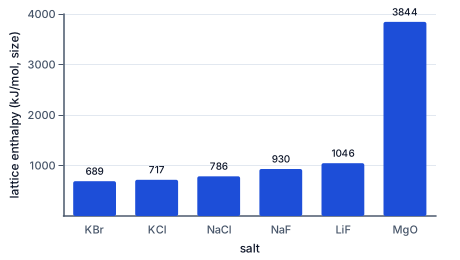
The chart shows the pattern across six salts. Lattice enthalpy grows as the ions get smaller, because the attraction between charges grows as they come closer: from potassium bromide through sodium chloride to lithium fluoride. And it grows enormously with charge: magnesium oxide, with ions of charge $2+$ and $2-$, has a lattice enthalpy nearly five times that of sodium fluoride, whose ions are about the same size, because the attraction depends on the product of the charges.
Another way: picture
Think of the cycle as a trip between two places at different heights, with the solid salt in a valley and the elements on a hillside. You can walk straight down, the enthalpy of formation, or climb first to a high ridge, the gaseous ions, and then drop a long way into the valley, the lattice enthalpy. The height of the valley is the same either way, so the long drop can be found from the climb and the short walk.
Another way: steps
Magnesium oxide shows the cycle at its most extreme. Making $\mathrm{Mg^{2+}}$ takes both the first and second ionization energies, $738 + 1{,}451 = 2{,}189$ kJ/mol, and making $\mathrm{O^{2-}}$ is worse still: the first electron is taken up with a release of $141$ kJ/mol, but forcing a second electron onto a negative ion costs $798$, a net $+657$. Together with atomizing the magnesium and the oxygen, the ions cost $3{,}242$ kJ/mol to make.
Nothing that costly could exist without a huge payback, and the lattice supplies it: $-3{,}844$ kJ/mol, because the attraction between $2+$ and $2-$ ions is four times that between $1+$ and $1-$ ions at the same distance. The oxide ion exists only because a crystal holds it; as a free gaseous ion it would shed its extra electron at once. Many compounds of highly charged ions are like this, stable only because of their lattice enthalpies.
Born-Haber cycles also answer why some compounds do not exist. Why is sodium chloride $\mathrm{NaCl}$ and not $\mathrm{NaCl_2}$? Making $\mathrm{Na^{2+}}$ would require the second ionization energy of sodium, $4{,}562$ kJ/mol, removing an electron from a full inner shell. A $\mathrm{NaCl_2}$ lattice would be more strongly bound than sodium chloride's, but nowhere near enough to repay that cost, so its enthalpy of formation would be strongly positive.
Magnesium is the opposite case. $\mathrm{MgCl}$, with $\mathrm{Mg^+}$, would save the second ionization energy, but its lattice, with singly charged ions, is far weaker than that of $\mathrm{MgCl_2}$. Balancing the two, $\mathrm{MgCl_2}$ is much more stable, and $\mathrm{MgCl}$ is not formed. The oxidation states the main-group elements show are the ones for which the cycle comes out most negative.
The same balance explains a famous prediction. Bartlett's reasoning in lesson 24, that xenon could be oxidized by platinum hexafluoride, rested on comparing ionization energies; the lattice and bond energies of the product decided whether the compound would hold together once formed. Chemists still use cycles of this kind to judge whether an unknown ionic compound is worth trying to make: if the estimated lattice enthalpy cannot repay the cost of the ions, the compound will decompose or never form, and the attempt is saved for a more promising target.
The lattice enthalpy is mostly the electrostatic attraction of the ions, and it can be estimated from their charges and the distance between them, the approach of Max Born and Alfred Landé. For the alkali halides, such estimates agree with the Born-Haber values within a few percent, which is strong evidence that these solids really are made of ions.
Where the two disagree, the disagreement is informative. For silver chloride and silver iodide the cycle gives a lattice enthalpy noticeably larger than the purely ionic estimate. The extra stability comes from covalent sharing between the soft silver ion and the soft halide, the effect lesson 18 described as soft-soft bonding. The gap between the measured and the ionic lattice enthalpy is one way chemists measure how covalent an ionic-looking solid really is.
Three checks catch most slips. First, the signs of the steps: atomizing and ionizing always cost energy and are positive; the first electron affinity of a halogen or oxygen is negative; any second electron affinity is positive. Getting one of these backward is the commonest error, and it changes the answer by twice that step.
Second, the sign of the result: the lattice enthalpy, defined as ions coming together, is always negative, and larger in size than the enthalpy of formation. Third, the stoichiometry: for a salt such as magnesium chloride, two chlorine atoms must be made and two electrons added, so those steps are doubled. A lattice enthalpy for a salt of doubly charged ions that comes out near that of sodium chloride has almost certainly left out a second ionization energy.
Finally, compare with the trend. Within a series of similar salts, smaller ions must give a more negative lattice enthalpy; an answer that runs the other way points to a misplaced number.
The furnaces that make steel run hotter than $1{,}600\ ^{\circ}\text{C}$, and their linings must survive molten metal and slag for months. Many are built of magnesium oxide bricks, often mixed with carbon, because magnesium oxide melts at about $2{,}850\ ^{\circ}\text{C}$, among the highest of any common compound. The reason is its lattice enthalpy: nearly $3{,}900$ kJ/mol holds its $2+$ and $2-$ ions together, almost five times the lattice enthalpy of sodium chloride, which melts at only $801\ ^{\circ}\text{C}$.
Magnesium oxide is also basic, so it resists the basic slags of steelmaking, and it is made in large quantity from seawater and from the mineral magnesite. The U.S. refractories industry supplies these materials to steel, cement and glass plants, and the choice among magnesia, alumina and other ceramics begins with the kind of comparison of lattice strength this lesson makes.
Lithium fluoride's large lattice enthalpy, the largest of the alkali halides, makes it far less soluble in water than sodium or potassium fluoride: water cannot easily pull its small, tightly held ions apart. The same small size that gives lithium its strong lattices gives it very high charge density, so lithium compounds often behave more like those of magnesium than like those of the other alkali metals, a pattern chemists call the diagonal relationship.
Battery engineers meet these effects directly. Lithium-ion batteries use lithium salts dissolved in organic solvents, and the salt must dissolve well enough to carry current, which rules out salts with very large lattice enthalpies such as lithium fluoride. The usual choice, lithium hexafluorophosphate, has a large, diffuse anion that holds the small lithium ion loosely, a smaller lattice enthalpy by design, chosen so that the salt dissolves readily and the lithium ions move freely between the electrodes as the battery charges and discharges.
It is tempting to think that sodium giving its electron to chlorine is a downhill step, since the two are happier as ions. In the gas it is not: removing sodium's electron costs $496$ kJ/mol and chlorine gives back only $349$. Making gaseous ions from the elements is uphill for every salt. The salt forms because the lattice releases far more energy than the ions cost.
The companion error is thinking an octet makes an ion stable on its own. The oxide ion has a full octet and is unstable as a free gaseous ion: its second electron affinity is strongly positive. It exists only inside a lattice, held by the attraction of the surrounding cations.
Write the direct route.
$\Delta H_f = -411\ \text{kJ/mol}$
Sodium and chlorine straight to the salt.
Add the atomizations.
$107 + 121 = 228$
Solid sodium to atoms; half a mole of chlorine molecules to atoms.
Add the ion-forming steps.
$496 + (-349) = 147$
Ionizing sodium costs more than chlorine's electron affinity returns.
Total the energy to make the ions.
$228 + 147 = 375\ \text{kJ/mol}$
The climb to gaseous ions.
Close the cycle.
$\Delta H_{\text{latt}} = -411 - 375 = -786\ \text{kJ/mol}$
The drop into the crystal.
Write the direct route.
$\Delta H_f = -616\ \text{kJ/mol}$
More exothermic than sodium chloride.
Add the atomizations.
$159 + 79 = 238$
Lithium metal is harder to atomize; fluorine's bond is weak.
Add the ion-forming steps.
$520 + (-328) = 192$
Lithium holds its electron more tightly than sodium.
Total the energy to make the ions.
$238 + 192 = 430\ \text{kJ/mol}$
A higher climb than for sodium chloride.
Close the cycle.
$\Delta H_{\text{latt}} = -616 - 430 = -1{,}046\ \text{kJ/mol}$
The smallest ions give the largest lattice enthalpy.
Compare with sodium chloride.
$-1{,}046 \text{ against } -786$
Smaller ions, closer together, held more tightly.
Write the direct route.
$\Delta H_f = -602\ \text{kJ/mol}$
Magnesium burning in oxygen.
Add the atomizations.
$147 + 249 = 396$
Magnesium metal, and half a mole of oxygen molecules.
Add the two ionization energies of magnesium.
$738 + 1{,}451 = 2{,}189$
Both electrons must go to make $\mathrm{Mg^{2+}}$.
Add the two electron affinities of oxygen.
$-141 + 798 = 657$
The second electron is forced onto a negative ion.
Total the energy to make the ions.
$396 + 2{,}189 + 657 = 3{,}242\ \text{kJ/mol}$
A very high climb.
Close the cycle.
$\Delta H_{\text{latt}} = -602 - 3{,}242 = -3{,}844\ \text{kJ/mol}$
Four times the charge product repays it.
Total the energy to make the ions.
$89 + 419 + 121 + (-349) = 280$
Atomize, ionize, atomize, add the electron.
Close the cycle.
$\Delta H_{\text{latt}} = -437 - 280$
Formation less the ion energy.
Evaluate the lattice enthalpy.
Match each salt to its lattice enthalpy.
| $-717$ kJ/mol | $-786$ kJ/mol | $-1046$ kJ/mol | $-3844$ kJ/mol | |
|---|---|---|---|---|
| $\mathrm{KCl}$ | ||||
| $\mathrm{NaCl}$ | ||||
| $\mathrm{LiF}$ | ||||
| $\mathrm{MgO}$ |
Complete the worked solution: the Born-Haber cycle for $\mathrm{KCl}$ from its measured steps, ending with its lattice enthalpy.
Add the energies that turn both elements into gaseous atoms.
$\text{atomizing} =$ t $\text{kJ/mol}$
Breaking up the metal and the nonmetal molecule.
Add the energies that turn the atoms into ions.
$\text{ionizing} =$ q $\text{kJ/mol}$
Removing electrons from the metal and giving them to the nonmetal.
Close the cycle with the enthalpy of formation.
$\text{lattice enthalpy} =$ u $\text{kJ/mol}$
Formation less everything spent making the ions.
Which of these salts has the most exothermic lattice enthalpy: $\mathrm{MgO}$, $\mathrm{LiF}$ or $\mathrm{NaCl}$?
In kJ/mol, $\mathrm{NaCl}$ has $\Delta H_f = -411$ with steps $107$, $496$, $121$ and $-349$ to its gaseous ions, and $\mathrm{NaF}$ has $\Delta H_f = -576$ with steps $107$, $496$, $79$ and $-328$. For each, in that order, fill in the energy to make the gaseous ions and the lattice enthalpy.
| gaseous ions from elements (kJ/mol) | lattice enthalpy (kJ/mol) | |
|---|---|---|
| the first salt | ||
| the second salt |
To make the gaseous ions of $\mathrm{NaF}$ from its elements, the steps are, in kJ/mol: atomize the metal $107$, ionize it $496$, atomize the halogen $79$, add an electron to it $-328$. What is the total?
Answer: kJ/mol to make the gaseous ions
For $\mathrm{KBr}$, in kJ/mol: enthalpy of formation $-394$; atomizing the metal $89$; ionizing it $419$; atomizing the nonmetal $112$; adding its electrons $-325$. Find the lattice enthalpy, the enthalpy change when the gaseous ions form the solid.
Answer: kJ/mol, lattice enthalpy
A materials engineer choosing a lining for a furnace compares ionic solids by how tightly their lattices hold together. In kJ/mol: $\mathrm{NaCl}$, $\Delta H_f = -411$, steps $107$, $496$, $121$, $-349$; $\mathrm{NaF}$, $\Delta H_f = -576$, steps $107$, $496$, $79$, $-328$; $\mathrm{KBr}$, $\Delta H_f = -394$, steps $89$, $419$, $112$, $-325$. For each, in that order, fill in the energy to make the gaseous ions and the lattice enthalpy.
| gaseous ions (kJ/mol) | lattice enthalpy (kJ/mol) | |
|---|---|---|
| the first compound | ||
| the second compound | ||
| the third compound |
Lesson test: one question per skill, one attempt each, no hints. Your answers are checked when you submit.
In kJ/mol, $\mathrm{KCl}$ has $\Delta H_f = -437$ with steps $89$, $419$, $121$ and $-349$ to its gaseous ions, and $\mathrm{KBr}$ has $\Delta H_f = -394$ with steps $89$, $419$, $112$ and $-325$. For each, in that order, fill in the energy to make the gaseous ions and the lattice enthalpy.
| gaseous ions from elements (kJ/mol) | lattice enthalpy (kJ/mol) | |
|---|---|---|
| the first salt | ||
| the second salt |
You can use a Born-Haber cycle. Explain why magnesium oxide's lattice enthalpy is so much larger than sodium fluoride's, and why sodium forms NaCl rather than NaCl₂.
15. Your turn: find the lattice enthalpy of potassium chloride, with $\Delta H_f = -437$ and steps $89$, $419$, $121$ and $-349$ kJ/mol., step 3
$-717\ \text{kJ/mol}$
Less than sodium chloride's, since potassium is larger.