Back to the on-screen lesson ·
Paramagnetism and diamagnetism, the spin-only magnetic moment $\sqrt{n(n+2)}$, and counting unpaired electrons from a measured moment to decide a spin state.
Paper packet. Every task here also exists on screen, where it is checked automatically; answers written on paper are not assessed by Nydus. When you are back at a device, enter your answers there.
By the end of this lesson you will be able to predict the spin-only magnetic moment of a complex and count its unpaired electrons from a measured moment.
Lessons 10 to 12 showed how to fill the d orbitals of a complex, high spin or low spin, octahedral or tetrahedral, and how to count the electrons left unpaired. Lesson 11 said that a low-spin complex has fewer unpaired electrons than a high-spin one and that a magnet can tell them apart. This lesson turns that into a number: the magnetic moment, measured in the lab and predicted from the filling.
| Term | What it means |
|---|---|
| Paramagnetic | Drawn into a magnetic field, because the substance has unpaired electrons. |
| Diamagnetic | Weakly pushed out of a magnetic field, because every electron is paired. |
| Magnetic moment, $\mu$ | The strength of a molecule's own magnetism, measured in Bohr magnetons. |
| Bohr magneton, $\mu_B$ | The natural unit of electron magnetism, about $9.27 \times 10^{-24}$ J/T. |
| Spin-only formula | $\mu = \sqrt{n(n+2)}\ \mu_B$ for $n$ unpaired electrons, counting their spin and ignoring their orbital motion. |
| Orbital contribution | Extra magnetism from electron orbital motion, which makes some measured moments larger than the spin-only value. |
| Evans method | A way of measuring a moment in solution from how far a paramagnetic sample shifts an NMR signal. |
An electron is a tiny magnet. In a filled orbital two electrons have opposite spins and their magnetism cancels, so a complex with every electron paired has no moment of its own and is diamagnetic. Each unpaired electron contributes, and a complex with unpaired electrons is paramagnetic: it is pulled into a magnetic field, more strongly the more unpaired electrons it has.
For the first-row metals, the moment comes almost entirely from the electrons' spin, and quantum mechanics gives it a simple form. For $n$ unpaired electrons the spin-only magnetic moment is
$$\mu = \sqrt{n(n+2)}\ \mu_B,$$
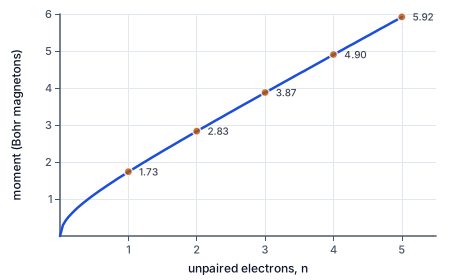
where $\mu_B$, the Bohr magneton, is the natural unit. One unpaired electron gives $\sqrt{3} = 1.73\ \mu_B$; five give $\sqrt{35} = 5.92\ \mu_B$.
The chart shows the moment rising almost in a straight line, each electron adding about one magneton, so that $\mu$ is always a little less than $n + 1$. The five values are worth knowing: $1.73$, $2.83$, $3.87$, $4.90$ and $5.92$. They are far enough apart that a measured moment, even one that strays a few tenths from the formula, points to one whole number of electrons.
The formula works in both directions. Forward, a filling gives $n$ and $n$ gives the expected moment. Backward, a measured moment gives $n$: since $\mu^2 = n^2 + 2n$, adding one completes a square, $\mu^2 + 1 = (n + 1)^2$, and
$$n = \sqrt{\mu^2 + 1} - 1.$$
Round the result to the nearest whole number. That is the chemist's reason for measuring moments: the number of unpaired electrons settles the spin state, and often the oxidation state and geometry too.
Another way: picture
Think of each electron as a compass needle. Two needles in one orbital are held pointing opposite ways, and together they point nowhere. The magnetism you can measure comes only from the needles that have no partner, and the more of them there are, all pointing the same way in a field, the harder the sample is pulled.
Another way: steps
A measured moment answers more than the spin-state question. Because it counts unpaired electrons, it can decide between structures that a formula alone leaves open, and chemists use it that way constantly.
It can settle a geometry. A four-coordinate nickel(II) complex is either square planar or tetrahedral, and the two cannot be told apart from the formula. The square-planar form has every electron paired and no moment at all; the tetrahedral form has two unpaired electrons and a moment of about three magnetons. One measurement decides it.
It can settle an oxidation state. A cobalt complex with no moment cannot hold cobalt(II), because a $d^7$ ion always has at least one unpaired electron whatever its field; it must hold low-spin cobalt(III). A manganese complex with about four magnetons has three unpaired electrons, which fits manganese(IV), $d^3$, and not manganese(II) or manganese(III) in any spin state. When a new compound is made, its moment is one of the first things measured, because it rules out so many wrong structures at once.
It can even show two metals talking to each other. In some compounds with two metal ions bridged by a ligand, the unpaired electrons on the two metals pair up across the bridge, and the measured moment is smaller than the two ions would give apart. That coupling is the basis of molecular magnetism, the study of magnets built one molecule at a time.
The classic instrument is the Gouy balance. A tube of the powdered sample hangs from a balance with its lower end between the poles of an electromagnet. When the magnet is switched on, a paramagnetic sample is pulled down into the field and appears to weigh more; a diamagnetic one is pushed out and appears to weigh a little less. From the change in mass, the field and the amount of sample, the magnetic susceptibility follows, and from it the moment. Pierre Curie showed that the susceptibility of a paramagnet falls as the temperature rises, because heat scrambles the electron magnets, so a moment is always worked out at a known temperature.
Modern labs more often use the Evans method, which needs only an NMR spectrometer. A small sealed tube of pure solvent is placed inside a tube of the complex dissolved in the same solvent. The paramagnetic complex shifts the solvent's signal, and the size of the shift gives the susceptibility of the solution. A sensitive magnetometer, called a SQUID, measures the smallest samples and follows moments across a wide range of temperature.
The formula ignores the magnetism of the electrons' orbital motion. In most first-row complexes the ligands lock that motion out, and measured moments come within a few tenths of the spin-only values: $\mathrm{[Mn(H_2O)_6]^{2+}}$ measures $5.9\ \mu_B$ against $5.92$. Where an electron can circulate among orbitals of equal energy, some orbital moment survives and the measurement comes out higher. The usual case is an octahedral ion whose $t_{2g}$ set is partly filled but not half full.
Octahedral cobalt(II), high-spin $d^7$ with three unpaired electrons, is the standard example: the spin-only value is $3.87\ \mu_B$, but measured moments run from about $4.7$ to $5.2$. Tetrahedral cobalt(II) and nickel(II) show a similar excess. So a moment counts electrons reliably only after that possibility has been considered, and a chemist interpreting one checks whether the ion is a known case of orbital contribution before rounding.
Four checks catch most slips. First, the moment depends on the unpaired electrons, never on the total $d$ count: $d^6$ can be $0\ \mu_B$, low spin, or $4.90\ \mu_B$, high spin, but never $\sqrt{48}$. Second, a spin-only moment is always a little less than $n + 1$; an answer bigger than that, or smaller than $n$, has gone wrong in the arithmetic. Third, a diamagnetic complex has $n = 0$ and $\mu = 0$, and only low-spin $d^6$, square-planar $d^8$ and the $d^0$ and $d^{10}$ ions are diamagnetic among the complexes met so far.
Fourth, when working backward, the unrounded $n$ should land within about half an electron of a whole number. If it lands near a half, say $3.5$, suspect an orbital contribution and look at which spin state makes chemical sense, rather than rounding blindly. Then check the count against the fillings you know: the number of unpaired electrons you settle on must be one that some filling of the ion actually gives, in its geometry and one of its spin states. A count that no filling produces points to a different oxidation state or a different structure.
An MRI scanner builds its picture from the protons in the body's water. A paramagnetic ion near those water molecules makes their protons relax back to equilibrium faster after each radio pulse, and faster relaxation shows as a brighter signal. That is how a contrast agent sharpens the image of a blood vessel or a tumor, and the more unpaired electrons the ion has, the stronger the effect.
The ion used in most agents is gadolinium(III), with seven unpaired f electrons and a spin-only moment of $\sqrt{63} = 7.94\ \mu_B$, the largest of any common ion. It is toxic as the free ion, so it is always held in a tight chelate, the subject of lesson 17. Concern about small amounts of gadolinium retained in the body has led researchers to develop agents based on manganese(II), high-spin $d^5$ with five unpaired electrons and $5.92\ \mu_B$, the largest moment a first-row ion can have, and one the body already knows how to handle.
More than a thousand kilometers down in the Earth's mantle, the mineral ferropericlase, $\mathrm{(Mg,Fe)O}$, holds iron(II) in octahedral sites of oxide ions. At the surface this iron is high spin, like the aqua ion. As pressure rises with depth, the oxide ions are squeezed closer, $\Delta_o$ grows, and between about $50$ and $70$ gigapascals it passes the pairing energy. The iron turns low spin, its four unpaired electrons pair up, and its moment falls to zero.
Experiments in diamond-anvil cells detected the change by the loss of the iron's magnetic signal, the same count of unpaired electrons this lesson makes. Because low-spin iron is smaller, the mineral becomes denser and stiffer, which changes how fast seismic waves travel through the lower mantle, and geophysicists now include the spin transition in their models of the Earth's interior.
It is natural to think that more d electrons means more magnetism. But paired electrons cancel, so the moment rises from $d^1$ to $d^5$ and then falls again as each new electron pairs one that was alone. High-spin $d^8$ has the same moment as $d^2$, and $d^{10}$ the same as $d^0$: none.
A second error is to report $n$ as the moment, or $n(n+2)$ without its square root. Four unpaired electrons give $4.90\ \mu_B$, not $4$ and not $24$. The check is the rule that the moment is always between $n$ and $n + 1$.
Find the $d$ count of $\mathrm{[Cr(H_2O)_6]^{3+}}$.
$6 - 3 = 3$
Chromium is in group $6$.
Fill the orbitals.
$t_{2g}^{3}\,e_g^{0}$
Three electrons, one to each $t_{2g}$ orbital; no spin choice at $d^3$.
Count the unpaired electrons.
$n = 3$
All three are alone.
Work out the product under the root.
$3 \times 5 = 15$
$n(n+2)$.
Take the square root.
$\mu = \sqrt{15} = 3.87\ \mu_B$
The measured value is $3.8\ \mu_B$.
Fill high-spin $\mathrm{[Fe(H_2O)_6]^{2+}}$, $d^6$.
$t_{2g}^{4}\,e_g^{2}$
Water is a weak-field ligand.
Count its unpaired electrons and moment.
$n = 4, \quad \mu = \sqrt{24} = 4.90\ \mu_B$
One pair in $t_{2g}$, four single electrons.
Fill low-spin $\mathrm{[Fe(CN)_6]^{4-}}$, $d^6$.
$t_{2g}^{6}\,e_g^{0}$
Cyanide is a strong-field ligand.
Count its unpaired electrons and moment.
$n = 0, \quad \mu = 0$
Every electron is paired: diamagnetic.
Compare with the measurement for the aqua ion.
$5.2\ \mu_B \approx 4.90$
Close to four unpaired electrons, nowhere near zero.
State the conclusion.
$\text{aqua: high spin; cyanide: low spin}$
A single measurement settles what lesson 11 predicted.
Write the measured moment of $\mathrm{[Mn(H_2O)_6]^{2+}}$.
$\mu = 5.9\ \mu_B$
A room-temperature measurement.
Square it and add one.
$5.9^2 + 1 = 34.81 + 1 = 35.81$
$\mu^2 + 1 = (n+1)^2$.
Take the root and subtract one.
$\sqrt{35.81} - 1 = 5.98 - 1 = 4.98$
$n = \sqrt{\mu^2 + 1} - 1$.
Round to whole electrons.
$n = 5$
Within a few hundredths of a whole number.
Match the count to a filling.
$t_{2g}^{3}\,e_g^{2}$
Five unpaired electrons means high-spin $d^5$.
Compare with the low-spin alternative.
$t_{2g}^{5}: \ n = 1, \ \mu = 1.73\ \mu_B$
Nothing like the measurement, so the aqua ion is high spin.
Fill the orbitals and count.
$t_{2g}^{6}\,e_g^{2}: \ n = 2$
Two single electrons in $e_g$.
Work out the product under the root.
$2 \times 4 = 8$
$n(n+2)$.
Take the square root.
Match each number of unpaired electrons to its spin-only magnetic moment in Bohr magnetons.
| $1.73\ \mu_B$ | $3.87\ \mu_B$ | $4.90\ \mu_B$ | $5.92\ \mu_B$ | |
|---|---|---|---|---|
| $n = 1$ | ||||
| $n = 3$ | ||||
| $n = 4$ | ||||
| $n = 5$ |
Complete the worked solution: the spin-only magnetic moment of a high-spin octahedral $d^{9}$ ion.
Count the unpaired electrons.
$n =$ u
Ten less the electrons, once every orbital holds one.
Work out the product under the root.
$n(n+2) =$ q
The unpaired electrons times two more than themselves.
Take the square root.
$\mu = \sqrt{n(n+2)} =$ m $\mu_B$
The spin-only moment, to two places.
What spin-only magnetic moment does a high-spin octahedral $d^{6}$ ion have?
For a low-spin octahedral $d^{6}$ ion, a high-spin $d^{2}$ ion and a high-spin $d^{8}$ ion, in that order, fill in the unpaired electrons, $n(n+2)$ and the spin-only moment in Bohr magnetons.
| unpaired electrons | n(n+2) | moment (Bohr magnetons) | |
|---|---|---|---|
| the low-spin ion | |||
| the first high-spin ion | |||
| the second high-spin ion |
A sample containing $\mathrm{[Cu(H_2O)_6]^{2+}}$ has a measured magnetic moment of $1.9\ \mu_B$. How many unpaired electrons does the complex have?
Answer: unpaired electrons
The complex $\mathrm{[CoF_6]^{3-}}$ is $d^{6}$, with $\Delta_o = 13000$ cm$^{-1}$ and pairing energy $P = 21000$ cm$^{-1}$. What spin-only magnetic moment, in Bohr magnetons, do you expect it to have?
Answer: Bohr magnetons, spin only
A university lab checks the complexes it has made with the Evans NMR method, which measures a moment from the shift of a solvent signal. It records $1.7\ \mu_B$ for $\mathrm{[Ti(H_2O)_6]^{3+}}$, $4.8\ \mu_B$ for $\mathrm{[Cr(H_2O)_6]^{2+}}$ and $1.9\ \mu_B$ for $\mathrm{[Cu(H_2O)_6]^{2+}}$. For each, in that order, fill in the unpaired electrons and the spin-only moment they predict.
| unpaired electrons | spin-only moment (Bohr magnetons) | |
|---|---|---|
| the first sample | ||
| the second sample | ||
| the third sample |
Lesson test: one question per skill, one attempt each, no hints. Your answers are checked when you submit.
For a low-spin octahedral $d^{6}$ ion, a high-spin $d^{2}$ ion and a high-spin $d^{8}$ ion, in that order, fill in the unpaired electrons, $n(n+2)$ and the spin-only moment in Bohr magnetons.
| unpaired electrons | n(n+2) | moment (Bohr magnetons) | |
|---|---|---|---|
| the low-spin ion | |||
| the first high-spin ion | |||
| the second high-spin ion |
You can connect magnetism to electrons. Explain how a moment of $5.2\ \mu_B$ shows that $\mathrm{[Fe(H_2O)_6]^{2+}}$ is high spin.
15. Your turn: what is the spin-only moment of $\mathrm{[Ni(H_2O)_6]^{2+}}$, $d^8$?, step 3
$\mu = \sqrt{8} = 2.83\ \mu_B$
The measured value is about $3.1\ \mu_B$.