Back to the on-screen lesson ·
Bonding and antibonding orbitals from atomic orbitals, the filling order with and without s-p mixing, bond order, and the paramagnetism of oxygen.
Paper packet. Every task here also exists on screen, where it is checked automatically; answers written on paper are not assessed by Nydus. When you are back at a device, enter your answers there.
By the end of this lesson you will be able to fill the molecular orbitals of a second-row diatomic, find its bond order, and count its unpaired electrons.
From general chemistry you know atomic orbitals, s and p, and Lewis structures with single, double and triple bonds. From lesson 13 you know that unpaired electrons make a substance paramagnetic. Crystal field theory in lessons 10 to 12 treated ligands as points of charge and ignored their orbitals. This unit brings the orbitals back, starting with the simplest molecules there are.
| Term | What it means |
|---|---|
| Molecular orbital | An orbital that spreads over a whole molecule, formed by combining atomic orbitals. |
| Bonding orbital | A combination lower in energy than the atomic orbitals, with electron density between the nuclei. |
| Antibonding orbital | A combination higher in energy, with a node between the nuclei; marked with a star. |
| $\sigma$ orbital | A molecular orbital symmetric around the bond axis. |
| $\pi$ orbital | A molecular orbital with a node along the bond axis, coming in degenerate pairs. |
| Bond order | Half the difference between bonding and antibonding electrons. |
| s-p mixing | The interaction between the 2s and 2p combinations that lifts $\sigma_{2p}$ above $\pi_{2p}$ for the lighter second-row elements. |
| Paramagnetic | Having unpaired electrons, and so drawn into a magnetic field. |
When two atoms approach, each pair of atomic orbitals that overlap combines in two ways. Added in phase, they build up electron density between the nuclei and form a bonding orbital, lower in energy than either atomic orbital. Subtracted, they leave a node between the nuclei and form an antibonding orbital, marked with a star, higher in energy by at least as much. Electrons in bonding orbitals hold the atoms together; electrons in antibonding orbitals push them apart.
For two second-row atoms, the 2s orbitals give $\sigma_{2s}$ and $\sigma^_{2s}$. The 2p orbitals pointing along the bond give $\sigma_{2p}$ and $\sigma^_{2p}$, and the two pairs pointing sideways give a degenerate pair $\pi_{2p}$ and a pair $\pi^*_{2p}$. The order of filling is
$$\sigma_{2s} < \sigma^_{2s} < \sigma_{2p} < \pi_{2p} < \pi^_{2p} < \sigma^*_{2p}$$
for oxygen and fluorine, but for boron, carbon and nitrogen $\pi_{2p}$ lies below $\sigma_{2p}$, because the 2s and 2p orbitals are close enough in energy to mix and push $\sigma_{2p}$ up.
Fill the valence electrons, lowest first, two to an orbital, and one to each of a degenerate pair before any pair up. Then
$$\text{bond order} = \tfrac{1}{2}(\text{bonding} - \text{antibonding}).$$
Nitrogen, with ten valence electrons, has eight bonding and two antibonding: bond order three, the triple bond of its Lewis structure. Oxygen, with twelve, puts its last two electrons into the $\pi^$ pair, one in each: bond order two, a double bond, and two unpaired electrons*. That is the result the Lewis structure misses, and it is why liquid oxygen is paramagnetic.
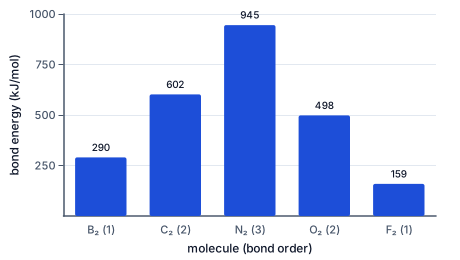
The chart sets the second-row molecules beside their bond orders. The bond energy climbs from boron to nitrogen as electrons fill bonding orbitals, then falls from nitrogen to fluorine as they fill antibonding ones. The bond order predicts the whole pattern.
Another way: picture
Think of two water waves meeting. Where crest meets crest they build a bigger wave: that is the bonding orbital, with more electron between the nuclei. Where crest meets trough they cancel to a flat spot: that is the antibonding orbital, with a node between the nuclei. Electrons in the first glue the atoms together; electrons in the second cancel some of that glue.
Another way: steps
The simplest cases show the idea with no complications. Two hydrogen atoms bring one electron each, and both go into $\sigma_{1s}$: bond order one, a stable molecule. Two helium atoms bring four electrons: two in $\sigma_{1s}$ and two in $\sigma^*_{1s}$. The antibonding pair cancels the bonding pair, the bond order is zero, and helium stays as single atoms, which is why it is a monatomic gas.
Remove one electron from $\mathrm{He_2}$ and the balance tips: $\mathrm{He_2^+}$ has two bonding electrons and one antibonding, bond order one half. It is a real ion, seen in electrical discharges through helium. Half-integer bond orders are normal in molecular orbital theory; they appear whenever a species has an odd number of electrons, and they have no place in a Lewis structure.
Because the frontier orbitals of oxygen are antibonding, removing electrons strengthens its bond and adding them weakens it. The dioxygenyl cation, $\mathrm{O_2^+}$, has one fewer $\pi^*$ electron than dioxygen: bond order two and a half, and a shorter bond, $112$ pm against $121$. Superoxide, $\mathrm{O_2^-}$, has one more: bond order one and a half, bond length about $133$ pm. Peroxide, $\mathrm{O_2^{2-}}$, has two more: bond order one, a single bond of about $149$ pm.
Nitrogen behaves the other way at first. Its highest filled orbital, $\sigma_{2p}$, is bonding, so removing an electron to make $\mathrm{N_2^+}$ weakens the bond, from order three to two and a half. The direction of the change depends on which kind of orbital the electron leaves, and that is only visible in the orbital diagram.
The same reasoning runs the other way for chemistry at a metal. When dioxygen binds to iron in hemoglobin, or to cobalt in the synthetic oxygen carriers chemists have made, the metal pushes some electron density into oxygen's empty half of the $\pi^*$ pair. The O-O bond lengthens and its vibration drops toward the value for superoxide, which is how spectroscopists tell that bound oxygen has taken on partial superoxide character. Reading a bond's stretching frequency as a measure of how many electrons sit in its antibonding orbitals is one of the most used tools in inorganic chemistry, and the next lesson applies it to carbon monoxide bound to metals.
Molecular orbitals are a model, but three kinds of measurement confirm the diagrams. The first is magnetism: dioxygen and diboron are paramagnetic, exactly as their diagrams predict, while dinitrogen, dicarbon and difluorine are not.
The second is bond length and stiffness. A higher bond order means more electron density between the nuclei, which pulls them closer and holds them more firmly. The bond lengths of the oxygen series lengthen steadily as the bond order falls, and the vibrational frequencies measured by infrared and Raman spectroscopy fall with them: dinitrogen, with its triple bond, vibrates at about $2{,}330$ cm$^{-1}$, dioxygen at about $1{,}550$ and difluorine at about $900$.
The third, and most direct, is photoelectron spectroscopy. Ultraviolet light or X-rays knock electrons out of a molecule, and the energy each electron carries away shows how tightly it was held, so the spectrum is a map of the orbital energies. For dinitrogen the spectrum shows the $\sigma_{2p}$ electrons easier to remove than the $\pi_{2p}$ electrons, confirming that s-p mixing has pushed $\sigma_{2p}$ above $\pi_{2p}$. For dioxygen the order is reversed. The photoelectron spectrum also shows fine structure from the molecule's vibration, and the spacing of that structure says whether the electron removed was bonding, which loosens the bond and narrows the spacing, or antibonding, which tightens it.
Three checks catch most slips. First, the electrons must add up: bonding plus antibonding equals the valence electrons, adjusted for the charge. A cation has fewer, an anion more.
Second, the ordering must fit the element. Using the oxygen ordering for nitrogen gives the right bond order for $\mathrm{N_2}$ but the wrong answer for $\mathrm{B_2}$: filled with $\sigma_{2p}$ first, boron's last two electrons would pair in $\sigma_{2p}$, but measurements show $\mathrm{B_2}$ is paramagnetic, with one electron in each $\pi_{2p}$ orbital. That observation is the evidence for s-p mixing.
Third, the bond order must fit what is known. A bond order of zero means no stable molecule; a bond order above three is impossible for a second-row diatomic, since only four bonding orbitals are available beyond $\sigma_{2s}$ and it is cancelled by $\sigma^*_{2s}$.
Cells burn food with oxygen, and a small fraction of the oxygen they handle picks up a single stray electron and becomes superoxide, $\mathrm{O_2^-}$. With one unpaired electron and a bond order of one and a half, it is a reactive radical, and cells convert it quickly to hydrogen peroxide with the enzyme superoxide dismutase, whose active site holds copper and zinc, or manganese.
Hydrogen peroxide contains the peroxide unit, bond order one, and its weak O-O bond breaks easily into radicals that damage proteins and DNA; a second enzyme, catalase, an iron enzyme, breaks it down to water and oxygen. The same weak bond is useful outside the body: hydrogen peroxide bleaches pulp for paper and whitens teeth because its O-O bond gives up oxygen so readily. The bond orders of this lesson are the chemistry behind both the damage and the defense.
In 1962 Neil Bartlett noticed that platinum hexafluoride, $\mathrm{PtF_6}$, was strong enough to pull an electron off dioxygen, making the dioxygenyl salt $\mathrm{O_2^+[PtF_6]^-}$. Removing an electron from oxygen's antibonding $\pi^*$ orbital raises its bond order to two and a half, and the ionization energy of $\mathrm{O_2}$ is almost the same as that of xenon.
Reasoning that xenon should react too, Bartlett mixed xenon with platinum hexafluoride and made the first compound of a noble gas, ending the belief that those elements could form no compounds at all. The step from oxygen to xenon rested on knowing which orbital oxygen's electron came from.
It is tempting to think that adding electrons adds bonding. From boron to nitrogen that is true, because the new electrons go into bonding orbitals. From nitrogen to neon it is false: the new electrons go into $\pi^$ and $\sigma^$, and each one undoes half a bond. Fluorine has more valence electrons than nitrogen and a bond only a sixth as strong.
A related error is trusting the Lewis structure for oxygen. It shows every electron paired, and so it predicts a diamagnetic molecule. Pour liquid oxygen between the poles of a strong magnet and it hangs there, held by its two unpaired electrons. The molecular orbital picture predicts that; the Lewis picture cannot.
Count the electrons in $\mathrm{He_2}$.
$2 + 2 = 4$
Two from each atom.
Fill the orbitals.
$(\sigma_{1s})^2(\sigma^*_{1s})^2$
The bonding orbital takes two, the antibonding the rest.
Count bonding and antibonding electrons.
$2 \text{ and } 2$
Equal numbers.
Find the bond order.
$\tfrac{1}{2}(2 - 2) = 0$
No net bond.
State the prediction.
$\text{helium stays monatomic}$
The antibonding pair cancels the bonding pair.
Count the valence electrons.
$5 + 5 = 10$
Nitrogen is in group 15.
Choose the ordering.
$\pi_{2p} < \sigma_{2p}$
s-p mixing is strong for nitrogen.
Fill the orbitals.
$(\sigma_{2s})^2(\sigma^*_{2s})^2(\pi_{2p})^4(\sigma_{2p})^2$
Ten electrons, lowest first.
Count bonding and antibonding electrons.
$8 \text{ and } 2$
Only $\sigma^*_{2s}$ is antibonding here.
Find the bond order.
$\tfrac{1}{2}(8 - 2) = 3$
The triple bond of the Lewis structure.
Count the unpaired electrons.
$0$
Every orbital is full: nitrogen is diamagnetic.
Count the valence electrons.
$6 + 6 = 12$
Oxygen is in group 16.
Choose the ordering.
$\sigma_{2p} < \pi_{2p}$
Mixing is weak from oxygen on.
Fill the first ten electrons.
$(\sigma_{2s})^2(\sigma^*_{2s})^2(\sigma_{2p})^2(\pi_{2p})^4$
Every bonding orbital full.
Place the last two electrons.
$(\pi^*_{2p})^2: \text{ one in each}$
Hund's rule in a degenerate pair.
Find the bond order.
$\tfrac{1}{2}(8 - 4) = 2$
A double bond, as the Lewis structure says.
Count the unpaired electrons.
$2$
Which the Lewis structure does not show: oxygen is paramagnetic.
Place the extra electron.
$(\pi^*_{2p})^3$
One more than dioxygen's two.
Count bonding and antibonding electrons.
$8 \text{ and } 5$
Two in $\sigma^_{2s}$, three in $\pi^_{2p}$.
Find the bond order.
Match each species to its bond order.
| $1$ | $2$ | $2.5$ | $3$ | |
|---|---|---|---|---|
| $\mathrm{F_2}$ | ||||
| $\mathrm{C_2}$ | ||||
| $\mathrm{N_2^+}$ | ||||
| $\mathrm{N_2}$ |
Complete the worked solution: fill the valence orbitals of $\mathrm{N_2}$ and find its bond order.
Count the electrons in the unstarred orbitals.
$\text{bonding electrons} =$ b
They lower the energy of the pair of atoms.
Count the electrons in the starred orbitals.
$\text{antibonding electrons} =$ a
They raise it again, undoing part of the bonding.
Halve the difference.
$\text{bond order} =$ o
Two net bonding electrons make one bond.
Which of these species is paramagnetic?
$\mathrm{H_2}$ has $2$ valence electrons and $\mathrm{N_2}$ has $10$. For each, in that order, fill in the electrons in bonding orbitals, the electrons in antibonding orbitals and the bond order.
| bonding electrons | antibonding electrons | bond order | |
|---|---|---|---|
| the first species | |||
| the second species |
How many unpaired electrons does $\mathrm{B_2}$, with $6$ valence electrons, have?
Answer: unpaired electrons
$\mathrm{O_2^{2-}}$ has $14$ valence electrons. Fill its molecular orbitals and find its bond order.
Answer: bond order
A biochemist studying oxidative damage compares the oxygen species a cell can make: dioxygen, superoxide and peroxide, and the dioxygenyl cation made in the lab. For $\mathrm{O_2^+}$ ($11$ valence electrons), $\mathrm{O_2^-}$ ($13$) and $\mathrm{O_2^{2-}}$ ($14$), fill in the bond order and the unpaired electrons, in that order.
| bond order | unpaired electrons | |
|---|---|---|
| the first species | ||
| the second species | ||
| the third species |
Lesson test: one question per skill, one attempt each, no hints. Your answers are checked when you submit.
$\mathrm{H_2^+}$ has $1$ valence electrons and $\mathrm{C_2}$ has $8$. For each, in that order, fill in the electrons in bonding orbitals, the electrons in antibonding orbitals and the bond order.
| bonding electrons | antibonding electrons | bond order | |
|---|---|---|---|
| the first species | |||
| the second species |
You can use a molecular orbital diagram. Explain why oxygen is paramagnetic and why fluorine's bond is weaker than nitrogen's.
15. Your turn: what is the bond order of superoxide, $\mathrm{O_2^-}$, with $13$ valence electrons?, step 3
$\tfrac{1}{2}(8 - 5) = 1.5$
Weaker than dioxygen's double bond, with one unpaired electron.