Back to the on-screen lesson ·
Chiral complexes without a stereocenter: chelate propellers, the stereoisomer count as geometric isomers plus mirror images, and the enantiomeric excess from optical rotation.
Paper packet. Every task here also exists on screen, where it is checked automatically; answers written on paper are not assessed by Nydus. When you are back at a device, enter your answers there.
By the end of this lesson you will be able to decide whether a complex is chiral, count its stereoisomers including mirror images, and find the enantiomeric excess of a partly resolved sample from its rotation.
From organic chemistry you know that a molecule is chiral when it cannot be superimposed on its mirror image, that the two mirror-image forms are enantiomers, and that enantiomers rotate plane-polarized light by equal amounts in opposite directions. From lesson 8 you can count the geometric isomers of a complex. This lesson finds which of those isomers are chiral and adds their mirror images.
| Term | What it means |
|---|---|
| Chiral | Not superimposable on its mirror image; a chiral molecule has no mirror plane. |
| Enantiomers | A chiral molecule and its mirror image. |
| Optical isomers | Enantiomers, named for their opposite effect on polarized light. |
| Δ and Λ | The labels for the right-handed and left-handed propeller of three or two chelate rings round an octahedral metal. |
| Racemic mixture | Equal amounts of two enantiomers, which rotate polarized light by nothing overall. |
| Enantiomeric excess | The percentage by which one enantiomer exceeds the other: observed rotation over the pure enantiomer's, times $100$. |
| Resolution | Separating a racemic mixture into its enantiomers, often by crystallizing it with a chiral partner. |
Hold your hands palm to palm and they are mirror images; lay one on the other, both palms down, and they do not match. A molecule with that property is chiral, and the test is simple: a molecule with a mirror plane is its own mirror image and is not chiral; a molecule with no mirror plane is.
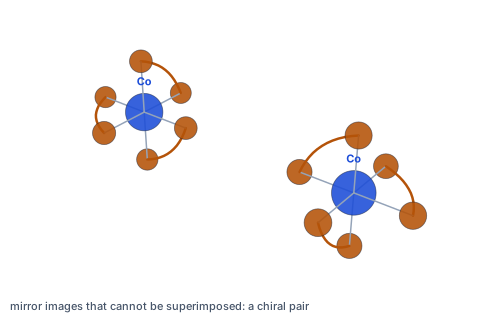
Octahedral complexes with chelating ligands are the commonest chiral complexes. In $\mathrm{[Co(en)_3]^{3+}}$ three ethylenediamines each span two neighboring corners of the octahedron. Looked at down the axis through the middle of two opposite faces, the three chelate rings wind round the cobalt like the blades of a propeller, and a propeller can wind left or right. The two forms are labeled $\Lambda$ (lambda, left-handed) and $\Delta$ (delta, right-handed), and no rotation turns one into the other.
Turn the two complexes in the figure. However you orient them, the propeller on the left winds the opposite way from the one on the right. Each is the other's mirror image, and neither has a mirror plane of its own, which is exactly what makes them a pair of enantiomers.
Chirality adds to the isomer count from lesson 8 in a simple way: each chiral geometric isomer has one mirror-image partner, so
$$\text{stereoisomers} = \text{geometric isomers} + \text{chiral geometric isomers}.$$
For $\mathrm{[Co(en)_2Cl_2]^+}$ the trans isomer has a mirror plane through the two chlorides and the cobalt, so it is achiral; the cis isomer has none, so it comes as a pair. That is two geometric isomers and three stereoisomers. Enantiomers have identical melting points, colors and solubilities; they differ only in how they interact with other chiral things, including polarized light and the chiral molecules of living cells.
Another way: picture
Picture a three-bladed fan seen from the front. Its blades slope so that they either screw away from you clockwise or anticlockwise. A fan and its reflection in a mirror slope opposite ways, and no turning of the fan changes which way it screws. Three chelate rings round a metal are that fan.
Another way: steps
| Complex | Type | Geometric | Chiral | Stereoisomers |
|---|---|---|---|---|
| $\mathrm{[Co(NH_3)_4Cl_2]^+}$ | $\mathrm{MA_4B_2}$ | $2$ | $0$ | $2$ |
| $\mathrm{[Co(NH_3)_3Cl_3]}$ | $\mathrm{MA_3B_3}$ | $2$ | $0$ | $2$ |
| $\mathrm{[Co(en)_3]^{3+}}$ | $\mathrm{M(AA)_3}$ | $1$ | $1$ | $2$ |
| $\mathrm{[Co(en)_2Cl_2]^+}$ | $\mathrm{M(AA)_2B_2}$ | $2$ | $1$ | $3$ |
| $\mathrm{[Co(NH_3)_2(H_2O)_2Cl_2]^+}$ | $\mathrm{MA_2B_2C_2}$ | $5$ | $1$ | $6$ |
Complexes of only monodentate ligands of two kinds always have a mirror plane in every isomer, which is why the first two rows add nothing. Chelates break the symmetry, and so does having three kinds of ligand, where the all-cis arrangement of $\mathrm{MA_2B_2C_2}$ has no mirror plane. Square-planar complexes are almost never chiral, because the plane of the square is itself a mirror plane.
Two enantiomers rotate plane-polarized light by the same angle in opposite directions, so a racemic mixture shows no rotation at all. A sample that is partly resolved shows a rotation proportional to the excess of one enantiomer:
$$\mathrm{ee} = \frac{\alpha_{\text{observed}}}{\alpha_{\text{pure}}} \times 100\%,$$
with both rotations measured at the same concentration, path length, wavelength and temperature. An excess of $60\%$ means the major enantiomer makes up $(100 + 60)/2 = 80\%$ of the sample and the minor one $20\%$, since the excess is their difference and together they make $100\%$.
Transition-metal complexes often rotate light far more strongly than organic molecules near the wavelengths where they absorb, because their d–d transitions are what the polarized light interacts with. That is why chemists studying chiral complexes usually measure circular dichroism, the difference in absorption of left- and right-circularly polarized light, alongside the rotation.
A complex made from achiral starting materials forms both enantiomers equally. Separating them, resolution, uses a chiral partner. If the complex is a cation, crystallize it with a single enantiomer of a chiral anion, such as tartrate: the two salts, $\Delta$-cation with the anion and $\Lambda$-cation with the same anion, are no longer mirror images of each other, so they have different solubilities and one crystallizes first. Filtering and repeating the crystallization raises the excess of one enantiomer step by step, and the rotation of each crop tracks the progress. Werner used exactly this method in 1911 to resolve cis-$\mathrm{[Co(en)_2(NH_3)Cl]^{2+}}$, proving that octahedral cobalt complexes can be chiral.
To check whether a complex is chiral, look for a mirror plane: a plane through the metal that reflects the complex onto itself. If you can find one, or a center of inversion, the complex is achiral and has no separate mirror image. $\mathrm{trans\text{-}[Co(en)_2Cl_2]^+}$ has a mirror plane through both chlorides and the metal, so it is achiral, while the cis isomer has none and is chiral. A complex with no chelating ligands and only two kinds of ligand is almost never chiral, so a claim that it is deserves a model.
A count of stereoisomers can be checked by listing the geometric isomers and adding one mirror image for every chiral one; the total can never be less than the number of geometric isomers.
An enantiomeric excess must lie between zero and one hundred percent. A racemic mixture rotates polarized light by nothing and has an excess of zero; a pure enantiomer has the full rotation and an excess of one hundred percent. The sign of the rotation says which enantiomer is in excess, not how much, so the excess is calculated from the sizes of the two rotations. An excess above one hundred percent means the rotations were divided the wrong way round, and a sample whose rotation exceeds the pure enantiomer's was measured under different conditions, since rotation depends on concentration, path length, wavelength and temperature.
Models are worth the trouble. A chelating ligand such as ethylenediamine spans two neighboring corners of the octahedron, never two opposite ones, so a drawing that stretches it across the metal is not a real complex. Build the complex and its mirror image from a kit or on the screen, and try to lay one on the other: if no rotation makes every ligand match, the two are enantiomers. The test takes a minute and settles questions that drawings on paper leave open, because a flat drawing hides which way the chelate rings twist.
The ruthenium complex $\mathrm{[Ru(bpy)_3]^{2+}}$, with three bipyridine chelates, is a propeller like $\mathrm{[Co(en)_3]^{3+}}$, and its relatives with a larger, flat ligand such as dppz slide between the stacked base pairs of DNA. They are almost dark in water and glow brightly once bound to DNA, a "light switch" first reported in 1990 and now used to probe DNA structure.
DNA is itself a right-handed helix, and the two enantiomers of such a complex do not fit it equally: for $\mathrm{[Ru(phen)_2(dppz)]^{2+}}$ the $\Delta$ form binds more strongly and glows several times brighter than the $\Lambda$ form. Studying that difference needs each enantiomer as pure as possible, so the groups doing it resolve the racemic complex by crystallization with a chiral anion and check every batch's excess by its rotation or circular dichroism, the arithmetic of this lesson.
Many chiral drugs are made with chiral metal catalysts, and the handedness of the catalyst decides the handedness of the product. The 2001 Nobel Prize in Chemistry went to William Knowles and Ryoji Noyori for chiral rhodium and ruthenium catalysts, and to Barry Sharpless for a chiral titanium one. Knowles's rhodium catalyst was used by Monsanto from the 1970s to make L-DOPA for Parkinson's disease with an enantiomeric excess of about $95\%$, meaning that about $97.5\%$ of the product was the active enantiomer.
The catalysts work because their metal is held by chelating ligands arranged with one handedness, which makes the space round the metal chiral; a substrate can approach it comfortably only one way. Manufacturers state a product's quality as its enantiomeric excess, and a regulator will ask for it on every batch, measured by exactly the comparison of observed and pure rotation, or by chiral chromatography, that this lesson calculates.
Organic chemistry teaches chirality through the carbon atom with four different groups, and it is tempting to look for the same thing in a complex. Most chiral complexes have nothing of the kind: in $\mathrm{[Co(en)_3]^{3+}}$ the cobalt carries six identical nitrogen donors, yet the complex is chiral because of how the chelate rings are arranged. The only test that always works is the mirror plane.
The reverse error is to assume that any complex with different ligands is chiral. $\mathrm{[Co(NH_3)_4Cl_2]^+}$ has two kinds of ligand and two geometric isomers, but each has a mirror plane through the metal and both chlorides, so neither is chiral. Different ligands make geometric isomers; missing mirror planes make optical ones. In 1914 Werner resolved "hexol", a cobalt complex containing no carbon atom at all, to settle the argument that chirality needs carbon.
Count the geometric isomers of $\mathrm{[Co(en)_2Cl_2]^+}$.
$\text{cis and trans} \Rightarrow 2$
The two chlorides are neighbors or opposite, as in lesson 8.
Look for a mirror plane in trans.
$\text{plane through Cl–Co–Cl and between the en rings}$
The two en rings lie symmetrically in the equatorial plane.
Look for a mirror plane in cis.
$\text{none}$
The two en rings twist like two blades of a propeller.
Count the chiral isomers.
$1$
Only cis.
Add the mirror images.
$2 + 1 = 3$
trans, $\Delta$-cis and $\Lambda$-cis.
Count the geometric isomers of $\mathrm{[Co(NH_3)_6]^{3+}}$.
$1$
All six ligands are identical.
Look for a mirror plane.
$\text{several, through the metal}$
Any plane containing four ammines is a mirror plane.
Count its stereoisomers.
$1 + 0 = 1$
Achiral.
Count the geometric isomers of $\mathrm{[Co(en)_3]^{3+}}$.
$1$
Three identical chelates can be arranged only one way.
Look for a mirror plane.
$\text{none: the three rings make a propeller}$
A propeller has a handedness.
Count its stereoisomers.
$1 + 1 = 2$
$\Delta$ and $\Lambda$.
A sample of one pure enantiomer rotates light by $400°$ under set conditions; a batch rotates it by $+240°$. Write the definition.
$\mathrm{ee} = \dfrac{\alpha_{\text{observed}}}{\alpha_{\text{pure}}} \times 100\%$
The racemic part rotates nothing.
Substitute the rotations.
$\mathrm{ee} = \dfrac{240}{400} \times 100\%$
Both measured the same way.
Divide the two rotations.
$\dfrac{240}{400} = 0.60$
Sixty percent of the full rotation.
State the excess.
$\mathrm{ee} = 60\%$
Multiply by $100$.
Find each enantiomer's share.
$\text{major} = \dfrac{100 + 60}{2} = 80\%, \quad \text{minor} = 20\%$
Their difference is the excess and their sum is $100\%$.
Check with the rotations.
$(0.80 - 0.20) \times 400 = 240$
The minor enantiomer cancels an equal amount of the major.
Count the geometric isomers.
$1$
Three identical chelates.
Look for a mirror plane.
$\text{none: a propeller}$
Like $\mathrm{[Co(en)_3]^{3+}}$.
Add the mirror image.
Match each complex to the number of stereoisomers it has, mirror images included.
| $1$ | $2$ | $3$ | $6$ | |
|---|---|---|---|---|
| $\mathrm{[Co(NH_3)_5Cl]^{2+}}$ | ||||
| $\mathrm{[Pt(NH_3)_2Cl_2]}$ | ||||
| $\mathrm{[Cr(en)_2(NH_3)_2]^{3+}}$ | ||||
| $\mathrm{[Co(NH_3)_2(H_2O)_2Cl_2]^{+}}$ |
Complete the worked solution: count the stereoisomers of $\mathrm{[Co(NH_3)_5Cl]^{2+}}$, a complex of type $\mathrm{MA_5B}$.
Count the geometric isomers.
$\text{geometric isomers} =$ g
Arrangements of ligands that no rotation relates.
Add a mirror image for every chiral one.
$\text{stereoisomers} = (\text{geometric}) + (\text{chiral}) =$ n
An isomer with no mirror plane has a distinct mirror-image partner.
Check the total against the geometric count.
$\text{stereoisomers} \ge \text{geometric isomers}$
Mirror images only add to the count; an achiral isomer adds none.
Which of these complexes can exist as a pair of non-superimposable mirror images?
Fill in the table for $\mathrm{[Pt(NH_3)_2Cl_2]}$, $\mathrm{[Cr(en)_2(NH_3)_2]^{3+}}$ and $\mathrm{[Co(NH_3)_2(H_2O)_2Cl_2]^{+}}$, in that order.
| geometric isomers | chiral geometric isomers | stereoisomers in all | |
|---|---|---|---|
| the first complex | |||
| the second complex | |||
| the third complex |
$\mathrm{[Cr(ox)_3]^{3-}}$ has $1$ geometric isomer(s), of which $1$ has no mirror plane. How many stereoisomers does it have in all?
Answer: stereoisomers
A sample of one pure enantiomer of $\mathrm{[Cr(en)_2(NH_3)_2]^{3+}}$ rotates polarized light by $110°$ under fixed conditions. A partly resolved sample, measured under the same conditions, rotates it by $88°$ in the same direction. What is its enantiomeric excess?
Answer: percent enantiomeric excess
A research group resolves $\mathrm{[Ru(bpy)_3]^{2+}}$, whose two enantiomers bind DNA differently, by crystallizing it with a chiral anion. The pure enantiomer rotates polarized light by $580°$ under their conditions. Three batches rotate it by $174°$, $232°$ and $406°$. For each, in that order, fill in the enantiomeric excess and the percentage of the major enantiomer.
| enantiomeric excess (%) | major enantiomer (%) | |
|---|---|---|
| the first batch | ||
| the second batch | ||
| the third batch |
Lesson test: one question per skill, one attempt each, no hints. Your answers are checked when you submit.
Fill in the table for $\mathrm{[Co(NH_3)_3Cl_3]}$, $\mathrm{[Co(en)_2Cl_2]^{+}}$ and $\mathrm{[Co(NH_3)_2(H_2O)_2Cl_2]^{+}}$, in that order.
| geometric isomers | chiral geometric isomers | stereoisomers in all | |
|---|---|---|---|
| the first complex | |||
| the second complex | |||
| the third complex |
You can recognize chiral complexes and count their stereoisomers. Explain why cis-$\mathrm{[Co(en)_2Cl_2]^+}$ is chiral while its trans isomer is not.
15. Your turn: how many stereoisomers does $\mathrm{[Cr(ox)_3]^{3-}}$ have?, step 3
$1 + 1 = 2$
$\Delta$ and $\Lambda$.