Back to the on-screen lesson ·
Reading polarity and chirality from a molecule's point group, and counting its vibrations, stretches and bends, with why some vibrations absorb infrared light.
Paper packet. Every task here also exists on screen, where it is checked automatically; answers written on paper are not assessed by Nydus. When you are back at a device, enter your answers there.
By the end of this lesson you will be able to decide from its point group whether a molecule is polar or chiral, and count its vibrations, stretches and bends.
From lessons 20 and 21 you can list a molecule's symmetry operations and assign its point group. From general chemistry you know that a bond between different atoms has a bond dipole, and that a molecule's overall dipole is what the bond dipoles add up to. From lesson 9 you know that a molecule is chiral when it cannot be superimposed on its mirror image. This lesson shows that the point group settles all of these questions at a glance.
| Term | What it means |
|---|---|
| Dipole moment | The separation of positive and negative charge in a molecule, a vector with a size and a direction. |
| Polar molecule | A molecule with a dipole moment that is not zero. |
| Chiral | Not superimposable on its mirror image. |
| Improper axis | An $S_n$ axis; a mirror plane counts as $S_1$ and a centre of inversion as $S_2$. |
| Degree of freedom | One independent way an atom or a molecule can move. |
| Vibrational mode | One independent way a molecule can vibrate, in which all its atoms move in step. |
| Infrared active | Able to absorb infrared light, which a vibration can do only if it changes the dipole moment. |
Polarity. A dipole moment is an arrow, and a symmetry operation must leave the molecule, and so every property of it, exactly as it was. So the dipole must point in a direction that every operation leaves unchanged. A rotation axis leaves only its own line unchanged; so do the mirror planes that contain it. But a horizontal plane reverses that line, a perpendicular twofold axis turns it end over end, and a centre of inversion reverses every direction. The only groups that leave some direction untouched are $C_1$, $C_s$, $C_n$ and $C_{nv}$, and only molecules in those groups can be polar. In the others the bond dipoles cancel exactly, however polar each bond is.
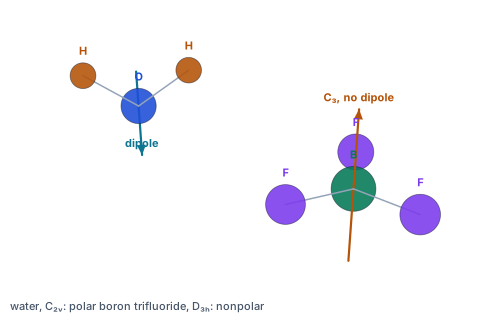
The figure shows the reasoning. Water is $C_{2v}$, and its dipole lies along the twofold axis, which both of its planes contain. Boron trifluoride is $D_{3h}$: a dipole would have to lie along the threefold axis to survive the rotations, and in the plane of the molecule to survive the horizontal reflection, and no arrow can do both. Its three polar B-F bonds cancel.
Chirality. A molecule is chiral only if it cannot be turned into its mirror image. Any improper operation, a mirror plane, a centre of inversion or an $S_n$ axis, carries the molecule into its mirror image and back into itself, so a chiral molecule has no improper axis of any kind. That leaves $C_1$, $C_n$ and $D_n$ (and the rare pure-rotation cubic groups). The tris-chelate complexes of lesson 9 are $D_3$, which is exactly why they are chiral.
Vibrations. Each of a molecule's $N$ atoms can move in three directions, $3N$ motions in all. Three of those move the whole molecule, the translations, and three turn it, the rotations, and neither changes a bond. What is left are the vibrational modes: $3N - 6$ for a nonlinear molecule, $3N - 5$ for a linear one, which can turn in only two independent ways. Water has $3 \times 3 - 6 = 3$. A vibration absorbs infrared light only if it changes the dipole moment as it goes, and the symmetry of each mode decides whether it does, as the next lesson shows.
Another way: picture
Imagine the dipole as a weather vane fixed to the molecule. Every symmetry operation must leave the molecule looking unchanged, so it must leave the vane pointing the same way too. If one operation would flip the vane round, the only vane that looks the same afterward is no vane at all: the dipole is zero.
Another way: steps
The rule explains results that the bonds alone make puzzling. Carbon tetrachloride has four strongly polar C-Cl bonds and no dipole moment: it is $T_d$, and the tetrahedral arrangement cancels the four bond dipoles exactly. Chloroform, $\mathrm{CHCl_3}$, with one chlorine replaced by hydrogen, drops to $C_{3v}$ and becomes polar, with its dipole along the C-H bond. Sulfur hexafluoride, $O_h$, is nonpolar; sulfur tetrafluoride, $C_{2v}$, a seesaw with a lone pair, is polar.
Symmetry says whether a dipole is allowed, not how big it is. A molecule in a polar group may still have a very small dipole if its bond dipoles nearly cancel, as in the chlorofluoromethanes. But a molecule in a nonpolar group has a dipole of exactly zero, and no measurement will find one. That makes the rule a reliable screen: if a molecule of supposed $D_{3h}$ structure shows a dipole moment, the structure is wrong.
For a molecule with one central atom, the vibrations divide cleanly into two kinds. Each bond can lengthen and shorten, a stretch, so there are as many stretches as bonds. Everything else changes an angle, a bend. Water has two O-H bonds and three vibrations: two stretches and one bend, the scissoring motion of the H-O-H angle. Methane, with five atoms, has nine: four stretches and five bends.
Stretches usually need more energy than bends, because it is harder to lengthen a bond than to open an angle, so stretching bands appear at higher wavenumber in an infrared spectrum. The O-H stretches of water absorb near $3{,}700$ cm$^{-1}$, its bend near $1{,}600$ cm$^{-1}$. Symmetry groups the vibrations further: some are degenerate, two or three vibrations of the same energy that give a single band. Methane's nine vibrations produce only four distinct frequencies, and only two of those absorb infrared.
Light of other kinds sees the vibrations differently. In Raman spectroscopy, a laser is shone on the sample and a small part of the scattered light comes back shifted in energy by one vibration. A vibration shows up there if it changes how easily the electron cloud is distorted, not the dipole, so vibrations invisible in the infrared often appear in the Raman spectrum instead. For a molecule with a centre of inversion, no vibration appears in both, a rule chemists use in reverse: if every band of an unknown compound shows up in only one of the two spectra, the compound very likely has a centre of inversion.
Three checks catch most slips. First, the polarity rule is one-way: a molecule in a nonpolar group is certainly nonpolar, but a molecule in a polar group need not have a large dipole. Second, a molecule with any mirror plane is achiral; if your chiral molecule has a plane, recheck the group. Third, the vibration count needs the right subtraction: five for a linear molecule, six otherwise. Carbon dioxide, linear with three atoms, has $9 - 5 = 4$ vibrations, not three; water, bent, has $9 - 6 = 3$. A count of zero or less means the molecule was taken as linear when it is not, or the atoms were miscounted.
Finally, the number of stretches can never exceed the number of vibrations, and for a molecule with a central atom the bends are what is left. If you find more stretches than bonds, you have counted a bend as a stretch. And a molecule's count of infrared-active vibrations can never be larger than its count of vibrations; for a homonuclear diatomic it is always zero, which is the quickest check of all on an answer about the atmosphere.
About $99$ percent of the dry atmosphere is nitrogen and oxygen, yet neither traps heat. The Earth gives off infrared light, and a gas absorbs that light only through vibrations that change its dipole moment. Nitrogen and oxygen are homonuclear diatomic molecules: their single vibration, a stretch of two identical atoms, never separates any charge, so they are transparent to it.
Carbon dioxide, with four vibrations, has three that change its dipole, and its bending mode absorbs strongly near $667$ cm$^{-1}$, close to the peak of the Earth's infrared emission. Methane, water vapor, nitrous oxide and ozone all have infrared-active modes too. Sulfur hexafluoride, used to insulate high-voltage electrical equipment, has six active vibrations and lasts thousands of years in the atmosphere, which is why the U.S. Environmental Protection Agency lists it among the most potent greenhouse gases it tracks. Every one of those facts follows from counting vibrations and asking which change the dipole.
A measured dipole moment is a quick test of a proposed structure, and it settled one of the early questions of structural chemistry. Xenon difluoride, made in 1962 when chemists first found that noble gases could form compounds, was shown to have no dipole moment, which ruled out a bent structure and confirmed that it is linear, $D_{\infty h}$.
The same test is used on coordination compounds. The cis and trans isomers of a square-planar complex such as $\mathrm{[PtCl_2(NH_3)_2]}$ have the same formula, but the cis isomer is $C_{2v}$ and polar, while the trans isomer is $D_{2h}$ and nonpolar. A dipole measurement tells them apart, which matters because only the cis isomer, cisplatin, is the cancer drug.
A common line of reasoning is that a molecule with polar bonds must be polar. Carbon tetrachloride, boron trifluoride and sulfur hexafluoride all have strongly polar bonds and no dipole at all. The bond dipoles are vectors, and symmetry makes them add to zero. Only the point group can tell whether they cancel, and it tells without adding anything up.
The companion error concerns chirality: thinking a molecule needs a carbon atom with four different groups to be chiral. Symmetry says only that it must lack every improper axis. The $D_3$ tris-chelate complexes have no such carbon and are chiral; some molecules with two such carbons have a mirror plane and are not.
Find its shape.
$\text{seesaw: four F and one lone pair}$
Five electron domains, one of them a lone pair.
Find its point group.
$C_{2v}$
A twofold axis through the lone pair and two vertical planes.
Apply the polarity rule.
$C_{2v} \in \{C_1, C_s, C_n, C_{nv}\}$
A polar group.
Place the dipole.
$\text{along the } C_2 \text{ axis}$
The one direction both planes and the axis keep.
Check it for chirality.
$\text{mirror planes} \Rightarrow \text{achiral}$
Polar but not chiral.
Count the atoms.
$N = 5$
One carbon and four hydrogens.
Count every motion.
$3N = 15$
Three directions per atom.
Take away translations and rotations.
$15 - 6 = 9$
Methane is not linear.
Count the stretches.
$4$
One per C-H bond.
Count the bends.
$9 - 4 = 5$
The rest change H-C-H angles.
Say what symmetry adds.
$\text{9 vibrations, 4 frequencies, 2 infrared bands}$
Degenerate vibrations share a frequency; only some change the dipole.
Count nitrogen's vibrations.
$3 \times 2 - 5 = 1$
A linear diatomic has one stretch.
Test it for infrared activity.
$\text{dipole stays zero}$
Stretching two identical atoms never separates charge.
Count carbon dioxide's vibrations.
$3 \times 3 - 5 = 4$
Linear, three atoms.
Test the symmetric stretch.
$\text{both oxygens move out together: dipole stays zero}$
Inactive, like nitrogen's.
Test the asymmetric stretch and the two bends.
$\text{each makes a dipole}$
One oxygen closer than the other, or the molecule bent: charge separates.
Count the active vibrations.
$3 \text{ of } 4$
So carbon dioxide absorbs infrared and traps heat; nitrogen cannot.
Find its point group.
$D_{3h}$
A flat triangle with three perpendicular twofold axes.
Apply the polarity rule.
$D_{3h} \notin \{C_1, C_s, C_n, C_{nv}\}: \text{nonpolar}$
The three B-F dipoles cancel.
Count its vibrations.
Match each molecule to what its point group allows.
| polar, not chiral | neither polar nor chiral | chiral | |
|---|---|---|---|
| $\mathrm{NH_3}$ | |||
| $\mathrm{PCl_5}$ | |||
| $\mathrm{H_2O_2}$ |
Complete the worked solution: count the motions, vibrations and bends of $\mathrm{CH_2Cl_2}$, a nonlinear molecule with one central atom.
Multiply the atoms by three.
$\text{motions} =$ t
Each atom can move along three directions.
Take away the translations and rotations.
$\text{vibrations} =$ q
Three of each move the molecule without deforming it.
Take away one stretch for each bond.
$\text{bends} =$ e
What is left changes angles, not bond lengths.
The point groups are $\mathrm{NH_3}$, $C_{3v}$; $\mathrm{BF_3}$, $D_{3h}$; $\mathrm{[Co(en)_3]^{3+}}$, $D_3$. Which molecule has a dipole moment?
$\mathrm{SF_6}$ ($O_h$, $7$ atoms) and $\mathrm{HOCl}$ ($C_s$, $3$ atoms) are both nonlinear. For each, in that order, fill in $1$ if it is polar or $0$ if not, $1$ if it is chiral or $0$ if not, and its number of vibrational modes.
| polar (1 or 0) | chiral (1 or 0) | vibrational modes | |
|---|---|---|---|
| the first molecule | |||
| the second molecule |
$\mathrm{BrF_5}$ has $6$ atoms and $5$ bonds to its central atom. How many of its vibrations are bends rather than stretches?
Answer: bending vibrations
How many vibrational modes does $\mathrm{H_2O_2}$, a nonlinear molecule of $4$ atoms, have?
Answer: vibrational modes
A climate scientist lists which gases in the atmosphere can absorb the infrared light the Earth gives off. For $\mathrm{CO_2}$ ($3$ atoms), $\mathrm{H_2O}$ ($3$ atoms) and $\mathrm{N_2O}$ ($3$ atoms), fill in the number of vibrations and the number that absorb infrared, in that order. Diatomic and triatomic molecules here are linear except water and ozone.
| vibrations | infrared-active vibrations | |
|---|---|---|
| the first gas | ||
| the second gas | ||
| the third gas |
Lesson test: one question per skill, one attempt each, no hints. Your answers are checked when you submit.
$\mathrm{H_2O}$ ($C_{2v}$, $3$ atoms) and $\mathrm{SF_4}$ ($C_{2v}$, $5$ atoms) are both nonlinear. For each, in that order, fill in $1$ if it is polar or $0$ if not, $1$ if it is chiral or $0$ if not, and its number of vibrational modes.
| polar (1 or 0) | chiral (1 or 0) | vibrational modes | |
|---|---|---|---|
| the first molecule | |||
| the second molecule |
You can use symmetry to predict. Explain why carbon tetrachloride has no dipole moment though its bonds are polar, and why nitrogen is not a greenhouse gas.
14. Your turn: is boron trifluoride polar, and how many vibrations does it have?, step 3
$3 \times 4 - 6 = 6$
Four atoms, nonlinear.