Back to the on-screen lesson ·
The five kinds of symmetry element, the operations each generates, and the order of a molecule's group counted from its operations.
Paper packet. Every task here also exists on screen, where it is checked automatically; answers written on paper are not assessed by Nydus. When you are back at a device, enter your answers there.
By the end of this lesson you will be able to find the symmetry elements of a molecule, list the operations they generate, and count the order of its group.
From lessons 6 to 9 you can picture complexes in three dimensions: an octahedron's six corners, the difference between cis and trans, and why a propeller of chelates has a mirror image it cannot be turned into. Those arguments already used symmetry without naming it. This unit names it, so that a shape can be described exactly and the description used to predict polarity, chirality and spectra.
| Term | What it means |
|---|---|
| Symmetry operation | A movement of a molecule after which it looks exactly as it did before. |
| Symmetry element | The point, line or plane about which an operation is carried out. |
| Identity, $E$ | The operation of doing nothing, which every molecule has. |
| Proper axis, $C_n$ | An axis about which a turn of $360/n$ degrees leaves the molecule unchanged. |
| Principal axis | The proper axis with the highest $n$. |
| Mirror plane, $\sigma$ | A plane through which reflection leaves the molecule unchanged; $\sigma_h$ is perpendicular to the principal axis, $\sigma_v$ and $\sigma_d$ contain it. |
| Centre of inversion, $i$ | A point through which every atom can be sent to an identical atom the same distance beyond. |
| Improper axis, $S_n$ | An axis for a turn of $360/n$ degrees followed by a reflection in the plane perpendicular to it. |
| Order of a group, $h$ | The total number of symmetry operations a molecule has. |
Turn a water molecule half a turn about the line through the oxygen that bisects the two hydrogens, and the hydrogens swap places. Since they are identical, the molecule looks exactly as it did. That move is a symmetry operation, and the line it is made about is a symmetry element. Every symmetry of a molecule is one of five kinds.
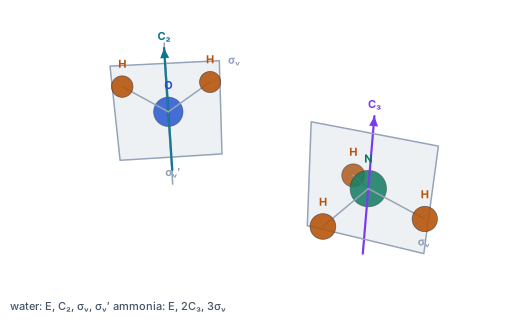
The figure shows water and ammonia standing on their principal axes. Water has $E$, a $C_2$ axis and two vertical mirror planes: one holds the whole molecule, the other cuts between the hydrogens. That is four operations. Ammonia has $E$, a $C_3$ axis and three vertical planes, one through each hydrogen.
An element can generate more than one operation. Ammonia's single $C_3$ axis gives two: $C_3$, a turn of $120^\circ$, and $C_3^2$, a turn of $240^\circ$. (A third turn, $C_3^3$, is a full circle and is just $E$.) So ammonia's operations, grouped into classes, are written $E, 2C_3, 3\sigma_v$: one identity, two rotations, three reflections, six operations in all. That total is the order of the molecule's group, $h$, and it is found by adding the coefficients.
Another way: picture
Imagine closing your eyes while a friend does something to a model of the molecule and then asks you to open them. If you cannot tell whether anything happened, what your friend did was a symmetry operation. The more of these invisible moves a shape allows, the more symmetric it is, and the order $h$ counts them.
Another way: steps
Chemists count operations rather than elements because the operations combine with each other. Do one operation and then another, and the result is always a third operation of the same molecule: for water, reflecting through one plane and then the other is the same as turning by $180^\circ$ about the axis. Every operation can also be undone by another in the set, and the identity is there to do nothing. A collection with those properties is what mathematicians call a group, and the complete set of a molecule's operations is its point group, so called because at least one point, the centre of mass, is left where it is by every operation.
That structure is what makes symmetry useful. The next lesson sorts every molecule into one of a small number of point groups, and once a molecule's group is known, a single table tells a chemist how its orbitals, its vibrations and its electronic states can behave, without calculating anything about the molecule itself. The order $h$ appears in all of those calculations, which is why it is worth counting correctly now.
Start with the axes, because they organize everything else. For boron trifluoride, a flat triangle, the principal axis is a $C_3$ through the boron, perpendicular to the plane of the molecule. There are also three $C_2$ axes in the plane, each along one boron-fluorine bond. The plane of the molecule itself is perpendicular to the principal axis, so it is $\sigma_h$. Three more planes each contain the principal axis and one bond: three $\sigma_v$. Finally, turning by $120^\circ$ and then reflecting in $\sigma_h$ leaves the molecule unchanged, so there is an $S_3$ axis along the principal axis. Counting operations: $E$, $2C_3$, $3C_2$, $\sigma_h$, $2S_3$, $3\sigma_v$, which is twelve.
Two habits prevent most mistakes. Build or picture the molecule and actually carry out each move rather than guessing. And list the operations in classes as you go, so that nothing is counted twice and nothing is forgotten. It also helps to look for the obvious elements before the hidden ones: the axes and planes you can see in a drawing first, then the centre of inversion, and the improper axes last, since they are the easiest to miss and are usually implied by the others.
Three checks catch most slips. First, the order of the group must be a multiple of the principal axis's $n$, because all $n$ of its rotations, the identity included, are in the group: $h = 12$ for boron trifluoride is four times three. An odd total for a molecule with a twofold axis is always wrong.
Second, a molecule with a principal axis and a horizontal plane $\sigma_h$ also has an $S_n$ axis along the principal axis, since the turn and the reflection are each allowed separately. If you have found $C_n$ and $\sigma_h$ but no $S_n$, look again. Third, $S_2$ is the same as inversion and $S_1$ is the same as a reflection, so they are never listed under those names. A count that includes both $i$ and $S_2$ has counted one operation twice.
A last check is to compare with a molecule of the same shape. Every flat triangle of three identical atoms round a centre has the twelve operations of boron trifluoride, and every regular tetrahedron the twenty-four of methane. If your count for a molecule differs from its shape's, one of its atoms is not like the others, or an operation has been missed.
Quantum chemistry programs, the software chemists use to predict structures, energies and spectra before making a compound, ask for a molecule's symmetry first. Parts of a molecule related by a symmetry operation must have identical properties, so the program calculates them once and copies the result. For a molecule of high symmetry the saving is large: the integrals that dominate the cost can be cut by a factor close to the order of the group.
For benzene, with $h = 24$, that is the difference between a calculation that finishes over lunch and one that runs overnight; for a large symmetric cluster or a buckminsterfullerene molecule, $\mathrm{C_{60}}$, with $h = 120$, it can decide whether the calculation is possible at all. The programs find the symmetry automatically, but a chemist who can count the operations by hand can tell when the program has missed some because the input structure was slightly distorted.
Every crystal structure reported in the research literature starts with its symmetry. When crystallographers solve a structure from X-ray diffraction, the pattern of spots shows which symmetry operations the crystal has, and those limit where the atoms can be. A molecule sitting on a site with a twofold axis, for instance, needs only half its atoms located; the other half follow from the operation.
The same bookkeeping is used in materials science. A property such as the ability to generate a voltage when squeezed, piezoelectricity, the effect behind the quartz crystal that keeps time in a watch, is impossible in any crystal with a centre of inversion. Checking a candidate material for $i$ is one of the first screens, and it is exactly the test this lesson teaches.
It is easy to count ammonia's symmetry as one axis and three planes and conclude it has four symmetries. But a threefold axis generates two different rotations, by $120$ and by $240$ degrees, and each is a separate operation. The order of the group counts operations, so ammonia has six: $E$, two rotations and three reflections.
The opposite error is to count too many: listing $C_3^3$ as well, or both $i$ and $S_2$. A full turn is the identity, and $S_2$ is inversion under another name. Each distinct move is counted exactly once.
Find the rotation axis.
$C_2$
A half turn about the line bisecting the H-O-H angle swaps the hydrogens.
Find the mirror planes.
$\sigma_v, \ \sigma_v'$
One holds the whole molecule; the other cuts between the hydrogens.
Test for a centre of inversion.
$\text{no } i$
Opposite a hydrogen, through the oxygen, there is nothing.
List the operations in classes.
$E, \ C_2, \ \sigma_v, \ \sigma_v'$
A $C_2$ axis gives one rotation besides $E$.
Count the operations.
$h = 1 + 1 + 1 + 1 = 4$
A multiple of two, as the $C_2$ axis requires.
Find the principal axis.
$C_3$
Through the nitrogen and the centre of the three hydrogens.
List the rotations it gives.
$C_3 \ (120^\circ), \ C_3^2 \ (240^\circ)$
A threefold axis gives two rotations besides $E$.
Find the mirror planes.
$3\sigma_v$
Each contains the axis and one hydrogen.
Test for a horizontal plane and inversion.
$\text{no } \sigma_h, \ \text{no } i$
The lone pair on top has no partner below.
List the operations in classes.
$E, \ 2C_3, \ 3\sigma_v$
Like operations are grouped with a coefficient.
Count the operations.
$h = 1 + 2 + 3 = 6$
A multiple of three.
Find the threefold axes.
$4 \text{ axes} \times 2 = 8C_3$
One along each C-H bond, each giving two rotations.
Find the twofold axes.
$3C_2$
Each bisects a pair of opposite H-C-H angles.
Find the improper axes.
$3 \text{ axes} \times 2 = 6S_4$
Along each $C_2$: a quarter turn then a reflection leaves methane unchanged, though a quarter turn alone does not.
Find the mirror planes.
$6\sigma_d$
Each contains two C-H bonds.
List the operations in classes.
$E, \ 8C_3, \ 3C_2, \ 6S_4, \ 6\sigma_d$
No centre of inversion: a hydrogen has nothing opposite it.
Count the operations.
$h = 1 + 8 + 3 + 6 + 6 = 24$
The order of the tetrahedral group.
List the operations in classes.
$E, \ 2C_3, \ 3C_2, \ \sigma_h, \ 2S_3, \ 3\sigma_v$
The principal axis is perpendicular to the flat molecule.
Add the coefficients.
$1 + 2 + 3 + 1 + 2 + 3$
Each class counts its operations.
Write the order of the group.
Match each symmetry element to the operation it performs.
| the identity: leave the molecule as it is | a reflection through a plane | an inversion of every atom through a centre | a rotation by 360/n degrees followed by a reflection through the plane perpendicular to the axis | |
|---|---|---|---|---|
| $E$ | ||||
| $\sigma$ | ||||
| $i$ | ||||
| $S_n$ |
Complete the worked solution for $\mathrm{BF_3}$: its principal axis, its mirror planes, and the total number of its symmetry operations.
Find the axis with the highest fold.
$\text{principal axis order} =$ n
The axis that turns the molecule by the smallest angle.
Count every mirror plane.
$\text{mirror planes} =$ m
Planes through the axis and any perpendicular to it.
Add up every operation, the identity included.
$\text{operations} =$ h
Each rotation by each allowed angle counts once, as does each reflection.
Which of these molecules has a centre of inversion?
For $\mathrm{BF_3}$ and $\mathrm{CHCl_3}$, in that order, fill in the order $n$ of the principal axis (write $1$ if there is no rotation axis), the number of mirror planes, and $1$ if there is a centre of inversion or $0$ if not.
| principal axis order | mirror planes | centre of inversion (1 or 0) | |
|---|---|---|---|
| the first molecule | |||
| the second molecule |
Through how many degrees in all does the operation $C_{8}^{7}$ turn a molecule?
Answer: degrees of rotation
The symmetry operations of $\mathrm{C_2H_4}$, collected in classes, are $E,\ C_2(z),\ C_2(y),\ C_2(x),\ i,\ \sigma(xy),\ \sigma(xz),\ \sigma(yz)$. How many symmetry operations does the molecule have in all?
Answer: symmetry operations
A computational chemist sets up quantum calculations on three molecules. The program uses each molecule's symmetry to cut the work by the order of its group. The operations are $E,\ 2C_6,\ 2C_3,\ C_2,\ 3C_2',\ 3C_2'',\ i,\ 2S_3,\ 2S_6,\ \sigma_h,\ 3\sigma_d,\ 3\sigma_v$ for $\mathrm{C_6H_6}$, $E,\ 2S_4,\ C_2,\ 2C_2',\ 2\sigma_d$ for $\mathrm{H_2C=C=CH_2}$ and $E,\ C_2(z),\ C_2(y),\ C_2(x),\ i,\ \sigma(xy),\ \sigma(xz),\ \sigma(yz)$ for $\mathrm{C_2H_4}$. In that order, fill in the order of each group and the number of reflections among its operations.
| order of the group | reflections | |
|---|---|---|
| the first molecule | ||
| the second molecule | ||
| the third molecule |
Lesson test: one question per skill, one attempt each, no hints. Your answers are checked when you submit.
For $\mathrm{NH_3}$ and $\mathrm{CH_4}$, in that order, fill in the order $n$ of the principal axis (write $1$ if there is no rotation axis), the number of mirror planes, and $1$ if there is a centre of inversion or $0$ if not.
| principal axis order | mirror planes | centre of inversion (1 or 0) | |
|---|---|---|---|
| the first molecule | |||
| the second molecule |
You can describe a molecule's symmetry. Explain why ammonia has six symmetry operations although it has only one rotation axis.
14. Your turn: how many symmetry operations does boron trifluoride have?, step 3
$h = 12$
Four times the principal axis's three.