Back to the on-screen lesson ·
The tetrahedral splitting of the d orbitals into $e$ and $t_2$, tetrahedral stabilization energies, octahedral site preference in spinels, and why $d^8$ ions are square planar.
Paper packet. Every task here also exists on screen, where it is checked automatically; answers written on paper are not assessed by Nydus. When you are back at a device, enter your answers there.
By the end of this lesson you will be able to fill the d orbitals in a tetrahedral field, calculate its stabilization, and find an ion's preference for an octahedral site.
Lesson 10 split the d orbitals in an octahedral field: $e_g$, pointing at the ligands, raised to $+0.6\,\Delta_o$, and $t_{2g}$, pointing between them, lowered to $-0.4\,\Delta_o$. Lesson 11 showed that the spin state depends on $\Delta_o$ against the pairing energy. From lesson 6 you know the tetrahedron and the square plane, the two four-coordinate shapes. This lesson applies the same reasoning to them.
| Term | What it means |
|---|---|
| $e$ (tetrahedral) | The two orbitals $d_{z^2}$ and $d_{x^2-y^2}$, the lower set in a tetrahedral field. |
| $t_2$ | The three orbitals $d_{xy}$, $d_{xz}$ and $d_{yz}$, the upper set in a tetrahedral field. |
| Tetrahedral splitting, $\Delta_t$ | The gap between $t_2$ and $e$, about four ninths of $\Delta_o$ for the same metal and ligands. |
| Octahedral site preference energy | The extra stabilization an ion gains in an octahedral site over a tetrahedral one. |
| Spinel | An oxide $\mathrm{AB_2O_4}$ whose metal ions sit in tetrahedral and octahedral holes between oxide ions. |
| Inverse spinel | A spinel in which the octahedral sites hold both kinds of metal ion and half the B ions take the tetrahedral sites. |
Place four ligands at alternate corners of a cube around the metal and they form a tetrahedron. None of them lies on an axis. The two orbitals that point along the axes, $d_{z^2}$ and $d_{x^2-y^2}$, now point between the ligands; the three that point between the axes, $d_{xy}$, $d_{xz}$ and $d_{yz}$, point more nearly toward them. So the order of lesson 10 reverses:
The weights keep the average fixed, as before: two orbitals down by $0.6$ balance three up by $0.4$. The gap $\Delta_t$ is much smaller than $\Delta_o$: there are four ligands instead of six, and no orbital points straight at any of them. For the same metal, ligands and distances,
$$\Delta_t \approx \tfrac{4}{9}\,\Delta_o.$$
Because $\Delta_t$ is so small, it is almost always less than the pairing energy, and tetrahedral complexes are high spin. Fill $e$ singly, then $t_2$ singly, then pair in $e$, then in $t_2$. The stabilization is
$$\text{CFSE}_t = (0.6\,n_e - 0.4\,n_{t_2})\,\Delta_t.$$
A tetrahedral $d^2$ ion, $e^2$, gains $1.2\,\Delta_t$; $d^3$, $e^2 t_2^1$, gains $0.8\,\Delta_t$; $d^5$, $e^2 t_2^3$, gains nothing, exactly as in an octahedral field. The tetrahedral pattern peaks at $d^2$ and $d^7$, where the octahedral one peaks at $d^3$ and $d^8$.
The tetrahedral stabilization is always smaller in kJ/mol than the octahedral one for the same ion, because $\Delta_t$ is less than half of $\Delta_o$. That is one reason tetrahedral complexes of the first-row metals are formed mostly with large, weak-field ligands such as chloride, bromide and iodide, which crowd each other around a small ion and gain little from a strong field anyway.
Another way: picture
Put the metal at the center of a cube. The octahedral ligands sat in the middle of the six faces, right where $d_{z^2}$ and $d_{x^2-y^2}$ point. The tetrahedral ligands sit at four of the eight corners, which lie closer to the directions of $d_{xy}$, $d_{xz}$ and $d_{yz}$, toward the middle of the cube's edges. The crowded orbitals and the roomy ones have swapped places.
Another way: steps
The factor is not a measured accident; it falls out of the crystal field model itself. Two things shrink the tetrahedral gap. The first is the number of ligands: four push on the d electrons instead of six, which by itself would give two thirds of the octahedral splitting. The second is the angle. In an octahedron the $e_g$ orbitals point exactly at the ligands and the $t_{2g}$ orbitals exactly between them, so the two sets feel the ligands as differently as they possibly can. In a tetrahedron no orbital points exactly at a ligand, and the $t_2$ set is only somewhat closer to the ligands than the $e$ set. The difference between the two sets is therefore smaller again, by a further factor of two thirds. Two thirds of two thirds is four ninths.
Real complexes follow the rule roughly, not exactly, because a tetrahedral complex usually has different bond lengths from an octahedral one of the same ion. It is still the right size to reason with: whatever the ligand, a tetrahedral splitting is less than half the octahedral one, and so it is almost always smaller than the pairing energy. That is why no one needs to ask whether a tetrahedral complex of a first-row metal is high spin or low spin.
In many solids, metal ions can sit in either octahedral or tetrahedral holes between oxide ions. An ion with no crystal field stabilization in either, $d^0$, high-spin $d^5$ or $d^{10}$, has no preference from this source. Every other ion gains more in an octahedral site, and the difference is its octahedral site preference energy:
$$\text{preference} = \text{CFSE}_{\text{oct}} - \text{CFSE}_{\text{tet}}.$$
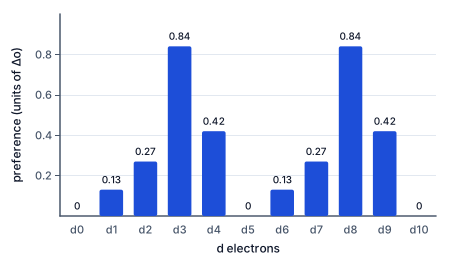
The chart gives the preference in units of $\Delta_o$, taking $\Delta_t = \frac{4}{9}\Delta_o$. It peaks at $d^3$ and $d^8$: chromium(III) and nickel(II) gain about $0.84\,\Delta_o$ in an octahedral site, and are almost never found in tetrahedral ones in oxides. Iron(II), $d^6$, prefers octahedral sites only weakly, and iron(III) and manganese(II), $d^5$, not at all. Those differences, of tens of kJ/mol, are enough to decide where ions sit in a crystal, as the applications show.
Start with an octahedron and pull the two ligands on the $z$ axis away. Every orbital with a $z$ in its name, $d_{z^2}$, $d_{xz}$ and $d_{yz}$, is relieved and drops in energy. $d_{x^2-y^2}$, pointing straight at the four ligands left in the plane, rises far above the rest, and $d_{xy}$, lying in the plane between them, sits below it. The result is four orbitals fairly close together and one high above them.
That pattern explains why square-planar complexes are almost all $d^8$. Eight electrons exactly fill the four lower orbitals and leave $d_{x^2-y^2}$ empty, which is a large stabilization when the gap is large. So $d^8$ ions with strong fields, platinum(II), palladium(II), gold(III), and nickel(II) with cyanide, are square planar and diamagnetic, with every electron paired. With a weak field the gap is too small, and nickel(II) chooses a tetrahedron instead: $\mathrm{[NiCl_4]^{2-}}$ is tetrahedral, with two unpaired electrons, while $\mathrm{[Ni(CN)_4]^{2-}}$ is square planar with none. Magnetism tells the two shapes apart at once.
Three checks catch most slips. First, the lower set has two orbitals, so $n_e$ can never exceed four, and it fills before $t_2$ takes a second electron in any orbital. A filling such as $e^3 t_2^0$ for $d^3$ has paired an electron that should have climbed.
Second, a tetrahedral ion is high spin, so its unpaired electrons are the same as the free ion's: $d$ unpaired up to $d^5$, then $10 - d$. Any other count means the filling went low spin.
Third, compare sizes. A tetrahedral stabilization in kJ/mol should be well below the octahedral one for the same ion, and the site preference should be positive or zero for high-spin ions: an octahedral site always gains at least as much. A negative preference means the two stabilizations were subtracted the wrong way round, or the tetrahedral one was multiplied by $\Delta_o$.
For a square-planar answer, the check is the electron count and the magnetism. A square-planar complex of a first-row metal should be $d^8$ with a strong-field ligand and should have no unpaired electrons; a four-coordinate $d^8$ complex measured with two unpaired electrons is tetrahedral, whatever a drawing of it suggests.
Spinels are oxides of formula $\mathrm{AB_2O_4}$, with oxide ions packed closely and metal ions in the holes: one eighth of the tetrahedral holes and half the octahedral ones. In a normal spinel the A ions take the tetrahedral sites; in an inverse spinel the octahedral sites prefer some A ions so strongly that half the B ions are pushed into tetrahedral ones. Crystal field site preference predicts which: magnetite, $\mathrm{Fe_3O_4}$, and nickel ferrite, $\mathrm{NiFe_2O_4}$, are inverse because iron(II) and above all nickel(II) gain from octahedral sites while iron(III) gains nothing; hausmannite, $\mathrm{Mn_3O_4}$, is normal because it is manganese(III), $d^4$, not manganese(II), $d^5$, that gains.
The same reasoning guides battery chemistry. Lithium manganese oxide, $\mathrm{LiMn_2O_4}$, a spinel cathode used in power tools and some electric vehicles, keeps lithium in tetrahedral sites and manganese in octahedral ones, and lithium moves in and out through the empty sites between them. Designers substituting nickel or chromium for part of the manganese, to raise the voltage, can count on those ions staying in octahedral sites, because their site preferences are among the largest there are.
The small beads of silica gel packed with electronics and medicines often include a few blue ones that turn pink when the gel has absorbed too much water. The color comes from cobalt(II) chloride. Dry, the cobalt sits in a tetrahedral site with chloride ligands, like $\mathrm{[CoCl_4]^{2-}}$, and is deep blue. Wet, water molecules take its coordination sphere and it becomes octahedral $\mathrm{[Co(H_2O)_6]^{2+}}$, which is pale pink.
Two things change together. The splitting changes size and pattern, so the ion absorbs light of a different color. And the intensity changes: a tetrahedral complex has no center of symmetry, which lets it absorb light far more strongly than an octahedral one, so a little tetrahedral cobalt is vividly blue while the octahedral form is faint. Because cobalt compounds are toxic, many manufacturers now use an orange indicator based on an organic dye instead, but the cobalt beads remain common in laboratories.
The most common error is to reuse lesson 10: three orbitals below at $0.4$, two above at $0.6$. In a tetrahedron it is the other way round. Two orbitals, $e$, are lower and are weighted $0.6$; three, $t_2$, are higher and weighted $0.4$. The labels lose their $g$, too, because a tetrahedron has no center of symmetry.
A second error is to compare stabilizations in different units. $1.2\,\Delta_t$ is not more than $0.8\,\Delta_o$; converted, it is about $0.53\,\Delta_o$. Put both in kJ/mol, or both in units of $\Delta_o$, before comparing sites.
Find the $d$ count of $\mathrm{Co^{2+}}$ in $\mathrm{[CoCl_4]^{2-}}$.
$9 - 2 = 7$
Cobalt is in group $9$; four chlorides make the ion $2-$.
Fill the tetrahedral orbitals high spin.
$e^{4}\,t_2^{3}$
Two singly in $e$, three singly in $t_2$, then two pair in $e$.
Weigh the filling.
$0.6 \times 4 - 0.4 \times 3 = 2.4 - 1.2 = 1.2\,\Delta_t$
The tetrahedral maximum.
Count the unpaired electrons.
$3$
The three single electrons in $t_2$.
Convert with $\Delta_t = 3{,}300$ cm$^{-1}$.
$3{,}300 \times 0.01196 = 39.5\ \text{kJ/mol}, \quad 1.2 \times 39.5 = 47.4\ \text{kJ/mol}$
A small splitting, and a small stabilization.
Weigh the octahedral filling of $d^8$.
$t_{2g}^{6}\,e_g^{2}: \ 0.4 \times 6 - 0.6 \times 2 = 1.2\,\Delta_o$
The octahedral peak.
Convert with $\Delta_o = 102$ kJ/mol.
$1.2 \times 102 = 122.4\ \text{kJ/mol}$
The hexaaqua value of lesson 10.
Weigh the tetrahedral filling of $d^8$.
$e^{4}\,t_2^{4}: \ 0.6 \times 4 - 0.4 \times 4 = 0.8\,\Delta_t$
Four in $e$, four in $t_2$.
Find the tetrahedral splitting.
$\tfrac{4}{9} \times 102 \approx 45\ \text{kJ/mol}$
Four ninths of the octahedral splitting.
Convert the tetrahedral stabilization.
$0.8 \times 45 = 36.0\ \text{kJ/mol}$
Much smaller than the octahedral value.
Subtract for the site preference.
$122.4 - 36.0 = 86.4\ \text{kJ/mol}$
A strong preference for octahedral sites.
Write the ions of $\mathrm{Fe_3O_4}$.
$\mathrm{Fe^{2+}} + 2\,\mathrm{Fe^{3+}} + 4\,\mathrm{O^{2-}}$
One iron(II) and two iron(III) balance four oxide ions.
Find the preference of $\mathrm{Fe^{3+}}$, $d^5$.
$0 - 0 = 0$
High-spin $d^5$ has no stabilization in either site.
Weigh $\mathrm{Fe^{2+}}$, $d^6$, in each site.
$\text{oct } 0.4\,\Delta_o, \quad \text{tet } 0.6\,\Delta_t$
$t_{2g}^4 e_g^2$ and $e^3 t_2^3$.
Convert with $\Delta_o = 124$ and $\Delta_t = 55$ kJ/mol.
$0.4 \times 124 = 49.6, \quad 0.6 \times 55 = 33.0$
Both in kJ/mol.
Subtract for the preference of $\mathrm{Fe^{2+}}$.
$49.6 - 33.0 = 16.6\ \text{kJ/mol}$
Small, but larger than iron(III)'s, which is nothing.
Place the ions.
$\mathrm{Fe^{3+}[Fe^{2+}Fe^{3+}]O_4}$
Iron(II) takes an octahedral site, pushing half the iron(III) into the tetrahedral ones: an inverse spinel.
Fill the orbitals.
$e^{2}\,t_2^{1}$
Two singly in $e$, the third singly in $t_2$.
Weigh the filling.
$0.6 \times 2 - 0.4 \times 1 = 1.2 - 0.4 = 0.8$
Lower-set gain minus upper-set cost.
Write the CFSE.
Match each $d$ count to its filling in a tetrahedral field.
| $e^{2}\,t_2^{0}$ | $e^{2}\,t_2^{2}$ | $e^{3}\,t_2^{3}$ | $e^{4}\,t_2^{4}$ | |
|---|---|---|---|---|
| $d^{2}$ | ||||
| $d^{4}$ | ||||
| $d^{6}$ | ||||
| $d^{8}$ |
Complete the worked solution: the crystal field stabilization energy of a tetrahedral $d^{7}$ ion.
Count the electrons in the lower set.
$e\ \text{electrons} =$ e
Its two orbitals fill first, singly, and pair only after the upper set has one each.
Count the electrons in the upper set.
$t_2\ \text{electrons} =$ t
The small tetrahedral gap never makes pairing cheaper than climbing.
Weigh them.
$\text{CFSE} = (\text{lower} \times \text{gain}) - (\text{upper} \times \text{cost}) =$ c $\Delta_t$
Each lower electron gains six tenths of the splitting; each upper one costs four tenths.
What is the crystal field stabilization energy of a tetrahedral $d^{8}$ ion, in units of $\Delta_t$?
For tetrahedral ions with $d^{2}$, $d^{3}$ and $d^{9}$, in that order, fill in the $e$ electrons, the $t_2$ electrons, the unpaired electrons and the stabilization in units of $\Delta_t$.
| e electrons | t2 electrons | unpaired electrons | stabilization (units of Δt) | |
|---|---|---|---|---|
| the first ion | ||||
| the second ion | ||||
| the third ion |
A tetrahedral $d^{8}$ complex has $\Delta_t = 86$ kJ/mol. What is its crystal field stabilization energy in kJ/mol?
Answer: kJ/mol of tetrahedral stabilization
In an oxide, the $\mathrm{Co^{2+}}$ ion ($d^{7}$, high spin) has $\Delta_o = 111$ kJ/mol in an octahedral site and $\Delta_t = 49$ kJ/mol in a tetrahedral one. What is its octahedral site preference energy, in kJ/mol?
Answer: kJ/mol of octahedral site preference
A battery chemist designing a spinel oxide cathode needs to know which metal ions will take its octahedral sites. For $\mathrm{Cr^{3+}}$ ($\Delta_o = 208$, $\Delta_t = 92$), $\mathrm{Co^{2+}}$ ($111$, $49$) and $\mathrm{Ni^{2+}}$ ($102$, $45$), all in kJ/mol and high spin, fill in the octahedral stabilization, the tetrahedral stabilization and the octahedral site preference, in kJ/mol, in that order.
| octahedral (kJ/mol) | tetrahedral (kJ/mol) | preference (kJ/mol) | |
|---|---|---|---|
| the first ion | |||
| the second ion | |||
| the third ion |
Lesson test: one question per skill, one attempt each, no hints. Your answers are checked when you submit.
For tetrahedral ions with $d^{1}$, $d^{4}$ and $d^{9}$, in that order, fill in the $e$ electrons, the $t_2$ electrons, the unpaired electrons and the stabilization in units of $\Delta_t$.
| e electrons | t2 electrons | unpaired electrons | stabilization (units of Δt) | |
|---|---|---|---|---|
| the first ion | ||||
| the second ion | ||||
| the third ion |
You can compare two fields. Explain why nickel(II) takes the octahedral sites of nickel ferrite, and why $\mathrm{[Ni(CN)_4]^{2-}}$ is square planar and diamagnetic.
15. Your turn: what is the crystal field stabilization energy of a tetrahedral $d^3$ ion in units of $\Delta_t$?, step 3
$0.8\,\Delta_t$
Compare $1.2\,\Delta_o$ for the same ion in an octahedron.