Back to the on-screen lesson ·
The extra stability of chelates over complexes with the same donor atoms, measured in powers of ten and kJ/mol, its origin in entropy, ring size and the macrocyclic effect, and chelating drugs.
Paper packet. Every task here also exists on screen, where it is checked automatically; answers written on paper are not assessed by Nydus. When you are back at a device, enter your answers there.
By the end of this lesson you will be able to measure the chelate effect in powers of ten and in kJ/mol, explain it by entropy, and judge the selectivity of a chelating agent.
From lesson 3 you know that a chelating ligand such as ethylenediamine, en, binds one metal through two or more donor atoms, and from lesson 16 you can compare complexes by their formation constants. From general chemistry you know that $\Delta G^\circ = \Delta H^\circ - T\,\Delta S^\circ$ and that a reaction which increases the number of free particles usually has a positive entropy change. This lesson puts those together.
| Term | What it means |
|---|---|
| Chelate | A complex in which one ligand binds through two or more donor atoms, closing a ring through the metal. |
| Chelate effect | The extra stability of a chelate over a complex with the same donor atoms supplied by separate ligands. |
| Chelate ring | The ring of atoms formed by the metal, two donor atoms and the chain that joins them. |
| Denticity | The number of donor atoms a ligand uses: bidentate for two, hexadentate for six. |
| Macrocyclic effect | The further gain in stability when the donor atoms are joined in a closed ring around the metal. |
| Chelation therapy | Treatment of metal poisoning with a chelating drug that binds the metal so it can be excreted. |
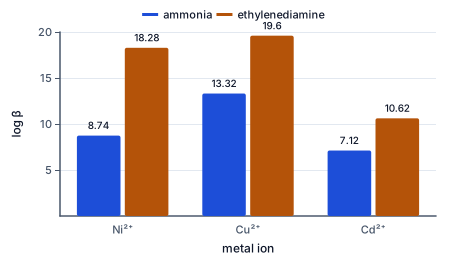
Compare two nickel complexes, each with six nitrogen atoms around the metal: $\mathrm{[Ni(NH_3)_6]^{2+}}$, with six ammonia molecules, and $\mathrm{[Ni(en)_3]^{2+}}$, with three ethylenediamines, each holding the metal with both of its nitrogens. The nickel-nitrogen bonds are nearly identical. Yet $\log\beta$ is $8.74$ for the ammine and $18.28$ for the chelate, a difference of almost ten powers of ten. That extra stability is the chelate effect.
The chart shows the same pattern for copper and cadmium. The difference in $\log\beta$ measures the effect; multiplied by $-5.71$ kJ/mol, the free energy of one power of ten at $25\ ^{\circ}\text{C}$, it becomes an energy:
$$\Delta G^\circ = -2.303\,RT\log K = -5.71 \log K\ \text{kJ/mol}.$$
For nickel, $-5.71 \times 9.54 \approx -54.5$ kJ/mol.
Where does it come from? Write the reaction that exchanges one for the other:
$$\mathrm{[Ni(NH_3)_6]^{2+}} + 3\,\mathrm{en} \rightleftharpoons \mathrm{[Ni(en)_3]^{2+}} + 6\,\mathrm{NH_3}.$$
Four particles on the left become seven on the right. Six nickel-nitrogen bonds are broken and six made, so the enthalpy change is small, but the number of free molecules rises, and so does the entropy. At room temperature $T\,\Delta S^\circ$ is large and positive, and it drives the exchange.
The same idea can be put as a matter of chance. Once one end of an ethylenediamine is bound, its other nitrogen is held a few tenths of a nanometer from the metal, far closer than any free ammonia molecule is likely to be. If that second bond breaks, it re-forms almost at once; for the whole ligand to leave, both bonds must break together. A chelate is hard to pull off for the same reason a two-handed grip is hard to break.
Another way: picture
Picture a metal ion holding six single balloons on separate strings against three balloons each tied with two strings. A gust that snaps one string lets a single balloon float away, but a double-tied balloon stays, held by its other string, until the snapped one is tied again. The strings are just as strong in both cases; what differs is how many must fail at once.
Another way: steps
The clearest evidence compares complexes whose bonds really are the same. Cadmium(II) forms a complex with four methylamine molecules, $\mathrm{CH_3NH_2}$, and another with two ethylenediamines; in both, cadmium is bonded to four nitrogen atoms, each carrying one carbon, so even the electronic effect of the carbon chain is matched.
The enthalpies of formation are almost equal, $-57.3$ and $-56.5$ kJ/mol. The entropies are not: $-67.3$ J/(K mol) for the methylamine complex, because four free molecules become fixed to the metal, but $+14.1$ J/(K mol) for the chelate, because only two ligands are fixed while four water molecules are released. At $298$ K the entropy term is worth $+20.1$ kJ/mol against the first complex and $-4.2$ kJ/mol in favor of the second, and that difference of about $24$ kJ/mol is the chelate effect, measured as about four powers of ten in $\log\beta$. The heat released is the same; the chaos gained is not.
Not every chelate is equally favored. Ethylenediamine, with two carbons between its nitrogens, closes a five-membered ring with the metal: metal, nitrogen, carbon, carbon, nitrogen. Five- and six-membered rings are the most stable, because their bond angles need little strain; a three-membered ring is too strained, and a ring of seven or more is floppy enough that the second donor is no longer held close to the metal.
Joining the donor atoms into a closed ring gives more stability still, the macrocyclic effect. The ligand is already shaped to fit the metal, so little is lost when it binds, and a metal inside a macrocycle almost never escapes. Nature relies on it: the iron of heme sits in the porphyrin ring, the magnesium of chlorophyll in a similar chlorin ring, and the cobalt of vitamin $\mathrm{B_{12}}$ in a corrin ring, each held for the life of the molecule.
Bacteria faced the problem of getting iron long before chemists did. Iron(III) is essential to them, but at the pH of soil or blood it is almost completely insoluble. Many bacteria release siderophores, small molecules with three chelating groups arranged to wrap one iron(III) ion in an octahedron of six oxygen atoms. Enterobactin, made by Escherichia coli, binds iron(III) more strongly than almost any other known ligand, with a formation constant near $10^{49}$, strong enough to pull iron away from the body's own iron-carrying proteins.
Medicine borrowed the idea. Deferoxamine, a siderophore made by a soil bacterium, is used to remove excess iron from patients who need repeated blood transfusions, as in the inherited anemia thalassemia; each molecule grips one iron(III) ion with six oxygen donors, and the complex is excreted.
The same principle keeps MRI contrast agents safe. Free gadolinium(III) is toxic, so every agent holds it in a chelate. Some agents use open-chain ligands, and others close the ligand into a ring around the metal. After reports in the 2000s of a rare but serious fibrosis in patients with kidney disease, linked to gadolinium released from the less stable agents, regulators restricted several open-chain agents. The macrocyclic agents, which gain the extra stability of the macrocyclic effect and let go of their metal far more slowly, became the preferred choice.
Three checks catch most slips. First, compare like with like: the two complexes must have the same number and kind of donor atoms, or the difference in $\log\beta$ measures something else as well. Second, the signs: the chelate effect in log units is positive, and in kJ/mol it is negative, a free energy that favors the chelate. An answer with the chelate less stable has subtracted the wrong way round.
Third, the units in $\Delta G^\circ = \Delta H^\circ - T\,\Delta S^\circ$: entropies are tabulated in J/(K mol) and enthalpies in kJ/mol, so divide the entropy by $1000$ before multiplying by the temperature. Forgetting to do so makes the entropy term a thousand times too large, and gives free energies of tens of thousands of kJ/mol, far beyond any bond energy.
A last check is the size of the effect. For ethylenediamine against ammonia it runs from about three to ten powers of ten, growing with the number of chelate rings formed. An answer of a fraction of a power of ten, or of thirty, is outside anything measured for simple chelates and points to a slip in the subtraction.
Lead poisoning, from old paint, contaminated water or industrial exposure, damages the nervous system and is especially harmful to children. At high blood lead levels, doctors treat it with chelating drugs that bind lead so it can be excreted. Edetate calcium disodium, the calcium complex of EDTA, is given by infusion; succimer, a smaller two-toothed chelator, is taken by mouth.
The choice of the calcium complex is a lesson in formation constants. EDTA binds lead about $10^{7.3}$ times more strongly than calcium, so the calcium complex readily trades its calcium for lead. Given as the sodium salt instead, EDTA would bind the calcium in the blood as well, and the U.S. Food and Drug Administration has warned against that mix-up after patients died of dangerously low blood calcium. The same numbers explain a side effect: EDTA's preference for lead over zinc is only $10^{1.5}$, so treatment also removes zinc, which doctors monitor.
Read the label of a jar of mayonnaise or a bottle of salad dressing and you may find calcium disodium EDTA. Traces of iron and copper in food catalyze the oxidation of fats, which turns them rancid. EDTA binds those metals as chelates and holds them out of action, and a few tens of parts per million are enough to extend shelf life by months.
In detergents and industrial cleaners, chelating agents soften hard water by binding calcium and magnesium, which would otherwise form scum with soap and scale on heating elements. Because EDTA breaks down slowly in the environment, manufacturers increasingly use biodegradable chelators such as methylglycinediacetic acid, designed with the same five-membered rings around the metal.
A natural expectation is that a complex's stability is the sum of its bonds, so six nickel-nitrogen bonds should give the same stability however the nitrogens are supplied. The measured constants say otherwise by ten powers of ten. The bonds are indeed nearly the same, and the enthalpies show it; what differs is the entropy, because the chelate's formation sets more molecules free.
A related error is to think the chelate is more stable because ethylenediamine is a stronger base or a better donor than ammonia. Its nitrogens are very similar to ammonia's, and methylamine, which matches them even more closely, gives the same result: the whole effect comes from holding the donors together in one molecule.
Check the donor atoms.
$6\ \mathrm{NH_3} \text{ and } 3\ \mathrm{en}: \ 6 \text{ N each}$
A fair comparison.
Subtract the logarithms.
$18.28 - 8.74 = 9.54$
Chelate minus ammine.
Turn it into a ratio.
$10^{9.54} \approx 3.5 \times 10^{9}$
The chelate is billions of times more stable.
Turn it into an energy.
$-5.71 \times 9.54 \approx -54.5\ \text{kJ/mol}$
The free energy of the exchange.
Count the particles in the exchange.
$1 + 3 \to 1 + 6$
Four particles become seven: the entropy rises.
Write the entropy term for the methylamine complex at 298 K.
$-T\,\Delta S^\circ = -298 \times (-0.0673) = +20.1\ \text{kJ/mol}$
Entropy in kJ; fixing four molecules costs free energy.
Find its free energy.
$\Delta G^\circ = -57.3 + 20.1 = -37.2\ \text{kJ/mol}$
$\Delta H^\circ - T\,\Delta S^\circ$.
Write the entropy term for the chelate.
$-T\,\Delta S^\circ = -298 \times 0.0141 = -4.2\ \text{kJ/mol}$
Freed water molecules outweigh the bound ligands.
Find its free energy.
$\Delta G^\circ = -56.5 - 4.2 = -60.7\ \text{kJ/mol}$
Almost the same enthalpy, a much better free energy.
Subtract the two.
$-60.7 - (-37.2) = -23.5\ \text{kJ/mol}$
The chelate effect, nearly all from entropy.
Convert to powers of ten.
$23.5 \div 5.71 \approx 4.1$
Matches $10.62 - 6.55 = 4.07$ in the measured constants.
Read the constants.
$\log K = 18.0 \text{ for } \mathrm{PbY^{2-}}, \ 10.7 \text{ for } \mathrm{CaY^{2-}}$
$\mathrm{Y^{4-}}$ stands for the EDTA anion.
Write the exchange.
$\mathrm{CaY^{2-}} + \mathrm{Pb^{2+}} \rightleftharpoons \mathrm{PbY^{2-}} + \mathrm{Ca^{2+}}$
The drug arrives as the calcium complex.
Find the exchange constant.
$\log K_{\text{ex}} = 18.0 - 10.7 = 7.3$
The ratio of the two formation constants.
Turn it into an energy.
$-5.71 \times 7.3 \approx -41.7\ \text{kJ/mol}$
Strongly downhill.
Say what the drug does.
$\text{lead taken, calcium given back}$
The lead complex is excreted in the urine.
Say why the calcium form matters.
$\text{free EDTA would also strip calcium}$
Giving it already loaded with calcium protects the blood's calcium.
Subtract the logarithms.
$19.60 - 13.32 = 6.28$
Four nitrogens on each side.
Turn it into an energy.
$-5.71 \times 6.28 \approx -35.9\ \text{kJ/mol}$
At $25\ ^{\circ}\text{C}$.
Compare with nickel.
Match each chelating ligand to the number of chelate rings it closes when all its donor atoms bind one metal ion.
| $1$ ring | $2$ rings | $3$ rings | $5$ rings | |
|---|---|---|---|---|
| $\mathrm{en}$ | ||||
| $\mathrm{dien}$ | ||||
| $\mathrm{trien}$ | ||||
| $\mathrm{EDTA^{4-}}$ |
Complete the worked solution: $\log\beta = 7.12$ for $\mathrm{[Cd(NH_3)_4]^{2+}}$ and $10.62$ for $\mathrm{[Cd(en)_2]^{2+}}$. Find the chelate effect and the chelate's own free energy of formation.
Subtract the ammine's logarithm from the chelate's.
$\text{chelate effect} =$ d $\text{powers of ten}$
How many times more stable the chelate is, as a power of ten.
Turn it into an energy.
$\Delta\Delta G^\circ \approx$ e $\text{kJ/mol}$
Minus five point seven one kJ/mol for each power of ten.
Find the chelate's own free energy of formation.
$\Delta G^\circ \approx$ h $\text{kJ/mol}$
The same factor, times the chelate's own logarithm.
Both $\mathrm{[Cd(NH_3)_4]^{2+}}$ and $\mathrm{[Cd(en)_2]^{2+}}$ bind the metal through the same number of nitrogen atoms. Which has the larger formation constant?
For $\mathrm{Ni^{2+}}$, $\log\beta = 8.74$ for $\mathrm{[Ni(NH_3)_6]^{2+}}$ and $18.28$ for $\mathrm{[Ni(en)_3]^{2+}}$. For $\mathrm{Cd^{2+}}$, $\log\beta = 7.12$ for $\mathrm{[Cd(NH_3)_4]^{2+}}$ and $10.62$ for $\mathrm{[Cd(en)_2]^{2+}}$. For each metal, in that order, fill in the chelate effect in powers of ten and in kJ/mol.
| chelate effect (log units) | chelate effect (kJ/mol) | |
|---|---|---|
| the first metal | ||
| the second metal |
The EDTA complex of $\mathrm{Zn^{2+}}$ has $\log K = 16.5$ at $25\ ^{\circ}\text{C}$. What is its standard free energy of formation, $\Delta G^\circ$, in kJ/mol?
Answer: kJ/mol, ΔG° of the EDTA complex
For the formation of $\mathrm{[Cd(NH_2CH_3)_4]^{2+}}$, $\Delta H^\circ = -57.3$ kJ/mol and $\Delta S^\circ = -67.3$ J/(K mol). Taking both as constant, what is $\Delta G^\circ$ at $336$ K, in kJ/mol?
Answer: kJ/mol, ΔG° of formation
A toxicologist judging EDTA as a treatment for heavy-metal poisoning compares how strongly it holds the metal it must remove against a metal the body needs. For $\mathrm{Pb^{2+}}$ ($\log K = 18.0$) against $\mathrm{Ca^{2+}}$ ($10.7$), $\mathrm{Pb^{2+}}$ ($18.0$) against $\mathrm{Mg^{2+}}$ ($8.8$) and $\mathrm{Hg^{2+}}$ ($21.5$) against $\mathrm{Ca^{2+}}$ ($10.7$), in that order, fill in the preference in powers of ten and the free energy of exchanging one metal for the other.
| preference (log units) | exchange ΔG° (kJ/mol) | |
|---|---|---|
| the first pair | ||
| the second pair | ||
| the third pair |
Lesson test: one question per skill, one attempt each, no hints. Your answers are checked when you submit.
For $\mathrm{Ni^{2+}}$, $\log\beta = 8.74$ for $\mathrm{[Ni(NH_3)_6]^{2+}}$ and $18.28$ for $\mathrm{[Ni(en)_3]^{2+}}$. For $\mathrm{Cd^{2+}}$, $\log\beta = 7.12$ for $\mathrm{[Cd(NH_3)_4]^{2+}}$ and $10.62$ for $\mathrm{[Cd(en)_2]^{2+}}$. For each metal, in that order, fill in the chelate effect in powers of ten and in kJ/mol.
| chelate effect (log units) | chelate effect (kJ/mol) | |
|---|---|---|
| the first metal | ||
| the second metal |
You can explain chelation. Say why $\mathrm{[Ni(en)_3]^{2+}}$ is billions of times more stable than $\mathrm{[Ni(NH_3)_6]^{2+}}$, though both hold six nitrogen atoms.
15. Your turn: for copper, $\log\beta = 13.32$ for $\mathrm{[Cu(NH_3)_4]^{2+}}$ and $19.60$ for $\mathrm{[Cu(en)_2]^{2+}}$. How large is the chelate effect in kJ/mol?, step 3
$-35.9 \text{ against } -54.5$
Two chelate rings for copper, three for nickel.