Back to the on-screen lesson ·
The octahedral splitting of the d orbitals into $t_{2g}$ and $e_g$, high-spin filling, and the crystal field stabilization energy in units of $\Delta_o$ and in kJ/mol.
Paper packet. Every task here also exists on screen, where it is checked automatically; answers written on paper are not assessed by Nydus. When you are back at a device, enter your answers there.
By the end of this lesson you will be able to split the d orbitals in an octahedral field, fill them high spin, and calculate the crystal field stabilization energy in units of $\Delta_o$ and in kJ/mol.
From lesson 1 you can find a metal's $d$ count and fill five equal-energy d orbitals by Hund's rule. You know the shapes of the d orbitals: $d_{z^2}$ and $d_{x^2-y^2}$ point along the axes, and $d_{xy}$, $d_{xz}$ and $d_{yz}$ point between them. From lesson 6 you know that an octahedral complex has its six ligands on the axes. This lesson puts those two facts together.
| Term | What it means |
|---|---|
| Crystal field theory | A model that treats ligands as negative charges and asks how they change the energies of the metal's d orbitals. |
| $e_g$ | The two d orbitals that point at the ligands in an octahedron, $d_{z^2}$ and $d_{x^2-y^2}$; raised in energy. |
| $t_{2g}$ | The three d orbitals that point between the ligands, $d_{xy}$, $d_{xz}$ and $d_{yz}$; lowered in energy. |
| Octahedral splitting, $\Delta_o$ | The energy gap between $e_g$ and $t_{2g}$. |
| Barycenter | The average energy of the five d orbitals, which the splitting leaves unchanged. |
| CFSE | Crystal field stabilization energy: $(0.4\,n_{t_{2g}} - 0.6\,n_{e_g})\,\Delta_o$ below the barycenter. |
| High spin | Filling one electron per orbital across both sets before pairing, which a weak field allows. |
Crystal field theory makes one simplification: it treats each ligand as a point of negative charge, the lone pair it points at the metal. The metal's d electrons are negative too, so any d orbital that points toward a ligand has its electrons pushed up in energy, and any that points between ligands is pushed up less.
In an octahedron the six ligands lie on the $x$, $y$ and $z$ axes. Two d orbitals, $d_{z^2}$ and $d_{x^2-y^2}$, have their lobes along those axes, pointing straight at the ligands; they are raised. Three, $d_{xy}$, $d_{xz}$ and $d_{yz}$, have their lobes between the axes; they are lowered relative to the other two. The five equal orbitals of the free ion split into two sets:
The gap between them is the octahedral splitting, $\Delta_o$. The numbers $0.6$ and $0.4$ come from keeping the average energy fixed: two orbitals up by $0.6$ balance three down by $0.4$, since $2 \times 0.6 = 3 \times 0.4$.
Electrons fill the lower set first. Each electron in $t_{2g}$ is $0.4\,\Delta_o$ below the average, a gain; each in $e_g$ is $0.6\,\Delta_o$ above it, a cost. The net is the crystal field stabilization energy:
$$\text{CFSE} = (0.4\,n_{t_{2g}} - 0.6\,n_{e_g})\,\Delta_o.$$
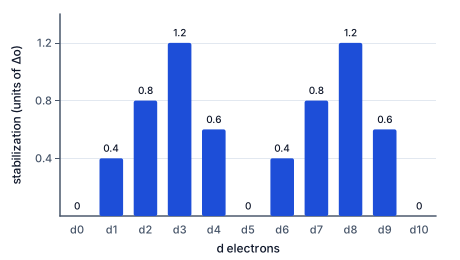
With water and other weak-field ligands, $\Delta_o$ is small, and electrons occupy all five orbitals singly before any pair, just as in the free ion: the high-spin filling. $d^3$ is $t_{2g}^3$ with CFSE $1.2\,\Delta_o$; $d^4$ puts its fourth electron in $e_g$, $t_{2g}^3 e_g^1$, and falls to $0.6\,\Delta_o$; $d^5$, $t_{2g}^3 e_g^2$, gains nothing at all.
Read the chart across. The stabilization climbs to $1.2\,\Delta_o$ at $d^3$, falls to zero at $d^5$ as the $e_g$ electrons cancel the $t_{2g}$ ones, climbs again to $1.2\,\Delta_o$ at $d^8$, and returns to zero at $d^{10}$. Ions at $d^0$, $d^5$ and $d^{10}$ get no extra stability from the field.
Another way: picture
Picture the metal at the center of a room with a ligand pressed against the middle of each wall, the floor and the ceiling. Two of the d orbitals are like people standing with arms stretched straight at the walls: they are crowded. Three are like people with arms held toward the corners of the room: they have space. Electrons prefer the roomy positions, and they pay a price when they are forced into the crowded ones.
Another way: steps
Imagine first surrounding the free ion with a sphere of negative charge equal to the six ligands, spread evenly. Every d orbital is raised by the same amount, and they stay equal. Now gather that charge into six points on the axes. The total repulsion is unchanged, so the average energy of the five orbitals, the barycenter, stays where it was; the orbitals along the axes rise above it and those between the axes fall below it.
Keeping the average fixed fixes the two numbers. If $e_g$ rises by $a$ and $t_{2g}$ falls by $b$, the total change is $2a - 3b = 0$, and the gap is $a + b = \Delta_o$. Solving gives $a = 0.6\,\Delta_o$ and $b = 0.4\,\Delta_o$. So a complex with an electron in each of the five orbitals, high-spin $d^5$, is no more stable than it would be in a spherical field: the three $t_{2g}$ electrons gain $1.2\,\Delta_o$ and the two $e_g$ electrons lose exactly $1.2\,\Delta_o$.
Splittings are measured from spectra, usually in wavenumbers, cm$^{-1}$, and for first-row aqua ions they run from about $7{,}800$ cm$^{-1}$ for $\mathrm{[Mn(H_2O)_6]^{2+}}$ to about $20{,}300$ cm$^{-1}$ for $\mathrm{[Ti(H_2O)_6]^{3+}}$. To compare with bond energies they are converted to kJ/mol: one wavenumber per molecule is $0.01196$ kJ/mol, so $17{,}400$ cm$^{-1}$, the splitting of $\mathrm{[Cr(H_2O)_6]^{3+}}$, is $208$ kJ/mol.
Two patterns hold. A $3+$ ion splits more than a $2+$ ion of the same metal, because its ligands are pulled closer: $\mathrm{[Fe(H_2O)_6]^{3+}}$ has about $14{,}000$ cm$^{-1}$ and $\mathrm{[Fe(H_2O)_6]^{2+}}$ about $10{,}400$. And the ligand matters enormously, which is the subject of the next lesson. A CFSE of $1.2 \times 208 = 250$ kJ/mol for chromium(III) in water is a real part of that ion's stability, though far smaller than the total energy of its bonds.
The two-humped chart is not only a calculation. The enthalpies of hydration of the first-row $2+$ ions, the energy released when each gaseous ion is surrounded by water, follow the same pattern. They grow steadily more negative across the row as the ions shrink, but $d^0$ calcium, $d^5$ manganese and $d^{10}$ zinc lie on a smooth curve, while the ions in between lie below it, more stable, by roughly their CFSE. The same double hump appears in the lattice energies of the metal chlorides and in the octahedral site preferences of ions in minerals. It is some of the strongest evidence that the d-orbital splitting is real and not just a bookkeeping device.
Four checks catch most errors. First, the electrons in the two sets must add up to the $d$ count: $n_{t_{2g}} + n_{e_g} = d$. A filling that loses or gains an electron gives a stabilization for the wrong ion.
Second, a high-spin octahedral ion never gains more than $1.2\,\Delta_o$, and that only at $d^3$ and $d^8$. An answer above it has counted some $e_g$ electrons as stabilizing, or filled the ion low spin, which lesson 11 treats separately.
Third, $d^0$, high-spin $d^5$ and $d^{10}$ gain nothing, because their electrons, if any, are spread evenly over all five orbitals. Any other result for them is wrong.
Fourth, the chart repeats itself. Adding five electrons to a high-spin ion adds one to every orbital, which changes nothing, so $d^1$ and $d^6$ both have $0.4\,\Delta_o$, $d^2$ and $d^7$ both $0.8\,\Delta_o$, $d^3$ and $d^8$ both $1.2\,\Delta_o$, and $d^4$ and $d^9$ both $0.6\,\Delta_o$. If you know one member of a pair, you know the other. When converting to kJ/mol, check the size too: first-row splittings in water are about $90$ to $250$ kJ/mol, so a stabilization of several thousand kJ/mol has skipped the conversion from wavenumbers.
The last check is the sign. A crystal field stabilization energy as defined here is a positive number, an amount of stability gained. Some books write it as a negative energy, the drop below the average, and both are correct if used consistently, but a mixture of the two conventions in one answer is a common source of error.
When a basaltic magma cools, olivine, $\mathrm{(Mg,Fe)_2SiO_4}$, is among the first minerals to crystallize, and its metal ions sit in octahedral sites of oxide ions. Geochemists noticed long ago that nickel is strongly taken up into early olivine, and chromium into early spinels, while manganese is not. The first lavas to crystallize can hold several thousand parts per million of nickel; the liquid left behind is depleted of it.
Crystal field stabilization explains it. In the melt, the ions sit in a mixture of sites, many of them not octahedral; in the crystal, they sit in true octahedral sites. Nickel(II), $d^8$, gains $1.2\,\Delta_o$ from an octahedral site, about $120$ kJ/mol, and chromium(III), $d^3$, gains the same fraction of a larger splitting; manganese(II), $d^5$, gains nothing. That difference, the octahedral site preference energy, is why nickel and chromium ores are found with the rocks that crystallized first, the ultramafic rocks mined for them in places such as Sudbury, Ontario, and the chromite belts of the Stillwater Complex in Montana.
Lesson 1 said that ruby and emerald owe their colors to the same chromium(III) ion. Crystal field theory says why they differ. In both, $\mathrm{Cr^{3+}}$, $d^3$, sits in an octahedron of oxide ions with all three electrons in $t_{2g}$. The color comes from light promoting one of them to $e_g$, which costs energy close to $\Delta_o$.
In ruby the oxide ions are squeezed close to the chromium, and $\Delta_o$ is about $18{,}000$ cm$^{-1}$: the crystal absorbs yellow-green light near $555$ nm and looks red. In emerald the chromium site is roomier and $\Delta_o$ is about $16{,}000$ cm$^{-1}$; the absorption moves toward yellow-orange, near $610$ nm, and the stone looks green. A shift in $\Delta_o$ of about $10\%$ is the whole difference between the two most valuable colored gems, and lesson 14 turns an absorbed wavelength into $\Delta_o$ exactly.
It is tempting to picture the ligands stabilizing every d electron, so that more electrons always mean more stabilization. The splitting keeps the average energy where it was: $t_{2g}$ falls by $0.4\,\Delta_o$ only because $e_g$ rises by $0.6\,\Delta_o$. Electrons forced into $e_g$ cost stability, and that is why the chart falls at $d^4$, $d^5$, $d^9$ and $d^{10}$ rather than climbing all the way.
The related error is to count only the $t_{2g}$ electrons, giving $d^5$ a CFSE of $1.2\,\Delta_o$ instead of zero. The $e_g$ electrons must be subtracted at $0.6$ each, and the check is the rule that a half-filled or full d set, $d^5$ high spin or $d^{10}$, gains nothing.
Find the $d$ count of $\mathrm{Cr^{3+}}$.
$6 - 3 = 3$
Chromium is in group $6$.
Fill the orbitals high spin.
$t_{2g}^{3}\,e_g^{0}$
Three electrons go one to each $t_{2g}$ orbital.
Weigh the filling.
$0.4 \times 3 - 0.6 \times 0 = 1.2$
Every electron is in the lower set.
Write the CFSE.
$1.2\,\Delta_o$
The maximum a high-spin ion can have.
Convert with $\Delta_o = 17{,}400$ cm$^{-1}$ for the aqua ion.
$17{,}400 \times 0.01196 = 208.1\ \text{kJ/mol}, \quad 1.2 \times 208.1 = 249.7\ \text{kJ/mol}$
The splitting in kJ/mol, times the stabilization in units of it.
Fill five electrons singly.
$t_{2g}^{3}\,e_g^{2}$
In a weak field the upper set takes one each before anything pairs.
Place the sixth electron.
$t_{2g}^{4}\,e_g^{2}$
It pairs in the lower set.
Weigh the filling.
$0.4 \times 4 - 0.6 \times 2 = 1.6 - 1.2 = 0.4$
Two $e_g$ electrons cancel three $t_{2g}$ ones.
Write the CFSE.
$0.4\,\Delta_o$
Only the paired electron's gain is left.
Convert with $\Delta_o = 10{,}400$ cm$^{-1}$.
$10{,}400 \times 0.01196 = 124.4\ \text{kJ/mol}, \quad 0.4 \times 124.4 = 49.8\ \text{kJ/mol}$
A modest stabilization.
Count the unpaired electrons.
$4$
Four singly occupied orbitals; lesson 13 measures them.
Fill $\mathrm{Mn^{2+}}$, $d^5$.
$t_{2g}^{3}\,e_g^{2}$
One electron in each orbital.
Weigh the manganese filling.
$0.4 \times 3 - 0.6 \times 2 = 0$
Gains and costs cancel exactly.
Fill $\mathrm{Ni^{2+}}$, $d^8$.
$t_{2g}^{6}\,e_g^{2}$
The lower set is full; two electrons are in the upper set.
Weigh the nickel filling.
$0.4 \times 6 - 0.6 \times 2 = 2.4 - 1.2 = 1.2$
The second peak of the chart.
Convert nickel's with $\Delta_o = 8{,}500$ cm$^{-1}$.
$8{,}500 \times 0.01196 = 101.7\ \text{kJ/mol}, \quad 1.2 \times 101.7 = 122.0\ \text{kJ/mol}$
A large stabilization even with a small splitting.
Compare the two ions.
$\text{Ni}^{2+}: 122\ \text{kJ/mol}, \quad \text{Mn}^{2+}: 0$
Nickel(II) gains a strong preference for octahedral sites; manganese(II) none.
Fill the orbitals.
$t_{2g}^{5}\,e_g^{2}$
Five singly, then two pair in $t_{2g}$.
Weigh the filling.
$0.4 \times 5 - 0.6 \times 2 = 2.0 - 1.2 = 0.8$
Lower-set gain minus upper-set cost.
Write the CFSE.
Match each $d$ count to its high-spin filling in an octahedral field.
| $t_{2g}^{2}\,e_g^{0}$ | $t_{2g}^{3}\,e_g^{1}$ | $t_{2g}^{5}\,e_g^{2}$ | $t_{2g}^{6}\,e_g^{3}$ | |
|---|---|---|---|---|
| $d^{2}$ | ||||
| $d^{4}$ | ||||
| $d^{7}$ | ||||
| $d^{9}$ |
Complete the worked solution: the crystal field stabilization energy of a high-spin $d^{6}$ octahedral ion.
Count the electrons in the lower set.
$t_{2g}\ \text{electrons} =$ t
They fill first, one per orbital, then pair after the upper set has one each.
Count the electrons in the upper set.
$e_g\ \text{electrons} =$ e
In a weak field they enter before the lower set pairs.
Weigh them.
$\text{CFSE} = (\text{lower} \times \text{gain}) - (\text{upper} \times \text{cost}) =$ c $\Delta_o$
Each lower electron gains four tenths of the splitting; each upper one costs six tenths.
What is the crystal field stabilization energy of a high-spin $d^{9}$ ion in an octahedral field?
For high-spin octahedral ions with $d^{1}$, $d^{4}$ and $d^{8}$, in that order, fill in the $t_{2g}$ electrons, the $e_g$ electrons and the stabilization in units of $\Delta_o$.
| t2g electrons | eg electrons | stabilization (units of Δo) | |
|---|---|---|---|
| the first ion | |||
| the second ion | |||
| the third ion |
A high-spin $d^{9}$ ion sits in an octahedral field with $\Delta_o = 236$ kJ/mol. What is its crystal field stabilization energy in kJ/mol?
Answer: kJ/mol of stabilization
The ion $\mathrm{[Cr(H_2O)_6]^{3+}}$ is $d^{3}$ and high spin, with $\Delta_o = 17400$ cm$^{-1}$. What is its crystal field stabilization energy in kJ/mol? Use $1$ cm$^{-1} = 0.01196$ kJ/mol.
Answer: kJ/mol of stabilization
Geochemists explain why nickel(II) concentrates in the octahedral sites of olivine as magma crystallizes by its crystal field stabilization. For $\mathrm{[Ti(H_2O)_6]^{3+}}$ ($\Delta_o = 20300$ cm$^{-1}$), $\mathrm{[Cr(H_2O)_6]^{3+}}$ ($17400$ cm$^{-1}$) and $\mathrm{[Co(H_2O)_6]^{2+}}$ ($9300$ cm$^{-1}$), all high spin, fill in the stabilization in units of $\Delta_o$ and in kJ/mol, in that order. Use $1$ cm$^{-1} = 0.01196$ kJ/mol.
| stabilization (units of Δo) | stabilization (kJ/mol) | |
|---|---|---|
| the first ion | ||
| the second ion | ||
| the third ion |
Lesson test: one question per skill, one attempt each, no hints. Your answers are checked when you submit.
For high-spin octahedral ions with $d^{1}$, $d^{4}$ and $d^{8}$, in that order, fill in the $t_{2g}$ electrons, the $e_g$ electrons and the stabilization in units of $\Delta_o$.
| t2g electrons | eg electrons | stabilization (units of Δo) | |
|---|---|---|---|
| the first ion | |||
| the second ion | |||
| the third ion |
You can calculate a crystal field stabilization energy. Explain why high-spin $d^5$ manganese(II) gains no stabilization while $d^8$ nickel(II) gains $1.2\,\Delta_o$.
15. Your turn: what is the CFSE of high-spin $d^7$, $\mathrm{Co^{2+}}$, in units of $\Delta_o$?, step 3
$0.8\,\Delta_o$
As the chart shows at $d^7$.