Back to the on-screen lesson ·
Linear, tetrahedral, square-planar and octahedral complexes: how the coordination number and the $d$ count decide the shape, and how many ligand pairs each shape puts at $90°$ and $180°$.
Paper packet. Every task here also exists on screen, where it is checked automatically; answers written on paper are not assessed by Nydus. When you are back at a device, enter your answers there.
By the end of this lesson you will be able to assign the shape of a complex from its coordination number and $d$ count, tell tetrahedral from square-planar complexes, and count the ligand pairs each shape holds at $90°$ and $180°$.
You know VSEPR: the electron domains round a main-group atom point as far apart as they can, and the shape is what the atoms alone make, so methane is tetrahedral and xenon tetrafluoride square planar. From lesson 3 you can find a complex's coordination number, and from lesson 2 its metal's $d$ count. This lesson connects those numbers to the complex's shape, and shows where VSEPR stops working.
| Term | What it means |
|---|---|
| Octahedral | Six ligands at the ends of three perpendicular axes through the metal; every neighboring pair at $90°$. |
| Square planar | Four ligands at the corners of a square round the metal, all in one plane, at $90°$ and $180°$. |
| Tetrahedral | Four ligands at the corners of a tetrahedron, every pair at $109.5°$. |
| Linear | Two ligands on opposite sides of the metal, at $180°$. |
| cis | Two ligands next to each other, at $90°$ in an octahedron or square plane. |
| trans | Two ligands opposite each other, at $180°$. |
| Jahn–Teller distortion | The stretching of two opposite bonds in an octahedral complex with an unevenly filled $e_g$ set, such as copper(II), $d^9$. |
For the first-row metals and their common ligands, the coordination number almost decides the shape by itself. The ligands' electron pairs repel each other and spread as far apart as the metal allows, just as VSEPR's electron domains do.
The choice between the two four-coordinate shapes is where transition metals part company with VSEPR. In VSEPR, a square plane needs two lone pairs above and below the plane, as in $\mathrm{XeF_4}$. A transition metal's $d$ electrons do not sit in a position of their own; they occupy d orbitals that point in particular directions, and what matters is whether the shape leaves them in low-energy orbitals. For a $d^8$ metal, a square plane leaves the one d orbital pointing straight at the ligands, $d_{x^2-y^2}$, empty, and that is favorable when the ligands are strong-field or the metal is heavy. So $d^8$ platinum(II), palladium(II) and gold(III) are nearly always square planar, and so is nickel(II) with cyanide, $\mathrm{[Ni(CN)_4]^{2-}}$. Metals with $d^{10}$, and most complexes with weak-field halide ligands, are tetrahedral: $\mathrm{[ZnCl_4]^{2-}}$, $\mathrm{[CoCl_4]^{2-}}$, $\mathrm{[NiCl_4]^{2-}}$.
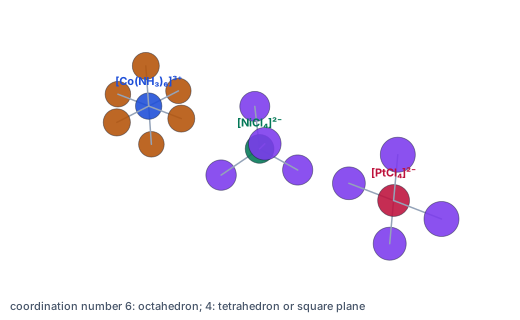
Turn the figure. The octahedron on the left has its six ammines on three perpendicular axes; the tetrahedron in the middle has no right angles at all; the square plane on the right is flat, with the two positions above and below the platinum empty rather than filled by lone pairs. The crystal-field lessons explain the choice in terms of orbital energies; for now the rule is enough.
Another way: picture
Think of the octahedron as a metal at the center of a cube with a ligand pressed into the middle of each face. Opposite faces give the $180°$ pairs; any two faces that share an edge give a $90°$ pair. Remove the top and bottom ligands and the four left in the middle ring are a square plane.
Another way: steps
Every pair of ligands defines one angle at the metal, and there are $\tfrac{1}{2}\,n(n - 1)$ pairs among $n$ ligands. The shape decides what those angles are.
| Shape | CN | All pairs | at $90°$ | at $180°$ | other |
|---|---|---|---|---|---|
| linear | $2$ | $1$ | $0$ | $1$ | $0$ |
| tetrahedral | $4$ | $6$ | $0$ | $0$ | $6$ at $109.5°$ |
| square planar | $4$ | $6$ | $4$ | $2$ | $0$ |
| octahedral | $6$ | $15$ | $12$ | $3$ | $0$ |
The octahedral count is worth doing once by hand. Each of the six ligands has one partner across the metal and four at right angles. Counting from every ligand gives $6 \times 4 = 24$ right-angle pairs and $6 \times 1 = 6$ straight ones, and since each pair was counted from both ends, the true numbers are $12$ and $3$. Together they make all $15$ pairs. These counts are the raw material of the next lesson on isomers: two ligands of one kind can be cis, at $90°$, or trans, at $180°$, and the counts tell you how many ways each can happen.
The shapes above are ideal. Real complexes bend when their $d$ electrons fill the orbitals unevenly. The most important case is copper(II), $d^9$. In an octahedral field its nine electrons leave one of the two high-energy $e_g$ orbitals half empty, and the complex lowers its energy by stretching two opposite bonds: in $\mathrm{[Cu(H_2O)_6]^{2+}}$ four Cu–O bonds are about $197$ pm and two are about $238$ pm. This is the Jahn–Teller distortion, and it is why copper(II) so often looks four-coordinate and square planar, as in $\mathrm{[Cu(NH_3)_4]^{2+}}$, with two more water molecules held only loosely above and below.
Tetrahedral complexes distort too: $\mathrm{[CuCl_4]^{2-}}$ is a flattened tetrahedron, halfway to a square plane. For counting ligands and isomers, the ideal shapes are the right model, and these lessons use them.
Five-coordinate complexes are either trigonal bipyramids, like $\mathrm{[Fe(CO)_5]}$, or square pyramids, like the five-coordinate iron in deoxyhemoglobin, and the two interconvert easily. Seven, eight and nine are found with the large ions of the second and third rows and the lanthanides: $\mathrm{[Mo(CN)_8]^{4-}}$ is eight-coordinate, and the gadolinium in MRI contrast agents is nine-coordinate. For the first-row ions of this course, two, four and six cover almost everything, and six covers most of it.
Start from the coordination number, because it limits the choice. Two donor atoms give a straight line, as in $\mathrm{[Ag(NH_3)_2]^+}$; six give an octahedron almost without exception; four give a tetrahedron or a square plane, and only four needs a second look.
For four-coordinate complexes, the $d$ count settles most cases. Metal ions with eight d electrons in the second and third rows, platinum(II), palladium(II) and gold(III), are square planar whatever the ligand. Ions with ten d electrons, such as zinc(II), are tetrahedral, and so are most complexes with large ligands like chloride and bromide around a first-row ion. Nickel(II) sits on the boundary: $\mathrm{[Ni(CN)_4]^{2-}}$ is square planar but $\mathrm{[NiCl_4]^{2-}}$ is tetrahedral.
The bond angles give a final check. Every angle between neighboring ligands in a square plane or an octahedron is $90^\circ$, and opposite ligands are $180^\circ$ apart; in a tetrahedron all six angles are $109.5^\circ$. An answer that pairs a square plane with $109.5^\circ$ has mixed the two shapes.
Counting one ligand's neighbors identifies the shape of a drawing. In an octahedron each ligand has four neighbors at $90^\circ$ and one opposite; in a square plane, two neighbors at $90^\circ$ and one opposite; in a tetrahedron, three neighbors and none opposite.
Carbonic anhydrase is one of the fastest enzymes known: each molecule converts about a million carbon dioxide molecules a second into bicarbonate, which is how your blood carries carbon dioxide from the tissues to the lungs. At its active site is a single zinc(II) ion held by three histidine nitrogens, with a water molecule as the fourth ligand, in a tetrahedron.
The shape is the chemistry. Zinc(II) is $d^{10}$, so no crystal-field preference pulls it toward a square plane, and the tetrahedron leaves the water pointing out into the pocket where carbon dioxide arrives. The zinc pulls electron density from that water, lowering its $\mathrm{p}K_a$ from about $15.7$ to about $7$, so at the body's pH it loses a proton and becomes a zinc-bound hydroxide that attacks carbon dioxide directly. Drugs for glaucoma and altitude sickness, such as acetazolamide, work by binding to that same fourth position and blocking it.
In 1890 Ludwig Mond found that finely divided nickel reacts with carbon monoxide at about $50$ °C to give nickel tetracarbonyl, $\mathrm{[Ni(CO)_4]}$, a volatile liquid that boils at $43$ °C, and that heating the vapor to about $230$ °C deposits pure nickel again. No other common metal forms a carbonyl so easily, so the process separates nickel from iron, cobalt and copper in one step, and Vale still refines nickel to $99.97\%$ purity this way in Wales and in Canada.
The molecule is tetrahedral: nickel(0), $d^{10}$, with four carbonyls at $109.5°$. With a full d subshell there is no preference for a square plane, and the ligands spread as far apart as four can. Nickel tetracarbonyl is also extremely toxic, more so than carbon monoxide itself, because the neutral, volatile tetrahedron slips through the lungs and delivers both nickel and carbon monoxide into the body; plants that use it run under strict monitoring for exactly that reason.
It is natural to carry VSEPR over and count the metal's $d$ electrons as lone pairs. That predicts nonsense: nickel(II) in $\mathrm{[Ni(CN)_4]^{2-}}$ has eight $d$ electrons, four "lone pairs", and VSEPR with eight domains has no answer at all. The $d$ electrons occupy d orbitals that are part of the metal and point between or along its bonds; they shape the complex only through which orbitals they fill, which is the crystal-field story of the next unit.
The related error is to assume that four ligands always mean a tetrahedron, as they do for carbon. For $d^8$ metals the square plane is the rule, not the exception: every platinum(II) complex, including cisplatin, is square planar, and cisplatin's cis and trans isomers exist only because of it. A tetrahedral $\mathrm{[Pt(NH_3)_2Cl_2]}$ would have no isomers, since in a tetrahedron every pair of positions is the same.
Find the coordination number.
$6 \times \mathrm{NH_3} \Rightarrow \mathrm{CN} = 6$
Six monodentate ligands.
Assign the shape.
$\mathrm{CN} = 6 \Rightarrow \text{octahedral}$
Six ligands at the ends of three perpendicular axes.
Count all the ligand pairs.
$\tfrac{1}{2} \times 6 \times 5 = 15$
Each ligand pairs with five others; halve for double counting.
Count the pairs across the metal.
$\tfrac{1}{2} \times 6 = 3$
Each ligand has one partner opposite it.
Count the right-angle pairs.
$15 - 3 = 12$
Every other pair in an octahedron is at $90°$.
Find nickel's $d$ count in both $\mathrm{[NiCl_4]^{2-}}$ and $\mathrm{[Ni(CN)_4]^{2-}}$.
$x + 4(-1) = -2 \Rightarrow x = +2, \quad d = 10 - 2 = 8$
Both complexes contain nickel(II), $d^8$.
Note the coordination number.
$\mathrm{CN} = 4 \text{ in both}$
Four monodentate ligands each.
Compare the ligands.
$\mathrm{Cl^-}: \text{weak field}, \quad \mathrm{CN^-}: \text{strong field}$
Cyanide splits the d orbitals far more strongly, as lesson 11 shows.
Assign the chloride complex.
$\mathrm{[NiCl_4]^{2-}}: \text{tetrahedral}$
With weak-field ligands the tetrahedron wins, which keeps the ligands furthest apart.
Assign the cyanide complex.
$\mathrm{[Ni(CN)_4]^{2-}}: \text{square planar}$
With strong-field ligands the square plane leaves the highest d orbital empty for eight electrons.
Check with magnetism.
$\text{tetrahedral: } 2 \text{ unpaired}, \quad \text{square planar: } 0$
The chloride complex is paramagnetic and the cyanide diamagnetic, as measured.
Find the coordination number of $\mathrm{[Pt(NH_3)_2Cl_2]}$.
$2 + 2 = 4$
Two ammines and two chlorides.
Assign the shape.
$\mathrm{Pt(II)}, d^8 \Rightarrow \text{square planar}$
Platinum(II) is square planar whatever its ligands.
Count all the ligand pairs.
$\tfrac{1}{2} \times 4 \times 3 = 6$
Six L–Pt–L angles.
Count the pairs across the platinum.
$\tfrac{1}{2} \times 4 = 2$
The two diagonals of the square.
Count the right angles.
$6 - 2 = 4$
The four sides of the square.
Place the two chlorides.
$\text{cis: at } 90°, \quad \text{trans: at } 180°$
Four right-angle pairs mean the chlorides can be neighbors, which is what makes the cis drug possible.
Count all the pairs.
$\tfrac{1}{2} \times 4 \times 3 = 6$
Four ligands.
Count the pairs across the metal.
$\tfrac{1}{2} \times 4 = 2$
Two diagonals.
Take them away.
Match each complex to its shape.
| linear | tetrahedral | square planar | octahedral | |
|---|---|---|---|---|
| $\mathrm{[Ag(NH_3)_2]^{+}}$ | ||||
| $\mathrm{[NiCl_4]^{2-}}$ | ||||
| $\mathrm{[PtCl_4]^{2-}}$ | ||||
| $\mathrm{[Cr(H_2O)_6]^{3+}}$ |
Complete the worked solution: the octahedral complex $\mathrm{[Cr(H_2O)_6]^{3+}}$ has $6$ ligands. How many ligand pairs are at $90°$?
Count every pair of ligands.
$\text{all pairs} = \tfrac{1}{2}\,n(n - 1) =$ t
Each pair is one L–M–L angle.
Count the pairs straight across the metal.
$\text{pairs at } 180° = \tfrac{1}{2}\,n =$ b
Each ligand has exactly one partner opposite it.
Take them away to leave the right angles.
$\text{pairs at } 90° = (\text{all pairs}) - (\text{pairs at } 180°) =$ a
In these shapes every pair that is not opposite is at a right angle.
What is the shape of the four-coordinate complex $\mathrm{[PtCl_4]^{2-}}$?
The complexes $\mathrm{[ZnCl_4]^{2-}}$, $\mathrm{[Ni(CN)_4]^{2-}}$ and $\mathrm{[Cr(H_2O)_6]^{3+}}$ are tetrahedral, square planar and octahedral. For each, in that order, fill in the coordination number and the ligand pairs at $90°$ and at $180°$.
| coordination number | ligand pairs at 90° | ligand pairs at 180° | |
|---|---|---|---|
| the tetrahedral complex | |||
| the square-planar complex | |||
| the octahedral complex |
The complex $\mathrm{[Cr(H_2O)_6]^{3+}}$ has coordination number $6$. How many different pairs of its ligands are there?
Answer: pairs of ligands
The complex $\mathrm{[Ni(CN)_4]^{2-}}$ is square planar. How many pairs of its ligands are at $90°$ to each other?
Answer: ligand pairs at 90 degrees
Structures solved by X-ray crystallography show the platinum in cisplatin is square planar, the iron in oxyhemoglobin is octahedral, and the copper in the deep blue tetraamminecopper(II) ion is square planar. For each, in that order, fill in the coordination number and the ligand pairs at $90°$ and at $180°$.
| coordination number | ligand pairs at 90° | ligand pairs at 180° | |
|---|---|---|---|
| the first center | |||
| the second center | |||
| the third center |
Lesson test: one question per skill, one attempt each, no hints. Your answers are checked when you submit.
The complexes $\mathrm{[ZnCl_4]^{2-}}$, $\mathrm{[Pt(NH_3)_2Cl_2]}$ and $\mathrm{[Cr(H_2O)_6]^{3+}}$ are tetrahedral, square planar and octahedral. For each, in that order, fill in the coordination number and the ligand pairs at $90°$ and at $180°$.
| coordination number | ligand pairs at 90° | ligand pairs at 180° | |
|---|---|---|---|
| the tetrahedral complex | |||
| the square-planar complex | |||
| the octahedral complex |
You can assign a complex's shape and count its angles. Explain why $\mathrm{[Ni(CN)_4]^{2-}}$ is square planar while $\mathrm{[NiCl_4]^{2-}}$ is tetrahedral, although both contain nickel(II).
15. Your turn: how many ligand pairs are at $90°$ in the square-planar $\mathrm{[PtCl_4]^{2-}}$?, step 3
$6 - 2 = 4$
The rest are the square's sides.