Back to the on-screen lesson ·
Counting the atoms in cubic unit cells, the rock-salt, cesium chloride, zinc blende and fluorite structures, density from a cell edge, and predicting coordination from the radius ratio.
Paper packet. Every task here also exists on screen, where it is checked automatically; answers written on paper are not assessed by Nydus. When you are back at a device, enter your answers there.
By the end of this lesson you will be able to count the atoms in a unit cell, find a solid's density from its cell edge, and predict a salt's coordination from its radius ratio.
From general chemistry you know that metals and ionic compounds are crystalline solids, and from lesson 27 that an ionic crystal is held by the attraction of its ions. You can convert between moles, mass and number of particles with Avogadro's number, and you know that density is mass divided by volume. This lesson looks inside the crystal at the arrangement of its atoms and connects it to those measurable quantities.
| Term | What it means |
|---|---|
| Unit cell | The smallest block of a crystal that, repeated in three dimensions, builds the whole crystal. |
| Lattice parameter | The length of the edge of a cubic unit cell, measured by X-ray diffraction. |
| Coordination number | The number of nearest neighbors each atom or ion has in the crystal. |
| Simple cubic | A cell with an atom at each corner only; one atom per cell and six neighbors. |
| Body-centered cubic | A cell with an atom at each corner and one at the center; two atoms per cell and eight neighbors. |
| Face-centered cubic | A cell with an atom at each corner and the center of each face; four atoms per cell and twelve neighbors, the cubic close-packed structure. |
| Radius ratio | The cation radius divided by the anion radius, which limits how many anions fit around a cation. |
| Formula unit | The group of ions a salt's formula names; a cell of rock salt holds four NaCl formula units. |
A crystal repeats one arrangement of atoms over and over in three dimensions. The smallest box that captures that arrangement is the unit cell; stack copies of it face to face and the whole crystal is built. For many metals and simple salts the cell is a cube, and three cubic cells cover most cases.
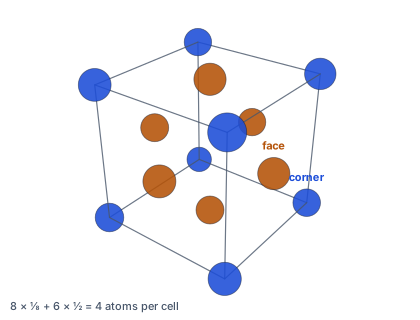
Counting the atoms in a cell needs care, because atoms on its surface are shared with the neighboring cells. An atom at a corner is shared by the eight cells that meet there, so one eighth of it belongs to each. An atom on an edge is shared by four cells, a quarter each. An atom on a face is shared by two, a half each. An atom inside belongs wholly to the cell.
The figure shows the face-centered cubic cell of copper, aluminum and gold. It has eight corner atoms and six face atoms, and they add up to $8 \times \frac{1}{8} + 6 \times \frac{1}{2} = 1 + 3 = 4$ atoms. The body-centered cubic cell of iron, sodium and tungsten has eight corners and one atom at the center: $1 + 1 = 2$. The simple cubic cell, rare in nature, has only its corners: $1$.
The number of nearest neighbors, the coordination number, differs too: six in simple cubic, eight in body-centered cubic, twelve in face-centered cubic, which is a way of packing equal spheres as tightly as possible.
Knowing the atoms per cell, $z$, and the cell edge $a$, found by X-ray diffraction, gives the density directly. One cell holds $z$ formula units of molar mass $M$, so a mole of cells has mass $zM$; a mole of cells has volume $N_A a^3$. So
$$\rho = \frac{z\,M}{N_A\,a^3},$$
with $a$ converted to centimeters for a density in g/cm$^3$. For copper, $\rho = 4 \times 63.55 / (6.022 \times 10^{23} \times (361.5 \times 10^{-10})^3) \approx 8.94$ g/cm$^3$, against the handbook's $8.96$.
Another way: picture
Think of a stack of cubical boxes packed with oranges, with oranges sitting right on the corners where eight boxes meet and on the walls between two. If you want to know how many oranges each box really owns, you cannot count every orange you can see touching it: a corner orange is shared by eight boxes, a wall orange by two. The unit cell is counted the same way.
Another way: steps
Salts pack two kinds of ion, and the common structures are variations on the cubic cells. Rock salt, sodium chloride's structure, is a face-centered cubic array of chloride ions with a sodium ion in every octahedral hole: a sodium at the center of the cell and on each of the twelve edges. Counting, the cell holds $8 \times \frac{1}{8} + 6 \times \frac{1}{2} = 4$ chlorides and $12 \times \frac{1}{4} + 1 = 4$ sodiums: four NaCl formula units, as the formula demands. Every ion has six neighbors of the other kind.
Cesium chloride is different: chloride at the corners and one cesium at the center, one formula unit per cell, eight neighbors each. Zinc blende, the structure of zinc sulfide, puts the zinc in half the tetrahedral holes of a face-centered cubic sulfide array, four neighbors each. Fluorite, calcium fluoride's structure, has twice as many anions as cations, so calcium has eight fluoride neighbors and each fluoride four calciums. The ratio of coordination numbers always matches the formula: in fluorite, $8:4$ for $\mathrm{CaF_2}$.
Which structure a salt takes depends largely on the sizes of its ions. Anions are usually the larger, so picture cations fitting into holes among them. A cation wants as many anion neighbors as possible, because each one adds attraction, but the anions around it must not touch each other before they touch the cation, or the cation rattles loose in a hole too big for it and the structure is unstable.
Simple geometry sets the limits. Eight anions at the corners of a cube can all touch a central cation only if the ratio of the cation radius to the anion radius, $r^+/r^-$, is at least $0.732$. Six anions at the corners of an octahedron need a ratio of at least $0.414$. Four at the corners of a tetrahedron need at least $0.225$. So the radius-ratio rule predicts: above $0.732$, eight neighbors, as in cesium chloride; from $0.414$ to $0.732$, six, as in rock salt; from $0.225$ to $0.414$, four, as in zinc blende. Sodium chloride's ratio, $102/181 = 0.564$, falls squarely in the octahedral range.
The radius-ratio rule is a guide, not a law, and its failures are instructive. Potassium chloride has a ratio of $138/181 = 0.76$, which predicts eight neighbors, but it takes the rock-salt structure with six. Many salts sit near a boundary, where the energy difference between structures is small, and pressure or temperature can switch them: rubidium chloride changes from rock salt to cesium chloride under modest pressure.
The rule also assumes hard spheres held by purely ionic attraction. Where bonding has covalent character, as for soft ions such as silver and iodide, the ions prefer directional, lower-coordinate arrangements the rule does not predict. Silver iodide's ratio suggests six neighbors, but it adopts a four-coordinate structure, the same pattern of soft-soft covalency that lesson 27 found in its lattice enthalpy.
Three checks catch most slips. First, the counts must match the formula: a cell of a salt $\mathrm{AB_2}$ must hold twice as many B as A. If your rock-salt count gives four chlorides and one sodium, you have missed the edge sites.
Second, the units of the density. The cell edge is measured in picometers and must be converted to centimeters, $1$ pm $= 10^{-10}$ cm, before it is cubed; skipping the conversion gives a density off by a factor of $10^{30}$, and dividing by $1{,}000$ instead of $100$ at the wrong stage gives one off by $1{,}000$. Densities of metals and salts run from under $1$ g/cm$^3$ for sodium to about $22$ for osmium.
Third, compare with the handbook. A calculated density within a percent or two of the measured value confirms both the structure and the cell edge; a large difference means a wrong $z$, usually a miscounted shared atom.
Iron is body-centered cubic at room temperature, but above $912\ ^{\circ}\text{C}$ it rearranges to face-centered cubic. That change of unit cell is the basis of heat-treating steel. The face-centered form has larger holes between its atoms and can dissolve far more carbon, up to about two percent, than the body-centered form, which holds only a trace.
Blacksmiths and steelmakers heat steel into the face-centered form so the carbon dissolves, then cool it. Cooled slowly, the carbon comes out as a separate phase and the steel is soft and workable. Quenched quickly in water or oil, the carbon is trapped in a distorted, strained version of the body-centered cell called martensite, which makes the steel very hard. The knife blades, springs and tools made this way owe their properties to the difference between two unit cells.
Gold is one of the densest common metals, about $19.3$ g/cm$^3$, and its density follows from its face-centered cubic cell with an edge of $407.8$ pm and a heavy atom. Assayers and refiners have long used density to test gold, because most cheaper metals that might be mixed in are far less dense: copper is $8.96$, silver $10.5$.
Tungsten is the problem. It is body-centered cubic, with a smaller cell, but its atoms are nearly as heavy as gold's, and its density, about $19.3$ g/cm$^3$, almost exactly matches. Counterfeit gold bars with tungsten cores have been found in the bullion trade, and they pass a simple density check. Refiners now add ultrasound and X-ray fluorescence tests, which detect the different atoms rather than the overall density, precisely because two different unit cells can give the same density.
Drawings of unit cells show whole atoms at the corners and on the faces, and it is natural to count them all: fourteen atoms in a face-centered cubic cell. But each corner atom is shared with seven other cells and each face atom with one other, so only four atoms belong to the cell. Counting all fourteen would make copper more than three times too dense.
The companion error concerns ionic solids: thinking a cell of sodium chloride holds one sodium and one chloride because the formula is NaCl. The formula gives the ratio, one to one, not the number in a cell, which is four of each.
Count the corner atoms.
$8 \times \tfrac{1}{8} = 1$
Eight cells share each corner.
Count the face atoms.
$6 \times \tfrac{1}{2} = 3$
Two cells share each face.
Add the two shares.
$1 + 3 = 4$
Four atoms belong to the cell.
Count one atom's neighbors.
$12$
Four in its own layer's square, four above, four below.
Name the metals with this cell.
$\text{copper, aluminum, silver, gold}$
The soft, ductile metals, whose close-packed layers slide easily.
Write the cell and the data.
$z = 2, \quad M = 55.85\ \text{g/mol}, \quad a = 286.6\ \text{pm}$
Iron is body-centered cubic at room temperature.
Find the mass per mole of cells.
$2 \times 55.85 = 111.70\ \text{g/mol}$
Two atoms per cell.
Find the cell volume.
$(286.6 \times 10^{-10})^3 \approx 23.54 \times 10^{-24}\ \text{cm}^3$
Edge in centimeters, cubed.
Multiply by Avogadro's number.
$6.022 \times 10^{23} \times 23.54 \times 10^{-24} \approx 14.18\ \text{cm}^3$
The volume of a mole of cells.
Divide mass by volume.
$111.70 \div 14.18 \approx 7.88\ \text{g/cm}^3$
Density is mass over volume.
Compare with the handbook.
$7.87\ \text{g/cm}^3$
Agreement within a fraction of a percent.
Write the radii.
$r(\mathrm{Cs^+}) = 174, \quad r(\mathrm{Cl^-}) = 181\ \text{pm}$
Cesium is a very large cation.
Divide the radii.
$174 \div 181 \approx 0.961$
Cation over anion.
Compare with the limits.
$0.961 > 0.732$
Room for eight anions around each cation.
Predict the coordination.
$8$
The cesium chloride structure.
Count the cell.
$8 \times \tfrac{1}{8} + 1 = 2 \text{ ions}$
One chloride from the corners and one cesium in the center.
Check against the formula.
$1 \ \mathrm{Cs^+} : 1 \ \mathrm{Cl^-}$
One formula unit per cell, as CsCl requires.
Divide the radii.
$72 \div 140 \approx 0.514$
Cation over anion.
Compare with the limits.
$0.414 < 0.514 < 0.732$
The octahedral range.
Predict the coordination.
Match each cubic cell of a metal to the coordination number of its atoms and the atoms it holds.
| $6$ neighbors, $1$ atom per cell | $8$ neighbors, $2$ atoms per cell | $12$ neighbors, $4$ atoms per cell | |
|---|---|---|---|
| simple cubic | |||
| body-centered cubic | |||
| face-centered cubic |
Complete the worked solution: the density of $\mathrm{Na}$ from its unit cell.
Multiply the formula units per cell by the molar mass.
$\text{mass per mole of cells} =$ g $\text{g/mol}$
Everything the cell holds, per mole.
Cube the cell edge in centimeters.
$\text{cell volume} \approx$ v $\times 10^{-24}\ \text{cm}^3$
A picometer is a ten-billionth of a centimeter.
Divide the mass by Avogadro's number times the volume.
$\text{density} \approx$ d $\text{g/cm}^3$
Mass per mole of cells over volume per mole of cells.
In $\mathrm{MgO}$ the cation radius is $72$ pm and the anion radius $140$ pm. What coordination number does the radius-ratio rule predict for the cation?
$\mathrm{W}$ has $2$ formula units in a cubic cell of edge $316.5$ pm and molar mass $183.84$ g/mol; $\mathrm{CsCl}$ has $1$ in a cell of edge $412.3$ pm and molar mass $168.36$ g/mol. For each, in that order, fill in the mass per mole of cells in g/mol, the cell volume in units of $10^{-24}$ cm$^3$ and the density in g/cm$^3$.
| mass per mole of cells (g/mol) | cell volume (10⁻²⁴ cm³) | density (g/cm³) | |
|---|---|---|---|
| the first solid | |||
| the second solid |
In a cubic cell, a kind of atom sits at $8$ corners, on $6$ faces, on $0$ edges and at $0$ place inside the cell. How many of those atoms belong to one cell?
Answer: atoms per cell
$\mathrm{Na}$ crystallizes in the body-centered cubic structure with $2$ formula units per cubic cell of edge $429.1$ pm. Its molar mass is $22.99$ g/mol. What is its density in g/cm$^3$?
Answer: g/cm³
An assay lab confirms the identity of three samples from their X-ray cell edges. For $\mathrm{Al}$ ($4$ units per cell, edge $404.9$ pm, $26.98$ g/mol), $\mathrm{Fe}$ ($2$, $286.6$ pm, $55.85$ g/mol) and $\mathrm{CsCl}$ ($1$, $412.3$ pm, $168.36$ g/mol), fill in the cell volume in units of $10^{-24}$ cm$^3$ and the density in g/cm$^3$, in that order.
| cell volume (10⁻²⁴ cm³) | density (g/cm³) | |
|---|---|---|
| the first sample | ||
| the second sample | ||
| the third sample |
Lesson test: one question per skill, one attempt each, no hints. Your answers are checked when you submit.
$\mathrm{Au}$ has $4$ formula units in a cubic cell of edge $407.8$ pm and molar mass $196.97$ g/mol; $\mathrm{CsCl}$ has $1$ in a cell of edge $412.3$ pm and molar mass $168.36$ g/mol. For each, in that order, fill in the mass per mole of cells in g/mol, the cell volume in units of $10^{-24}$ cm$^3$ and the density in g/cm$^3$.
| mass per mole of cells (g/mol) | cell volume (10⁻²⁴ cm³) | density (g/cm³) | |
|---|---|---|---|
| the first solid | |||
| the second solid |
You can work with unit cells. Explain why a face-centered cubic cell holds four atoms, and why cesium chloride takes a different structure from sodium chloride.
15. Your turn: what coordination does the radius-ratio rule predict for magnesium in magnesium oxide, with radii $72$ and $140$ pm?, step 3
$6$
Magnesium oxide takes the rock-salt structure.