Back to the on-screen lesson ·
Turning about a sigma bond changes a molecule's conformation without breaking anything, while turning a double bond breaks its pi bond; conformations are measured by the dihedral angle between groups.
Paper packet. Every task here also exists on screen, where it is checked automatically; answers written on paper are not assessed by Nydus. When you are back at a device, enter your answers there.
You will tell conformations from isomers and stereoisomers, find a dihedral angle after rotation, pick out bonds that rotate freely, explain why a double bond does not, and name butane's conformations by angle.
You know a single bond is one sigma bond and a double bond adds a pi bond, and that names fix connectivity. This unit looks at what can change without changing the name: the molecule's shape as it turns.
A conformation is one shape a molecule reaches by rotating about single bonds. The dihedral angle is the angle between two groups on neighbouring carbons, seen along the bond between them. Staggered conformations have dihedral angles of 60°, 180°, 300°; eclipsed, 0°, 120°, 240°.
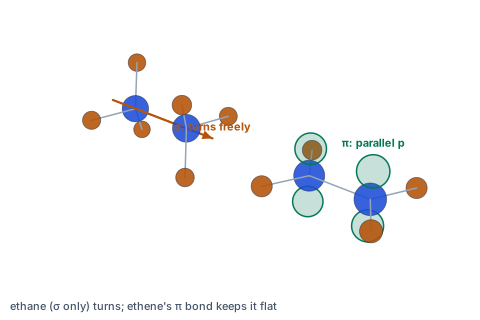
A sigma bond is head-on overlap along the line between the nuclei, symmetrical all the way round. Turn one end and the overlap is unchanged, so the bond does not break. Ethane's two CH3 groups spin relative to each other constantly at room temperature; every angle is a conformation of the same compound.
A pi bond is side-by-side overlap of two parallel p orbitals. Turn one end 90° and the orbitals are at right angles: no overlap, no pi bond. That costs about 260 kJ/mol, so double bonds do not rotate at room temperature, and (E) and (Z) alkenes are separate compounds — stereoisomers, not conformations.
Rings restrict rotation too: turning a bond in a small ring would tear it open.
Another way: table
Three relationships.
| Relationship | How they interconvert |
|---|---|
| conformations | turning about single bonds; no bond breaks |
| stereoisomers | only by breaking a bond |
| structural isomers | different connections altogether |
Look along the C2–C3 bond of butane. The dihedral angle between its two CH3 groups names the conformation. At 180° they are anti, as far apart as possible. At 60° or 300° they are gauche: staggered, but neighbours. At 0° one sits directly behind the other: fully eclipsed. Turning the back carbon adds to the angle, and each 60° switches between staggered and eclipsed. The next lessons draw these views (Newman projections) and put energies on them.
On the left is ethane, joined by a sigma bond alone. The bond lies along the carbon–carbon axis and is the same all the way round it, so turning one CH3 group about that axis changes nothing about the overlap; the figure shows one staggered conformation of the many the molecule passes through. On the right is ethene. Each carbon also has a p orbital standing up and down through the plane of the molecule, and the two are parallel: their side-by-side overlap is the pi bond. Turn the figure to look along the carbon–carbon bond. Rotating one end of ethene by 90° would leave its p orbital pointing sideways, at right angles to the other, with no overlap at all — so the pi bond locks the molecule flat.
Rotating a single bond breaks and reforms it. Sigma overlap is unchanged by rotation.
Conformations are isomers. They are one compound.
Double bonds rotate like single bonds. Rotation breaks the pi bond.
A molecule sits in one conformation. It passes through all of them constantly.
The C–O bond is a single sigma bond, not in a ring.
Free rotation is possible.
Turning the OH hydrogen changes the molecule's shape.
A new conformation.
Every atom keeps its partners, so it is still ethanol.
The same compound.
Can one become the other by turning about the C=C?
Only by breaking the pi bond.
So what is their relationship?
Stereoisomers: separate compounds, not conformations.
In a model of ethane, CH3–CH3, one CH3 group is turned 60° about the C–C bond. What has happened?
Match each pair to how the two structures are related.
| conformations of one compound | structural isomers | stereoisomers: a bond must break to interconvert | |
|---|---|---|---|
| butane with CH3 groups 180° apart, and 60° apart | |||
| butane and 2-methylpropane | |||
| (E)-but-2-ene and (Z)-but-2-ene | |||
| ethane staggered, and ethane turned a further 120° |
In butane, the angle between the two CH3 groups, viewed along the C2–C3 bond, starts at 0°. The back carbon is turned $240$° clockwise. What is the angle between the CH3 groups now, measured clockwise?
Answer:
Four bonds are described below. Mark every bond about which the molecule can rotate freely at room temperature.
This task has no paper form; do it on a device.
Turning about ethane's C–C bond costs about 12 kJ/mol at the worst point. Turning about a C=C bond costs about 260 kJ/mol. Why the difference?
Lesson test: one question per skill, one attempt each, no hints. Your answers are checked when you submit.
Viewed along butane's C2–C3 bond, name the conformation at each angle between the two CH3 groups.
| conformation | |
|---|---|
| 180° | |
| 60° | |
| 300° | |
| 0° |
You can tell a change of shape from a change of compound. Tell someone why cis and trans but-2-ene can be bottled separately. Next: drawing the view along a bond — the Newman projection.
9. Your turn: (Z)-but-2-ene and (E)-but-2-ene, step 3