Back to the on-screen lesson ·
A stereocentre is an sp3 carbon bonded to four different groups, compared as whole groups; a molecule with n of them has at most 2 to the power n stereoisomers.
Paper packet. Every task here also exists on screen, where it is checked automatically; answers written on paper are not assessed by Nydus. When you are back at a device, enter your answers there.
You will count a molecule's stereocentres, decide whether a carbon is one, explain why a carbon is not, mark stereocentres in a chain, find one in a drug, and give the most stereoisomers possible.
You met R and S as names for the arrangement at a stereocentre. This lesson is about finding stereocentres in the first place.
A chiral object is not superimposable on its mirror image, like a hand. A stereocentre (chiral centre) is an sp3 carbon bonded to four different groups. An achiral object is superimposable on its mirror image.
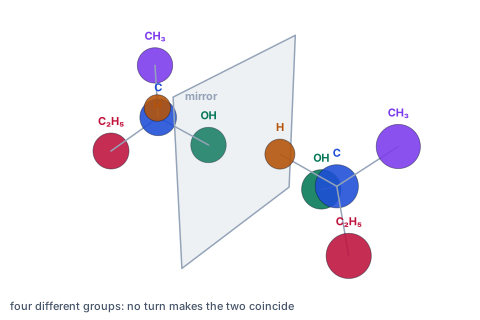
Hold a model of butan-2-ol's carbon 2: H, OH, CH3 and CH2CH3 point to the corners of a tetrahedron. Its mirror image has the same four groups, arranged the other way round, and no rotation makes the two coincide: carbon 2 is a stereocentre.
Change the ethyl to a second methyl and you have propan-2-ol, whose CH carbon carries two identical CH3 groups. Its mirror image can be turned to fit: not a stereocentre.
The test: list the four groups, comparing each whole group — follow the branch outwards until it differs. CH3 and CH2CH3 differ one carbon out; two CH2CH3 groups never differ.
Another way: steps
To find stereocentres:
A molecule can have several stereocentres. 2,3-dichloropentane has two, at carbons 2 and 3. Each can independently be R or S, so a molecule with n stereocentres has at most 2 to the power n stereoisomers; the next lessons show when symmetry makes some of them the same.
The question is not academic. Many drugs have a stereocentre, and the two mirror forms act differently in the body, because the body's own molecules are chiral: one form of ibuprofen relieves pain, and the body slowly converts the other.
The figure shows carbon 2 of butan-2-ol with its four groups, H, OH, CH3 and C2H5, and its reflection in a mirror. Turn the two molecules and try to lay one on the other. You can always line up two groups — say C2H5 up and H towards you — but then the OH and CH3 are on opposite sides in the two molecules. No rotation fixes that, because the only way to swap two groups is to break bonds. That is what a stereocentre is: a carbon with four different groups, whose mirror image is a different molecule. Replace the C2H5 by a second CH3 and the two mirror images can be turned to match, because swapping two identical groups changes nothing.
Any carbon with four bonds is chiral. The four groups must differ.
Compare only the first atom of each group. Compare whole groups.
An sp2 carbon can be a stereocentre. It has only three groups.
A molecule with a stereocentre always has exactly two stereoisomers. With n centres, up to 2 to the power n.
The CH carbon carries H, OH, CH3 and COOH.
List the four groups.
All four differ, so it is a stereocentre.
Four different groups.
Lactic acid therefore has two mirror-image forms, found in sour milk and in muscle.
Chiral molecule.
What four groups does the CH carbon carry?
H, CH3, CH3 and CH2CH3.
Is it a stereocentre?
No: two of its groups are identical methyls.
How many stereocentres does 3-methylpentane, CH3CH2CH(CH3)CH2CH3, have?
Answer:
In butan-2-ol, CH3CH(OH)CH2CH3, is carbon 2 — the carbon carrying the OH — a stereocentre?
Match each carbon to whether it is a stereocentre, and why.
| not a stereocentre: two identical groups | not a stereocentre: sp2, only three groups | a stereocentre | |
|---|---|---|---|
| the CH carbon of propan-2-ol, (CH3)2CHOH | |||
| the CH carbon of 3-methylpentane | |||
| the C=O carbon of propanone | |||
| carbon 2 of 2-chlorobutane |
In 2,3-dichloropentane, CH3CHClCHClCH2CH3, the carbons are numbered 1 to 5 from the left. Mark every stereocentre.
This task has no paper form; do it on a device.
Ibuprofen is written Ar–CH(CH3)–COOH, where Ar is a substituted benzene ring. Which atom is its stereocentre?
Lesson test: one question per skill, one attempt each, no hints. Your answers are checked when you submit.
At most, how many stereoisomers can 2-methylbutane, CH3CH(CH3)CH2CH3, have?
The molecule can have at most a stereoisomers.
You can find a molecule's stereocentres. Tell someone why propan-2-ol is not chiral. Next: assigning R or S to a stereocentre.
9. Your turn: 2-methylbutane, CH3CH(CH3)CH2CH3, step 3