Back to the on-screen lesson ·
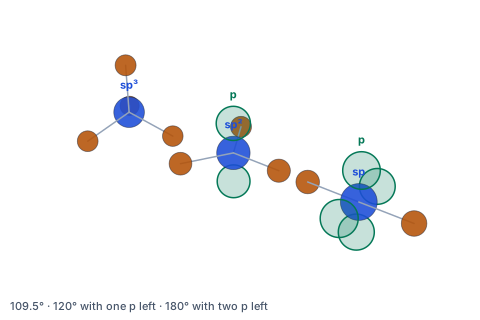
A carbon mixes as many orbitals as it has electron domains: four gives sp3 and 109.5°, three sp2 and 120°, two sp and 180°; the left-over p orbitals make pi bonds, and more s character makes shorter, stronger bonds.
Paper packet. Every task here also exists on screen, where it is checked automatically; answers written on paper are not assessed by Nydus. When you are back at a device, enter your answers there.
You will name each carbon's hybridization from its electron domains, predict its bond angle and pi bonds, count sigma and pi bonds in a molecule, and explain what more s character does.
You can count a central atom's electron domains and predict its shape: four domains point to the corners of a tetrahedron, three lie flat at 120°, two lie in a line. Hybridization is the orbital picture that goes with those shapes. Structures in this course are written as condensed formulas, read left to right: CH3CH2OH is a CH3 joined to a CH2 joined to an OH. Brackets hang a group off the carbon before them, so CH3CH(CH3)CH3 has a CH3 branch on its middle carbon.
A hybrid orbital is a mixture of an atom's s and p orbitals. sp3, sp2 and sp name how many p orbitals were mixed with the s. A sigma bond is head-on overlap along the line between two nuclei; a pi bond is side-by-side overlap of two p orbitals, above and below that line. s character is the share of a hybrid that came from the s orbital.
Carbon's valence orbitals are one 2s and three 2p. Methane's four C–H bonds are identical and 109.5° apart, which four unmixed orbitals could not give. The model: the carbon mixes its 2s with its three 2p into four sp3 hybrids, each a quarter s, pointing to a tetrahedron's corners.
A carbon only mixes as many orbitals as it has electron domains — bonded atoms or lone pairs, each counted once:
| Domains | Hybrid | Geometry | Angle | Left-over p orbitals |
|---|---|---|---|---|
| 4 | sp3 | tetrahedral | 109.5° | 0 |
| 3 | sp2 | trigonal planar | 120° | 1 |
| 2 | sp | linear | 180° | 2 |
The left-over p orbitals are where pi bonds come from. In ethene each sp2 carbon keeps one p orbital; the two overlap side by side above and below the molecule's plane, making the second bond of C=C. In ethyne each sp carbon keeps two, making two pi bonds at right angles.
Another way: steps
To read any carbon:
An sp hybrid is half s, an sp2 a third, an sp3 a quarter. Electrons in an s orbital sit closer to the nucleus than in a p orbital, so the more s character a hybrid has, the closer it holds its electrons: bonds from an sp carbon are shorter and stronger (C–H in ethyne is 106 pm; in ethane, 109 pm), and a lone pair in an sp orbital is held more tightly and is less available to a proton. That last fact reappears in unit 4, where it explains why a C–H next to a triple bond is unusually acidic.
Hybridization is a model of how the atom's own orbitals are shaped for bonding. It does not add or remove protons or electrons, and the same carbon can be sp3 in one compound and sp in the next.
The figure puts the three kinds of carbon next to each other. The sp3 carbon points its four bonds to the corners of a tetrahedron, 109.5° apart, and has no p orbital left. The sp2 carbon has three bonds in a flat triangle at 120°, and its one unmixed p orbital stands straight through the triangle, above and below; that is the orbital that makes a pi bond. The sp carbon has two bonds in a line at 180° and two unmixed p orbitals, at right angles to the line and to each other, which is where a triple bond's two pi bonds come from. Turn the sp2 carbon edge on and the triangle is a line with the p orbital square to it.
Hybridization changes the number of protons in carbon. It mixes orbitals; the nucleus is untouched.
Count the bonds, not the atoms. A double bond to one atom is one domain.
A C=O carbon is sp3 because oxygen is not carbon. It has three domains, so it is sp2.
A double bond is two sigma bonds. It is one sigma and one pi.
The CH2= carbon: two H and one C — three domains, sp2.
Atoms, not bonds.
The =CH– carbon: one H and two C — three domains, sp2.
Also in the double bond.
The CH3 carbon: three H and one C — four domains, sp3, 109.5°. Sigma bonds: two C–C and six C–H, eight; pi bonds: one.
Each bond has one sigma; the double bond adds a pi.
The CH3 carbon has four domains. Its hybridization?
sp3.
The CHO carbon is bonded to C, H and O (double). Domains and hybridization?
Three domains: sp2, with 120° angles and one p orbital in the C=O pi bond.
The molecule propene is CH2=CHCH3. How many of its carbon atoms are sp2 hybridized?
Answer:
Match each carbon environment to the hybridization and bond angle it has.
| sp3, about 109.5° | sp2, about 120° | sp, 180° | |
|---|---|---|---|
| a carbon of methane, CH4 | |||
| a carbon of ethene, CH2=CH2 | |||
| a carbon of ethyne, HC≡CH | |||
| the carbon of methanal, H2C=O |
Propyne is HC≡C–CH3. Number its carbons 1 (the HC≡), 2 (the ≡C–) and 3 (the CH3). Fill in each carbon's hybridization and the number of unhybridized p orbitals it keeps.
| hybridization | unhybridized p orbitals | |
|---|---|---|
| carbon 1 | ||
| carbon 2 | ||
| carbon 3 |
The C–H bond in ethyne (HC≡CH) is shorter and stronger than the C–H bond in ethane (CH3CH3). Which explanation is right?
Nitrogen hybridizes like carbon. Put these nitrogen atoms in order from the most s character in the orbital holding the lone pair to the least: the N of ethanenitrile (CH3C≡N), the N of an imine (CH3CH=NH), and the N of methylamine (CH3NH2).
Number the steps in order (write the number in the box):
Lesson test: one question per skill, one attempt each, no hints. Your answers are checked when you submit.
The molecule ethanenitrile is CH3CN. How many sigma bonds does it contain in all, counting the bonds to hydrogen?
The molecule has a sigma bonds in all.
You can read hybridization and geometry off a written structure. Tell someone why a C=O carbon is sp2. Next: formal charge, the bookkeeping that says where charge sits in a structure.
9. Your turn: ethanal, CH3CHO, step 3