Back to the on-screen lesson ·
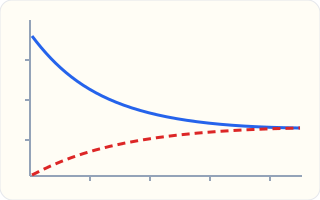
Equilibrium as a forward rate that falls and a reverse rate that rises until they are equal, in a closed system, with constant and usually unequal amounts.
Paper packet. Every task here also exists on screen, where it is checked automatically; answers written on paper are not assessed by Nydus. When you are back at a device, enter your answers there.
By the end of this lesson you will be able to explain how a reversible reaction in a closed system reaches equilibrium in terms of a falling forward rate and a rising reverse rate, recognise equilibrium from readings that stop changing, and use the equation's ratio to work out amounts at equilibrium. You will be able to say why equilibrium does not mean the reactions have stopped or that the amounts are equal, and what labelled atoms show.
You know that a rate depends on concentration: the more of a reactant there is, the faster it reacts, and as it is used up the rate falls. So far every reaction has gone one way until something ran out. Many reactions can also run backwards — the products react to give the reactants again — and this lesson follows what happens when both directions run in the same container.
A reversible reaction can go in both directions, and is written with the double half-arrow $\rightleftharpoons$. The forward reaction turns the substances on the left into those on the right; the reverse reaction turns them back. A closed system is one that nothing can enter or leave — a sealed flask. Dynamic equilibrium is the state a closed system reaches when the forward and reverse reactions are running at equal rates, so the amounts of every substance stay constant.
Seal hydrogen and iodine vapour in a hot flask. At the start there is no hydrogen iodide, so only one thing can happen: $\mathrm{H_2 + I_2 \rightarrow 2HI}$. The forward rate is at its largest, because the reactant concentrations are at their largest, and the reverse rate is zero.
As hydrogen iodide forms, two things change at once.
A falling rate and a rising rate must meet. At that moment every molecule of hydrogen iodide that forms is matched by one that breaks up somewhere else in the flask. The concentrations stop changing — not because anything stopped, but because each change is cancelled as fast as it happens.
Equilibrium is not a reaction that has stopped. Both directions are still running, at the same rate, so nothing measurable changes; the concentrations are constant, and they are almost never equal.
Why the container must be closed. If a product can escape — carbon dioxide bubbling out of an open flask, say — it is not there to react backwards. The reverse rate never catches up, and the forward reaction goes until a reactant runs out. Equilibrium belongs to closed systems.
Another way: picture
Picture an escalator going down while you walk up it at exactly its speed. You stay at the same step; an observer might think you are standing still. You are working hard — you and the escalator are cancelling out. A system at equilibrium is the walker, not a person standing on a stopped staircase.
Another way: steps
To decide whether a system is at equilibrium:
If all three, both reactions are running at equal rates.
How can anyone know that both reactions are still running, when nothing measurable changes? By labelling some of the atoms so they can be followed.
Take a saturated solution of lead(II) iodide standing on some undissolved solid. The amount of solid is constant: it is at equilibrium, $\mathrm{PbI_2(s) \rightleftharpoons Pb^{2+}(aq) + 2I^-(aq)}$. Now add a little solid lead iodide made with radioactive iodine. The mass of solid stays the same — but within hours the solution becomes radioactive, and the solid gradually contains less of the labelled iodine. The only way labelled iodide ions can reach the solution is by dissolving; the only way the solid mass can stay constant while that happens is if unlabelled ions crystallise out just as fast.
The same experiment works with gases: add some deuterium (heavy hydrogen) to an equilibrium mixture of hydrogen, iodine and hydrogen iodide, and deuterium soon turns up in the hydrogen iodide as $\mathrm{DI}$. A stopped reaction could not do that.
The amounts stop changing when the two rates are equal, and the rates depend on the rate constants as well as the concentrations. If the forward reaction is intrinsically fast and the reverse slow, the forward rate only falls to the reverse rate once most of the reactants are gone: the equilibrium lies to the right, with mostly products. If the reverse is the fast one, very little product is needed before it keeps up: the equilibrium lies to the left.
So a sealed flask of hydrogen and iodine at 450 °C settles with roughly seven parts hydrogen iodide to one part each of hydrogen and iodine, not with equal amounts of everything. The same equilibrium is reached whether you start from hydrogen and iodine or from pure hydrogen iodide, as long as the atoms and the temperature are the same — which is the strongest sign that the final state is set by the chemistry, not by the history.
Thinking the reactions have stopped. Constant amounts come from two reactions cancelling, and labelled atoms prove it: they spread into every substance at equilibrium.
Thinking the concentrations are equal. It is the rates that are equal. The concentrations settle wherever the rates match, which is almost never at equal values.
Thinking equilibrium means half reactants and half products. The position depends on the reaction and the temperature. Some equilibria lie almost entirely on one side.
Expecting equilibrium in an open container. If a product escapes, the reverse reaction has nothing to work on, and the forward reaction runs to completion.
A sealed flask of $\mathrm{N_2O_4}$ is read every minute: 0.50, 0.38, 0.33, 0.31, 0.31, 0.31 mol/L.
Only the dinitrogen tetroxide is measured here.
The readings fall, then stay at 0.31 mol/L from the fourth minute on.
A reading equal to the one before is the sign that equilibrium has been reached.
From then on $\mathrm{N_2O_4}$ is still splitting into $\mathrm{NO_2}$, and $\mathrm{NO_2}$ is still joining back up, at equal rates.
Constant readings describe equal rates, not zero rates.
A flask starts with 1.0 mol of $\mathrm{N_2O_4}$ and reaches equilibrium with 0.4 mol of $\mathrm{NO_2}$.
The equation $\mathrm{N_2O_4 \rightleftharpoons 2NO_2}$ gives the ratio.
Two moles of $\mathrm{NO_2}$ come from one of $\mathrm{N_2O_4}$, so 0.4 mol of $\mathrm{NO_2}$ used 0.2 mol.
Conservation still holds at equilibrium.
0.8 mol of $\mathrm{N_2O_4}$ is left, beside 0.4 mol of $\mathrm{NO_2}$: constant, unequal, both present.
The two amounts differ, and that is normal.
Cis plus trans stays at 20 mmol throughout.
One molecule becomes one molecule.
Trans $= 20 - 7 = \ldots$
…13 mmol, which is constant from now on and not equal to the 7 mmol of cis.
Over a catalyst in a sealed tube, cis-but-2-ene turns into trans-but-2-ene and back again, one molecule into one molecule. The tube starts with $32$ mmol of the cis isomer and no trans. The amount of cis is read every 10 minutes. Fill in the amount of trans at each reading, and say whether the amounts are still changing compared with the reading before.
| cis, in mmol | trans, in mmol | compared with the reading before | |
|---|---|---|---|
| after 10 min | 20 | ||
| after 20 min | 14 | ||
| after 30 min | 12 | ||
| after 40 min | 12 |
Hydrogen and iodine vapour are sealed in a flask at 450 °C. The concentration of hydrogen iodide is measured every 10 minutes: $0$ at the start, then $30$, $45$, $50$ and $50$ mmol/L. Plot the five readings.
Plot your answer on the grid:
A sealed tube of brown nitrogen dioxide and colourless dinitrogen tetroxide, $\mathrm{2NO_2 \rightleftharpoons N_2O_4}$, is kept at a steady temperature. After $7$ minutes its colour stops changing. What is happening in the tube from then on?
A closed flask of ethanoic acid and ethanol reaches equilibrium with ethyl ethanoate and water; at equilibrium it holds $0.4$ mol of ethanoic acid and $0.8$ mol of ethyl ethanoate. Mark every statement that is true of the flask at equilibrium.
This task has no paper form; do it on a device.
Hydrogen and iodine are sealed in a hot flask and reach equilibrium after about $60$ minutes. Match each moment to what the forward and reverse rates are doing.
| forward rate at its highest, reverse rate zero | forward rate falling, reverse rate rising, forward still larger | forward and reverse rates equal and both above zero | no equilibrium, because products can escape | |
|---|---|---|---|---|
| the instant the gases are mixed | ||||
| about 30 minutes after mixing | ||||
| after 120 minutes in the sealed flask | ||||
| the same mixture in a flask with no stopper |
Nitrogen and hydrogen are sealed in a hot vessel with an iron catalyst, $1$ mol of nitrogen to $3$ mol of hydrogen. Put the stages in the order they happen.
Number the steps in order (write the number in the box):
A sealed bottle half full of water has stood at a steady temperature for a day, and the water level no longer changes. At this temperature, molecules leave the liquid surface at $7$ µmol per second. How many µmol of water molecules evaporate from the surface in $30$ s?
Answer: µmol
Lesson test: one question per skill, one attempt each, no hints. Your answers are checked when you submit.
A sealed flask starts with $0.6$ mol of dinitrogen tetroxide and nothing else, and reaches equilibrium: $\mathrm{N_2O_4 \rightleftharpoons 2NO_2}$. At equilibrium it holds $0.5$ mol of nitrogen dioxide. How many moles of dinitrogen tetroxide are left?
Answer: mol
You can describe dynamic equilibrium as two equal rates in a closed system. Say out loud what radioactive iodine added to a saturated lead iodide solution shows, and why the amounts at equilibrium are constant but not equal. Next: a single number that says where an equilibrium settles.
10. Your turn: a sealed tube starts with 20 mmol of cis-but-2-ene, which converts one-for-one to trans. At equilibrium 7 mmol of cis remain. How much trans is there?, step 3