Back to the on-screen lesson ·
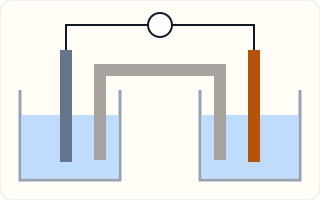
A redox reaction split into two half-cells: oxidation at the anode, reduction at the cathode, electrons through the wire and ions through the salt bridge.
Paper packet. Every task here also exists on screen, where it is checked automatically; answers written on paper are not assessed by Nydus. When you are back at a device, enter your answers there.
By the end of this lesson you will be able to identify the anode and cathode of a cell and the reaction at each, give the direction of electron flow and the job of the salt bridge, read cell notation, say which electrode loses and which gains mass, and turn a number of moles of electrons into masses at the electrodes.
Last lesson zinc reduced copper(II) ions in one beaker, with electrons passing directly from atom to ion. You can split any redox reaction into its two half equations, and you know electrons lost equal electrons gained. This lesson separates the halves so the electrons have to go the long way round.
An electrochemical cell (a galvanic or voltaic cell) turns the energy of a redox reaction into electrical energy. Each half-cell is a metal electrode dipping into a solution of its own ions. The anode is the electrode where oxidation happens; the cathode is where reduction happens. The external circuit is the wire joining the electrodes. The salt bridge is a tube or strip soaked in a solution of an unreactive salt, joining the two solutions. Cell notation is a one-line way of writing a cell.
The left beaker holds a zinc strip in zinc sulfate solution; the right holds a copper strip in copper(II) sulfate solution. They are joined twice: by a wire, through a meter, and by a salt bridge.
At the zinc strip, zinc atoms lose electrons and go into solution: $\mathrm{Zn \rightarrow Zn^{2+} + 2e^-}$. Oxidation, so this is the anode. The electrons it releases are left in the metal, which makes the zinc the negative terminal. Over time the zinc strip gets thinner.
Through the wire the electrons flow to the copper. They cannot go any other way: electrons move through metals, not through solutions.
At the copper strip, copper(II) ions from the solution take the electrons and are deposited as copper: $\mathrm{Cu^{2+} + 2e^- \rightarrow Cu}$. Reduction, so this is the cathode, the positive terminal. The copper strip gets heavier and the blue colour slowly fades.
Through the salt bridge ions move. Without it, the zinc beaker would fill with extra positive zinc ions and the copper beaker would lose positive ions, leaving extra sulfate. Within moments the build-up of charge would stop the flow. The salt bridge lets negative ions drift into the zinc beaker and positive ions into the copper beaker, keeping both neutral. It completes the circuit with ions, while the wire completes it with electrons.
The overall reaction is exactly the one that happens when zinc is dropped into copper sulfate. Separating the halves does not change the chemistry; it makes the electrons do work on the way.
Another way: picture
Picture two towns joined by a road and a river. Lorries carry goods (electrons) one way along the road (the wire). If nothing came back, one town would pile up with empty lorries and the other would run short; boats on the river (ions in the salt bridge) keep the two balanced. Close the river and the lorries soon stop.
Another way: steps
To describe any cell:
Chemists write a cell with the anode on the left and the cathode on the right:
$$\mathrm{Zn(s) \,|\, Zn^{2+}(aq) \,||\, Cu^{2+}(aq) \,|\, Cu(s)}$$
A single vertical bar marks a boundary between two phases — here a solid metal and a solution. The double bar is the salt bridge. Reading left to right follows the electrons' story: zinc is oxidised to zinc ions on the left; copper ions are reduced to copper on the right.
The same notation works for any pair. A magnesium–silver cell is $\mathrm{Mg(s) \,|\, Mg^{2+}(aq) \,||\, Ag^+(aq) \,|\, Ag(s)}$, with magnesium, the more reactive metal, as the anode.
Because every electron released at the anode is used at the cathode, the half equations turn a flow of electrons into masses. In the zinc–copper cell two electrons move for every zinc atom dissolved and every copper atom deposited. If $0.10$ mol of electrons flows, $0.050$ mol of zinc dissolves — $3.27$ g — and $0.050$ mol of copper is deposited — $3.18$ g.
The charge carried by one mole of electrons is about $96\,500$ coulombs, a quantity called the Faraday constant. A current of $1$ ampere is one coulomb each second, so a cell that delivers $0.2$ A for an hour moves $720$ C, about $0.0075$ mol of electrons. Batteries are rated in milliampere-hours for this reason: the rating is a count of electrons the chemicals inside can supply.
Electrons move through the salt bridge. They move only through the wire. The salt bridge carries ions.
The salt bridge is just a connector. Remove it and the current stops, because charge builds up in each beaker.
The anode is always positive. In a cell that produces electricity the anode is where electrons are released, so it is the negative terminal. (In electrolysis, where a power supply forces the reaction, the signs are reversed — but oxidation is still at the anode.)
Both electrodes lose mass. The anode dissolves; the cathode gains a coat of metal.
The cell makes electrons. It moves them. Every electron that leaves the anode is taken up at the cathode.
Magnesium in magnesium sulfate solution is joined to copper in copper(II) sulfate solution.
Magnesium is the more reactive metal.
Anode: $\mathrm{Mg \rightarrow Mg^{2+} + 2e^-}$, negative, loses mass. Cathode: $\mathrm{Cu^{2+} + 2e^- \rightarrow Cu}$, positive, gains mass.
Oxidation at the more reactive metal.
Electrons pass along the wire, leaving the magnesium and arriving at the copper; sulfate ions drift through the salt bridge towards the magnesium beaker.
Electrons in the wire, ions in the bridge.
A zinc–silver cell runs until $0.020$ mol of electrons have flowed. Silver is $108$ g/mol; zinc $65.4$ g/mol.
One electron per silver ion, two per zinc atom.
Silver deposited: $0.020$ mol, which is $2.16$ g.
Each electron deposits one silver atom.
Zinc dissolved: $0.010$ mol, which is $0.654$ g.
Each zinc atom supplies two electrons.
Iron is written first, on the left, so it is the anode, where iron is oxidised.
The notation puts the anode on the left.
The anode releases electrons, so it is the $\ldots$
…negative electrode, and electrons flow through the wire from the iron to the copper.
The picture shows a zinc strip in zinc sulfate solution on the left and a copper strip in copper(II) sulfate solution on the right, joined by a wire and a salt bridge. Mark the part of the cell where electrons travel from one half-cell to the other.
This task has no paper form; do it on a device.
A cell is made from magnesium in a solution of its ions and copper in a solution of its ions. magnesium is the more reactive metal. For each description, give the electrode it fits.
| electrode | |
|---|---|
| where oxidation happens | |
| the negative terminal | |
| the electrode that loses mass | |
| the electrode that gains mass | |
| where reduction happens |
In a zinc–copper cell, put the events in the order a pair of electrons experiences them.
Number the steps in order (write the number in the box):
The salt bridge in a zinc–copper cell is a tube of potassium chloride solution. What passes through it while the cell is working?
A zinc–copper cell runs until $0.02$ mol of electrons have passed through the wire. What mass of copper is deposited on the cathode? (Copper: $63.5$ g/mol.)
Answer: unit: g / kg / mg
The zinc–copper cell is written $\mathrm{Zn(s) \,|\, Zn^{2+}(aq) \,||\, Cu^{2+}(aq) \,|\, Cu(s)}$. Match each part of the notation to what it stands for.
| the anode, where oxidation happens | the cathode, where reduction happens | the boundary between a metal and its solution | the salt bridge | |
|---|---|---|---|---|
| $\mathrm{Zn(s)}$ at the far left | ||||
| $\mathrm{Cu(s)}$ at the far right | ||||
| a single bar | ||||
| the double bar in the middle |
The button cells in hearing aids and watches use zinc and silver oxide: $\mathrm{Zn + Ag_2O \rightarrow ZnO + 2Ag}$. Over its life a cell uses up $2.616$ g of zinc. What mass of silver metal has formed? (Zinc: $65.4$ g/mol; silver: $108$ g/mol.)
Answer: unit: g / kg / mg
Lesson test: one question per skill, one attempt each, no hints. Your answers are checked when you submit.
A cell is built from a half-cell of magnesium and a half-cell of copper, and magnesium is the more reactive metal. Which way do electrons flow, and through what?
You can trace the electrons and the ions through a cell. Say out loud why electrons cannot cross the salt bridge and what would happen if it were removed. Next: putting a number on how hard a cell pushes its electrons — the cell potential.
10. Your turn: in $\mathrm{Fe(s) \,|\, Fe^{2+}(aq) \,||\, Cu^{2+}(aq) \,|\, Cu(s)}$, which electrode is negative, and which way do electrons flow?, step 3