Back to the on-screen lesson ·
A rate as a measured change divided by its own time interval, and why the reaction that makes more is not the faster one.
Paper packet. Every task here also exists on screen, where it is checked automatically; answers written on paper are not assessed by Nydus. When you are back at a device, enter your answers there.
By the end of this lesson you will be able to choose what to measure to follow a reaction, calculate a mean rate from two readings over a stated interval, give it the unit that goes with the quantity measured, and explain why the rate falls as a reaction goes on. You will also be able to say why the reaction that makes the most product is not necessarily the fastest.
In Chemistry 1 a balanced equation told you how much a reaction makes: so many moles of reactant give so many moles of product, and a gas's volume or a solid's mass can be worked out from that. None of it said anything about when. A reaction that the equation says will give 120 mL of hydrogen might give it in four seconds or in four hours. This unit is about that missing question, and it starts with the measurement.
The rate of reaction is how quickly a reactant is used up or a product is formed. A mean rate is the rate averaged over a stated interval of time: the change in a measured quantity divided by the length of the interval. A gas syringe is a glass syringe whose plunger is pushed out by a gas as it forms, so its scale reads the volume collected. A reading is one measurement at one time; two readings make a change, and a change over a time makes a rate.
$$\text{mean rate} = \frac{\text{change in a measured quantity}}{\text{time taken for that change}}$$
That is the whole definition, and every word in it matters.
A measured quantity. A reaction cannot be timed until something about it can be read. If a gas comes off, its volume can be collected in a syringe or its escape can be read as the fall in mass of an open flask on a balance. If a coloured substance is used up, a colorimeter can read the colour fading. If a solid precipitate forms, the time for a cross drawn under the flask to disappear can be recorded. Whatever is read, the rate is that quantity's change per unit time.
A change, not a total. Two readings are needed: one at the start of the interval and one at the end. The rate belongs to the difference between them.
A stated time. The rate is attached to an interval. Over the first ten seconds of a reaction and over the last ten seconds, the same reaction usually has very different rates, because the reactants are being used up and there are fewer of them left to react.
The unit follows the quantity. Gas collected in millilitres and time in seconds give a rate in mL/s. A mass loss in grams gives g/s. A concentration in mol/L gives mol/(L s). The unit is not decoration: it tells you what was measured.
A rate is a change divided by the time it took. The height of a graph is how much has happened so far; the steepness is how fast it is happening now, and the two answer different questions.
Another way: picture
A car's mileage display and its speedometer answer different questions. The mileage says how far you have gone since you set off; the speedometer says how fast you are going now. A gas syringe reading is the mileage. The rate is the speed — and just as a long journey does not make a fast car, a large volume of gas does not make a fast reaction.
Another way: steps
To find a mean rate from two readings:
Different reactions give themselves away in different ways, and the choice of measurement comes from the equation.
| Reaction | What changes | What is read | Rate unit |
|---|---|---|---|
| Magnesium with hydrochloric acid | hydrogen gas forms | volume in a gas syringe | mL/s |
| Marble chips with hydrochloric acid, open flask | carbon dioxide escapes | fall in mass on a balance | g/s |
| Sodium thiosulfate with acid | a pale yellow sulfur solid forms | time for a cross under the flask to vanish | 1/s, from one over the time |
| Bromine water decolourising | orange colour fades | absorbance in a colorimeter | absorbance per second |
A fall in mass works only because the gas escapes: the balance weighs everything that stays in the flask, so the mass lost is exactly the mass of gas that left. A reading of a reactant goes down and a reading of a product goes up, but a rate is quoted as a positive number either way — it says how fast, and the equation already says which direction.
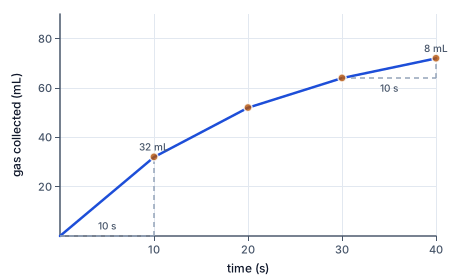
Suppose a syringe on the magnesium reaction reads 0, 32, 52, 64 and 72 mL at 0, 10, 20, 30 and 40 s. The gas collected in each ten-second interval is 32, then 20, then 12, then 8 mL. The mean rates over those intervals are 3.2, 2.0, 1.2 and 0.8 mL/s.
The rate is highest at the start, because that is when the most acid and the most magnesium are there to react. As they are used up, fewer particles are left to meet, and each interval collects less. Eventually one reactant runs out, the readings stop changing, and the rate is zero — even though the syringe is fuller than it has ever been.
That is why a mean rate must name its interval. The mean over the whole 40 s is $72 \div 40 = 1.8$ mL/s, which is the rate in none of the four intervals. It is a true average and a poor description of any moment.
On the chart the rate is the steepness. The first ten seconds climb 32 mL and the last ten only 8 mL, so the curve flattens while the syringe keeps filling.
Taking the larger total for the faster reaction. How much gas a reaction gives in the end is decided by the amount of the reactant that runs out first — a Chemistry 1 question. How quickly it comes off is a different question. Twice the reactant can give twice the gas at the same rate, or twice the gas at half the rate.
Dividing by the wrong time. The rate over the interval from 20 to 30 s is the change in that interval divided by 10 s, not by 30 s. Dividing a later reading by the total time since the start gives the mean over the whole reaction so far, which is a different number.
Dividing the wrong way round. Seconds per millilitre measures how long each millilitre takes — a big number for a slow reaction. A rate puts the time underneath.
Keeping the clock running after the reaction has stopped. If the syringe stopped moving at 50 s and the timer was read at 120 s, dividing by 120 describes seventy seconds of nothing happening.
Zinc granules react with sulfuric acid. After 25 s the syringe holds 40 mL of hydrogen, and it started empty.
Two readings — 0 mL at 0 s and 40 mL at 25 s — make one change over one interval.
Change: $40 - 0 = 40$ mL. Interval: $25 - 0 = 25$ s.
Both subtractions first, so nothing is divided by a reading rather than by a time.
Mean rate $= 40 \div 25 = 1.6$ mL/s.
The unit is the measured quantity's unit per second, and it says a volume was read.
Marble chips react in an open flask. At 60 s the balance reads 151.24 g; at 90 s it reads 150.94 g.
The interval asked about starts at 60 s, not at zero.
Mass lost: $151.24 - 150.94 = 0.30$ g of carbon dioxide. Interval: $90 - 60 = 30$ s.
The mass goes down because the gas leaves; the loss is the mass of gas that escaped.
Mean rate $= 0.30 \div 30 = 0.010$ g/s.
Dividing by 90 s instead would describe the whole reaction so far and would be too small.
Change: $42 - 18 = 24$ mL. Interval: $30 - 10 = 20$ s.
Both readings belong to the interval, so both are subtracted.
Mean rate $= 24 \div 20 = \ldots$
…$1.2$ mL/s, and that rate belongs to the interval from 10 to 30 s only.
For hydrogen peroxide decomposing on manganese(IV) oxide, the oxygen is collected in the upturned measuring cylinder. In the first $40$ s, $180$ mL of gas is collected. What is the mean rate of reaction over that time, in mL/s?
Answer: mL/s
For zinc granules reacting with sulfuric acid, the volume of hydrogen in the gas syringe is read every $10$ s. For each interval, work out the volume collected in it and the mean rate over it, in mL/s.
| reading at the start, in mL | reading at the end, in mL | gas collected in the interval, in mL | mean rate over the interval, in mL/s | |
|---|---|---|---|---|
| from 0 to 10 s | 0 | 32 | ||
| from 10 to 20 s | 32 | 52 | ||
| from 20 to 30 s | 52 | 64 | ||
| from 30 to 40 s | 64 | 72 |
Two runs of marble chips reacting with hydrochloric acid use different amounts of reactant. Run A gives $30$ mL of carbon dioxide in total and stops after $20$ s. Run B gives $60$ mL in total and stops after $80$ s. Which run had the higher mean rate over the time it took?
Early in zinc granules reacting with sulfuric acid, hydrogen comes off at a mean rate of $0.5$ mL/s, and over this stretch the rate hardly changes. At that rate, how long does it take to collect $30$ mL? Give the time with its unit.
Answer: unit: h / s / min
Three runs of hydrogen peroxide decomposing on manganese(IV) oxide are timed until each stops giving off oxygen. Put them in order of mean rate, fastest first.
Number the steps in order (write the number in the box):
For magnesium ribbon reacting with hydrochloric acid, the gas syringe is read every 10 s: at $0$ s it reads $0$ mL, at $10$ s $20$ mL, at $20$ s $35$ mL, at $30$ s $45$ mL and at $40$ s $50$ mL. Plot the five readings, time across and volume up.
Plot your answer on the grid:
A food chemist follows a blue dye being bleached in a drink. A colorimeter shows the dye's concentration falling from $0.005$ mol/L at $50$ s to $0.001$ mol/L at $90$ s. What is the mean rate at which the dye is used up over that interval, in mol/(L s)?
Answer: mol/(L s)
Lesson test: one question per skill, one attempt each, no hints. Your answers are checked when you submit.
A flask of limestone powder in nitric acid stands open on a balance, and carbon dioxide escapes. At $50$ s the balance reads $154.2$ g; at $70$ s it reads $152.6$ g. What is the mean rate of mass loss between those two readings, in g/s?
Answer: g/s
You can turn two readings into a mean rate with its unit, and you know that a rate belongs to an interval. Say out loud why a syringe that ends up holding 90 mL may belong to a slower reaction than one that ends up holding 30 mL. Next: reading a rate off a graph, where the interval shrinks to a single moment.
10. Your turn: a syringe reads 18 mL at 10 s and 42 mL at 30 s. What is the mean rate between those readings?, step 3