Back to the on-screen lesson ·
Why a small rise in temperature has a large effect on rate, read from the distribution of particle energies, and the doubling rule of thumb.
Paper packet. Every task here also exists on screen, where it is checked automatically; answers written on paper are not assessed by Nydus. When you are back at a device, enter your answers there.
By the end of this lesson you will be able to read an energy distribution at two temperatures and use it to explain why warming increases the share of collisions with at least the activation energy, and why that matters far more than the small rise in collision frequency. You will be able to use the rule of thumb that a rate roughly doubles for every 10 °C rise to estimate rates, times and the temperature needed for a given speed-up.
The collision model says a rate depends on how often particles collide and on the share of collisions that carry at least the activation energy. Last lesson, concentration moved the first factor and left the second alone. Temperature moves both — but by very different amounts, and seeing which one matters is the point of this lesson.
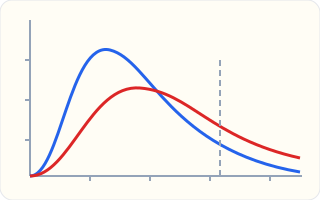
In any sample the particles do not all have the same energy: some are slow, most are middling, a few are very fast. An energy distribution (often called a Maxwell–Boltzmann distribution) is a graph of how many particles have each energy. Its peak is the most common energy and its tail is the thin stretch of rare, high-energy particles. Temperature measures the average kinetic energy of the particles.
The blue curve is a gas at a lower temperature, the red one the same gas after warming. Three things are worth reading off them.
The whole area is the same. The area under each curve counts every particle, and warming adds no particles. So when the warmer curve spreads out to the right, its peak has to come down.
The peak moves right a little. The average energy goes up in proportion to the absolute temperature. From 20 °C (293 K) to 30 °C (303 K) that is only about 3%, and the average speed rises by about half of that.
The tail grows a lot. The activation energy of a typical reaction sits far out in the tail, where very few particles are. Stretching the curve slightly to the right makes that thin tail much fatter: for many reactions near room temperature, the number of particles beyond the activation energy roughly doubles for a 10 °C rise.
So temperature works on both factors of the collision model:
| collisions per second | share with at least $E_a$ | rate | |
|---|---|---|---|
| 10 °C warmer | up a few per cent | roughly doubles | roughly doubles |
The second factor is the one that matters. That is why a modest change in temperature has such a large effect, and why cooking, fridges and freezers work at all.
Another way: picture
A high-jump bar set well above what most of a class can clear. If everyone trains a little and jumps a few centimetres higher, the average barely changes — but the number who clear the bar can double, because the bar was sitting right among the few best jumpers. The bar is the activation energy.
Another way: steps
To explain a temperature change:
For many reactions with activation energies of about 50 kJ/mol, near room temperature, the rate roughly doubles for every 10 °C rise. It is a rule of thumb, not a law: a reaction with a higher activation energy is more sensitive, one with a lower activation energy less so, and far from room temperature the factor changes. Used with that warning it makes useful estimates.
The doublings multiply:
| rise | doublings | rate factor |
|---|---|---|
| 10 °C | 1 | 2 |
| 20 °C | 2 | 4 |
| 30 °C | 3 | 8 |
| 40 °C | 4 | 16 |
A reaction that takes 16 minutes at 20 °C takes about 2 minutes at 50 °C. Cooling works the same way in reverse: 20 °C of cooling makes a reaction about four times slower, which is roughly the difference between milk on a warm kitchen table and milk in a fridge.
A rate is an amount per unit time, so for a fixed amount of product
$$\text{time} \propto \frac{1}{\text{rate}}.$$
If the rate doubles, the time to make the same amount halves. Most everyday uses of temperature are about time rather than rate: cooking food faster in a pressure cooker, where water boils at about 120 °C instead of 100 °C; keeping food longer in a fridge at about 5 °C; slowing the reactions of a donated organ by keeping it on ice. In each case the chemistry is the same, and only the share of collisions with enough energy has changed.
Heating works mainly by making particles collide more often. A 10 °C rise raises the collision frequency by a few per cent and often doubles the rate. The difference is the share of collisions carrying the activation energy.
Heating lowers the activation energy. The activation energy belongs to the reaction's route and does not move. Heating gives more particles enough energy to get over the same barrier.
At a high temperature every collision succeeds. Even a large increase leaves most collisions without enough energy. Doubling a tiny share gives a slightly less tiny share.
Doublings add. Three 10 °C steps give $2 \times 2 \times 2 = 8$ times the rate, not $2 + 2 + 2 = 6$.
A reaction has an initial rate of 0.3 mL/s at 25 °C. Estimate the rate at 55 °C.
Start from the size of the rise.
The rise is 30 °C, three steps of 10 °C, so the rate is multiplied by $2^3 = 8$.
Each step doubles, so the factors multiply.
$0.3 \times 8 = 2.4$ mL/s, about eight times faster.
An estimate, because the doubling is a rule of thumb.
A reaction takes 5 minutes at 40 °C. How long at 20 °C, and why?
A fall in temperature, so expect a slower rate and a longer time.
20 °C of cooling is two halvings of the rate: the rate is a quarter, so the time is $5 \times 4 = 20$ minutes.
A quarter of the rate means four times the time.
At the lower temperature a much smaller share of collisions has the activation energy, so fewer collisions a second succeed.
The explanation names the share that succeed, not just the collision frequency.
The rise is 30 °C, three doublings, so the rate is 8 times faster.
Count the 10 °C steps.
Eight times the rate takes an eighth of the time: $240 \div 8 = \ldots$
…about $30$ s, because far more collisions now carry the activation energy.
A reaction near room temperature has an initial rate of $0.8$ mL/s at $30$ °C. Assume the rate roughly doubles for every 10 °C rise. Estimate the initial rate at $50$ °C, in mL/s.
Answer: mL/s
A reaction takes $224$ s to produce a fixed amount of product at 20 °C. Assume the rate roughly doubles for every 10 °C rise. Fill in the rate compared with the rate at 20 °C, and the time to make the same amount of product, at each temperature.
| rate compared with 20 °C | time for the same amount, in s | |
|---|---|---|
| 20 °C | 1 | 224 |
| 30 °C | ||
| 40 °C | ||
| 50 °C |
The picture shows how the energies of the particles are spread out in a sample of gas at two temperatures. The dashed line marks the activation energy. Mark the part of the picture that shows the particles that have enough energy to react.
This task has no paper form; do it on a device.
Warming a gas from 20 °C to 30 °C makes its molecules move only about $3$ % faster on average, yet the rate of a typical reaction roughly doubles. What explains the doubling?
An energy distribution shows the number of particles with each energy, for one gas at two temperatures. Match each feature to what it means.
| the most common energy | the total number of particles, the same at both temperatures | the particles able to react when they collide | energies spread more widely, with more particles at high energy | |
|---|---|---|---|---|
| the highest point of a curve | ||||
| the whole area under a curve | ||||
| the area beyond the activation energy | ||||
| the warmer curve being lower, broader and further right |
An enzyme-free reaction in a warm solution is heated from $30$ °C to $40$ °C. Using the rule of thumb that the rate roughly doubles for every 10 °C, by what factor does the rate increase?
Answer: times
Souring milk is a set of chemical reactions run by bacteria. On a warm kitchen table at $15$ °C a bottle turns sour in about $6$ hours. Assume the souring rate roughly halves for every 10 °C of cooling. Estimate how long the same bottle keeps in a fridge at 5 °C. Give the time with its unit.
Answer: unit: h / s / min
Lesson test: one question per skill, one attempt each, no hints. Your answers are checked when you submit.
A reaction runs at $20$ °C. A chemist needs it to go $4$ times faster without a catalyst. Using the rule of thumb that the rate roughly doubles for every 10 °C rise, to what temperature should the mixture be heated, in °C?
Answer: °C
You can explain a temperature effect with the energy distribution and estimate its size. Say out loud why a 10 °C rise can double a rate while making the particles only a few per cent faster. Next: surface area, the lever that works only when one reactant is a solid.
10. Your turn: a reaction produces a fixed amount of gas in 240 s at 15 °C. Estimate the time at 45 °C., step 3