Back to the on-screen lesson ·
pH as minus the power of ten in the hydronium concentration: a scale that runs backwards and in which every unit is a factor of ten.
Paper packet. Every task here also exists on screen, where it is checked automatically; answers written on paper are not assessed by Nydus. When you are back at a device, enter your answers there.
By the end of this lesson you will be able to convert between a hydronium ion concentration that is a power of ten and its pH in both directions, compare two solutions by the ratio their pH difference implies, rank solutions by acidity, and work out the dilution that moves a strong acid's pH by a stated amount.
You can find the hydronium ion concentration of a strong acid from its concentration, and of a weak acid from the share that ionises. Those numbers are awkward — $0.1$, $0.000\,01$, $0.000\,000\,000\,001$ mol/L — and you have met powers of ten in mathematics. This lesson turns the awkward number into a short one.
pH is minus the base-ten logarithm of the hydronium ion concentration in mol/L: $\mathrm{pH} = -\log_{10}[\mathrm{H_3O^+}]$. For a concentration that is an exact power of ten, $10^{-n}$ mol/L, the pH is simply $n$. A logarithmic scale is one where each equal step is a multiplication by the same factor rather than an addition. A solution is acidic below pH 7, neutral at 7 and alkaline above 7, at 25 °C. Universal indicator is a mixture of dyes whose colour changes step by step across the whole scale.
Write the hydronium concentration as a power of ten and read off the power:
| $[\mathrm{H_3O^+}]$ in mol/L | as a power of ten | pH |
|---|---|---|
| $0.1$ | $10^{-1}$ | 1 |
| $0.001$ | $10^{-3}$ | 3 |
| $0.000\,000\,1$ | $10^{-7}$ | 7 |
| $0.000\,000\,000\,01$ | $10^{-11}$ | 11 |
That is all the definition $\mathrm{pH} = -\log_{10}[\mathrm{H_3O^+}]$ does for these numbers: the logarithm finds the power, and the minus sign makes it positive.
Two consequences follow, and both surprise people.
The scale runs backwards. A lower pH means more hydronium ions. The minus sign reverses the direction, so the most acidic solutions have the smallest pH numbers.
The scale is not linear. Going from pH 3 to pH 2 multiplies the hydronium concentration by ten, not by a third or by one more share. Two steps is a factor of a hundred; three steps is a thousand. The difference between pH 1 and pH 7 is a factor of a million.
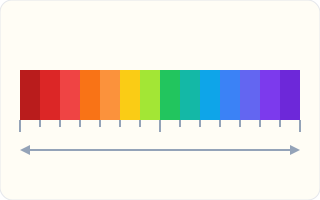
The strip shows universal indicator's colours. Every block is one pH unit and ten times the hydronium concentration of the block to its right, so equal-looking distances on the strip are equal ratios, not equal amounts.
Another way: picture
Think of a building where each floor is ten times as tall as the one above it. Climbing from floor 3 to floor 2 is ten times the height of climbing from 4 to 3. The floor numbers go up evenly; what they measure does not. The pH number is the floor, and the hydronium concentration is the height.
Another way: steps
To go between concentration and pH:
Most of the liquids in a kitchen and a body sit somewhere between 1 and 13:
| Liquid | Typical pH | $[\mathrm{H_3O^+}]$ compared with pure water |
|---|---|---|
| stomach acid | 1 | a million times more |
| lemon juice | 2 | a hundred thousand times more |
| black coffee | 5 | a hundred times more |
| pure water at 25 °C | 7 | — |
| blood | 7.4 | about 2.5 times less |
| seawater | 8.1 | about 12 times less |
| household ammonia | 11 | ten thousand times less |
| oven cleaner | 13 | a million times less |
Blood is held between 7.35 and 7.45; outside that narrow band, which is a factor of only about 1.26 in hydronium concentration, the body's proteins stop working properly. The ocean's average surface pH has fallen from about 8.2 to about 8.1 since industrial times, as it absorbed carbon dioxide — a change that sounds small and is a rise of about a quarter in hydronium ions, enough to make it harder for shellfish and corals to build their shells.
Diluting a strong acid tenfold lowers its hydronium concentration tenfold and raises its pH by one unit. So:
| Dilution | Change in $[\mathrm{H_3O^+}]$ | Change in pH |
|---|---|---|
| $10$ times | $\div 10$ | $+1$ |
| $100$ times | $\div 100$ | $+2$ |
| $1000$ times | $\div 1000$ | $+3$ |
To take $10$ mL of hydrochloric acid from pH 1 to pH 3 needs a hundredfold dilution — to $1000$ mL, not to $30$ mL. The logarithm is why diluting an acid is such a slow way to change its pH.
No amount of dilution takes an acid past pH 7. As the acid's own hydronium ions become very few, the ions from water itself — $10^{-7}$ mol/L of them — take over, so a very dilute acid approaches neutral from the acidic side and never crosses it.
pH 2 is twice as acidic as pH 4. It has a hundred times the hydronium concentration. pH numbers are exponents, so they are subtracted to compare, and the difference is the number of factors of ten.
A higher pH means more acid. It means less. The minus sign in the definition reverses the scale.
Diluting ten times changes the pH by ten. It changes it by one.
Everything below 7 is about equally acidic. pH 6 and pH 1 are a hundred thousand times apart.
pH only goes from 0 to 14. Those are the values of ordinary solutions. Concentrated hydrochloric acid, above 1 mol/L of hydronium, has a slightly negative pH.
Tomato juice is at pH 4 and a solution of baking soda at pH 9.
Five pH units apart.
Ratio of hydronium concentrations: $10^{-4} \div 10^{-9} = 10^{5}$.
One factor of ten for each unit.
The tomato juice has $100\,000$ times the hydronium ion concentration of the baking soda solution.
The one with the lower pH has more.
A drain cleaner has $[\mathrm{H_3O^+}] = 0.000\,000\,000\,000\,1$ mol/L.
Count places after the decimal point up to the 1: thirteen.
That is $10^{-13}$ mol/L.
Thirteen places is the thirteenth power of a tenth.
pH $= 13$: strongly alkaline.
Well above 7.
A thousand is $10^{3}$, which is three pH units.
Count the factors of ten.
More acidic means a lower pH, so the new pH is $6 - 3 = \ldots$
…pH 3, and the hydronium concentration is $10^{-3} = 0.001$ mol/L.
Solution X has a pH of $2$ and solution Y a pH of $5$. How many times greater is the hydronium ion concentration in X than in Y?
Answer:
A solution has a hydronium ion concentration of $0.0000000001$ mol/L. Put the marker at its pH.
0 |——————————| 14
Mark the position with a cross, then write the value:
Complete the table for three solutions at 25 °C. Write concentrations as decimals.
| hydronium concentration in mol/L | pH | acidic, neutral or alkaline | |
|---|---|---|---|
| solution 1 | 0.1 | ||
| solution 2 | 4 | ||
| solution 3 | 11 |
Put these in order from the highest hydronium ion concentration to the lowest. Their typical pH values are given.
Number the steps in order (write the number in the box):
a sports drink has a pH of $2$ and a glass of milk a pH of $5$. Which statement is correct?
$40$ mL of hydrochloric acid has a pH of $1$. It is diluted with water until the pH is $2$. What is the final volume of the solution?
Answer: unit: L / mL
The average pH of the surface ocean has fallen as it absorbs carbon dioxide from the air. Suppose it falls by $0.3$ pH units. Given that $10^{0.3} = 2.00$ to two decimal places, by what percentage has the hydronium ion concentration risen?
Answer: %
Lesson test: one question per skill, one attempt each, no hints. Your answers are checked when you submit.
A solution has a pH of $5$. Its hydronium ion concentration rises by a factor of $10$. What is its new pH?
Answer:
You can read pH as an exponent and you know one unit is a factor of ten. Say out loud why a pH 3 solution is a thousand times more acidic than a pH 6 one, not twice. Next: pH for concentrations that are not exact powers of ten, pOH, and the ion product of water.
10. Your turn: a solution at pH 6 is made a thousand times more acidic. What is its new pH, and its new hydronium concentration?, step 3