Back to the on-screen lesson ·
Relate dated financial claims to discount rates, market prices, and risk assumptions.
Paper packet. Every task here also exists on screen, where it is checked automatically; answers written on paper are not assessed by Nydus. When you are back at a device, enter your answers there.
Construct present-value tables and price-yield comparisons, distinguish coupon, face value, and return, and identify why maturity, default risk, liquidity, and inflation limit simple asset comparisons.
Buying an existing bond transfers a financial claim rather than directly adding a newly produced machine to investment in the national accounts. The bond can still affect financing and spending through its price and yield. We use fictional contracts with explicit dates and payoffs, not current market quotations or investment recommendations.
| Term | What it means |
|---|---|
| Bond | A debt claim specifying promised payments under contractual terms. |
| Face value | The principal amount specified for repayment by the contract. |
| Coupon | A contractual interest payment, distinct from the bond's current market price. |
| Yield | A return measure relating dated payments to the price paid under stated assumptions. |
| Present value | The current value of a future payment discounted at a specified rate. |
| Liquidity and default risk | The ease of trading a claim and the possibility that promised payments are not made in full. |
A fictional one-year bond promises a single payment of 120 dollars at the end of the year. Assume the payment is certain, there are no fees or taxes, and comparable claims have the same relevant risk and liquidity. If its current price is one hundred dollars, the one-year nominal yield is (120 - 100)/100, or twenty percent. The numerator is the gain, while the denominator is the amount paid today.
If the required yield rises to 25 percent while the promised payment remains 120 dollars, the price consistent with that return is 120/1.25, or 96 dollars. Paying 96 and receiving 120 produces a 24-dollar gain, which is 25 percent of 96. The higher yield corresponds to a lower current price. This inverse relationship holds the dated payment and relevant risk conditions fixed.
It is not a claim that every financial asset's price must fall whenever any quoted interest rate rises. Expected payments, default probabilities, maturity, liquidity, and other terms can change too. A comparison needs to isolate the rate relevant to discounting the specified cash flows. The simple bond formula is exact within its contract assumptions and a starting point for analyzing those additional influences.
Another way: steps
List every promised payment and its date. Identify the current price and the relevant discount rate. For one payment one period ahead, divide the payment by one plus the rate. For several dates, discount each payment separately before adding.
A bond's face value is a contractual principal amount, not necessarily its current market price. A bond can trade above or below face value depending on its payments and the required return. Calling every price below face value a loss confuses the issuer's promised repayment with what a new buyer pays. A buyer's return depends on that purchase price and the payments actually received.
The coupon is a specified payment. A ten-dollar annual coupon on a face value of one hundred dollars gives a ten-percent coupon rate. If the bond trades at 125 dollars, the annual coupon divided by price is eight percent, often called current yield. That current-yield calculation ignores any difference between purchase price and principal repaid at maturity. It is therefore not generally the same as the full yield to maturity.
For a one-year bond paying a ten-dollar coupon and one hundred dollars of principal together at maturity, the total payoff is 110 dollars. If its current price is one hundred, the full one-year return is ten percent. If the price changes, the coupon amount remains ten under the fixed contract, but the return to a new buyer changes. Do not alter the promised coupon merely because the market price moved.
An existing holder also needs to distinguish a market-price change from a realized holding-period return. If the holder sells before maturity, the sale price becomes part of the actual cash-flow calculation. If the holder keeps a certain fixed-payment bond until maturity, interim market-price movements affect the opportunity value of the asset but do not rewrite its contractual payment. This does not make all long-term holding risk-free: default, inflation, liquidity needs, and alternative opportunities can still matter.
The one-period formula compares like periods. An annual yield cannot be inserted unchanged into a monthly discount calculation without a declared conversion convention. Likewise, a bond with payments at several dates needs each date represented. Our exercises state one-year periods and simple dated payments so that the mathematical task is unambiguous rather than hiding a timing assumption inside the word interest.
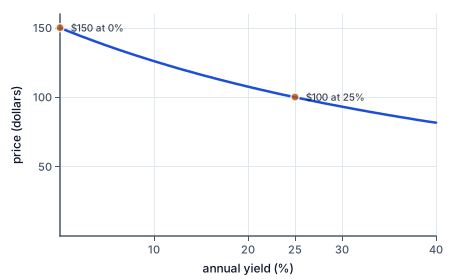
The figure plots this bond's price at every yield: 100 dollars at 25 percent, and higher at every lower yield.
For a certain payment F received one year ahead, present price is F/(1+i), where i is the relevant annual nominal discount rate expressed as a decimal. For a payment two years ahead at the same annual rate, price is F/(1+i) squared. The second year requires another period of discounting. Dividing by one plus twice the rate would ignore compounding and generally give a different answer.
Suppose a fictional two-year bond pays 25 dollars after one year and 125 dollars after two years, including its final principal. At a constant annual discount rate of 25 percent, the first payment's present value is 25/1.25 = twenty dollars. The second is 125/1.5625 = eighty dollars. Total price is one hundred dollars. Each payment is discounted according to its own waiting time before the values are added.
This calculation assumes the same discount rate for both dates. A richer model can use different rates for different maturities, reflecting the term structure. The basic procedure remains to match each cash flow with an appropriate discount factor. A single quoted short-term policy rate is not automatically the discount rate for every risky payment at every future date.
Payment timing affects price sensitivity. Compare two certain zero-coupon claims, each paying one hundred dollars, one after one year and one after two. At a zero discount rate both are priced at one hundred. At an annual rate of 25 percent, the one-year price is eighty and the two-year price is 64. The more distant payment undergoes an additional round of discounting and experiences the larger proportional price decline in this controlled comparison.
This example illustrates interest-rate exposure without making a general ranking of which asset a person should buy. Different payment schedules, coupons, default risks, and holding periods affect that decision. The lesson's purpose is to identify the mathematical source of price sensitivity and preserve the cash-flow assumptions. A longer maturity does not mean a larger guaranteed loss in every circumstance; it means the dated-payment structure responds differently to a specified rate change.
A promised payment is not always an expected payment. A risky issuer may fail to pay in full or on time. Comparing a risky bond's promised yield with a certain bond's yield without acknowledging default risk can make the risky instrument look mechanically superior. The higher promised return may compensate for possible losses, illiquidity, or other disadvantages. Calculating a promised yield does not estimate those risks by itself.
Liquidity refers to how readily an asset can be exchanged on acceptable terms. A claim that can be sold quickly with little price impact can differ from an otherwise similar claim that is costly to trade. Investors may require compensation for the less liquid claim. A money-like asset can therefore be attractive despite a lower financial return because it provides payment or liquidity services. The relevant comparison is broader than one coupon percentage.
Different financial assets represent different claims. A bond specifies debt payments subject to its terms and credit risk. An equity share is an ownership claim on residual earnings and assets rather than a promise to repay one fixed principal at a known date. A bank deposit is a liability of a bank and may provide transaction services. These distinctions explain why assets are imperfect substitutes rather than identical containers for a universal interest rate.
When the return on a safe short-term alternative changes, holders may reconsider portfolios, affecting prices and financing conditions in other markets. The size and direction of each response depend on expected returns, risk, liquidity, and constraints. This helps connect monetary policy to borrowing conditions without asserting that the central bank directly fixes every corporate bond yield or loan rate.
Nominal and real returns remain distinct. The present-value formula here uses nominal dollar payments and a nominal discount rate. If inflation differs from expectations, the realized purchasing power of fixed nominal payments changes. Mixing a real discount rate with unadjusted nominal cash flows would compare inconsistent units unless the model explicitly provides the appropriate transformation.
Finally, an observed price movement does not identify one cause automatically. A bond price can fall because the relevant discount rate rose, expected payments deteriorated, liquidity became more valuable, or several factors changed together. To attribute the movement to rates alone, hold the other terms fixed or provide evidence addressing them. The classroom inverse-price-yield relationship is a controlled comparison, not a complete explanation of every market observation.
A fictional bond promises a certain payment of 120 dollars exactly one year from today, with no separate coupon before maturity. Yesterday it traded at one hundred dollars under a twenty-percent one-year required yield. Today the relevant required yield is 25 percent, while the promised payment, credit assumptions, fees, and payment date remain unchanged. A report says the bond must now pay 125 dollars because its yield rose.
The contract still pays 120 dollars. The current price adjusts to 120/1.25 = 96 dollars. A new buyer's 24-dollar gain is 25 percent of the 96-dollar price. The report changed the cash flow instead of changing the market price and therefore described a different bond. Holding the promised payment fixed is exactly what makes the inverse price-yield comparison meaningful.
An existing holder who bought at one hundred and sells now for 96 realizes a four-dollar price loss before considering any other cash flows. A holder who keeps the certain claim until maturity still receives the contractual 120 dollars. These are different holding-period calculations. Neither observation removes the need to consider inflation or alternative uses of funds when evaluating purchasing power and opportunity cost.
The corrected report should state the fixed payoff, the new required yield, and the implied price. It should also retain the certainty and no-fee assumptions. If the issuer's repayment prospects changed at the same time, the simple price calculation would no longer isolate a pure discount-rate effect. The exercise is a model comparison, not a recommendation to buy, sell, or hold an actual security.
A market yield change does not rewrite a fixed coupon. Face value is not necessarily market price. Current yield ignores some capital gains or losses before maturity. A promised risky return is not a guaranteed realized return. Use nominal rates with nominal cash flows and match the discount period to the payment date.
Record the current purchase price.
One hundred dollars paid today.
The return denominator is the amount invested now.
Record the complete future payment.
120 dollars received after one year.
The scenario has no separate interim coupon or fee.
Calculate the nominal gain.
120-100=20 dollars.
Principal returned is not itself the gain.
Divide the gain by the price.
20/100=20%.
This is the full one-year nominal yield under the certainty assumption.
Check by reconstructing the payoff.
100×1.20=120 dollars.
The gross-return factor must reproduce the stated future cash flow.
Keep the contractual payoff fixed.
One-year payment remains 120 dollars.
A market-rate change does not alter this fixed contract.
Convert the new yield to a gross factor.
1+0.25=1.25.
Discounting includes both principal and return.
Divide the payoff by the factor.
120/1.25=96 dollars.
This price gives the required return for the unchanged payment.
Verify the new buyer's gain.
120-96=24; 24/96=25%.
The lower price creates the higher yield.
State the held-fixed conditions.
Same date, promised payment, credit assumption, and fees.
Without these controls the price change could reflect other influences.
List the contract's cash flows.
Twenty-five dollars after year one; 125 after year two.
The final amount includes the principal payment.
Record the stipulated annual discount rate.
Twenty-five percent for both years.
The model uses one constant rate rather than a maturity-specific curve.
Discount the first payment once.
25/1.25=20 dollars.
The payment is one year away.
Construct the two-year discount factor.
1.25 squared = 1.5625.
The second payment waits through two compounding periods.
Discount the second payment and sum.
125/1.5625=80; total price 20+80=100 dollars.
Present values can be added after their different dates are accounted for.
Explain why a shortcut would fail.
Do not discount the full 150 dollars only once.
Combining the payments before accounting for timing would treat a later dollar as arriving earlier.
State the controlled comparison.
Two claims each pay one hundred dollars, one in a year and one in two years.
Only the payment date differs; default and fees are excluded.
Discount the nearer payment at twenty-five percent.
100/1.25=80 dollars.
The payment is discounted for one period.
Discount the more distant payment.
A fictional certain one-year claim pays 150 dollars at maturity. There are no fees or other payments. Compute its price at required nominal yields of zero, twenty, and fifty percent.
| Price dollars | |
|---|---|
| Yield 0% | |
| Yield 20% | |
| Yield 50% |
A fictional one-year claim promises 180 dollars. A buyer pays 144 dollars today. There are no other payments or fees and repayment is certain. Complete its gain and nominal return.
Subtract purchase price from maturity payment.
Nominal gain=gain dollars.
The full future payment includes the amount originally paid.
Divide the gain by the purchase price.
Nominal yield=yield percent.
The return denominator is the actual price paid today.
Express the payoff-to-price comparison as a factor.
Gross return factor=factor.
The factor includes the principal as well as the gain.
Plot price horizontally and required annual yield percent vertically for a fictional certain one-year payment of 120 dollars. Use exactly these required yields: zero, twenty, and twenty-five percent. No fees or other cash flows occur.
Plot your answer on the grid:
A fictional certain bond pays 25 dollars after one year and 125 dollars after two years. Use a constant annual nominal discount rate of 25%, with no fees or taxes. Compute the present value of each payment and the total price.
| Dollars | |
|---|---|
| Year-one payment present value | |
| Year-two payment present value | |
| Total price |
Construct the fixed-payoff bond argument. The scenario holds payment date, credit risk, and all contractual cash flows unchanged while the required yield rises.
This task has no paper form; do it on a device.
A fictional firm holds two certain receivables, each promising one hundred dollars: one arrives after one year, the other after two. Under a common annual nominal discount rate of 25%, compute their present values and the combined value. No early payments, fees, or default occur.
| Dollars | |
|---|---|
| One-year receivable | |
| Two-year receivable | |
| Combined present value |
Lesson test: one question per skill, one attempt each, no hints. Your answers are checked when you submit.
A fictional fixed one-year bond promises a total payment of 150 dollars. Its required yield changes from twenty percent to fifty percent while the payment, risk, date, and fees remain unchanged. Compute the original price, new price, and dollar price change for a holder selling at the new price after buying at the original price, with no intervening cash flow.
| Dollars | |
|---|---|
| Original price | |
| New price | |
| Price change |
You can price a specified payment stream and explain the inverse price-yield relationship without changing the contract. Next, distinguish the markets for money balances and loanable funds.
13. Two dates for the same certain payoff, step 3
100/1.25 squared=64 dollars.
The extra waiting period produces another discount factor.