Convert currencies and solve conditional currency-market models with explicit quote directions.
Paper packet. Every task here also exists on screen, where it is checked automatically; answers written on paper are not assessed by Nydus. When you are back at a device, enter your answers there.
1. What you will learn
Calculate reciprocal quotations, currency-price changes and market-clearing rates while distinguishing price conversion from predictions about trade quantities.
2. Use common units and conditional schedules
Market clearing equates desired purchases and offers at one price. Currency conversion adds a crucial requirement: label which currency is being priced and which currency expresses its price.
3. Currency-market language
Term
What it means
Exchange rate
The price of one currency in units of another, with direction stated.
Appreciation
An increase in a currency's value relative to another currency.
Depreciation
A decrease in that relative currency value.
Reciprocal quote
The reverse currency quotation, equal to one divided by the original frictionless rate.
Pass-through
The extent to which an exchange-rate change is reflected in a specified transaction price.
Floating rate
An exchange-rate arrangement in which the rate can adjust to market conditions.
4. Read the currency units before calculating
An exchange rate is a price of one currency in another. Its direction must be stated. In this lesson e means foreign currency units per one home currency unit. If e equals four, one home unit exchanges for four foreign units under the supplied frictionless quote. The reciprocal quote is one quarter of a home unit per foreign unit. These describe the same conversion in opposite directions.
To convert a home amount into foreign currency, multiply by e. Ten home units at four foreign per home become forty foreign units. To convert a foreign amount into home currency, divide by e. Forty foreign units at the same rate become ten home units. The units explain the operation: a foreign amount divided by foreign per home leaves home units.
Real conversion can include fees and different buying and selling quotes. A case with those features must specify them. The introductory exercises state a single rate and no fees so that reciprocal conversion is exact. We should not infer that every actual customer can exchange both ways at an identical rate without cost.
A numerical rise in a quoted rate is not enough to identify appreciation until the quote direction is known. Under e as foreign per home, a rise means one home unit buys more foreign currency. Under the reciprocal home-per-foreign quote, the same home appreciation appears as a fall. Write the units beside the symbol every time rather than relying on an arrow divorced from its definition.
Another way: Appreciation changes relative currency values
A home currency appreciates against a foreign currency when one home unit buys more of the foreign currency. If e rises from four to five foreign units per home, the home currency appreciates. Its percentage appreciation in this quote is the increase of one divided by the initial four, or twenty-five percent. The foreign currency depreciates against home at the same time.
The reciprocal percentage is different. One foreign unit initially buys one quarter of a home unit and later one fifth. The decline of one twentieth divided by the original quarter is twenty percent. Twenty-five percent appreciation in one direction and twenty percent depreciation in the reciprocal direction are consistent because the starting denominators differ.
Distinguish a change against one currency from a broad exchange-rate index. A currency can rise against one partner and fall against another during the same interval. A trade-weighted index combines several rates using a defined method and weights. It is not interchangeable with a single bilateral quote. The exercises here specify one pair of fictional currencies.
The words strong and weak can suggest a general judgment that the arithmetic does not support. Appreciation changes the terms faced by different participants, including importers, exporters and holders of foreign-currency claims or obligations. Whether a particular person gains depends on those positions and on other responses. A higher currency price is not a complete measure of an economy's performance or everyone's welfare.
Another way: Convert product prices under stated invoicing assumptions
Suppose an imported item has a fixed foreign-currency price of one hundred. With e equal to four foreign per home, its converted home price is twenty-five. If e rises to five and the foreign price stays fixed, the converted home price falls to twenty. This is a price-conversion result under fixed invoicing and no fees, taxes or markup changes.
For a home-produced export priced at thirty home units, the foreign buyer's converted price is thirty times e. At e equal to four it is one hundred twenty foreign units; at five it is one hundred fifty. Holding the home invoice price fixed, appreciation makes this export more expensive in foreign currency. The two calculations use different starting currencies and therefore different operations.
Actual pass-through can be incomplete. A seller might change its invoice price or markup, contracts may be fixed for a period, and inputs may be priced in several currencies. The simple calculation isolates what conversion alone does. It does not prove that every retail price changes immediately or in exactly the same proportion as the exchange rate.
Quantity responses require demand and supply information. A lower converted import price can encourage more purchases under ordinary demand assumptions, but the number of additional units is not given by the exchange rate alone. The trade balance also depends on prices, quantities, timing and other conditions. Do not leap from a conversion result to an exact prediction of net exports without the additional schedules.
Another way: A currency market has a specified currency on its axes
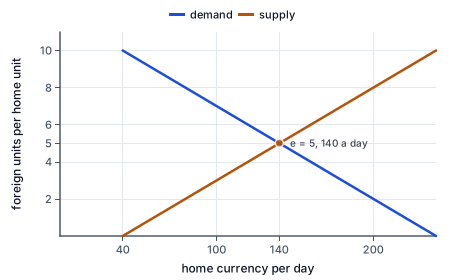
Foreign units per home unit against home currency traded per day. Demand Q = 240 − 20e falls and supply Q = 40 + 20e rises; they meet at an exchange rate of 5 foreign units per home unit and 140 home units a day. A rise in demand for home assets would shift demand right and appreciate the home currency.
The figure draws this market for the home currency, with the exchange rate in foreign units per home unit up the side.
A diagram for the home currency places its quantity horizontally and its price in foreign currency vertically. That vertical price is e, foreign units per home unit. Demand describes desired purchases of home currency at each e; supply describes home currency offered in exchange for foreign currency. The chart must not switch halfway to a market for the foreign currency.
Transactions can arise from goods, services, income payments and financial assets. A foreign purchaser who needs home currency for a home-issued asset can create demand for home currency in the simplified transaction. A home resident acquiring foreign currency for a foreign purchase can supply home currency. The exact settlement arrangement may be more complex in practice, so exercises state the conversion mechanism.
Consider demand Qd equals two hundred forty minus twenty e and supply Qs equals forty plus twenty e, measured in home units per day. Setting them equal gives two hundred equals forty e, so e is five and quantity is one hundred forty. Substitution in both schedules verifies the equality. The result is an exchange rate and a flow of currency trades, not a quantity of final goods.
A shift in demand for home currency can raise e along unchanged supply under these slopes. A rise in supply can lower it along unchanged demand. The curve that shifts depends on the initiating transaction and what is held fixed. A description of a portfolio change needs its currency conversion and expectations assumptions before it yields a definite market prediction.
Another way: Separate a floating-rate model from a maintained rate
In a floating-rate model, the exchange rate can adjust as currency demand and supply change. A maintained-rate arrangement instead involves a stated commitment and a mechanism for supporting the quoted rate. The two settings can produce different adjustment paths. A problem must identify the regime before asking what changes after a shift.
If a supplied maintained rate creates excess demand for home currency, an authority might sell home currency and acquire foreign assets to meet the gap under the model. If it creates excess supply of home currency, the authority might purchase home currency using foreign reserves. These are opposite transactions. Their effects on domestic liquidity and any offsetting operation need a separate balance-sheet account.
Resources and credibility can constrain a commitment. A model should not assume an unlimited ability to sell a finite foreign asset stock or to maintain every announced rate regardless of conditions. Expectations about future rates can also affect current demand for assets and currencies. These issues explain why a maintained rate is an institutional arrangement rather than simply a horizontal line that guarantees itself.
This lesson assesses the floating-market schedules and conversions it explicitly supplies. It introduces the regime distinction so later policy comparisons do not silently mix assumptions. No exercise asks the learner to forecast a real currency or choose a trading strategy. A computed rate is the solution of a fictional model, with the model's boundaries included in the explanation.
Another way: Nominal conversion differs from real competitiveness
A nominal exchange rate compares currencies. A real exchange-rate measure also includes price levels or product prices. Under our quote, a simple relative-price measure is e times the home price level divided by the foreign price level. It compares a home basket's converted price with a foreign basket's price, provided the baskets and index conventions make that comparison meaningful.
If e rises while home and foreign prices stay fixed, this measure rises: home goods become relatively more expensive in the comparison. But if foreign prices rise enough at the same time, the relative-price result can differ. A nominal appreciation alone does not settle a real comparison when other prices are changing.
Productivity, quality, delivery reliability and trade costs also matter for competitiveness. A single exchange-rate movement does not summarize every reason buyers choose one supplier over another. Nor does a broad index reveal the exact position of each firm, whose inputs, invoices and customers can differ. Use the measure appropriate to the question rather than treating all currency-related numbers as substitutes.
The final audit is dimensional and economic. Check quote direction, conversion operation, percentage-change denominator, axis labels and the assumptions about invoice prices. Then state the bounded result. 'At five foreign units per home, the fixed one-hundred-foreign-unit invoice converts to twenty home units before fees' is precise. Any claim about profits, quantities, fairness or future rates requires more information.
5. A fictional equipment invoice
A training center in the home economy orders equipment invoiced at one hundred twenty foreign units. The quote initially gives four foreign units per home unit. With no fees, its converted invoice is thirty home units. Before payment the quote rises to six, while the foreign invoice remains fixed. The converted payment becomes twenty home units, ten fewer than before.
The home currency appreciated in this quote. Its direct percentage increase is fifty percent, because the rate rose by two from an initial four. The reciprocal quote falls from one quarter to one sixth home per foreign. The reciprocal percentage decline is one third, not fifty percent. These different percentages describe the same rate change using different starting denominators.
A local equipment producer quotes a separate product at fifteen home units throughout the interval. A foreign purchaser would initially face sixty foreign units and later ninety, assuming full conversion and no other changes. The home appreciation lowers the home cost of the foreign invoice while raising the foreign cost of this home invoice. It does not help every participant in the same way.
The center still needs to check whether shipping, fees and taxes are included in a real quotation. Those costs are absent from this exercise, so adding guessed amounts would change the problem rather than improve the calculation. Likewise, the example does not predict how many products anyone buys or what the exchange rate does next. It demonstrates how explicit currency units and fixed-invoice assumptions support a precise, limited comparison.
6. The quote's direction controls the interpretation
A rising foreign-per-home quote means home appreciation; the reciprocal quote falls. Equal exchange-rate events need not have equal-magnitude reciprocal percentage changes, and conversion alone does not establish a quantity or welfare forecast.
7. Convert a foreign invoice
Read the quote direction.
e=4 foreign per home
Currency units determine the operation.
Read the fixed invoice.
100 foreign units
The starting amount is foreign currency.
Divide by the quoted rate.
100/4=25 home units
Foreign units cancel against foreign per home.
Check the reverse conversion.
25*4=100 foreign
This recovers the invoice under the same frictionless quote.
State the assumed costs.
No fees or markup changes
The calculation is a conversion, not a complete retail forecast.
The reciprocal describes the same exchange in reverse.
Compute foreign depreciation.
(0.20-0.25)/0.25=-20 percent
The reciprocal percentage uses a different initial base.
Reconcile the interpretation.
Home appreciates25%; foreign depreciates20%
Reciprocal rates need not have equal-magnitude percentage changes.
10. Complete the conversion check
Read a foreign invoice and quote.
90 foreign; e=3 foreign per home
The amount and quote must use compatible currency units.
Convert into home currency.
90/3=30 home
Division cancels the foreign unit.
Your turn: work this step out. Its working is at the end of the packet.
Check by reversing the exchange.
11. Guided practice
Use e=4 foreign units per home unit with no fees. Convert a 72-foreign-unit invoice into home currency and a 15-home-unit invoice into foreign currency.
Amount
Foreign invoice in home units
Home invoice in foreign units
12. Guided practice
A fictional foreign invoice is ninety-six units and the quote is four foreign units per home unit. Fill its home cost and the foreign amount recovered by reversing the conversion.
Divide by the stated currency quote.
Home cost=home
The invoice starts in foreign units.
Reverse the conversion.
Recovered foreign amount=foreign
Multiplication by the same no-fee rate reverses the exchange.
Check the original invoice.
Recovered amount equals the supplied invoice
Matching units confirm the operation.
13. Guided practice
For home-currency demand Q=120-20e, plot the rows at e=1,2,3. Home currency units per day are horizontal and foreign units per home unit are vertical.
Plot your answer on the grid:
14. Practice
The quote rises from2 to2.5 foreign units per home unit. Compute the home currency's percentage change in this quote and the foreign currency's percentage change in the reciprocal quote.
Signed percent
Home
Foreign
15. Practice
Construct only the stated links: foreign buyers demand more home currency; with home-currency supply fixed, e (foreign per home) rises; with a foreign invoice fixed, its home-currency cost falls. No quantity or welfare effect is supplied.
This task has no paper form; do it on a device.
16. Somewhere new
A fictional training center owes144 foreign units. The no-fee quote changes from4 to6 foreign per home before payment, with the invoice unchanged. Compute initial and final home costs and the signed change.
Home units
Initial
Final
Change
17. Lesson test
Lesson test: one question per skill, one attempt each, no hints. Your answers are checked when you submit.
18. Test question
In a fictional floating market for home currency, Qd=180-10e and Qs=20+10e, with e in fictional foreign crowns per home dollar and Q in home dollars per day. Find equilibrium e and Q, then convert an invoice fixed at120 foreign crowns into home dollars at that rate with no fees.
Value
Foreign per home
Home units per day
Invoice home cost
19. What you can do now
You can label a currency quote, solve its market and bound the invoice-price implication. Next, record international transactions without confusing flows and stocks.