Back to the on-screen lesson ·
Construct production and trade comparisons under explicit resource and technology assumptions.
Paper packet. Every task here also exists on screen, where it is checked automatically; answers written on paper are not assessed by Nydus. When you are back at a device, enter your answers there.
Compute opportunity costs, plot declared frontier combinations, compare comparative advantage, and verify consumption after a specified trade without inferring an unsupported welfare judgment.
You already distinguish a voluntary exchange from a claim that every person benefits from a policy. Here the starting object is a production constraint for an entire fictional economy. Keep physical output separate from expenditure in dollars, and distinguish what can be produced from what might be consumed after trade.
| Term | What it means |
|---|---|
| Production possibility frontier | Efficient combinations of two outputs available with stated resources and technology. |
| Opportunity cost | The next-best alternative forgone by a choice. |
| Comparative advantage | A lower opportunity cost for producing a particular good. |
| Absolute advantage | Greater output from the same specified resources. |
| Terms of trade | The rate at which two goods exchange, with its units explicitly stated. |
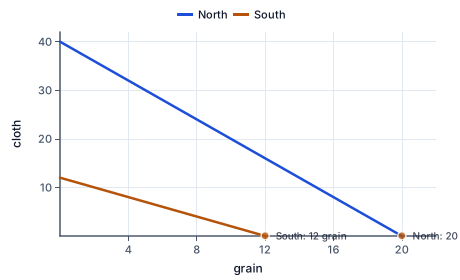
Suppose fictional North can produce at most twenty units of grain or forty units of cloth during one month. Its fixed labor force can be divided between the two industries, technology does not change, and every worker faces the same conversion rate between activities. Under these deliberately strong assumptions, the efficient combinations lie on a straight line: cloth equals forty minus twice grain. Grain is on the horizontal axis and cloth on the vertical axis.
Producing another grain unit reduces maximum cloth by two units. The opportunity cost of one grain unit is therefore two cloth units along this frontier. Conversely, one cloth unit costs half a grain unit. State both the item gained and the item forgone; a slope without units invites reciprocal errors. The frontier's downward slope expresses scarcity, while its straightness expresses constant opportunity cost, an additional assumption that scarcity alone does not imply.
A combination inside the boundary is feasible but productively inefficient under the model: more of at least one good can be produced without reducing the other. A combination on the boundary uses the available productive opportunities efficiently. A point beyond it cannot be produced with the current resources and technology. None of those descriptions decides which combination people ought to prefer. An efficient allocation can still conflict with a community's distributional or environmental priorities, which this two-output diagram has not measured.
Another way: steps
Name the two outputs and time period. Find the outputs forgone and gained between two frontier points. Divide forgone by gained with units attached. Compare the same opportunity-cost ratio across producers before proposing a trade rate.
The point (5, 30) lies on North's frontier because thirty equals forty minus twice five. Moving to (10, 20) raises grain by five and lowers cloth by ten. That movement reallocates the same productive capacity; it does not expand the economy's feasible production set. A headline saying production rose is incomplete because one output rose while another fell. An aggregate measure needs an explicit method for combining unlike goods, which later lessons will supply.
The point (5, 20) lies inside the original frontier. With grain held at five, the model permits up to thirty cloth units. Moving from (5, 20) to (5, 30) can represent recovery from idle capacity rather than new technology. It requires explaining why resources were previously underused; the frontier itself does not identify unemployment, broken equipment, or coordination failure as the cause. Inside is a location, not a complete causal diagnosis.
A new machine that increases cloth productivity may rotate the frontier outward toward the cloth axis rather than shift both intercepts equally. If it raises maximum cloth to sixty while maximum grain stays twenty, the new straight-line equation is cloth equals sixty minus three times grain. This model permits more cloth at any unchanged positive grain quantity below twenty. The grain intercept is unchanged because the stipulated innovation does not help grain production.
Real production frontiers often have increasing opportunity costs. Workers and machines may be differently suited to different activities. As grain expands, it draws resources away from increasingly valuable cloth uses. A bowed-out frontier represents this changing marginal tradeoff. Do not read a single constant slope from such a curve or apply the endpoint ratio to every local movement. Use the particular segment's change when the question asks for the cost of an additional output increment.
The model's domain also matters. We assume the outputs are defined consistently and productive inputs are fixed for the stated month. A longer horizon may allow investment, training, migration, or resource discovery to change capacity. Calling a point unattainable means unattainable within this model and horizon, not impossible forever. Likewise, trade can permit consumption beyond a domestic production frontier without moving domestic technology at all.
The figure draws both frontiers. North's is higher everywhere, but South's is flatter: each grain costs South less cloth.
Now suppose fictional South can produce at most twelve grain units or twelve cloth units using its own fixed monthly resources. With constant opportunity cost, one grain costs one cloth in South, and one cloth costs one grain. North gives up two cloth per grain, so South has comparative advantage in grain. North gives up only half a grain per cloth, so North has comparative advantage in cloth.
North has larger maximum outputs of both goods in this example. It can have absolute advantage in both and still benefit from obtaining one good through exchange. Absolute productivity and relative sacrifice answer different questions. To identify comparative advantage, do not simply circle the larger output. Calculate what that output requires giving up and compare the same unit of sacrifice in both places.
The reciprocal relationship between the two opportunity costs also provides a check. If North's grain cost is two cloth, its cloth cost must be half a grain under a straight two-good frontier. Writing two in both directions would imply that one grain exchanged through two production conversions returns four grain, an inconsistency in the stated technology. Reciprocal ratios restore the same physical tradeoff described from opposite directions.
Specialization according to comparative advantage can expand total output possibilities relative to an allocation that assigns production to higher-cost producers. This does not establish that complete specialization is always optimal in a richer world. Increasing opportunity costs, transport costs, adjustment costs, uncertainty, product differences, and preferences can change the extent of specialization. Our complete-specialization illustration follows from the particular constant-cost setup, not from a universal rule that each economy should make only one product.
Gains for an economy considered as a whole do not prove that every worker or household gains. Industry changes may shift incomes and employment even when a consumption combination exists that could make both trading groups better off. Whether gains are distributed or compensation occurs is a further question. The arithmetic of feasible gains should not be turned into an unsupported policy judgment about any real agreement.
Quote the proposed terms as cloth units per grain unit. South can produce grain at a cost of one cloth. It benefits from exporting grain for more than one cloth per grain, assuming the exchanged cloth is equally useful and there are no additional costs. North would otherwise sacrifice two cloth to produce one grain, so it benefits from importing grain for fewer than two cloth. Strict gains in this simple comparison therefore require a rate greater than one and less than two.
At exactly one cloth per grain, South is indifferent between the trade and its own production conversion. North can gain, but both do not strictly gain. At exactly two, North is indifferent. This is why the strict interval has open endpoints. An item asking for weakly beneficial terms, allowing indifference, would include the endpoints. Read the stated criterion rather than automatically excluding or including equality.
Take a rate of one and a half cloth per grain. If South exports eight grain units, it receives twelve cloth units. The same eight grain would have cost North sixteen cloth to produce domestically. Paying twelve instead saves four cloth-equivalent units under its constant-cost technology. South gives up eight cloth-equivalent units to make those grain exports and receives twelve cloth, so its corresponding gain is four cloth units. The comparison uses the same trade and clearly stated domestic alternatives.
This calculation does not by itself specify a complete consumption allocation. Check whether the proposed export quantity is feasible, whether each economy retains or acquires goods it wants, and whether the trade balances physically. Every exported grain unit must become an imported grain unit somewhere in the two-economy example. The same is true for cloth. A diagram showing both parties receiving goods without giving anything up violates the resource accounting.
Transport costs can narrow or eliminate the beneficial interval. If delivering one grain requires an additional half cloth worth of resources borne by South, its minimum compensating receipt rises to one and a half cloth. North's upper boundary remains two if its alternatives are unchanged. The gains interval is now narrower. This is a model comparison: adding a specified cost changes the constraint, rather than proving that transport always prevents trade.
North and South operate the fictional technologies above for one month. North can produce twenty grain or forty cloth; South can produce twelve grain or twelve cloth. Suppose North initially makes ten grain and twenty cloth, while South makes six grain and six cloth. Both initial points lie on their respective straight frontiers. Combined production is sixteen grain and twenty-six cloth, but that total alone does not identify the best allocation for either community.
Consider the stated proposal: North makes forty cloth, South makes twelve grain, and South sends eight grain to North in exchange for twelve cloth. After trade, North consumes eight grain and twenty-eight cloth. South consumes four grain and twelve cloth. World consumption equals world production: twelve grain and forty cloth. The trade has not manufactured goods during transport; it has changed their ownership.
These bundles are beyond each economy's own production frontier. North could produce only twenty-four cloth if it produced eight grain itself, so twenty-eight cloth with eight grain exceeds that domestic boundary. South could produce only eight cloth with four grain, so its twelve-cloth bundle also exceeds its domestic boundary. This demonstrates feasible gains relative to producing each final bundle domestically.
It does not prove that both prefer the final bundles to the particular initial bundles. Both receive more cloth but less grain than before, and their preferences were not given. A careful report distinguishes expanded feasible consumption opportunities from a demonstrated improvement over every initial allocation. To establish that both weakly retain all initial goods, propose and verify different quantities or supply an explicit preference assumption.
Scarcity does not by itself imply a straight frontier. Absolute advantage does not determine comparative advantage. A consumption point outside a domestic production frontier can be feasible through trade. Strict mutual gains exclude indifference endpoints. Expanded opportunities do not establish that every household benefits or that a particular final bundle is preferred to every starting bundle.
Fix the production period and outputs.
North's monthly grain and cloth frontier.
The two points must describe the same resources and horizon.
Identify the starting combination.
Five grain and thirty cloth.
The starting bundle lies on cloth = 40 - 2 grain.
Identify the ending combination.
Ten grain and twenty cloth.
This is another efficient combination under unchanged technology.
Calculate the gained and forgone quantities.
Five grain gained; ten cloth forgone.
The tradeoff concerns the change rather than either output level alone.
Divide with units attached.
10/5 = 2 cloth per grain.
This is the next-best production alternative sacrificed per added grain unit.
Write North's production endpoints.
Twenty grain or forty cloth.
The constant-cost assumption makes the endpoint ratio applicable throughout.
Compute North's grain cost.
40/20 = 2 cloth per grain.
Cloth is the output forgone to obtain grain.
Write South's production endpoints.
Twelve grain or twelve cloth.
These refer to South's own fixed productive resources.
Compute South's grain cost.
12/12 = 1 cloth per grain.
The comparison now uses identical units in both places.
Identify comparative advantage and its limit.
South has lower grain cost; North has lower cloth cost.
The result identifies a relative tradeoff rather than a policy or distributional verdict.
State the specialization proposal.
North produces forty cloth; South produces twelve grain.
Both outputs are feasible endpoints of the stated frontiers.
Apply the specified exchange rate.
Eight grain traded for twelve cloth: 1.5 cloth per grain.
The rate lies strictly between the two domestic grain costs.
Calculate North's consumption.
Eight grain and 40 - 12 = 28 cloth.
Imports add grain while exports reduce available cloth.
Calculate South's consumption.
12 - 8 = 4 grain and twelve cloth.
Exports reduce grain and imports add cloth without creating output.
Check both domestic counterfactuals.
North at eight grain permits twenty-four cloth; South at four grain permits eight cloth.
Each final consumption bundle exceeds its own domestic production capacity.
Check world totals and the preference limit.
Twelve grain and forty cloth remain; preference over an initial bundle is unspecified.
Physical feasibility and expanded opportunities do not by themselves rank every person's welfare.
Record the two monthly endpoint outputs.
Sixteen baskets or thirty-two mats.
Assume fixed resources and constant opportunity cost.
Calculate the cost of a basket.
32/16 = 2 mats per basket.
The numerator names the forgone output and the denominator the gained output.
Find mats remaining with six baskets.
A fictional economy's monthly straight frontier is cloth = 48 - 2 grain. Complete cloth output at the listed grain quantities, holding resources and technology fixed.
| Cloth units | |
|---|---|
| Grain 0 | |
| Grain 8 | |
| Grain 16 |
A straight frontier permits eighteen tools or fifty-four baskets per month. Complete the opportunity cost of one tool and baskets left when five tools are produced.
Compute the output sacrifice per tool.
54 divided by 18 = cost baskets per tool.
The ratio uses forgone baskets per gained tool.
Count baskets forgone for the chosen tools.
Five times the opportunity cost = forgone baskets.
Constant cost permits multiplication by the number of tools.
Subtract the forgone baskets from capacity.
54 minus the forgone output = remaining baskets.
The remaining capacity is allocated to baskets.
Plot the three efficient monthly combinations for a fictional economy: zero grain with twenty-four cloth, six grain with twelve cloth, and twelve grain with zero cloth. Grain is horizontal.
Plot your answer on the grid:
Alpha can make twenty grain or forty cloth; Beta can make ten grain or ten cloth per month. Both frontiers are straight. Give each opportunity cost using the column's units.
| Cloth per grain | Grain per cloth | |
|---|---|---|
| Alpha | ||
| Beta |
Construct the stated argument for possible trade gains. The argument concerns feasible opportunities, not every household's welfare.
This task has no paper form; do it on a device.
Two fictional workshops trade physical goods with no transport costs. Cedar can make sixteen bowls or thirty-two cups; Elm can make ten bowls or ten cups. Cedar makes cups and sends twelve cups to Elm for eight bowls. Compute each workshop's retained or imported output.
| Bowls | Cups | |
|---|---|---|
| Cedar after trade | ||
| Elm after trade |
Lesson test: one question per skill, one attempt each, no hints. Your answers are checked when you submit.
Fictional East can make twenty-four grain or forty-eight cloth; West can make sixteen grain or sixteen cloth per month. Both costs are constant. East specializes in cloth, West in grain. West sends ten grain for fifteen cloth. Complete final consumption and domestic maximum cloth at each final grain quantity.
| Grain consumed | Cloth consumed | Domestic maximum cloth at this grain | |
|---|---|---|---|
| East | |||
| West |
You can distinguish a frontier shift from a movement, attach units to opportunity costs, and check whether trade expands feasible consumption. Next, trace the transactions linking production to income and spending.
13. A different workshop's straight frontier, step 3
32 - 2 × 6 = 20 mats.
The frontier equation accounts for resources allocated to both products.