Back to the on-screen lesson ·
Reconcile budget balances and debt ratios before assessing conditional financing mechanisms.
Paper packet. Every task here also exists on screen, where it is checked automatically; answers written on paper are not assessed by Nydus. When you are back at a device, enter your answers there.
Construct primary and overall budget balances, reconcile debt stocks with stated adjustments, calculate nominal debt-to-GDP comparisons, and explain why interest, growth, financing conditions, and productive effects require explicit assumptions.
Fiscal purchases, transfers, taxes, and interest payments enter a government's budget, while public debt is a stock measured at a date. Earlier lessons analyzed spending multipliers and financing responses. This lesson reconciles the budget before comparing debt ratios, distinguishing accounting identities from conditional claims about interest costs, crowding out, and productive investment.
| Term | What it means |
|---|---|
| Budget deficit | The excess of specified government expenditure over revenue during a stated interval. |
| Primary deficit | Expenditure excluding interest minus revenue under the defined budget coverage. |
| Public debt | The specified government's outstanding debt stock measured at a stated date and valuation. |
| Debt-to-GDP ratio | A defined nominal debt stock divided by nominal GDP for the stated comparison period. |
| Stock-flow adjustment | A change in the debt stock not explained by the reported deficit under the stated accounting coverage. |
| Debt service | Payments associated with debt obligations, with interest and principal distinguished by the case. |
A budget deficit is measured over an interval, such as a year. Debt is measured at a date, such as the end of that year. In a simplified model with no asset transactions, valuation effects, or other stock-flow adjustments, ending debt equals opening debt plus the year's overall deficit. A smaller positive deficit still increases debt; it merely adds less than a larger deficit would.
The primary balance separates current non-interest spending from interest on inherited debt. With the sign convention used here, the primary deficit equals non-interest expenditure minus revenue. The overall deficit equals the primary deficit plus interest expenditure. A primary surplus is a negative primary deficit. Sign conventions vary across reports, so state whether a positive balance means a surplus or a deficit before comparing numbers.
Debt-to-GDP combines a nominal stock numerator with a nominal annual output denominator. It is often expressed as a percentage, but it is not a share of annual government spending or a literal fraction of GDP that must all be repaid immediately. Nominal debt can rise while the ratio falls if nominal GDP rises proportionately faster. A ratio change therefore needs a numerator and denominator explanation.
Another way: steps
Define budget coverage, interval, and sign convention. Separate primary spending, revenue, and interest. Reconcile ending debt with the deficit and any stated adjustments. Divide by matching nominal GDP. Then assess financing mechanisms and risks using explicit rate, growth, currency, maturity, and policy assumptions.
A fictional government has annual non-interest spending of two hundred dollars, revenue of 180 dollars, and interest expenditure of thirty dollars. Its primary deficit is twenty, while its overall deficit is fifty. If opening debt is six hundred and no other adjustment occurs, ending debt is 650. Counting the primary deficit as the entire debt increase would omit the interest-financing requirement in this simplified model.
A different government might run a primary surplus of ten dollars but pay interest of thirty. Its overall deficit would still be twenty. The primary surplus reduces the financing need relative to otherwise identical spending and revenue, but it does not necessarily produce an overall surplus. Conversely, a sufficiently large primary surplus can more than offset interest and reduce the debt stock under the stated accounting assumptions.
Principal repayment must be distinguished from interest expense and refinancing. If a maturing debt obligation is replaced with an equal new borrowing, the gross transactions can be large while the net debt stock is unchanged. An exercise that supplies only the overall deficit usually describes net financing under its simplified coverage. Do not add all principal rolled over as if it were an additional deficit unless the accounting definition explicitly requires a different treatment.
Actual debt measures differ in institutional coverage, consolidation, gross versus net treatment, and valuation. A central government measure is not automatically the same as a general government measure. Debt held by the public differs from some broader gross-debt totals. An empirical comparison needs matching definitions. Here each case fixes its debt concept and assumes away adjustments unless they are explicitly given.
Stock-flow adjustments can arise when a government buys or sells financial assets, recognizes obligations outside the measured deficit, or experiences valuation changes on foreign-currency liabilities. If opening debt is five hundred, the deficit is forty, and a separately specified valuation adjustment adds ten, ending debt is 550. Reporting an unexplained residual as evidence of an arithmetic error would be premature without checking the accounting coverage.
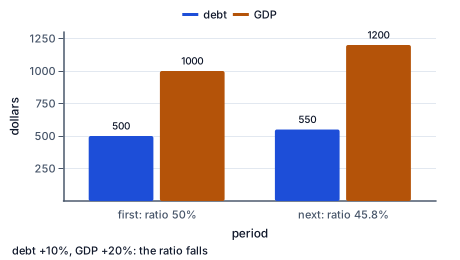
The figure compares the two periods: the debt bar grows, but the GDP bar grows faster, so the ratio falls.
Suppose nominal debt begins at five hundred dollars and annual nominal GDP is one thousand dollars. The initial debt-to-GDP ratio is fifty percent. In the next period debt rises to 550 while nominal GDP rises to 1,200. The new ratio is 550 divided by 1,200, approximately 45.83 percent. The debt stock rose ten percent, but the denominator rose twenty percent, so the ratio fell.
That ratio decline does not mean the government repaid fifty dollars of debt or ran a budget surplus. Under a no-adjustment assumption, the fifty-dollar debt increase corresponds to a positive overall deficit. The ratio and the stock provide different information. A clear report can state both without treating either as a contradiction.
Use nominal quantities on both sides of the ratio unless the problem explicitly constructs a consistent alternative. Dividing current nominal debt by real GDP measured in base-year prices mixes price conventions. It can create misleading movements caused by the chosen base year rather than a meaningful change in the debt burden. A real comparison requires a coherent price adjustment for the numerator as well as the denominator.
Nominal GDP growth reflects both real growth and changes in the price level. Exact decomposition uses growth factors: the nominal factor is the real-output factor multiplied by the GDP price factor. Higher inflation can change the ratio's denominator and affect real debt burdens, but its broader budget effects depend on indexation, maturity, refinancing, tax structures, and the response of nominal rates. It should not be presented as a costless universal debt solution.
A useful exact check compares proportional changes. If debt and nominal GDP each rise twenty percent, the ratio is unchanged. If debt rises by a smaller proportional amount, the ratio falls; if by a larger amount, it rises. This comparison identifies the arithmetic direction without deciding whether the resulting debt position is sustainable. Sustainability is a broader question about future primary balances, financing conditions, institutions, and possible shocks.
In a simplified one-period model, interest expenditure is i times opening debt, where i is the effective nominal rate expressed as a decimal. Let the primary deficit be PD, positive for spending above revenue. With no other adjustments, ending debt is (1+i) times opening debt plus PD. This timing rule assumes the given effective rate applies to the opening stock; real debt portfolios can have different coupons, maturities, and refinancing schedules.
Divide by next period's nominal GDP. If nominal GDP grows by g, the inherited-debt component of the ratio is multiplied by (1+i)/(1+g). The primary-deficit contribution must be divided by the new nominal GDP, not the old denominator. This exact relation shows why the rate-growth comparison matters while preserving the role of the primary balance.
For example, opening debt is five hundred and GDP is one thousand. The effective nominal interest rate is ten percent, nominal GDP grows by ten percent, and the primary balance is zero. Interest adds fifty to debt, so ending debt is 550; GDP becomes 1,100. The ratio remains fifty percent. Debt rises even though the primary budget is balanced, and equal nominal interest and growth preserve the inherited ratio under these assumptions.
If growth is twenty percent with the same interest rate and zero primary balance, the ratio falls to 550 divided by 1,200. But a sufficiently large primary deficit can reverse that decline. Conversely, a primary surplus can offset pressure from an interest rate above nominal growth. The rate-growth comparison is informative; it is not a complete one-number rule that removes fiscal choices or uncertainty.
Financing risk also depends on currency denomination, maturity, investor demand, liquidity, and institutional arrangements. An issuer borrowing in a currency it does not control can face different constraints from one borrowing in its own currency. The latter still faces real resource constraints, inflation risks, and institutional restrictions; monetary capacity is not unlimited real purchasing power. A course model should not infer inevitable default or automatic safety from a single debt ratio.
Unexpected changes in interest rates may affect debt service gradually as obligations mature and are refinanced. A case that immediately applies a new rate to the entire opening stock is a deliberately simplified effective-rate assumption. Identifying that assumption matters when comparing the arithmetic with a real portfolio. The exercises assess the supplied accounting mechanism rather than forecasting an actual government's borrowing costs.
During a downturn, tax receipts can fall and some transfers can rise automatically, increasing the deficit without a new discretionary policy decision. Weak output also reduces the denominator of the debt ratio. Observing a larger deficit alongside lower investment does not by itself prove that government borrowing caused the investment decline; both may reflect the downturn. A causal claim needs a counterfactual and a specified financing channel.
In a declared loanable-funds model, added borrowing can raise the real rate and reduce private investment. The amount depends on saving responses, foreign financing, and other assumptions. At the same time, well-used public investment can add productive capacity through its own mechanism. A comparison should include both possible channels rather than assuming the financing effect is the only consequence or that the expenditure benefit automatically dominates it.
Fiscal stabilization also depends on idle resources, monetary responses, spending composition, timing, expectations, and implementation. A temporary demand effect is different from a long-run capital or productivity effect. A complete policy appraisal would consider objectives, distribution, uncertainty, and alternative uses of resources. This lesson's deterministic tasks reconcile accounts and trace stated mechanisms; they do not claim to settle an open policy judgment from a debt ratio alone.
A fictional treasury reports opening debt of five hundred dollars and initial annual nominal GDP of one thousand dollars. Over the next year, non-interest spending exceeds revenue by twenty dollars, and interest expenditure is thirty dollars. There are no valuation changes or other stock-flow adjustments. Nominal GDP for the new year is 1,250 dollars.
The primary deficit is twenty, the overall deficit is fifty, and ending debt is 550. The debt stock has increased by fifty dollars. The new debt-to-GDP ratio is 550 divided by 1,250, or forty-four percent, down from fifty percent. The ratio fell because nominal GDP grew faster than debt, not because the budget was in surplus.
A draft headline says that the falling ratio shows the government repaid debt. The correction should state the actual stock increase and the positive overall deficit, then explain the denominator's larger proportional rise. It should preserve the distinction between the primary and overall balance: ignoring the thirty-dollar interest payment would understate the borrowing need under the case's assumptions.
The calculation alone does not establish whether future financing is secure or whether the spending was beneficial. Those questions require assumptions about future revenues, expenditure, interest costs, growth, currency denomination, and other risks. The report can accurately describe the improved ratio while acknowledging that it is one indicator within a broader assessment. Its first responsibility is to reconcile the reported stock and flows before interpreting their significance.
A declining positive deficit still adds to debt under the stated no-adjustment rule. A primary surplus can coexist with an overall deficit because interest remains payable. A falling debt-to-GDP ratio can coexist with rising nominal debt. Use nominal GDP with nominal debt, distinguish refinancing principal from interest, and avoid treating any single ratio as a universal sustainability threshold.
Record non-interest expenditure and revenue.
Spending200; revenue180 dollars per year.
The primary calculation excludes interest payments.
Calculate the primary deficit.
200-180=20 dollars per year.
Positive values denote deficits in this lesson's sign convention.
Add the stated interest expenditure.
Overall deficit=20+30=50 dollars per year.
Interest is part of the total financing need in the specified budget.
Reconcile the debt stock without other adjustments.
Opening600 plus deficit50 gives ending650 dollars.
The annual deficit increases the debt stock under the supplied assumptions.
State what the primary figure omits.
Using only20 would miss thirty dollars of interest financing.
Primary and overall balances answer different accounting questions.
Calculate the opening nominal ratio.
Debt500/GDP1,000×100=50%.
Both numerator and denominator use nominal dollars.
Record the new debt stock.
Ending debt550 dollars.
The debt level rises by fifty even before the denominator is considered.
Record the new nominal GDP denominator.
New GDP1,250 dollars per year.
The comparison must use the period specified for the ending ratio.
Calculate the new debt ratio.
550/1,250×100=44%.
Faster denominator growth lowers the ratio despite greater debt.
Separate the stock and ratio conclusions.
Debt rises fifty dollars; its ratio falls six percentage points.
A ratio decline does not imply debt repayment or a surplus.
Record opening debt and nominal GDP.
Debt500; GDP1,000 dollars.
The initial ratio is fifty percent.
Apply the effective interest rate to opening debt.
Ten percent of500 gives interest50 dollars.
The timing rule explicitly uses the opening stock.
Apply the zero primary-deficit condition.
Overall deficit=interest50 plus primary deficit0.
A balanced primary budget still has an interest-financing need.
Compute the ending nominal debt stock.
Debt500+50=550 dollars.
There are no other stock-flow adjustments in this example.
Grow nominal GDP by the supplied rate.
Ten-percent growth gives GDP1,100 dollars.
The nominal growth rate uses the same period as debt accumulation.
Compare the ending ratio with the opening ratio.
550/1,100×100=50%, unchanged.
Equal nominal interest and growth preserve the inherited ratio when the primary balance and adjustments are zero.
Combine the opening stock and overall deficit.
Opening debt500 plus deficit40 gives540 dollars.
This subtotal captures the reported budget flow only.
Add the stated valuation-related stock change.
A separate adjustment adds10, giving ending debt550.
The problem explicitly includes a debt change outside the measured deficit.
Reconcile the full stock increase.
A fictional government spends240 dollars excluding interest, receives260 dollars of revenue, and pays interest35 dollars during a year. Opening debt is500 dollars, and there are no other adjustments. Using positive numbers for deficits and negative numbers for surpluses, compute the primary deficit, overall deficit, and ending debt.
| Dollars | |
|---|---|
| Primary deficit | |
| Overall deficit | |
| Ending debt |
A fictional government starts with debt300 dollars. Its annual non-interest expenditure is180 dollars, revenue200 dollars, and interest30 dollars. No other adjustment occurs. Complete the primary deficit, overall deficit, and ending debt; use negative numbers for surpluses.
Subtract revenue from non-interest expenditure.
Primary deficit=primary dollars.
The sign convention records spending below revenue as a negative deficit.
Add the year's interest cost.
Overall deficit=overall dollars.
Interest can leave an overall deficit even when the primary budget has a surplus.
Update the opening debt stock.
Ending debt=debt dollars.
With no adjustments, the debt stock changes by the overall deficit.
For a fictional fixed nominal debt stock of300 dollars, plot debt-to-GDP percent at nominal GDP400,500,600 dollars per year. Nominal GDP is horizontal and debt-to-GDP percent vertical. Plot only these supplied comparisons.
Plot your answer on the grid:
A fictional government starts with debt400 and nominal GDP800 dollars. Its effective annual interest rate on opening debt is5%, its primary deficit iszero, nominal GDP grows5%, and no other debt adjustment occurs. Compute interest, ending debt, ending GDP, and ending debt-to-GDP percent.
| Value | |
|---|---|
| Interest dollars | |
| Ending debt dollars | |
| Ending nominal GDP dollars | |
| Debt-to-GDP percent |
Construct the stipulated accounting explanation. There are no stock-flow adjustments; a positive overall deficit raises nominal debt. Nominal GDP grows proportionately faster than that debt stock. Connect those facts to the ratio's decline and the conclusion that a falling ratio does not prove a surplus.
This task has no paper form; do it on a device.
A fictional treasury reports opening debt700 dollars, primary deficit25 dollars, interest35 dollars, and a separately stated valuation adjustment that adds ten dollars to debt. New nominal GDP is1,000 dollars. Compute the overall deficit, ending debt, and debt-to-GDP percent.
| Value | |
|---|---|
| Overall deficit dollars | |
| Ending debt dollars | |
| Debt-to-GDP percent |
Lesson test: one question per skill, one attempt each, no hints. Your answers are checked when you submit.
A fictional government starts with debt 600 dollars and nominal GDP 1,200 dollars. Annual non-interest spending is 260 dollars, revenue 240 dollars, and interest 40 dollars. There are no stock-flow adjustments. New nominal GDP is 1,500 dollars. Compute the primary deficit, overall deficit, ending debt, ending debt-to-GDP percent, and the change in the ratio in percentage points.
| Value | |
|---|---|
| Primary deficit dollars | |
| Overall deficit dollars | |
| Ending debt dollars | |
| Ending debt-to-GDP percent | |
| Ratio change percentage points |
You can distinguish budget flows from debt stocks and explain a ratio change using both its numerator and denominator. Next, extend model comparisons to exchange rates and international transactions.
14. Include a separately specified valuation adjustment, step 3
Debt rises50: forty from the deficit and ten from the adjustment.
A stock-flow residual can reflect measurement coverage rather than an unexplained budget expenditure.